
Introduction
Some of the most interesting food products are made from ingredients that have been part of everyday cooking for generations. Ginger and garlic are two such ingredients. Found in kitchens across India, they form the base of countless curries, dals, gravies, marinades, and traditional recipes.
But in Sirmaur, Himachal Pradesh, ginger and garlic have a story that goes beyond the kitchen. Both crops have an important place in the district’s agricultural economy, and the Government of India has identified Ginger and Garlic as the One District One Product (ODOP) for Sirmaur under the PMFME initiative.
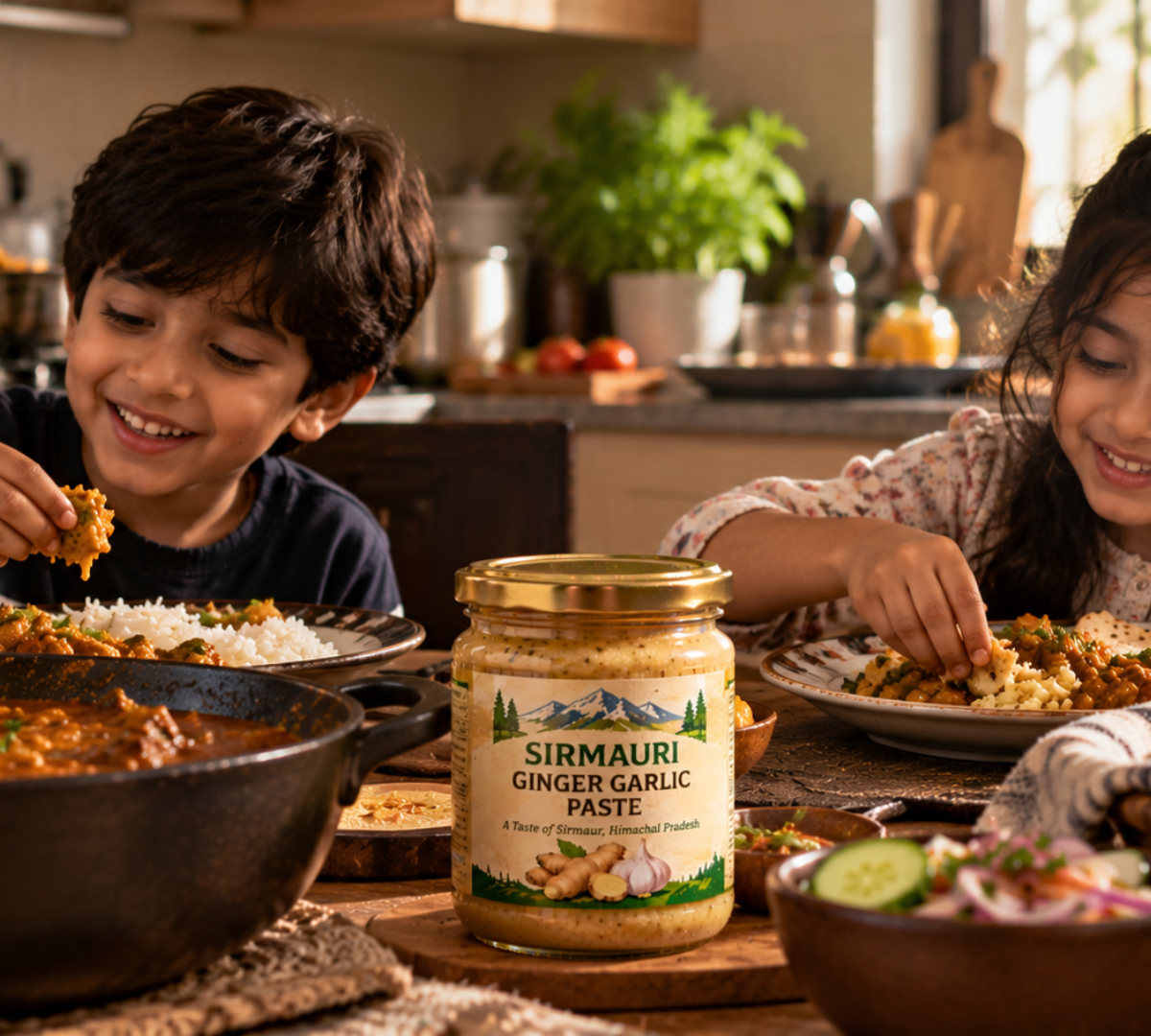
One practical way of bringing these two locally important ingredients together is ginger garlic paste. It combines the warm, slightly spicy character of ginger with the strong, savoury aroma of garlic in a convenient form that can be used in everyday cooking.
Sirmauri Ginger Garlic Paste represents an interesting connection between local agriculture and modern food processing. Instead of using ginger and garlic only as raw crops, they can be cleaned, processed, combined, packaged, and turned into a convenient food product.
This makes the product relevant not only to consumers but also to farmers, local food businesses, and the growing market for Himachal Pradesh local products.
What Is Sirmauri Ginger Garlic Paste?
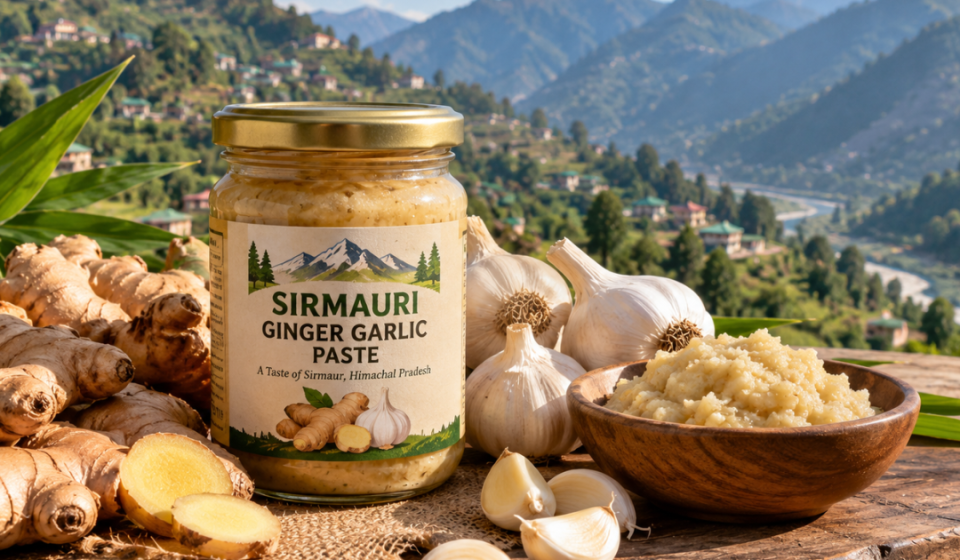
Sirmauri Ginger Garlic Paste is a ginger and garlic-based food preparation associated with the local agricultural identity of Sirmaur.
At its simplest, the product combines ginger and garlic into a smooth or semi-smooth paste that can be used as a cooking ingredient.
Fresh ginger provides warmth, aroma, and a characteristic spicy flavour, while garlic contributes its distinctive savoury taste and strong fragrance. Together, they create one of the most familiar flavour combinations in Indian cooking.
What gives this product a Sirmauri identity is its connection to the district’s agricultural produce.
Sirmaur is officially recognised under the ODOP programme for Ginger and Garlic, making these two crops central to the district’s value-chain and food-processing opportunities. The ODOP programme is intended to support processing, reduce wastage, improve storage, and strengthen marketing and branding around locally important products.
Therefore, Sirmauri Ginger Garlic Paste can be understood as a value-added product built around two important local crops.
Sirmaur’s Connection with Ginger and Garlic
Sirmaur is one of Himachal Pradesh’s important agricultural districts. Its geography includes areas at different elevations, creating varied conditions for farming.
Ginger is particularly important in the district. Areas including Paonta Sahib, Sangrah, Nahan, Pachhad, Rajgarh, and Shillai are associated with ginger cultivation.
Garlic is also an important agricultural crop in Sirmaur and contributes to the livelihoods of farming communities.
The official ODOP recognition of Ginger and Garlic brings these two crops together under one district-level product identity.
This recognition is significant because it creates opportunities beyond simply selling fresh produce. Processing agricultural crops into products such as pastes, powders, dried ingredients, pickles, and other food preparations can potentially increase their value.
For consumers, this means there is an opportunity to discover Sirmaur through its food.
Why Ginger and Garlic Work So Well Together
Ginger and garlic have been used together in Indian cooking for a very simple reason: they complement each other extremely well.
Ginger brings a fresh, warm, slightly sharp flavour. Garlic has a deeper and more pronounced savoury character. When combined, they create a versatile base for many different dishes.
A ginger garlic paste can save time in the kitchen because cooks do not have to peel, chop, and crush both ingredients separately every time they prepare a meal.
This makes the product suitable for modern households while still being based on familiar traditional ingredients.
For a local food business, this combination also offers an opportunity to take two agricultural products and create something convenient, consistent, and easy to package.
From Fresh Ingredients to Ginger Garlic Paste
The journey of Sirmauri Ginger Garlic Paste begins with its two main ingredients: ginger and garlic.
Fresh ginger and garlic are first selected and cleaned. Any unwanted material is removed before the ingredients are prepared for processing.
The ginger is peeled and cut into manageable pieces. Garlic is similarly cleaned and peeled. Both ingredients are then processed together until they reach the desired paste-like consistency.
Depending on the product and recipe, additional ingredients may be used to achieve the desired texture, flavour, or shelf life.
The final paste can then be packed into suitable food-grade containers and stored according to the manufacturer’s instructions.
The exact preparation process can differ between producers, which is why a commercial product should always clearly state its ingredients, storage instructions, and best-before information.
The important idea is the transformation of fresh agricultural produce into a ready-to-use value-added food product.
A Convenient Product for Everyday Cooking
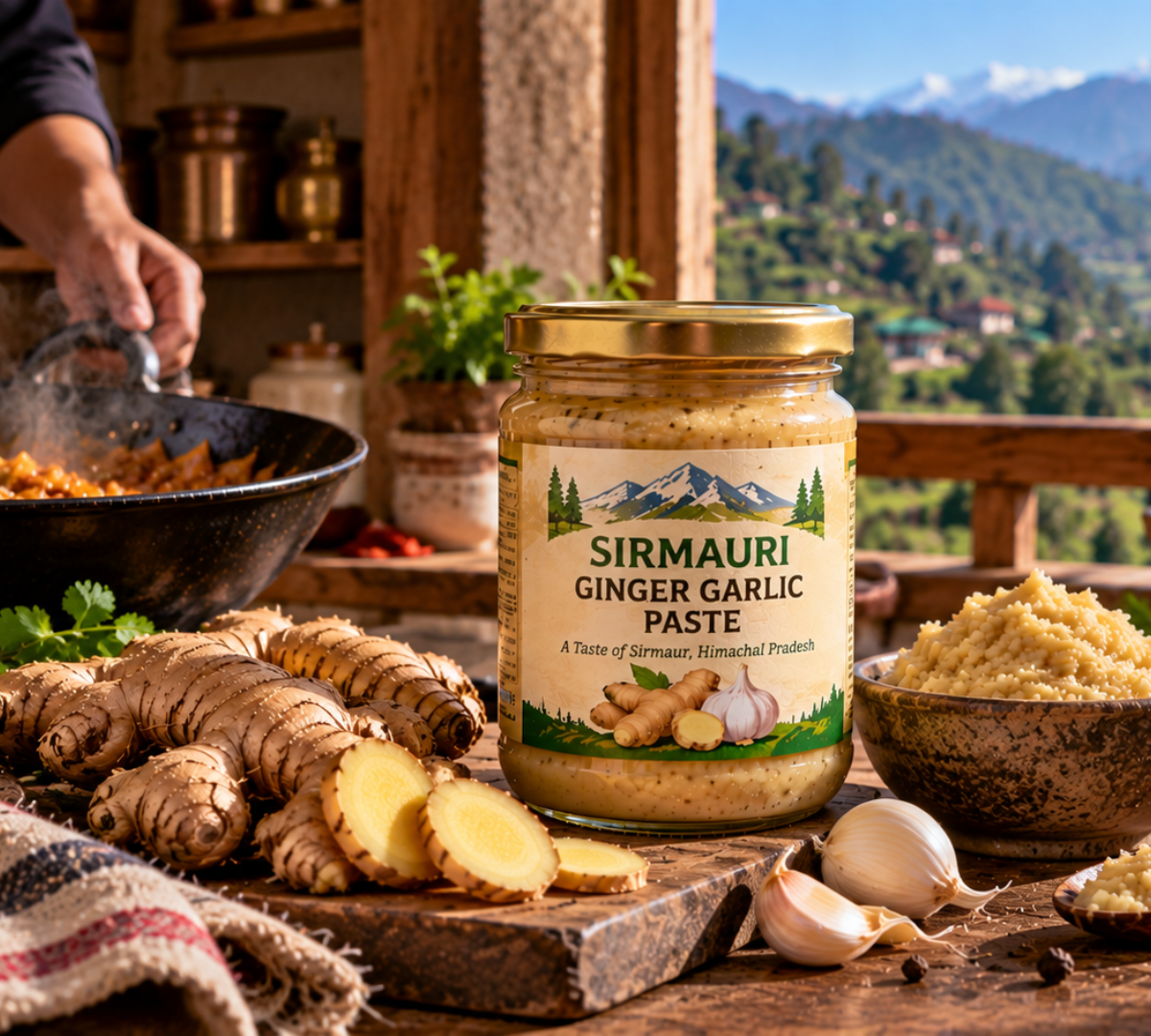
One of the biggest advantages of ginger garlic paste is convenience.
In traditional cooking, preparing ginger and garlic separately can take time. The ingredients have to be peeled, chopped, crushed, and cleaned before they are ready to use.
A prepared paste simplifies this process.
A spoonful can be added to hot oil or ghee as the base of a curry. It can also be incorporated into marinades, gravies, vegetable dishes, lentils, soups, and many other recipes.
This makes ginger garlic paste particularly suitable for people who enjoy cooking but want to reduce preparation time.
The product therefore combines traditional flavours with modern convenience.
Sirmauri Ginger: An Important Local Ingredient
Ginger is not simply an ingredient in this product; it is one of Sirmaur’s recognised agricultural products.
Local ginger has been cultivated across different parts of the district, and traditional processing has also developed around the crop.
One interesting example is sonth, which is dried ginger. Sonth should not be considered a separate type of ginger. It is simply ginger that has been processed and dried.
Government documentation on Sirmaur describes local communities using indigenous methods for processing ginger and producing a dried product referred to as Sondh. This demonstrates that adding value to ginger through processing is not a completely new idea in the region.
Ginger garlic paste takes the concept in a different direction by keeping the ingredients in a convenient paste form rather than drying the ginger.
Sirmauri Garlic: Another Important Crop
Garlic has its own important place in Sirmaur’s agriculture.
The crop is valued for its distinctive flavour and versatility. In Indian kitchens, garlic is used in an enormous range of recipes, from everyday vegetable dishes to rich gravies and spice-based preparations.
When combined with locally grown ginger, garlic becomes part of a product that represents both sides of Sirmaur’s ODOP identity.
This is one of the most interesting aspects of Sirmauri Ginger Garlic Paste.
Rather than highlighting only one crop, the product can tell the story of two important agricultural products from the same district.
A Connection Between Farmers and Consumers
Every packaged food product begins with agricultural production.
For ginger garlic paste, the journey starts with farmers growing ginger and garlic. The crops are harvested, sorted, and moved into the next stage of the value chain.
Processing businesses can then turn these ingredients into a finished product.
Packaging and branding give the product another layer of value, while retailers and online channels can help introduce it to consumers outside the immediate region.
This creates a connection between the farmer who grows the crop and the consumer who eventually uses it in a kitchen.
The stronger the demand for quality local products, the greater the potential for developing local processing and marketing opportunities.
The Importance of Value Addition in Sirmaur
Selling fresh agricultural produce is important, but value addition can create additional opportunities.
Imagine two different products made from the same harvest.
One is fresh ginger sold soon after harvesting.
The other is processed ginger used in a packaged food product.
Both have value, but the processed product can potentially have a different market, packaging format, shelf-life characteristics, and selling proposition.
This is why food processing is an important part of the ODOP approach. The Ministry of Food Processing Industries explains that ODOP is intended to support value-chain development, processing, storage, marketing, and related infrastructure for selected district products.
For Sirmaur, the focus on ginger and garlic creates an opportunity to develop more products around these crops.
Sirmauri Ginger Garlic Paste and Himachali Food Culture
Himachali food culture is strongly connected to locally available ingredients.
Although ginger and garlic are not exclusive to Himachal Pradesh, they are familiar ingredients in regional cooking and are useful in preparing many types of dishes.
A ginger garlic paste can therefore fit naturally into everyday cooking.
It does not need to be an elaborate recipe to represent a region. Sometimes the regional story comes from the ingredients themselves, the people who grow them, and the way those ingredients are processed.
Sirmauri Ginger Garlic Paste can carry that story in a simple and practical format.
How Can You Use Ginger Garlic Paste?
There are many ways to use ginger garlic paste in everyday cooking.
It can be added to:
- Vegetable curries
- Dal
- Gravies
- Soups
- Rice dishes
- Marinades
- Stir-fried vegetables
- Traditional Indian curry bases
- Homemade sauces and spice preparations
For a basic curry, the paste can be added during the initial cooking stage so that the ginger and garlic aromas blend with the other ingredients.
The amount used depends on the recipe and personal preference.
This versatility is one reason ginger garlic paste has become such a familiar product in Indian kitchens.
Why Local Products Like This Matter
Local products tell stories about places.
An apple can represent Shimla or Kullu. A traditional food can represent a particular community. A spice or processed agricultural product can represent the crops that farmers grow in a particular district.
Sirmauri Ginger Garlic Paste has the potential to play this role for Sirmaur.
Its story begins with two crops that are officially recognised as the district’s ODOP. It then moves through processing and packaging before reaching the consumer.
That entire journey represents a local food value chain.
It also shows how traditional agricultural products can be adapted for modern consumers without losing their connection to the region.
Supporting Local Farmers and Food Businesses
Choosing locally produced food products can help create awareness around the farmers and businesses behind them.
For Sirmaur, this is particularly relevant because ginger and garlic have already been recognised as the district’s ODOP.
Small and micro food-processing enterprises can potentially build businesses around these crops by developing products that are hygienically processed, properly packaged, clearly labelled, and marketed effectively.
The future of local food products is not necessarily about keeping them unchanged.
It can also be about finding new ways to present familiar ingredients.
A ginger garlic paste is a good example: the ingredients are traditional and familiar, while the product format is convenient for today’s consumer.
A Modern Product with a Local Story
One of the strengths of Sirmauri Ginger Garlic Paste is its simplicity.
There is nothing complicated about its core ingredients. Ginger and garlic are already well known.
The difference comes from the story behind them.
When the ingredients are connected with Sirmaur’s farming communities and presented as a locally inspired value-added product, they become more than ordinary kitchen ingredients.
They become part of a regional food story.
Modern consumers increasingly want to know where products come from, what ingredients they contain, and how they are connected to local communities.
A product with a clear regional identity can therefore have an advantage in a market where authenticity matters.
The Future of Sirmauri Ginger and Garlic Products
The future of Sirmaur’s ginger and garlic sector could extend far beyond fresh produce.
There is potential for a wider range of processed products, including dried ginger, ginger powder, ginger-based foods, garlic products, spice blends, pastes, pickles, and other packaged foods.
The ODOP framework specifically supports processing and related activities around selected district products, creating a foundation for local value addition.
For local entrepreneurs, this could mean opportunities in food processing, packaging, branding, tourism retail, online sales, and regional gifting.
For farmers, stronger value chains could create additional demand for quality produce.
And for consumers, it could mean greater access to authentic products connected with Himachal Pradesh.
Why Try Sirmauri Ginger Garlic Paste?
If you enjoy Indian cooking, ginger garlic paste is already a familiar and useful ingredient.
But a Sirmauri version can offer something extra: a connection to the agricultural identity of Sirmaur.
It brings together two crops that are officially recognised as the district’s ODOP and transforms them into a convenient product for modern kitchens.
It is easy to use, versatile, and suitable for many everyday recipes.
Most importantly, it provides a simple way to discover a lesser-known side of Himachal Pradesh’s food and agricultural heritage.
Conclusion
Sirmauri Ginger Garlic Paste brings together two important agricultural products of Sirmaur—ginger and garlic—in a convenient, modern food format.
Sirmaur’s official ODOP identity is built around Ginger and Garlic, reflecting the importance of these crops to the district.
The story of the paste begins with farmers and agricultural fields before moving through processing, packaging, and eventually into kitchens.
While ginger garlic paste itself should not be presented as an ancient traditional Sirmauri recipe without specific historical evidence, it can genuinely be described as a value-added product connected to Sirmaur’s recognised ginger and garlic sector.
That distinction makes the story even more interesting.
It shows how local agricultural products can evolve with changing lifestyles. Traditional ingredients can be transformed into convenient products while still carrying the identity of the place where those ingredients are grown.
From the farms of Sirmaur to kitchens beyond Himachal Pradesh, Sirmauri Ginger Garlic Paste has the potential to turn two familiar ingredients into a product with a distinctly local story.
Frequently Asked Questions
1. What is Sirmauri Ginger Garlic Paste?
Sirmauri Ginger Garlic Paste is a value-added food product made primarily from ginger and garlic associated with Sirmaur, Himachal Pradesh.
2. Is ginger and garlic the ODOP of Sirmaur?
Yes. The Government of India’s PMFME ODOP listing identifies Ginger and Garlic as the ODOP for Sirmaur district.
3. Is Sirmauri Ginger Garlic Paste a traditional product?
It is better described as a local value-added product based on Sirmaur’s important ginger and garlic crops. The official ODOP designation supports the regional importance of the two ingredients, but the paste itself should not automatically be described as an ancient traditional recipe.
4. Why are ginger and garlic important in Sirmaur?
Both are important agricultural products of the district and have been selected together under the ODOP initiative.
5. What is sonth?
Sonth is dried ginger. It is not a separate type of ginger. Fresh ginger can be processed and dried to produce sonth.
6. How is ginger garlic paste used?
It can be used in curries, dals, gravies, marinades, soups, vegetable dishes, rice preparations, and many other recipes.
7. What does ginger add to the paste?
Ginger provides a warm, aromatic, slightly spicy flavour.
8. What does garlic add to the paste?
Garlic contributes a strong, savoury aroma and flavour that complements ginger.
9. Why is food processing important for Sirmaur?
Processing can turn agricultural produce into value-added products and can create opportunities in packaging, branding, marketing, and local food businesses.
10. Can Sirmauri Ginger Garlic Paste be used every day?
Yes, provided the product is properly packaged and stored according to its label instructions. It can be used as a convenient cooking ingredient.
11. What makes this product different from ordinary ginger garlic paste?
Its regional identity comes from its connection with Sirmaur’s recognised ginger and garlic agricultural sector rather than simply being a generic ginger-garlic preparation.
12. Why should people try local Sirmauri products?
Local products provide an opportunity to experience regional ingredients while learning more about the farmers, food traditions, and agricultural identity of places such as Sirmaur.