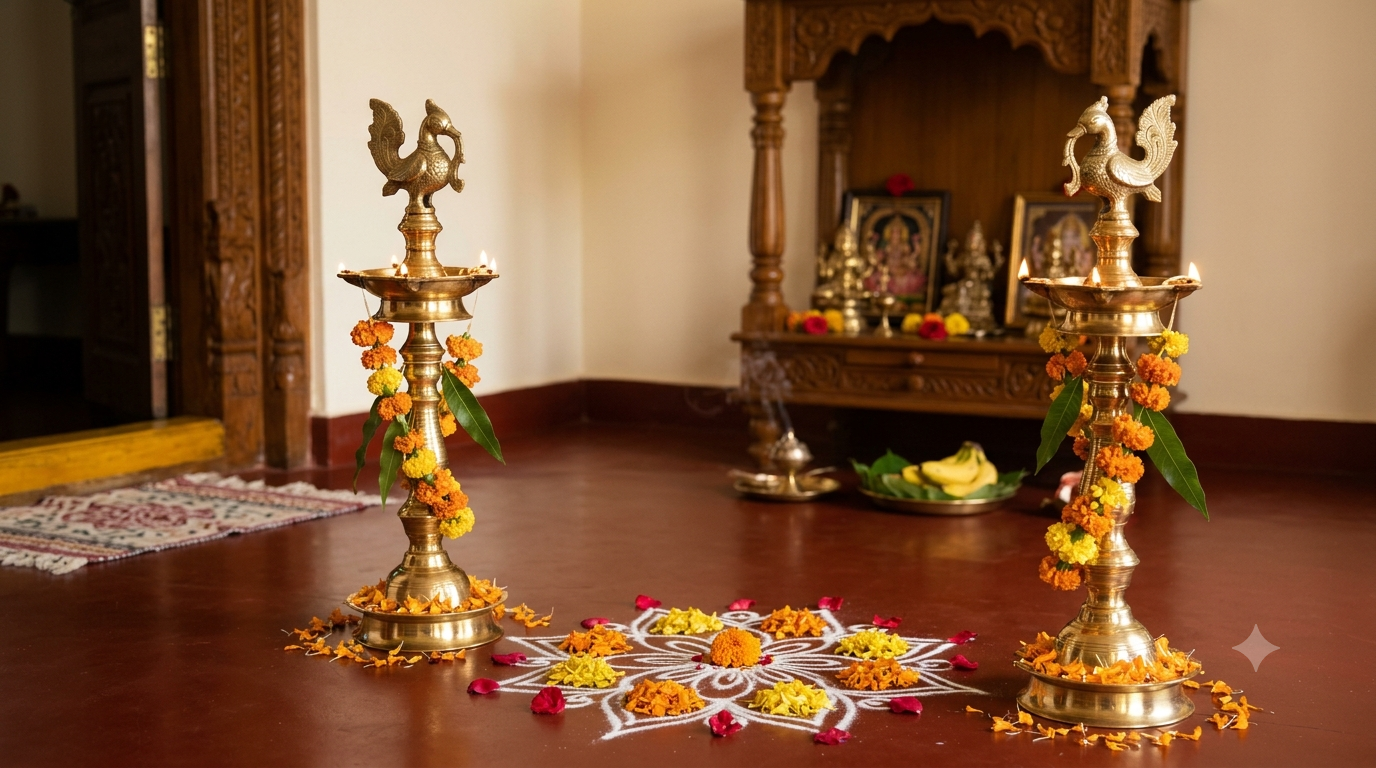
Nachiarkoil Kuthuvilakku: History, Craftsmanship and Uses
Introduction
Step into a heritage home or ancient temple in South India at twilight, and your attention will immediately gravitate toward the radiant, golden glow of a standing oil lamp. However, the modern market is flooded with lightweight, machine-spun imitations that tarnish quickly, leak oil, and lack cultural authenticity. For devotees, collectors, and interior decorators seeking genuine heirloom metalware, the Nachiarkoil Kuthuvilakku stands as the benchmark of traditional metallurgical artistry and spiritual devotion.
Originating from the historic town of Nachiarkoil near Kumbakonam in Tamil Nadu, this Geographical Indication (GI) certified brass lamp represents nearly two centuries of uninterrupted artisan mastery. Unlike mass-produced decorative lighting, every authentic Nachiarkoil brass lamp is sand-cast by hand using specialized river clay and assembled through precision-turned screw threads. Understanding this craft protects buyers from counterfeit goods while helping preserve one of India’s most treasured living traditions.
In this guide, you will learn the documented Kuthuvilakku history, structural anatomy, five-step sand-casting process, practical benefits, authentication checklists, and maintenance protocols for this iconic traditional South Indian oil lamp.
What Is Nachiarkoil Kuthuvilakku?
Quick Definition:Nachiarkoil Kuthuvilakku is a traditional, handcrafted South Indian standing oil lamp originating from Nachiarkoil in Tamil Nadu. Crafted primarily from heavy cast brass or bell metal, it features four modular, screw-threaded components topped with an ornamental finial. Awarded Geographical Indication (GI) status in 2013, it is widely used in temples, prayer rooms, and ceremonies.
Detailed Explanation
In Tamil culture, Kuthuvilakku refers to an ornamental standing oil lamp used to dispel darkness and invite auspicious energy. While traditional Indian lamps are produced across several states, the Nachiarkoil variant is celebrated for its heavy gauge, acoustic resonance, leak-proof threading, and balanced proportions.
According to documentation from the Development Commissioner (Handicrafts), Government of India, these lamps are engineered as modular structures rather than welded units. Artisans cast each segment separately and cut interlocking threads on hand-operated lathes, allowing the user to dismantle the lamp effortlessly for deep cleaning, storage, or safe transport.
Key Components of Nachiarkoil Kuthuvilakku
Every authentic lamp consists of specific interlocking parts that combine structural stability with visual grace:
- Base (Keezh-bagam): A wide, heavy, lotus- or bell-shaped pedestal engineered to lower the lamp’s center of gravity and prevent accidental tipping.
- Stem (Kandam): The central cylindrical pillar featuring lathe-turned grooves and ergonomic grip rings that connect the base to the upper oil reservoir.
- Oil Container (Thanguli): A deep pan—typically featuring five spouts (Pancha Mukha) or seven spouts—designed to hold sesame oil or ghee without seeping down the stem.
- Wick Holders (Mukam): Specially shaped spouts along the rim of the Thanguli that support twisted cotton wicks and ensure a steady, smokeless flame.
- Decorative Top (Prabhai): The ornamental crown screwed into the center of the oil pan. Popular motifs include the Annam (mythical swan symbolizing wisdom), Kalasam (sacred pot), Siluvai (cross-shaped floral bud), or Hindu deities such as Goddess Lakshmi and Lord Ganesha.
History of Nachiarkoil Kuthuvilakku
Direct Answer:Kuthuvilakku history in Nachiarkoil dates back to 1857, when five artisan families from the Pather (Kammalar) metalworking community migrated from Nagercoil and settled near Kumbakonam in Tamil Nadu. They discovered that the fine Vandal alluvial clay along the Cauvery River basin was ideal for high-precision brass and bell-metal sand casting.
Detailed Explanation
Before the mid-nineteenth century, metalworkers in the region primarily crafted agricultural tools and heavy household vessels. When the Pather community arrived in Nachiarkoil, they brought refined Travancore metal-casting techniques and adapted them to local materials.
Initially, artisans worked with bell metal (Vengalam, a high-tin bronze alloy) before expanding into solid yellow brass (an alloy of copper and zinc) to make the lamps more accessible and malleable for intricate lathe work. Because Nachiarkoil sits directly on the fertile delta of the Cauvery River, artisans had unlimited access to Vandal—an ultra-fine, heat-resistant river silt found along the riverbeds. This specific clay allowed craftspeople to create sharp, non-porous sand moulds that captured delicate feather and floral textures without cracking under molten metal temperatures. Over generations, the town evolved into the undisputed hub of Tamil Nadu handicrafts for temple lighting.
Why Is Nachiarkoil Kuthuvilakku Important?
Direct Answer: The Nachiarkoil Kuthuvilakku is important because it unites Hindu spiritual practice, nineteenth-century metallurgical heritage, and protected economic value. Recognized under India’s Geographical Indications Registry (GI Application No. 196) on March 4, 2013, the craft sustains hundreds of rural artisan families while providing durable, heirloom-grade brassware for households and businesses.
Detailed Explanation
- User and Spiritual Benefits: In Hindu tradition, lighting a handmade brass diya or standing lamp symbolizes the triumph of divine knowledge (Jnana) over ignorance (Tamas). The five spouts represent five core virtues—love, intelligence, determination, patience, and caution. Having a stable, leak-proof lamp allows families to perform daily Puja safely.
- Cultural Heritage Preservation: Unlike automated factory assembly lines, Nachiarkoil workshops rely on tacit knowledge passed down from master artisans to apprentices. Every lamp reflects classical Dravidian temple proportions and sacred iconography.
- Business Value and GI Recognition: To protect artisans from cheap industrial counterfeits, the Government of India granted formal Geographical Indication status to Nachiarkoil Lamps on March 4, 2013 (GI Registry Application No. 196). For interior designers, luxury hotels, and handicraft exporters, sourcing GI-tagged products guarantees regional provenance and supports sustainable rural livelihoods.
How Is Nachiarkoil Kuthuvilakku Made? (How Does It Work?)
Direct Answer: Manufacturing a Nachiarkoil Kuthuvilakku involves a five-step traditional box sand-casting and lathe-finishing process. Artisans pack damp Cauvery river clay around master patterns inside wooden frames, pour molten brass at roughly 1,000°C into the hollow cavity, fettle the cooled castings, cut screw threads on a lathe, and buff the assembled lamp to a golden shine.
Step 1: Preparing the Design and Mould
Artisans begin by preparing two-part wooden moulding boxes (Adaipetti). Rather than using the lost-wax method, standard Nachiarkoil lamps rely on reusable master metal patterns. Craftsmen harvest fine Vandal clay from the Cauvery riverbanks, mix it with powdered burnt clay and natural binders, and ram it tightly around the master pattern of the Keezh-bagam or Kandam. Fine brick dust or talcum is sprinkled between the two halves of the box so the master pattern can be lifted out cleanly, leaving an exact hollow impression with carved pouring gates and air vents.
Step 2: Casting the Metal
Brass ingots and clean brass scrap (typically alloyed around 60% copper and 40% zinc) are loaded into graphite crucibles and heated inside coke-fired pit furnaces equipped with motorized air blowers. Once the metal reaches a luminous molten state between 950°C and 1,050°C, two artisans lift the crucible using long iron tongs and pour the liquid brass steadily into the clamped sand moulds.
Step 3: Shaping, Threading, Assembling, and Polishing
Once cooled, the sand moulds are broken open (and the clay is recycled). The rough, blackened castings undergo fettling, where metal sprues and rough edges are filed away. Each component is then mounted onto a horizontal lathe (Kadaisal). Skilled turners use diamond-tipped and high-carbon steel chisels to shave the rough outer layer, carve decorative concentric rings, and cut matching internal and external screw threads (Marai). Engravers then hand-chisel intricate feather details onto the Annam finial before buffing the assembled temple brass lamp on high-speed cotton wheels coated with polishing rouge.
Benefits of Nachiarkoil Kuthuvilakku
Direct Answer: Investing in an authentic Nachiarkoil Kuthuvilakku delivers multi-generational durability, superior fire safety, effortless modular cleaning, and timeless decorative elegance. Because each component is solid sand-cast rather than stamped from thin metal sheets, the lamp resists warping under heat, prevents oil seepage, and retains its structural and monetary value for decades.
- Multi-Generational Structural Durability:
- What it is: Solid sand-cast construction with thick brass walls ranging from 3mm to 6mm.
- Why it matters: Thin, machine-pressed lamps dent easily, crack along stress seams, and deform after repeated exposure to burning wicks.
- Expected outcome: A single purchase functions as a permanent family heirloom passed down across three to four generations without developing leaks.
- Enhanced Fire Safety and Bottom-Heavy Stability:
- What it is: A weighted pedestal base paired with deep, well-defined wick troughs.
- Why it matters: Open flames in homes with children, pets, or silk sarees pose severe fire hazards if a tall lamp is top-heavy.
- Expected outcome: Peace of mind during bustling festivals, weddings, and public stage inaugurations.
- Effortless Modular Maintenance:
- What it is: Precision lathe-cut screw threads connecting the base, stem, oil bowl, and finial.
- Why it matters: Sesame oil residue and carbon soot harden inside lamp crevices over time, making single-piece welded lamps difficult to wash in standard kitchen sinks.
- Expected outcome: Users can unscrew the Thanguli oil tray in seconds, wash and degrease it individually, and reassemble the lamp with a tight, leak-proof seal.
- Authentic Acoustic and Visual Elegance:
- What it is: High-copper-content brass polished to a deep golden luster with crisp hand-engraved iconography.
- Why it matters: Synthetic gold coatings and chemical lacquers peel off when exposed to flame heat and acidic cleaning agents.
- Expected outcome: Your prayer room or living space maintains an authentic, temple-grade aesthetic that restores to a mirror finish after every polish.
Different Uses, Comparisons, and Care Guide
Direct Answer: A Nachiarkoil Kuthuvilakku is used for temple rituals, home prayer altars, wedding trousseaus (Seervarisai), corporate inaugurations, and heritage interior design. While heavier and higher-priced than factory-made sheet-metal lamps, its GI-backed sand-cast construction offers superior longevity. Proper authentication and gentle organic cleaning preserve its finish for a lifetime.
Practical Use Cases and Industry Applications
- Temple Worship & Sanctums (36 to 60+ inches): Towering multi-tiered lamps placed before temple deities, engineered to hold substantial oil volumes for hours of continuous burning.
- Home Prayer Rooms (12 to 24 inches): Tabletop or floor pairs lit daily at dawn and dusk to anchor household meditation and Puja routines.
- Weddings, Festivals & Corporate Inaugurations: Gifted in pairs as auspicious wedding trousseaus or placed on auditorium stages where dignitaries light the five spouts to inaugurate conferences, hospitals, and cultural events.
- Luxury Interior Design & Hospitality: Five-star hotels and biophilic interior designers display unlit or flower-draped Nachiarkoil lamps alongside brass Urulis (water bowls) in foyers to showcase regional South Indian heritage.
Nachiarkoil Kuthuvilakku vs. Ordinary Brass Lamps
| Feature | Authentic Nachiarkoil Kuthuvilakku | Ordinary Commercial Brass Lamp |
|---|---|---|
| Craft Identity & Origin | Produced in Nachiarkoil, Tamil Nadu (GI Registered #196) | Mass-produced in generic industrial metal hubs |
| Manufacturing Process | Traditional two-part Vandal clay sand casting & hand-lathe turning | Hydraulic sheet-metal spinning or thin die-casting |
| Wall Thickness & Weight | Heavyweight solid walls (approx. 2.5 kg to 15+ kg per pair) | Lightweight hollow shells (often 400g to 1 kg) |
| Thread Construction | Deep, hand-cut brass screw threads that resist stripping | Shallow pressed threads prone to jamming or oil leaks |
| Heat Resistance | Absorbs and dissipates wick heat safely without warping | Thin spouts overheat rapidly and discolor |
| Drawbacks / Limitations | Higher upfront cost; heavy to lift; requires periodic polishing | Dents easily; prone to tipping; low resale or heirloom value |
How to Choose an Authentic Nachiarkoil Kuthuvilakku
Before buying online or in stores, run through this verification checklist:
- Inspect the Inner Unpolished Surface: Unscrew the lamp and examine the hollow underside of the base (Keezh-bagam). Because artisans only lathe-turn the exterior, the hidden interior wall of a genuine sand-cast lamp will feel slightly rough and granular from the Vandal clay mould. Perfectly smooth, paper-thin interiors indicate machine-spun sheet metal.
- Verify Weight-to-Height Ratios: Always check both dimensions and net metal weight. A genuine 18-inch Nachiarkoil brass lamp typically weighs between 2.2 kg and 3 kg per single unit.
- Test the Threading and Stability: Screw and unscrew all four components to verify smooth alignment without wobbling, and place the assembled lamp on a flat surface to confirm it sits completely level.
- Request Seller Provenance: Buy from government handicraft emporiums (such as Poompuhar / Tamil Nadu Handicrafts Development Corporation), registered GI artisans, or verified Kumbakonam metal merchants.
Care and Maintenance Tips
- Cool and Degrease First: Allow the lamp to cool completely after extinguishing the flame. Wipe away leftover oil and black carbon soot with a dry cotton cloth or paper towel before applying water.
- Use Natural Acid Cleansers: Scrub the disassembled components gently using wet tamarind pulp, fresh lemon juice mixed with a pinch of salt, or specialized brass polishing powder (Pitambari).
- Avoid Steel Wool: Never use abrasive iron scrubbers or harsh floor acids, as they leave permanent micro-scratches on the lathe-turned finish.
- Rinse and Buff Bone-Dry: Wash off cleaning residues with mild dish soap and lukewarm water, then immediately wipe dry with a clean microfiber cloth to prevent green water-spot oxidation.
Frequently Asked Questions (FAQs)
1. What is Nachiarkoil Kuthuvilakku famous for?
Nachiarkoil Kuthuvilakku is famous for its heavy sand-cast brass construction, leak-proof screw-threaded modular segments, intricate Annam (swan) crowns, and specialized manufacturing using Vandal alluvial clay from the Cauvery River basin.
2. Where is Nachiarkoil Kuthuvilakku made?
It is handcrafted exclusively in and around Nachiarkoil, a historic town located near Kumbakonam in the Thanjavur district of Tamil Nadu, India.
3. Is Nachiarkoil Kuthuvilakku GI registered?
Yes. Nachiarkoil Lamps are officially registered under the Geographical Indications of Goods Act in India (Application No. 196), with the registration certificate issued on March 4, 2013.
4. What material is used to make Nachiarkoil Kuthuvilakku?
Artisans primarily use high-grade yellow casting brass (an alloy of copper and zinc). Historically and upon custom request, traditional lamps are also cast in bell metal (Vengalam, an alloy of copper and tin).
5. Which oil and how many wicks should be used at home?
Pure gingelly (sesame) oil or cow’s ghee is recommended for a clean, low-soot flame. Traditionally, families light either two twisted cotton wicks (forming a single flame) or all five spouts (Pancha Mukha) during auspicious prayers.
6. How can I identify an authentic Nachiarkoil lamp vs a fake?
Check for a heavy solid-cast weight, a slightly granular sand-cast texture on the unpolished underside of the base, deep lathe-cut screw threads, and seller documentation linking the product to Nachiarkoil artisans.
Conclusion
The Nachiarkoil Kuthuvilakku is far more than a functional vessel for lighting oil; it is a living monument to Tamil Nadu’s metallurgical ingenuity, spiritual devotion, and ecological connection to the Cauvery River. By understanding how Vandal clay sand-casting, precision lathe threading, and heavy brass alloys distinguish a genuine craft from a factory-made imitation, you can invest with complete confidence.
Whether you are setting up a sacred home prayer altar, selecting an auspicious wedding gift, or curating heritage Indian decor, choosing an authentic Nachiarkoil Kuthuvilakku brings timeless golden warmth into your space while directly sustaining the master artisans who keep this nineteenth-century tradition alive.