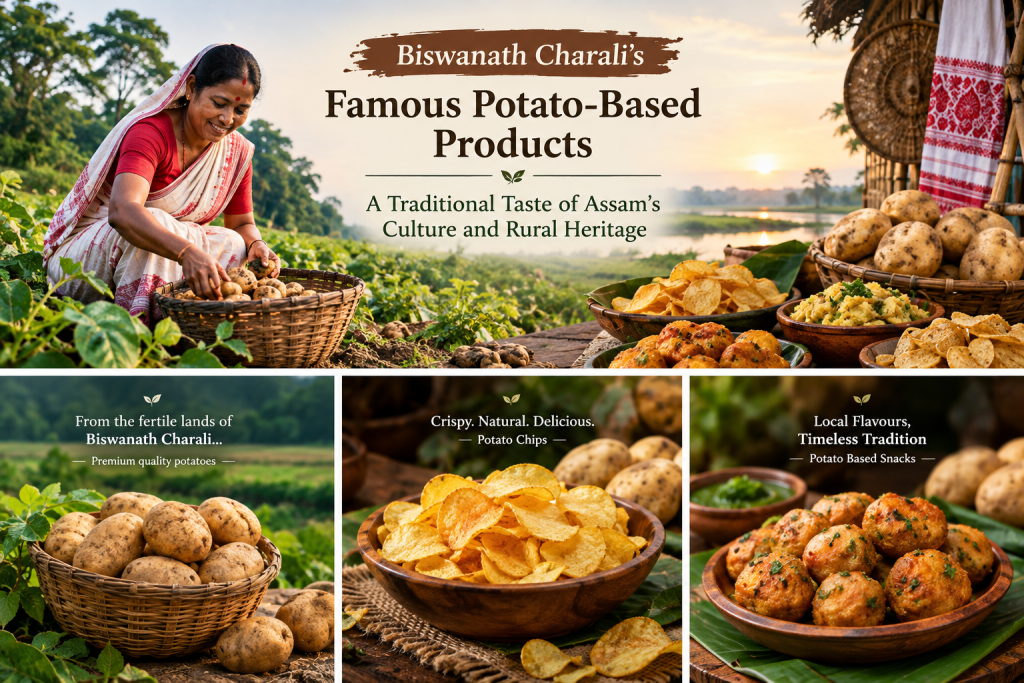
Biswanath Charali’s Famous Potato-Based Products: A Traditional Taste of Assam’s Culture and Rural Heritage

Assam is famous for its tea, but the cultural significance of the region extends beyond the plantations. The local vegetables, rice, fruits and spices are an integral part of Assamese cuisine. One of these staples is the humble potato, which is deeply connected with the food culture and rural livelihoods of Assam. In Biswanath Charali, Assam, potato cultivation and potato-based products are linked with local agriculture, traditional food, and changing food economy.
The Government of India’s One District One Product (ODOP) list includes Biswanath Charali and potato, while the Ministry of Food Processing Industries has Biswanath Charali listed under Assam’s potato-based products. This indicates the potential of potato cultivation and processing in the region.
However, the cultural significance of the potato extends beyond commercial processing units and the ODOP scheme. It is found in the traditional Assamese kitchen, where simple ingredients are combined to make satisfying meals. One such dish is the famous Aloo Pitika, a mashed potato preparation made with mustard oil, onion, green chilli and herbs. Assam Tourism describes Aloo Pitika as comfort food, which is eaten with rice and dal.
From the agricultural fields of Biswanath to the home kitchens of Assam, the potato is a symbol of tradition and opportunity.
Biswanath Charali: Agriculture and Culture
Biswanath Charali is a small town in Assam, surrounded by green fields of tea bushes. The wider Biswanath district is also closely associated with tea, as noted by official Assam tourism sites.
However, the region is not solely defined by its tea plantations. Local vegetables also play an important role in the economy and food culture of the region. The cultivation of potatoes has become an important agricultural practice in some parts of Biswanath.
According to a report on the potato sector in Assam, Gingia in Biswanath district is one of the potato-growing centres in the state. Local growers utilise the Sonitiprabha Cold Storage in Gingia to store and market their produce. The report also mentions that local potato growers’ societies have participated in the storage chain.
This indicates the importance of potato cultivation for the local economy. Potatoes are a perishable item, and proper storage facilities are necessary for farmers to get a good price for their produce.
The humble vegetable is thus deeply connected with the local economy and agricultural practices of Biswanath.
Potato in the Traditional Assamese Kitchen
When one thinks of Assamese cuisine, images of rice, fish, tenga, xaak, pitha, and other local specialties may come to mind. However, vegetables also play an important part in the traditional Assamese diet.
Assamese cooking is all about highlighting the freshness and natural flavours of ingredients. It does not rely on heavy use of spices, but rather on fresh vegetables, herbs, mustard oil, and simple preparation methods.
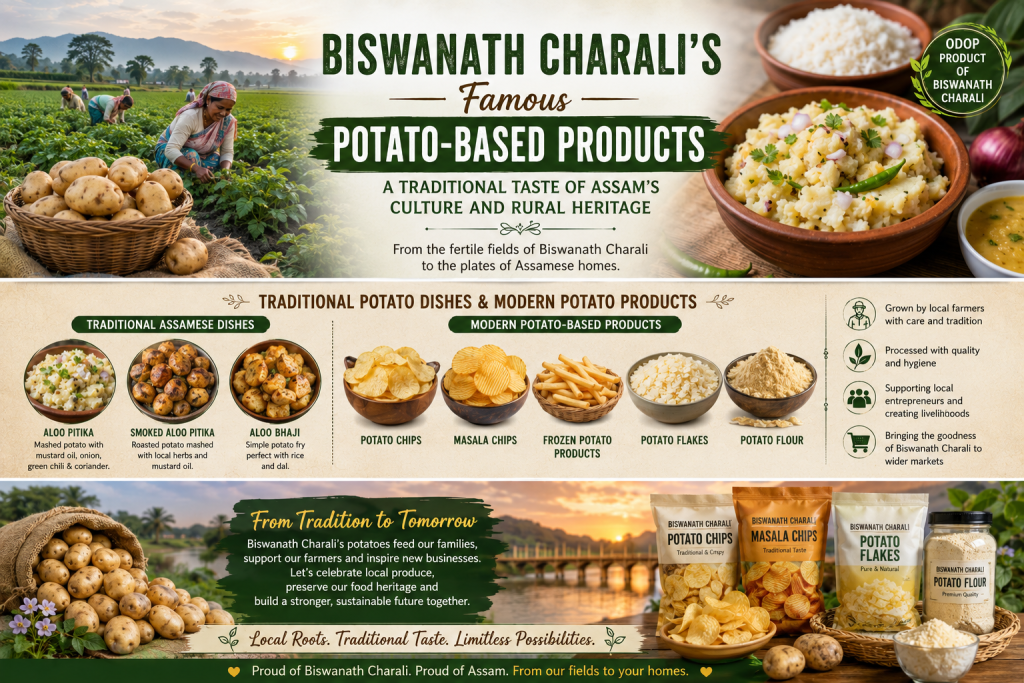
The versatility of the potato makes it a great fit for Assamese cuisine. It can be boiled, roasted, mashed, or fried. Instead of using a variety of spices, it can be mixed with local ingredients such as mustard oil, green chillies, coriander, and onions to make a simple but tasty dish. This is the basis of the famous Assamese dish, Aloo Pitika.
Aloo Pitika: The Soul of Assamese Potato Cuisine
Aloo Pitika can be broadly described as a mashed potato dish. However, there is much more to this humble preparation that makes it a staple of Assamese cuisine.
The word ‘Pitika’ refers to a mashed preparation, while potato is the most common vegetable used in the dish. Assam Tourism describes Aloo Pitika as mashed potato garnished with finely chopped onions, green chillies and coriander, served with rice and dal.
The preparation is simple but satisfying. Potatoes are boiled or roasted and mashed into a thick mash. Chopped onions, green chillies, coriander and salt are added to it. Mustard oil is used to add the characteristic Assamese flavour to the dish.
There is no need for complicated preparation or use of exotic ingredients. However, when served with steaming hot rice and dal, Aloo Pitika becomes a comfort food that is deeply connected with Assamese home cooking.This dish is a great example of how traditional Assamese cuisine focuses on simply bringing out the natural flavours of food. It uses local vegetables and ingredients and does not rely on exotic spices or complicated preparation methods. A few well-chosen ingredients, combined with local knowledge and generations of culinary tradition, can produce something unique and deeply satisfying.
Pura Aloo: The Smoky Side of Tradition
Another interesting way to enjoy the goodness of potatoes is to roast them. Traditional Assamese kitchens often used wood or clay stoves for cooking. Potatoes could be roasted over an open flame until their skin turned crisp and the inside became soft and fluffy. They could then be mashed and mixed with mustard oil, onions and green chillies to make a delicious variant of the traditional Aloo Pitika.
The smoky flavour of roasted potatoes adds a unique depth to the dish. This preparation method is also used to make other variations of Assamese pitika. According to culinary sources, traditional Assamese cooks sometimes combine potato with other vegetables like tomato or brinjal to make roasted preparations. These variations bring out different flavours in the vegetable, while also adding variety to the dish.
The versatility of the potato allows it to be prepared in different ways depending on the ingredients and tools available. It can be roasted over an open flame to bring out its natural smokiness, or mashed with mustard oil and green chillies to make a comforting side dish.
Aloo Bhaji: Everyday Comfort on the Assamese Plate
Aloo Bhaji is another simple but tasty way to prepare potatoes. It is a type of curry made with boiled or fried potatoes. It is often prepared with minimal spices and served with rice and dal. Aloo Bhaji can be made in a variety of ways depending on the ingredients available.
The traditional Assamese diet consists of a number of simple dishes that utilise locally available ingredients. These dishes are often prepared on a daily basis and become an important part of the local food culture. Aloo Bhaji is one such dish that is connected with the everyday lives of Assamese people.
Potato and Rice: A Natural Assamese Combination
Rice is the staple food of Assam, and it goes well with a variety of local dishes. A simple plate of rice with dal, Aloo Pitika, seasonal vegetables and another local dish can be a wholesome and satisfying meal.
This combination also reflects the agricultural basis of Assamese cuisine. Rice is one of the most important crops of Assam, while vegetables like potatoes can be found growing abundantly across the region. The combination of rice and potato is thus a part of the traditional Assamese diet.
The NITI Aayog publication on India’s cultural food traditions also mentions Aloo Bhaji with Joha Rice as a comforting Assamese combination, while describing pitika as a traditional Assamese side dish made with boiled potato, mustard oil and green chilli.
Potato-Based Products Beyond the Home Kitchen
While traditional dishes are an important part of the story, there is also potential to develop value-added potato products in Biswanath Charali. The Government of India’s ODOP scheme and the Ministry of Food Processing Industries both recognise the potential of developing potato-based products in the region.
This creates an opportunity to develop a range of commercial products using locally available produce. Some of the potential products include:
Potato chips
Masala potato chips
Potato wafers
Frozen products
Potato fries
Potato snacks
Dehydrated potato
Potato flour or flakes
Ready-to-cook products
Traditional potato-based snack mixes
It must be noted that the traditional dishes of Assam cannot be claimed to be ancient or unique to the region without proper documentation. The same applies to the commercial products mentioned above. However, they can be seen as a part of the local food economy and culture.
This distinction is important because the cultural significance of the potato in Assamese cuisine is deeply connected with traditional dishes such as Aloo Pitika. At the same time, the commercial potential of value-added products can help create new economic opportunities for local producers.
From Farmer to Food Entrepreneur
The journey of a potato does not end when it is picked from the field. It can be sold to local traders, processed into value-added products, packaged and marketed as a regional specialty, and distributed to new customers. This creates a number of economic opportunities at different levels.
Farmers can sell their produce to local traders or processing units. Processors can utilise these raw materials to make a variety of products. Local entrepreneurs can brand and market these products to create employment and business opportunities. Online marketplaces can help distribute these products to a wider customer base.
This is the potential of the ODOP scheme – to utilise local resources and create economic opportunities at different levels. The humble potato can thus become a part of a larger value chain that benefits farmers, processors, entrepreneurs, and consumers.
The Importance of Potato Storage
One of the main challenges of potato cultivation is storage. Potatoes cannot be stored for long periods of time at room temperature. Farmers need proper storage facilities if they want to sell their produce at a good price.
The NEDFi report on the potato value chain in Assam highlights the importance of cold storage facilities. It mentions that Sonitiprabha Cold Storage at Gingia in Biswanath district accommodates the produce of local growers. It also discusses the issues of storage, pricing and market access faced by farmers.
This indicates the importance of storage infrastructure for potato cultivation in Biswanath. Farmers need proper storage facilities if they want to sell their produce without having to sell it at a loss.
It is important to remember that the development of the local potato economy cannot be done in isolation. Farmers need proper storage, transportation and market access facilities. Processing units need to follow food-safety guidelines. Entrepreneurs need to understand the local market and its potential. Only then can the local potato economy truly thrive.
Potato, Women and the Traditional Kitchen
Traditional food preparation has always been an important part of Assamese culture. Women have played a major role in this process, passing on their knowledge and skills to younger generations.
They are also the ones who decide what dishes to prepare and how to prepare them. Aloo Pitika is a great example of this – there is no need for complicated recipes or exotic ingredients. The woman preparing the dish knows how to make it just right – she knows when the potatoes have been boiled enough, how much mustard oil to add, how much green chilli to include, and so on.
This knowledge is part of the cultural heritage of Assam. It can be passed on to younger generations, or utilised to create new business opportunities. Women can be encouraged to make and sell traditional potato-based snacks, catering services, ready-to-eat meals, and other food products.
This not only helps preserve traditional food culture but also creates economic opportunities for women.
Festivals, Gatherings and the Culture of Sharing
Festivals and gatherings are an important part of Assamese culture, and food plays a major role in them. Bihu, for example, is a festival that brings people together to share food, music and dance. While Bihu cuisine has its own unique dishes, a number of traditional Assamese preparations such as pitika are also eaten during the festival.
Food is often shared among family members and friends during festivals and gatherings. This is another unique feature of Assamese cuisine and food culture. Preparations such as Aloo Pitika are not served as standalone dishes – they are part of a larger meal that is shared by everyone.
This is one of the reasons why regional food stories should not be limited to discussing ingredients and dishes. They should also focus on the people, their homes, and their culture.
The Cultural Value of Simplicity
One of the unique aspects of Assamese cuisine is its emphasis on using simple ingredients to bring out natural flavours. This is evident in a dish as simple as Aloo Pitika. It does not require exotic spices or complicated preparation methods. A few well-chosen ingredients such as
mustard oil, green chillies and coriander can be combined with boiled or roasted potatoes to make a dish that is enjoyed by people of all ages.
This approach to cooking has a certain appeal in today’s modern food culture. There is a growing demand for authentic regional dishes that utilise traditional ingredients and preparation methods. A modern-day Biswanath potato brand can utilise this to its advantage by focusing on simplicity and authenticity.
It can capitalise on the cultural value of traditional Assamese dishes to create a unique brand identity. It can utilise the local resources and ingredients to create a product that is different from what is currently available in the market.
Rather than trying to compete with large-scale commercial brands, a local Biswanath potato product can focus on its unique selling point – its authenticity and connection with Assamese food culture.
From Biswanath Fields to the Digital Marketplace
The modern food economy is undergoing a digital transformation. Local producers can now connect directly with customers through online marketplaces, social media, and other digital platforms. This has created a number of opportunities for small-scale producers and traditional food brands.
This is where a platform like DesiBiz can play an important role. It can help local food producers and traditional brands connect with a wider audience. The story of Biswanath’s famous potato-based products can be told through this platform, highlighting the unique selling points of the local cuisine and its cultural significance.
A regional food product can utilise the power of storytelling to engage with customers. The packaging can highlight the unique selling points of the product. It can mention that the product is made with locally-grown potatoes, following traditional Assamese recipes. It can also mention the potential benefits – such as supporting local farmers and food entrepreneurs.
This way, the product can appeal to a wider audience while also supporting local producers and traditional food culture.
Sustainable Growth for Biswanath’s Potato Economy
The future of Biswanath’s potato economy is closely connected with sustainable agricultural practices. Farmers need to utilise water and other resources wisely. They need to follow good agricultural practices to get the best yield without damaging the environment. Processing units need to utilise proper food-safety and waste-management practices.
Potato processing can also generate by-products and waste that can be used in other ways. This will help create a sustainable local ecosystem around potato cultivation and processing.
Potato storage is also an important consideration. Farmers need proper cold storage facilities to keep their produce fresh for longer. This will help them get a better price for their produce while also reducing food waste.
The ultimate goal should be to create a complete local ecosystem around potato cultivation. This will involve farmers, processors, packaging units, brand owners, digital marketers, and other stakeholders. It will create economic opportunities at different levels while also promoting sustainability and good business practices.
Why Biswanath Potato Matters
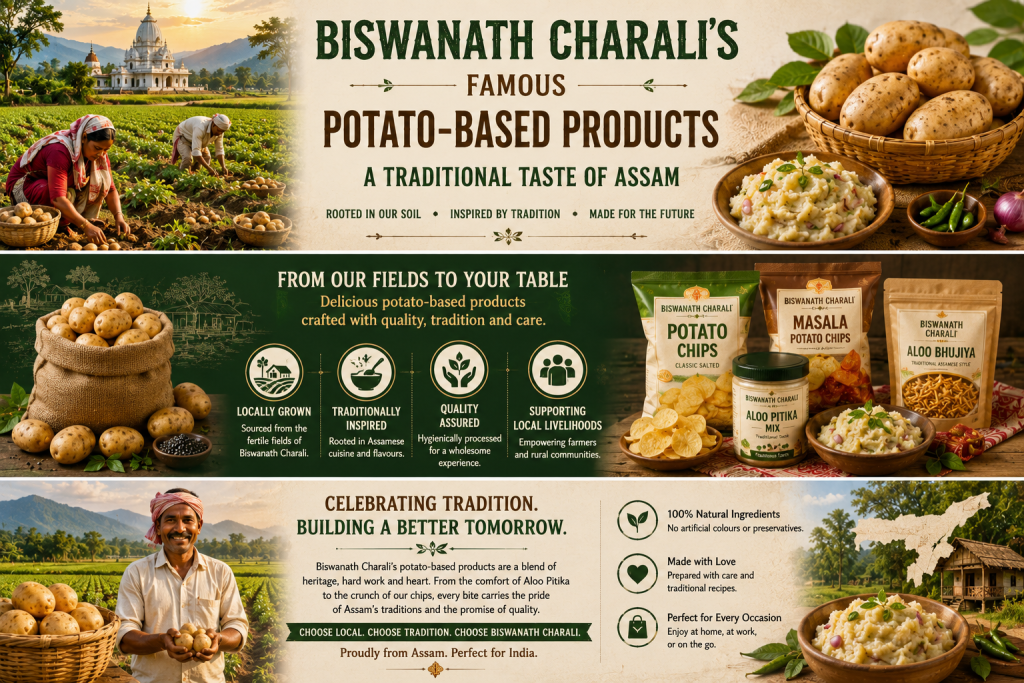
The significance of Biswanath’s potato economy can be seen from three perspectives – agriculture, culture, and entrepreneurship. Potatoes can provide an economic opportunity for local farmers. They can also be used to create traditional Assamese dishes that reflect the local food culture. Finally, they can be processed into value-added products to create new business opportunities.
These three aspects are connected – the agricultural produce serves as the foundation, the traditional dishes add cultural value, and the processed products create economic opportunities.
Agriculture provides the raw materials for food production and commercial processing. Traditional food culture gives these products unique cultural significance. Finally, entrepreneurial initiatives can utilise these resources and cultural heritage to create new business opportunities. This will help establish a strong local economy that is based on sustainable agricultural practices and rich cultural traditions.
The Future of Potato-Based Products in Biswanath Charali
Biswanath Charali has the potential to establish itself as a major centre for potato-based products. This includes both traditional Assamese dishes and commercial food products. The traditional dishes need to be preserved and promoted, while the commercial products need to be developed with an emphasis on quality and unique selling points.
This can be achieved by highlighting the cultural significance of traditional Assamese cuisine. It can also be achieved by developing a strong brand identity for commercial products that utilise local resources and follow good manufacturing practices.
The traditional and commercial aspects of Biswanath’s potato economy can complement each other rather than compete. The unique cultural heritage of Assamese cuisine can be used to create a strong brand identity for local food products. At the same time, commercial processing can utilise this cultural value to create new economic opportunities.
This can also be an opportunity to promote Assamese culture and cuisine on a wider platform. It can encourage younger generations to explore their cultural roots and utilise their local resources and traditional knowledge to create business opportunities.
Conclusion
Biswanath Charali’s potato economy is a great example of how local resources can be utilised to create economic opportunities. It has the potential to become a major centre for traditional Assamese cuisine as well as commercial food processing. The Government of India’s ODOP scheme has identified the region as a potato cultivation centre, while the Ministry of Food Processing Industries has recognised its potential for commercial food processing.
At the same time, traditional Assamese cuisine showcases the versatility and value of the humble potato. It can be used to make a variety of simple but tasty dishes such as Aloo Pitika. This dish, along with other traditional Assamese preparations, reflects the unique food culture of the region.
From the agricultural fields to the home kitchens, from cold storage facilities to commercial processing units, the potato has the potential to become a major economic asset for Biswanath Charali. And for a platform like DesiBiz, it is a great opportunity to highlight the local food culture and support local food entrepreneurs.
The future of Biswanath’s potato economy will be determined by how successfully its traditional and commercial aspects can come together. After all, the most successful business stories are often built on a foundation of tradition and local resources.
Frequently Asked Questions
1. What is Biswanath Charali famous for under the ODOP initiative?
The Government of India’s One District One Product (ODOP) list includes Biswanath Charali and potato, while the Ministry of Food Processing Industries has Biswanath Charali listed under potato-based products.
2. What is the most famous traditional potato dish of Assam?
Aloo Pitika is one of Assam’s best-known potato preparations. It is made by mashing boiled or roasted potato with mustard oil, onion, green chilli and coriander.
3. Is potato cultivation important around Biswanath?
Yes. Gingia in Biswanath district has been documented as a potato-growing area, and local potatoes have been stored at Sonitiprabha Cold Storage for marketing purposes.
4. What potato-based products can be developed commercially?
Potential value-added products include potato chips, wafers, frozen products, dehydrated potato, potato flakes, ready-to-cook snacks and traditional-style potato preparations.
5. Why are potato-based products culturally important in Assam?
Potato is deeply connected with the traditional Assamese diet, and is used to make a variety of simple but tasty dishes such as Aloo Pitika.