Assam’s region of many landscapes and cultures has produced its share of unique food staples and delicacies. From the fertile Brahmaputra valley and the riverine communities to the ancient Assamese towns, local produce has made its way into home-cooked meals, preserved products and even traditional cuisine.
Among the range of traditional Assamese food items, chilli is an indispensable item – lending its fiery zest and flavor to numerous regional dishes. It also plays a vital role in pickles, chutneys, masalas and other regional delicacies.
Dhubri district of Assam is a famous producer of chillies, so much so that the Government of India has identified Dhubri – Chilli as the district’s One District One Product (ODOP). The local economy has seen a significant amount of development in this sector, but there is room for identifying and developing the local market for Dhubri’s famous produce.
Dhubri – The Cultural Crossroads of Assam
According to one description, Dhubri is the ‘gateway’ to western Assam. The district has a unique location at the crossroads of West Bengal, Bangladesh, Meghalaya, and Assam. It is a region of cultural convergence reflected in its linguistic, religious, and artistic diversity.
The district has a unique folk cultural heritage, particularly the Assamese Goalpariya songs and dances. The area also has a number of temples, satras, and cultural centers. Language and script are important markers of Dhubri’s varied cultural traditions. The region has a thriving rural economy based on agriculture and forest produce. Its main produce is paddy, with jute and mustard also playing a significant role in the local economy.
Chilli fits in as a major agricultural crop, a staple ingredient in regional cuisine and a commercial product.
Chilli and Assamese Cuisine
Chilli is ubiquitous across the Indian subcontinent, but its use varies between regions. Traditional Assamese cooking features fresh vegetables, herbs, leafy greens, fish, and subtle spicing. The Assam Tourism website describes Assamese cuisine as being distinct for its natural produce and relatively less use of oil and spices.
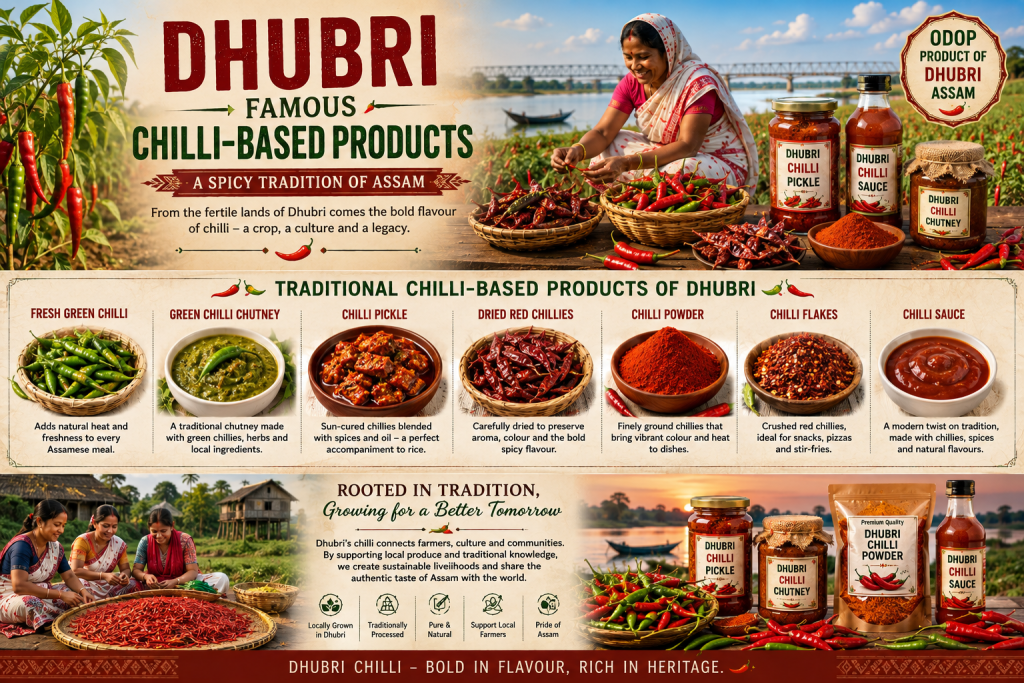
In the Assamese meal, chilli is an important source of heat and flavor. A few fresh green chillies enhance the flavor of a plate of vegetables. A couple of dried red chillies can make an attractive addition to meals. Chilli can be ground into a fresh chutney to accompany a variety of dishes. Alternatively, the fruit can be preserved as a pickle to be used as a flavoring agent for meals.
It can be prepared into a traditional piquant masala that goes well with a wide variety of local dishes. Chilli can also find its way into modern and commercial food formats such as powders, flakes, sauces, and oils.
From Farm to Kitchen: Processing Chilli
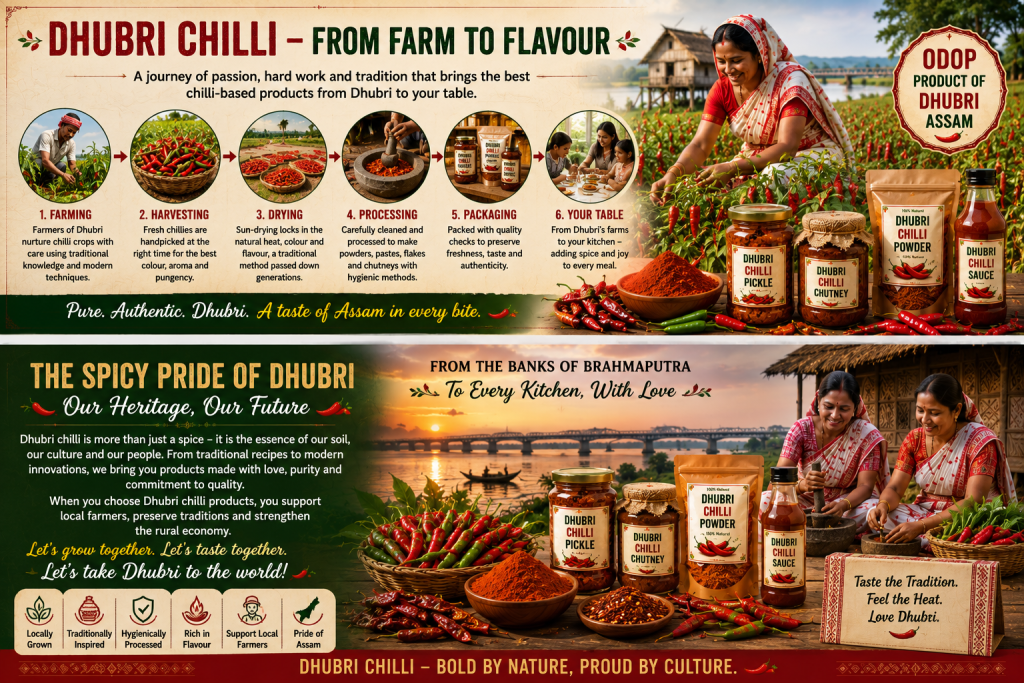
The chilli processing industry begins with the farming activity. Farmers grow the crop of their choice according to the season. At the appropriate time, the fruits are harvested and sorted according to quality and maturity level.
Fresh green chillies can be sent to local markets for fresh sale. Matured red chillies can be dried for further processing. The product can then enter several downstream processes:
• Fresh chillies for local sale
• Fresh chillies for chutney
• Mature chillies for drying and powder making
• Dried red chillies for paste and sauce preparation
• Chilli for oil or other value-added products
As per The Ministry of Food Processing Industries, other possible products from the humble chilli are: red chillies without stalk, dried flakes, powder, paste, chutney, seeds, oil, and oleoresin. This can be an interesting starting point for any value addition activity for the local chilli produce.
Fresh Green Chilli – The Simple Pleasure of Home-Cooked Meals
One of the simplest uses of green chillies is in fresh meals. A typical Assamese meal comprises of rice and dal accompanied by vegetables and other side-dishes. Fresh green chillies are an easily available condiment to cut through the blandness of boiled vegetables and provide some much-needed flavor to the meal.
It is this very convenience that makes fresh green chillies so appealing. They can serve as an accompaniment to most home-cooked meals – requiring no special preparation. At the same time, they can also qualify as an important part of a healthy diet and be consumed in abundance. For a local farmer, there is also a market for bulk fresh chillies.

Local Flavors: Green Chilli Chutney
Chutney is an Indian specialty that showcases the diverse flavor profiles of local ingredients. A simple green chilli chutney made with the addition of salt, herbs, and other local spices can provide a fiery twist to any meal.
Every household has its own recipe for chutney that has been passed down through generations. A typical Assamese meal of rice and vegetables can be enhanced with the addition of some good green chutney. This can be an ideal value-added product for local entrepreneurs as a branded item.
The brand name can be: “Dhubri Green Chilli Chutney – Inspired by the culture of Western Assam”. The key is to differentiate between traditional items and the modern adaptations as far as local produce is concerned.
Chilli Pickle: Preserved Taste of Home
Pickle-making is one of the traditional methods of preserving seasonal vegetables, fruits, and other food items. Chilli pickle, with its sharp flavor and pleasant aroma, is a welcome addition to many meals. Green or red chillies can be used to prepare pickle – the ingredients may vary from household to household. Some pickles are prepared with oil as the main ingredient while others are salt-preserved.
Chilli pickle is the link between tradition and commerce as far as local food is concerned. It can be a convenient way to preserve excess crop. Moreover, it can also be packaged in attractive jars to create a marketable product. Local entrepreneurs can brand their product as the famous pickle of the region and sell it at local fairs, markets, and online platforms.
Dried Red Chillies: A Staple Condiment in Assam
One of the traditional methods of preserving red chillies is to dry them. This not only enhances the flavor but also increases the shelf-life of the product several times over.
Chillies can either be sun-dried or processed using modern techniques. According to PMFME processing guidelines, cleaning and drying are essential preliminary steps in downstream processing. Dried red chillies can then be used to make flakes, powders, pastes, etc. The entire process essentially revolves around the preservation of the fruit.
Traditional methods require hand-plucking and sun-drying of the chillies while modern equipment can help to speed up the process.
Dhubri Chilli Powder: Ready-Made Flavor for Every Household
Chilli powder is one of the most common value-added products prepared from red chillies. The freshly dried chillies are cleaned, stemmed, and ground to make red chilli powder. As per the PMFME guidelines, red chilli powder is one of the most common processed products and involves cleaning and grinding of dried red chillies.
A local brand of Dhubri chilli powder can connect the local farmer with the local consumer. The package can carry the tagline “Assam’s local flavor – Grown in Dhubri”.
The entire value chain from growing to processing to selling can be controlled by the local entrepreneur.
Chilli Flakes: An Exciting Option
Chilli flakes can be used as a convenient spice to add piquancy to various dishes. According to PMFME guidelines, red chillies can also be roasted and ground to make coarse flakes. Chilli flakes are a popular spice in contemporary cuisine that can be used to season noodles, salads, pizza, and much more.
This is one of the easiest and most exciting applications of local raw materials. A local brand of flakes can be developed as a product that adds value to the local crop and is in demand in the modern market.
Chilli Paste: Old Grinders, New Techniques
Paste-making is a traditional activity that has been performed since ages. It involves grinding fresh or dried red chillies into a coarse paste.
Modern processing equipment can be used to prepare chilli paste at a commercial level. According to PMFME processing guidelines, red chilli paste is a potential value-added product that requires crushing or pulping of washed and dried chillies followed by hygienic packaging.
It is yet another way in which local traditional ingredients are processed using modern machinery to create value-added products.
Chilli Sauce: A Marketable Item Worth Developing
Chilli sauce is a potential product from the humble local chilli. It can be made into a spicy sauce or a milder version for general consumption. According to PMFME guidelines, it can be prepared by combining a variety of ingredients such as tomatoes, garlic, vinegar, sugar, salt, and chillies. Chilli sauce can be a potential value-added product with an extensive market.
When it comes to branding, it is important to identify the cultural connection between the local product and the market. In this case, the connection must be made in a way that clearly highlights the distinction between the traditional item and the modern adaptation. In other words, the sauce must be clearly identified as a modern product made from a traditional ingredient.
Chilli Chutney: A Unique Value-Added Product
Chilli chutney has been discussed earlier and fits in nicely as one of the value-added products from local raw materials. According to PMFME documentation, chutney can be prepared using chillies, spices, tamarind, jaggery, and garlic as some of the key ingredients. The recipe can be adjusted as per the requirements of the local market.
Chilli chutney can be marketed as an appetizer or an accompaniment. It can be paired with a variety of dishes ranging from rice to snacks to fried meats and fish.
It can be a potential value-added product due to its strong appeal. The local taste can be captured in the chutney to create a unique flavor that can be marketed extensively.
Chilli Oil: A Contemporary Take on a Local Ingredient
Chilli oil can be used as a substitute for regular oil in some specific dishes. It is a potential value-added product that requires roasting and grinding of chillies as per the desired recipe. The processed oil can be marketed as a special sauce or spice. Chilli oil and oleoresin have been identified by PMFME as major potential products from chillies.
The same applies to a local brand that can be developed as a modern adaptation of a local recipe. Chilli oil can be a contemporary take on the traditional local spice. It can be marketed as a specialty item for use in select dishes. It is important to recognize this as a modern value-added item and not confuse it with an age-old local tradition unless otherwise documented.
Chilli Seeds: An Undervalued Processing Option
Chilli seeds can also be separated and processed as a separate product. PMFME guidelines mention that red chillies can be split to separate the seeds which in turn can be processed into a finished product. This essentially means that we can look at the crop as a whole and explore various options for processing and utilization.
It is always a good idea to utilize every part of the crop to minimize wastage and increase profits. By exploring every potential lead, the local processor can create a truly integrated value-added activity.
Recognizing Bilasipara’s Role in Processing
Bilasipara has to be given due credit for playing a pivotal role in the processing activity. As mentioned in the district development report, Bilasipara witnessed a huge surplus in chilli production. The district administration took the matter to APEDA for exploring export markets. The local farmer was advised to think of organic cultivation for export purposes.
This has to be seen as an encouraging sign for the local processors. It means that the local production is in excess and ready to explore downstream avenues. It is now up to the local entrepreneur to create an integrated value addition activity.
Dhubri’s Cultural Mosaic, Regional Identity
Dhubri is a district with a unique geographical location and an equally unique cultural history. As mentioned earlier, it is a meeting point of different cultural traditions reflected in language, art, and religion. The district has a unique dialect, music, and dance, and its Assamese culture bears an imprint of Bengali influences from the neighboring states. The Goalpariya folk heritage is an important facet of the region’s cultural legacy.
It is not surprising that local food is just as diverse and colorful. Different communities have their own preferences and culinary traditions. As far as local processing is concerned, this means that the crop has multiple options as a starting point for value addition.
The product that eventually finds its way to the marketplace will essentially be the result of a confluence of diverse cultural traditions. This is particularly true in the case of Dhubri’s famous red chillies.
Chilli, Rice, and Assamese Cuisine
Rice is the staple crop of Assam and the Assamese meal typically revolves around it. A traditional Assamese meal has rice accompanied by dal, leafy vegetables, fish or meat, and certain acidic or spicy accompaniments. Assam Tourism’s website mentions dishes that comprise of a combination of dal, xaak, fish, meat, khar, and tenga. Chilli fits in very well as a spicy accompaniment.
It can be added to various dishes in different ways. It can be served fresh with a plate of vegetables. It can be made into a spicy chutney or a pickle that would go well with rice and dal. Chilli can also be combined with fish, meat, or vegetables in certain recipes. As a source of heat, it can also serve as an ingredient in pickle or chutney that would enhance the flavor of an Assamese meal.
It is obvious that this humble fruit has found its place in the Assamese cuisine in a big way.
Chilli, Fish, and Assam’s Food Culture
Fish has always been an important part of the Assamese diet. The region is rich in natural water bodies that have contributed to the local diet and food habits. The Brahmaputra River, along with numerous other rivers, wetlands, and ponds has facilitated fish cultivation in Assam for centuries.
Assam Tourism’s page mentions that fish is an integral part of the Assamese household and is prepared in various ways. The Assamese have developed traditional techniques of cooking fish that are unique to the region. Some of these preparations include Tenga Anjaa, Patot Diya, etc.
Chilli is an important ingredient in many of these fish curries. It can enhance the flavor profile of the dish. A few fresh green chillies added to the curry will give it the required amount of heat. Dried red chillies can also be added to add color and zest to Assamese fish curry. Chilli chutney and pickle can be used as accompaniments to such dishes.
Women and Value-Added Products
Processing of local produce is an important avenue for women’s entrepreneurship. Traditional activities such as pickle-making, chutney-making, and spice preparation require certain skills. With a little training and guidance, women-run enterprises can make a mark in the local market. Some Self Help Groups can be encouraged to develop a local brand.
The following value-added products can be explored:
• Pickle made from green chillies
• Powder made from dried red chillies
• Chilli chutney
• Chilli flakes
• Chilli paste
All of these are potential products with the right kind of branding and promotion. It is important to remember that such activities need not begin on a large scale.
Farmer to Market: A Possible Value Addition Activity
A local value addition activity can be explored in the context of the local produce. The following value chain can be initiated:
Farmer ↓ Collection ↓ Cleaning and Grading ↓ Drying/Processing ↓ Packaging ↓ Branding ↓ Market
The current scenario, as outlined in the Bilasipara district report, suggests that the farmer sells his fresh produce in the local markets. There is the potential to explore the processing route which offers much better returns. The local enterprise can utilize the raw material and process it into appropriate products. These can be marketed locally or further downstream depending on the infrastructure.
Establishing the Dhubri Chilli Brand
A local brand must highlight the authenticity of the produce. It would be an ideal idea to begin with the tagline: “Dhubri Chilli – A Taste of Western Assam.” The brand mark should indicate the scenic beauty of the region – its Assamese landscapes, Assamese culture, and the local produce.
It must indicate the journey of the product from Dhubri to the marketplace as the brand mark. This would help it connect with the consumer on a more emotional level.
DesiBiz and Local Marketing Needs
For DesiBiz, the local enterprise story of Dhubri’s famous chillies fits in perfectly as a means of creating a digital brand identity for local products. While most people outside Assam might have heard about Assamese tea, not many are aware about Dhubri chillies.
A website devoted to the local product will help to bridge this gap. The customer will be able to learn about the local produce and its unique features, its connection with the local culture and tradition, and the unique value-added products that can be developed. The brand can connect with the consumer at the local level while simultaneously reaching out to a much bigger audience via the internet.
A box of chilli powder will become much more than just a spice with its connection to the local produce and the distant customer. The same goes for a jar of pickle or a bottle of sauce.
Making the Modern Local Connection
The future of the local economy lies in such interesting and unique value addition activities. There is no reason why this activity should not continue to downstream markets. The current activity fits in nicely with the ODOP initiative and can serve as a launchpad for the local enterprise into much bigger markets.
Conclusion: The Spicy Heritage of Dhubri
Dhubri’s chilli is more than a spice. It is a connection between agriculture, food culture, community and the future of rural entrepreneurship in Assam.
The Government of India officially identifies Chilli as Dhubri’s One District One Product, confirming the crop’s importance within the district’s local-product development framework.
The significance of chilli becomes even clearer when we look at the district’s agricultural and cultural landscape.
Dhubri is a farming-dependent district with a rich blended culture shaped by different communities, languages, religions and traditions. Its official district profile highlights this cultural assimilation and the importance of Goalpariya folk heritage.
Within this diverse food culture, chilli has a natural place.
It brings heat to everyday rice meals.
It brightens vegetable preparations.
It can accompany fish.
It can be preserved in pickles.
It can be ground into chutney.
And today, it can also become powder, flakes, paste, sauce, chilli oil and other value-added products.
The story is particularly promising in Bilasipara, where government records have noted surplus chilli production and explored export possibilities with APEDA.
That means the journey from local crop to larger market has already begun.
For DesiBiz, Dhubri chilli represents a powerful “local to global” story.
A crop grown by local farmers can become a branded regional product.
A traditional food ingredient can become a modern business.
A simple chilli can carry the story of a district.
And a small food enterprise can introduce consumers across India to the flavours of western Assam.
The future of Dhubri chilli should therefore not be measured only in tonnes harvested.
Its success should also be measured in better opportunities for farmers, new enterprises for rural communities, preservation of food traditions and stronger recognition of Dhubri’s cultural identity.
Because behind every chilli is more than heat.
There is soil.
There is labour.
There is food.
There is tradition.
And there is a story waiting to be shared.
Dhubri chilli is that story—small in size, bold in flavour and deeply rooted in the cultural landscape of Assam.
Frequently Asked Questions
1. What is Dhubri famous for under the ODOP initiative?
The Government of India officially identifies Chilli as Dhubri district’s One District One Product.
2. Which part of Dhubri is particularly associated with chilli production?
The Bilasipara area has been specifically highlighted by the district administration for its substantial chilli production and surplus suitable for exploring larger markets.
3. What chilli-based products can be made from Dhubri chilli?
Potential products include dried chilli, chilli powder, chilli flakes, chilli paste, chilli chutney, chilli sauce, chilli seeds and chilli oil, all identified as possible value-added chilli products under PMFME guidance.
4. How is chilli traditionally used in Assamese food?
Chilli is used to add heat and flavour to rice meals, vegetable dishes, fish and other preparations. Assamese cuisine generally emphasises fresh ingredients and relatively simple seasoning.
5. Does Dhubri have a distinct cultural identity?
Yes. The district administration describes Dhubri as a region where different communities and traditions have blended over time, with Goalpariya folk music and diverse religious and cultural heritage forming important parts of its identity.
6. Can Dhubri chilli support local entrepreneurship?
Yes. The district’s ODOP status, documented surplus production in Bilasipara and the wide range of chilli-processing possibilities provide a strong basis for farmer groups, Self Help Groups and micro-food-processing businesses.