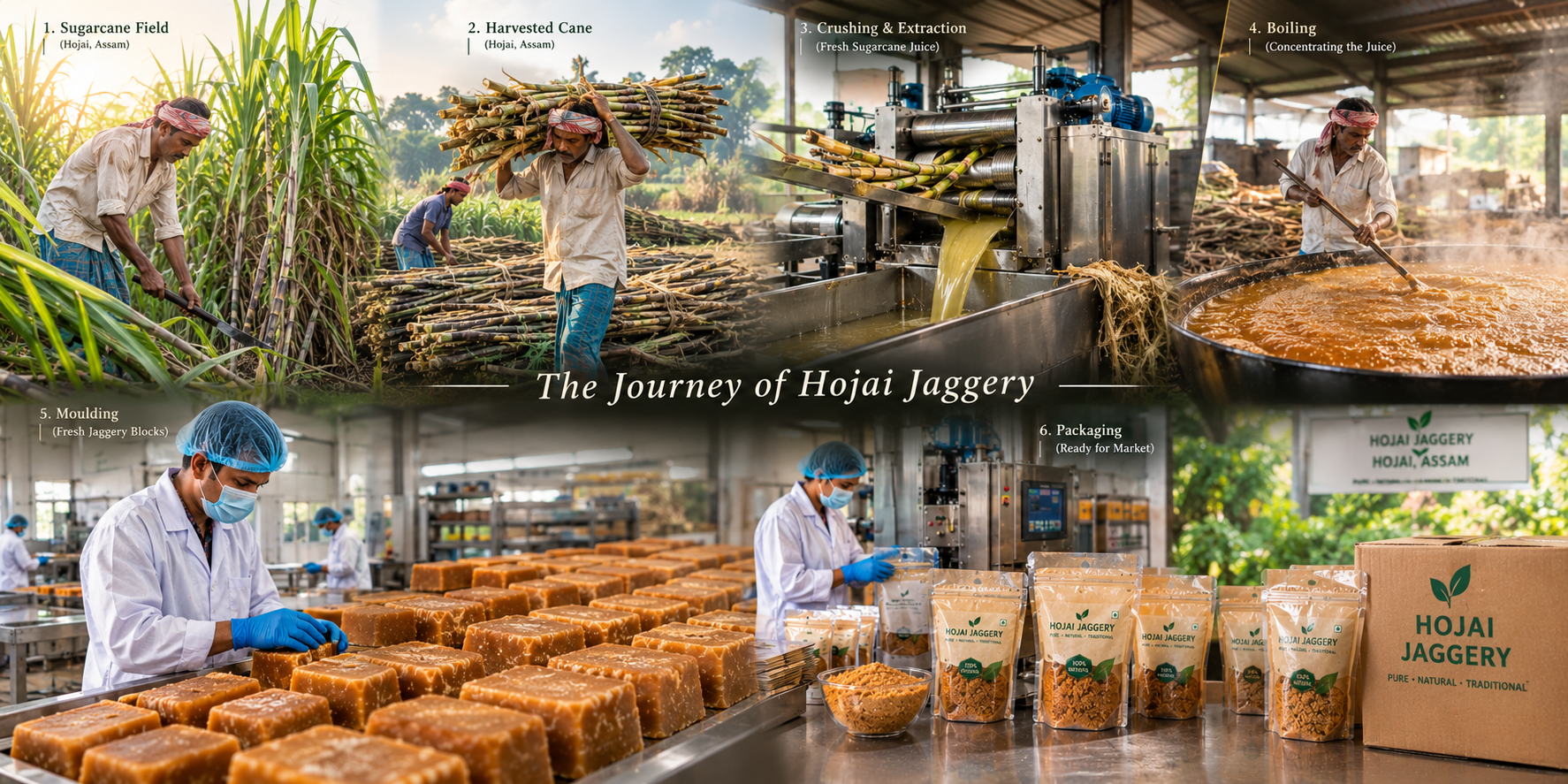
There is something unique about jaggery which refined sugar can never capture. It starts with a simple thing such as a sugarcane stalk. The sugarcane stalk is harvested and crushed, and the sweet juice is obtained from it. This leads to a process where the freshly extracted juice goes through various stages which include filtration, clarification, heating, concentrating and cooling to produce the golden-brown chunks, lumps or crystals known as ‘gur’ or ‘jaggery’.
The process of producing jaggery has become an integral part of the district’s agricultural and food processing culture in Hojai, Assam. According to government information sources, Hojai is one of the districts under Assam’s One District One Product (ODOP) program for sugarcane-based products, jaggery included.
According to information from the government, Hojai is considered as a district for traditional jaggery manufacturing based on sugarcane production and small producers. Agriculture in Hojai gives significant importance to sugarcane as well. However, the question remains how does a green sugarcane stalk change into a piece of jaggery? The solution lies in a series of carefully carried out processes. From the time when mature sugarcane stalks reach a processing.
Why is Sugarcane and Jaggery Important in Hojai?
The association of Hojai with jaggery is not just about the production of a sweet. Sugarcane provides the farmers with a farming product that goes into the local value-addition chain rather than remaining a raw farming produce. After the sugarcane has been converted to jaggery, then it transforms into a processed food produce.
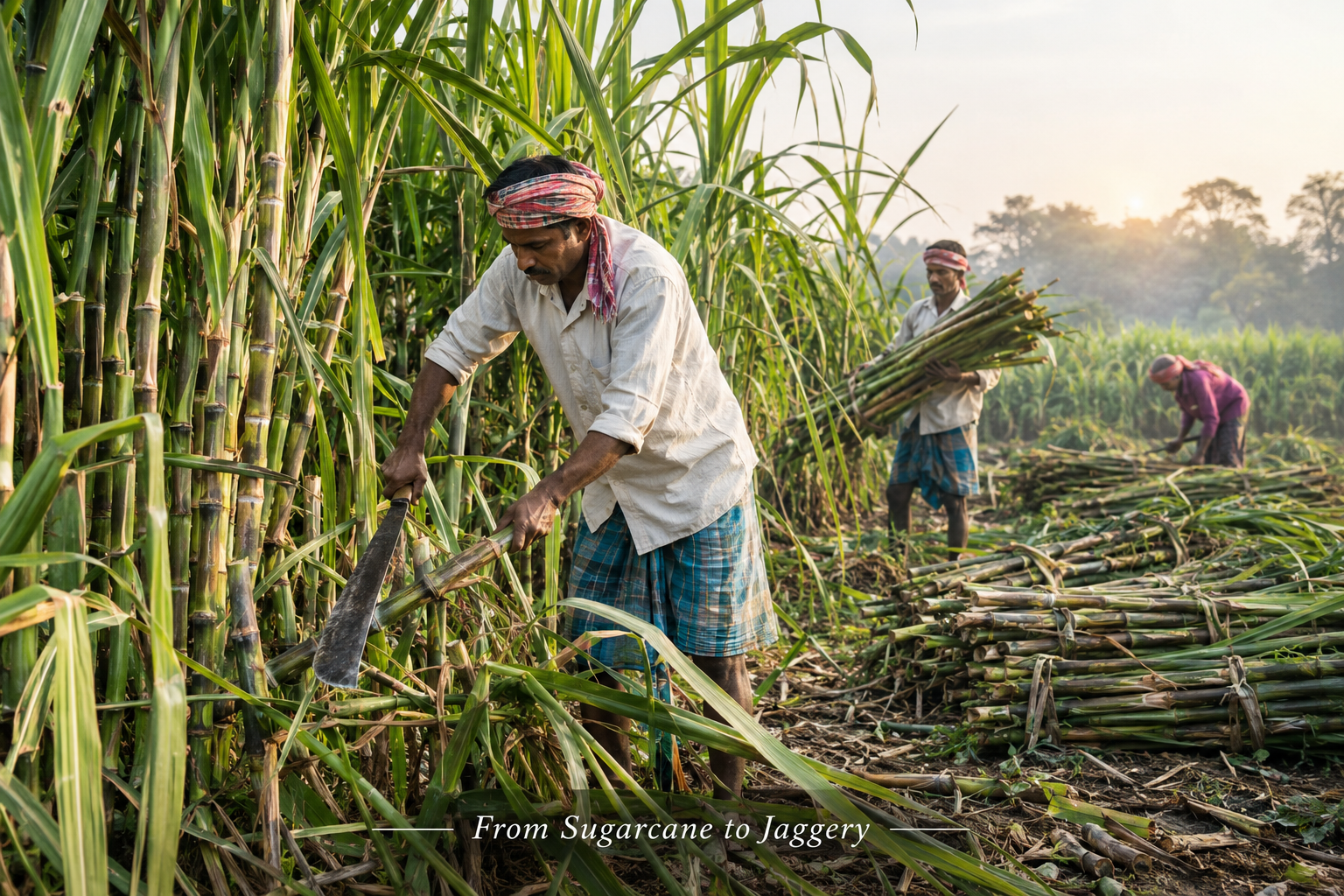
In the disaster management plan formulated by the Hojai district administration, there is an emphasis on the importance of sugarcane in terms of income generation for the farmers and the marketing of gur made from sugarcane in various parts of the country. This is one of the reasons why jaggery has importance in terms of the Hojai ODOP identity. Not only is the district growing sugarcane but is also known for processing it into a storable, sellable, and usable food item And the process begins right in the field.
1. It All Begins with Sugarcane
First of all, there must be high-quality sugarcane before we can obtain jaggery. The quality of jaggery obtained will depend much upon the quality and maturity of the sugarcane that comes into the process unit. The sugarcane has sucrose, water and other natural substances in it. The main goal of making jaggery is to extract the sweet juice and evaporate enough of the water content.
The maturity of the sugarcane is crucial in the case of jaggery production due to the effect that juice composition has upon the efficiency of concentration. As soon as the harvest time comes, the canes are cut and sent for processing.
It is essential.
After harvest, the juice composition starts changing, so freshly picked sugarcane should be processed rapidly. At the processing stage, the cane is checked and the undesirable stuff like leaves, dirt and damaged parts are discarded. he purer the raw materials, the better it is possible to get pure juice.
2. The Harvested Cane is Cleaned and Prepared
After the cane is brought to the processing zone, it must be prepared for crushing. There may still be soil, leaves, and other elements present on the stalks. Such substances should not enter the juice, since they can affect its cleanliness and increase the burden on the filtration. For this reason, the cane is being cleaned and sorted before going to the crusher.
At first glance, this procedure may seem unimportant; however, it is far from that. As was said earlier, jaggery is made by concentrating sugarcane juice. In the course of concentration, all substances that are in the juice become more significant. Thus, the handling of the raw material is the basis of clean jaggery production. Having prepared the cane, it is now brought to the crusher.
3. Crushing the Sugarcane: Getting the Sweet Juice
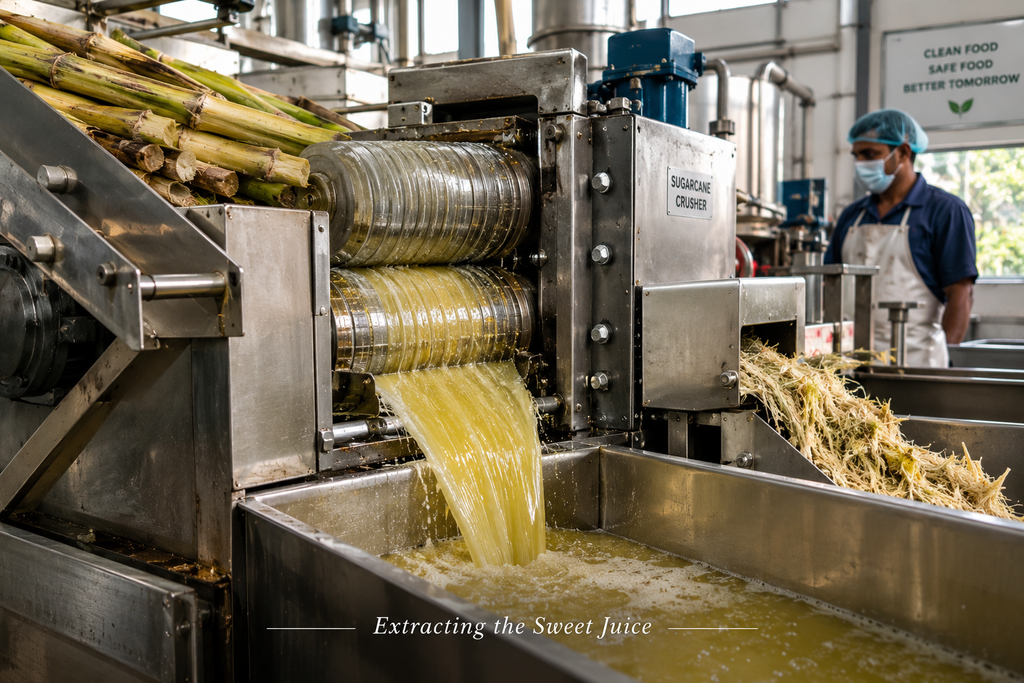
Here the transformation of the cane takes place. The prepared stalks are introduced into the mechanical crusher, which squeezes out the liquid juice from the fibre. Based on the description of jaggery manufacturing provided recently by ICAR, one can use power-operated vertical or horizontal crushers, with the latter having a multi-roller design, which allows extracting the juice efficiently. The result is two important flows:
Sugarcane juice – the liquid that is the basis for making the jaggery.
Bagasse – the remaining part of the cane (fibre).
Traditionally, bagasse is used to heat jaggery pans with its help. It means that the loop appears in the manufacturing process: the sugarcane provides both the juice and fiber, which is then used for heating the pan.
However, modern Hojai jaggery processing seems to show another way of proceeding.
4. Fresh Juice Is Filtered
Freshly squeezed sugarcane juice is not yet fit for boiling. It may carry some bits of fibre, bagasse, plant matter and suspended impurities. Therefore, the juice should be filtered before reaching the concentration process. ICAR states that the filtration process can involve filtering juice through meshes or cloth, and letting the impurities settle down. Even more elaborate systems may involve multi-stage filtration of the juice.
The objective is clear:
Keep the sweet juice. Get rid of the solid waste. In an efficient production process, filtration is a key step of quality control between the extraction and boiling processes. The next step could be allowing the juice to settle so that the solid waste will settle down first, while the juice is moved further ahead. This juice is now prepared for the most significant transformation.
5. Clarification: Treatment of Juice Before Concentration
Sugarcane juice, even when filtered, has natural non-sugar compounds present. Some of these include suspended solids, waxes, proteins, gums, tannins, and coloring matter. If not handled properly, they could impact the color, flavor and texture of jaggery produced. That is the reason why clarification becomes a necessary step in the process of making jaggery. As per ICAR, clarification may be performed by using approved clarifying agents. Also, organic clarifying agents like deola or okra mucilage could be employed in suitable processing. Clarification process affects the color, flavor, texture and acceptability of jaggery. One point needs to be made clear: techniques in making jaggery can vary from traditional to modern plants. In the case of traditional plants, open pan method and clarification technique may be different compared to modern processing plants where controlled and closed system of processing can be adopted.
Food safety and regulations become important. FSSAI standards provide specifications for jaggery and prescribe moisture and other parameters of quality along with prohibition of any artificial color as per the standard quoted above. The next step is to concentrate the clarified juice.
6. Boiling of Sugarcane Juice
In case anyone wonders how the liquid form of sugarcane juice is turned into solid jaggery, here is the phase that gives away the answer. Water has to be removed from the juice. The clear sugarcane juice is boiled for the water to evaporate as the concentrations of sugars and other soluble substances increase. Conventionally, the preparation of jaggery employs large pans exposed directly to the furnace fire. As per ICAR, traditionally, there are essentially three major phases in the heating process:
- The warming of the juice.
- Continuing heating to evaporate water.
- Increased concentration till the desired “striking point” of the juice is attained.
This is not simply a question of “boil it until it thickens.” Temperature control is extremely important. Insufficient concentration could make the jaggery soft or with too much moisture. Overheating or improper controlling of the heating process will make the jaggery too dark and impact adversely on its taste and quality. According to ICAR, the conventional process of uncontrolled heating could cause caramelization and Maillard reaction, thus making the jaggery dark and deteriorating its quality.
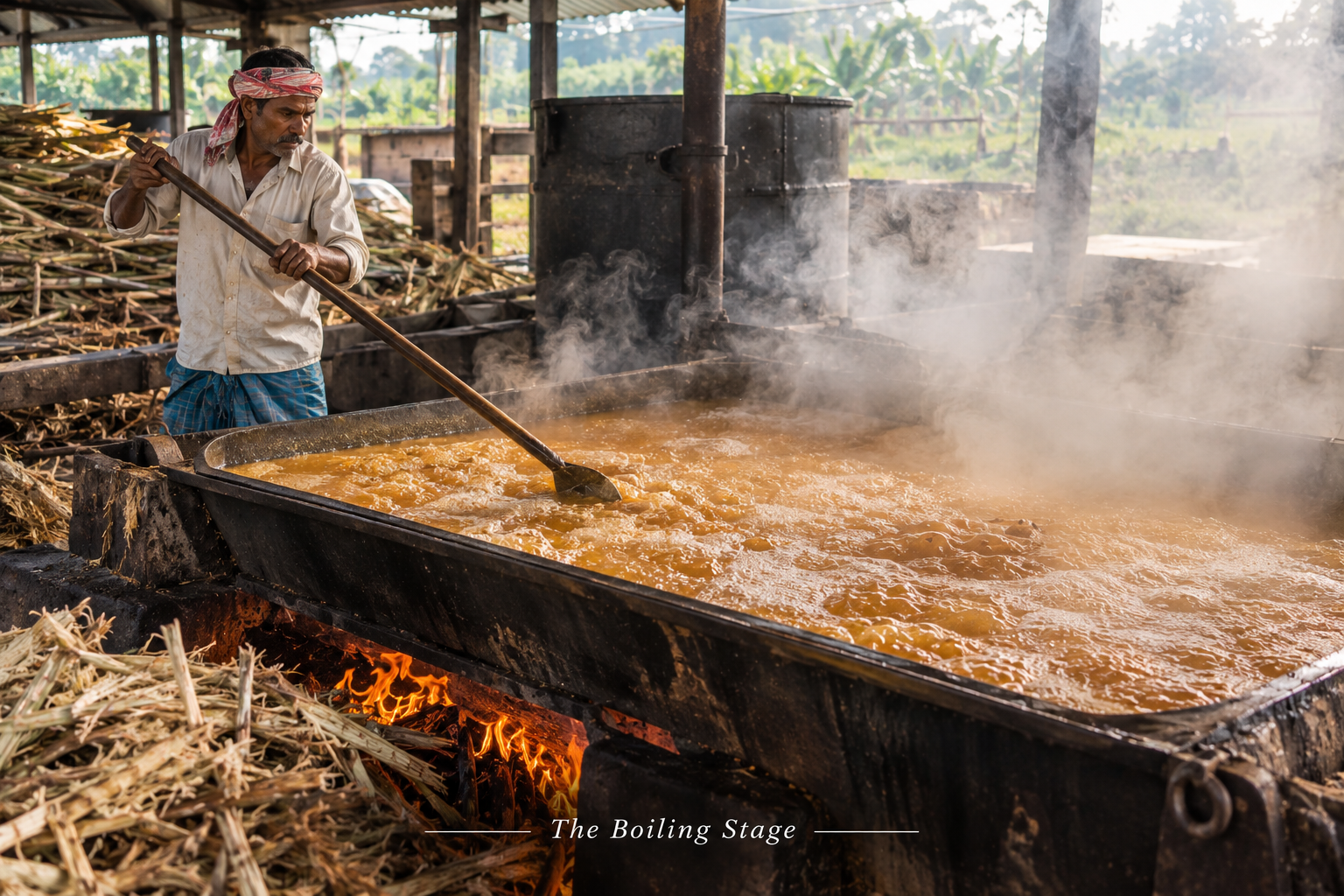
7. The Striking Point: When Juice Becomes Jaggery
There comes a point in the process of making jaggery that seasoned manufacturers are especially familiar with. This point is referred to as the striking point. At this point in the manufacturing process, the concentrated juice of sugarcane has lost sufficient moisture and acquired consistency in order to be extracted from the heating unit.
ICAR cites the temperature range of 116-118°C as the striking point temperature in the described method, but also notes that traditional manufacturers may use the cold-water drop test. Why is this point significant?
Because the difference between concentrated syrup and overcooked substance may be quite small.
A manufacturer has to evaluate:
- Temperature
- Consistency
- Color
- Behavior of the concentrated substance
- Moisture content
Modern facilities have at their disposal devices like infrared thermometer or digital thermometer in order to ensure consistency and avoid burning the product. When the proper degree of concentration is achieved, the hot substance is transferred out of the pan. The liquid that went into the process as sugarcane juice is being transformed into jaggery.
8. Cooling and Moulding
The thickened gur is very hot and still quite soft. It is placed in proper moulding trays where it starts cooling down. As it cools, the thickened mass slowly hardens and gains firmness. Depending upon the type of manufacture and market demand, gur can be moulded into:
Blocks
Balls
Cubes
Smaller pieces
Powdered form
ICAR states that the thick gur is poured into wooden or aluminum trays for cooling and then moulded into various shapes. his is one of the most aesthetically pleasing stages in the whole process. The flowing liquid of an amber brown color gradually becomes gur in its solid form that people can break, grate, or use directly as an ingredient in their food.
9. Cooling Determines the Final Texture
While cooling may seem like a passive process, it is essential in determining the final product. The process of cooling transforms the liquid into solid form as the hot concentrate starts to cool. This is determined by many factors, which include:
- Nature of sugarcane juice
- Degree of concentration
- Heat process
- Degree of moisture in the product
- Cooling process
- Formation process
In order for jaggery production to be successful, the end product should have a stable form instead of being too moist or sticky. Moisture is crucial for storage purposes. According to ICAR, jaggery should contain about 5% to 7% moisture for storage purposes, where the relative humidity is between 50% and 60%. Humidity is dangerous for the product, especially during rainy seasons. For Hojai manufacturers, this is particularly crucial since a good product will only be useful if it maintains its quality outside of the processing facility.
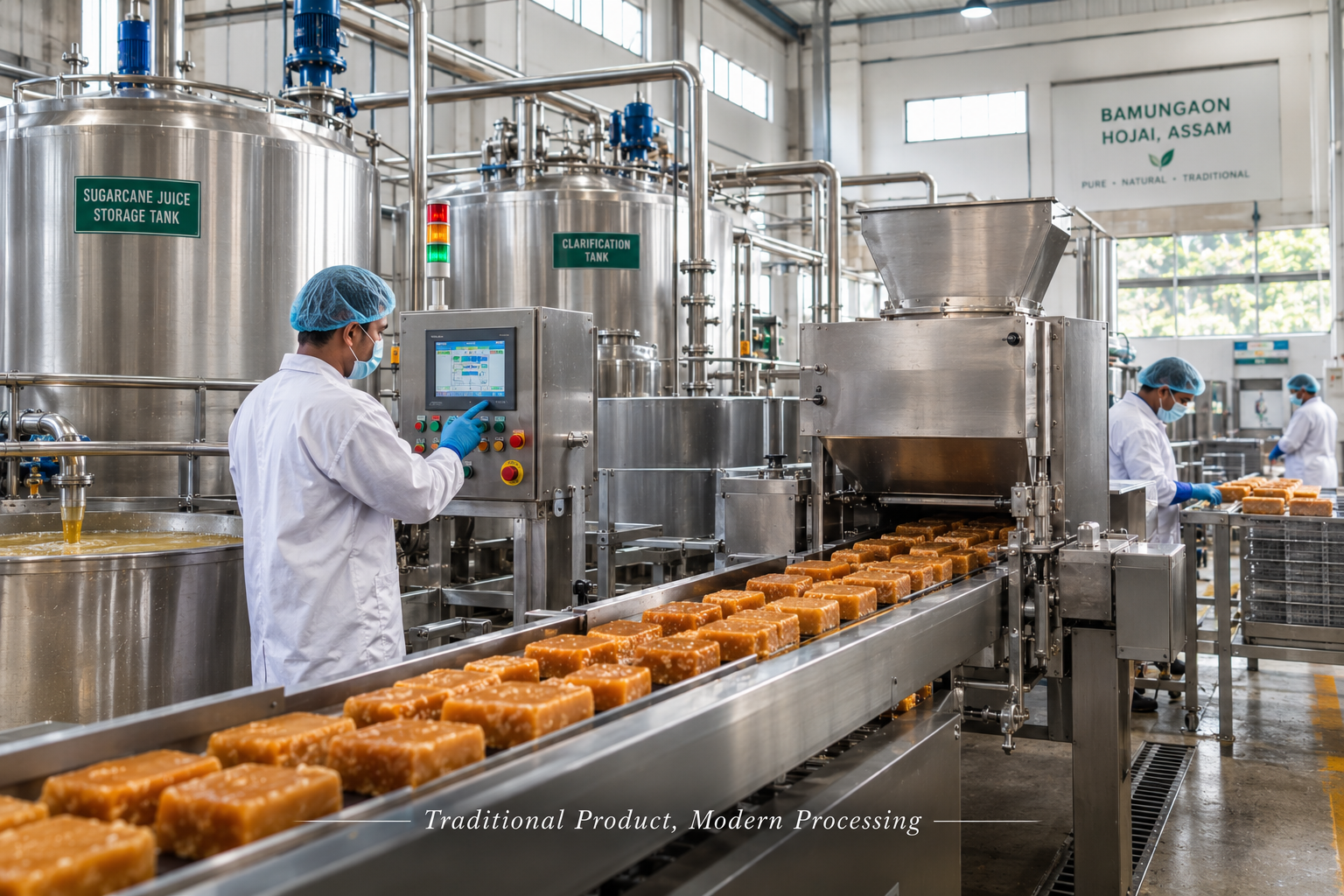
10. Traditional Hojai Jaggery with Modern Processing Technology
Another development that has made the history of jaggery in Hojai very interesting is that traditional methods of making jaggery are being complemented by modern technology.
Eco Tech Agro Mills located in Bamungaon in Hojai district of Lanka is one such company that uses modern technology for manufacturing jaggery from sugarcane juice.
According to the company, it uses the modern MVR—mechanical vapour recompression—technology for evaporation of water from sugarcane juice at low temperature. Instead of burning bagasse for providing heat in conventional systems, the company uses compressed vapours in a closed system.
The plant’s technology is completely different from the open pan technology.
As per the company, its process of production uses stainless steel equipment, closed processing, automatic control system, and controlled packing environment. According to the company, there is no usage of artificial colours and chemical additives for the improvement of the appearance of the end product.
A 2025 report of The Assam Tribune described the Hojai plant as a 500-tonne/day crushing plant which uses boilerless sugarcane-processing technology, while other reports have said that the technology is a new way of manufacturing jaggery without the combustion of residual biomass.
It does Traditional and small-scale production continues to be part of the district’s jaggery identity.
Instead, Hojai is becoming an interesting example of how an established agricultural product can move toward more controlled and technology-driven processing.
11. What Becomes of the Sugarcane Residue?
The sugarcane story does not end with extraction of the juice. What is left behind after extraction is the fibrous residue, which is called bagasse. In the case of traditional jaggery manufacturing, the bagasse can be dried and used as a fuel to heat the pans. ICAR has identified the bagasse as an alternative source of biofuel for the heating process.
The modern Hojai process seems to have something different to offer. According to Eco Tech Agro Mills, their MVR process does not use the residual biomass and reuses the extracted water for the process of heating. The company also outlines various future value chains associated with bagasse and other by-products.
This reveals an important principle in food processing: Not only the target product should be efficiently produced, but the waste should be minimized and its value should be found. In the case of the sugarcane-producing Hojai District, this may become increasingly relevant with development of processing infrastructure.
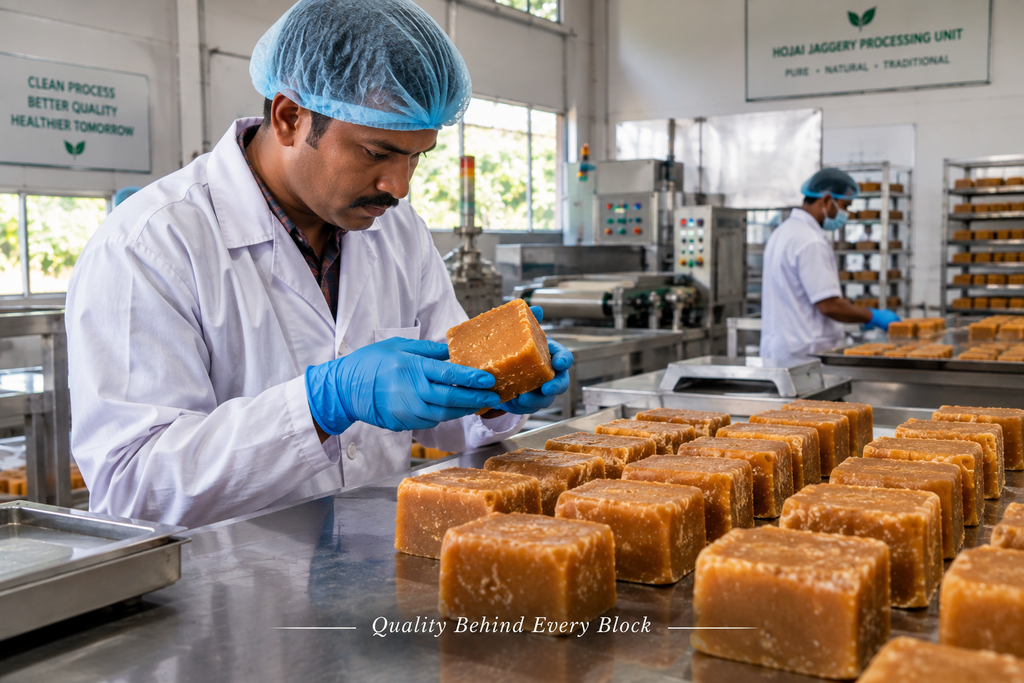
12. Quality Control: What Makes Good Jaggery?
Good jaggery is not just “very sweet.”
There are several aspects that make good jaggery.
Color
The color of the jaggery may be naturally golden or darker brown based on sugarcane juice content and process conditions.
The color alone does not constitute the sole indicator of good jaggery.
Texture
It should have the right firmness and not be overly moist or sticky.
Moisture Content
Too much moisture will decrease the shelf life. The Indian Council of Agricultural Research (ICAR) recommends 5-7% moisture content for preservation purposes.
Cleanliness
The jaggery should be clean due to the filtration process and good hygienic handling.
Flavour
Good jaggery should have the typical taste of concentrated sugarcane juice.
Moreover, the Food Safety Standards Authority of India (FSSAI) provides analytical standards for jaggery, including the moisture content, sucrose, total sugars, reducing sugars, ash and insoluble matter.
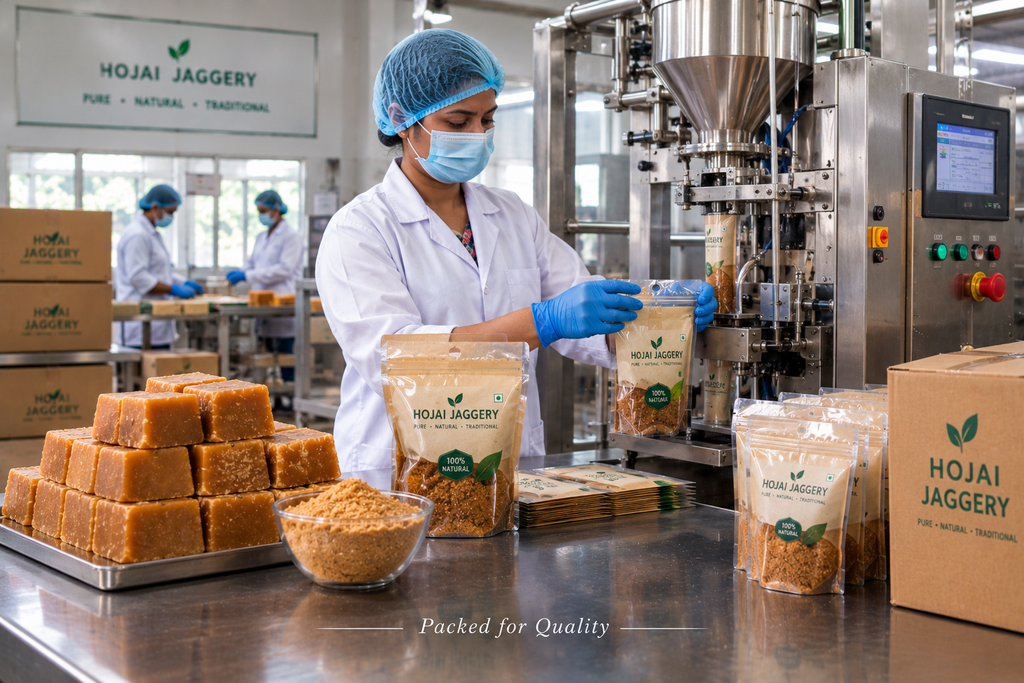
13. Packaging: Ensuring Proper Protection of the Ready Gur
Having been cooled down and acquired its definitive shape, the gur requires to be protected from the influences of moisture, dust and contamination. Though traditional goods can be stored in a variety of containers, modern food business establishments make increasing use of packaging, which ensures a higher level of hygiene and moisture-proofing of the product.
According to ICAR, gur may be packed using proper food-grade plastic and PET or other packaging systems, and vacuum packaging may increase the shelf life of the product. This trend is further developed in the modern Hojai manufacturing process.
According to Eco Tech Agro Mills, their gur is packed in air tight pouches in a dehumidified environment. Thus, packaging serves as the last line of defence for the gur, which is already subjected to the manufacturing process. The process started in the field with sugarcane finally ends up with the ready product to be packed.
14. From Hojai’s Sugarcane Fields to Indian Markets
The last part is the distribution process. Jaggery from Hojai may not necessarily remain confined to the region of production. The Hojai district authorities have pointed out that the gur made from sugarcane is sold to different parts of India.
Therefore, the value chain goes far beyond the processing stage:
Farmer → Sugarcane → Crusher → Juice → Filtering → Clarification → Evaporation → Molding → Packaging → Market
Each stage adds to the value. It is exactly for this reason that processing is so important.
Raw sugarcane being sold offers agricultural value. Conversion of sugarcane into an edible food item involves the other aspect of processing.
The Future of Hojai Jaggery
Hojai currently has something very valuable: a very close link between sugarcane production and jaggery manufacturing. What comes next is to make that link even closer. More efficient processing facilities will enhance consistency. Higher standards of hygiene will increase consumer confidence. More sophisticated packaging will ensure quality preservation during transportation. Modern testing techniques will help manufacturers comply with food safety regulations. And value-added products will bring new prospects beyond the manufacture of jaggery blocks. According to government food-processing programmes, manufacturing of jaggery out of sugarcane and production of value-added products from jaggery fall within the category of food-processing.
The future thus, may not just lie in the manufacture of jaggery. It may lie in the manufacture of higher quality jaggery, better packaged jaggery and even more value-added sugarcane products.
A Stalk of Sugarcane to a Block of Hojai Gur
The next time you come across a block of jaggery, it will do you good to reflect on all that it takes to transform it into that form. It started out as a sugarcane stalk growing in the soil. It was harvested, cleaned and crushed. Its juice was filtered and clarified. It lost water content via controlled heating or modern evaporation process. It reached its boiling point as concentrated syrup. It was then cooled and processed into its shape It was packaged.
And finally, it turned out to be the block of jaggery on a kitchen shelf. This is the reason why Hojai gur in Assam is not merely a sweetener. It symbolizes a whole journey starting from the cultivation of sugarcane to processing and marketing of the product. This is the reason why Hojai is now recognized as an Assam ODOP district for sugarcane based products. And with traditional methods of production being accompanied by modern methods of processing, the tale of Hojai gur is turning out to be a tale of much more than that: how a locally grown product can be transformed into a unique product.