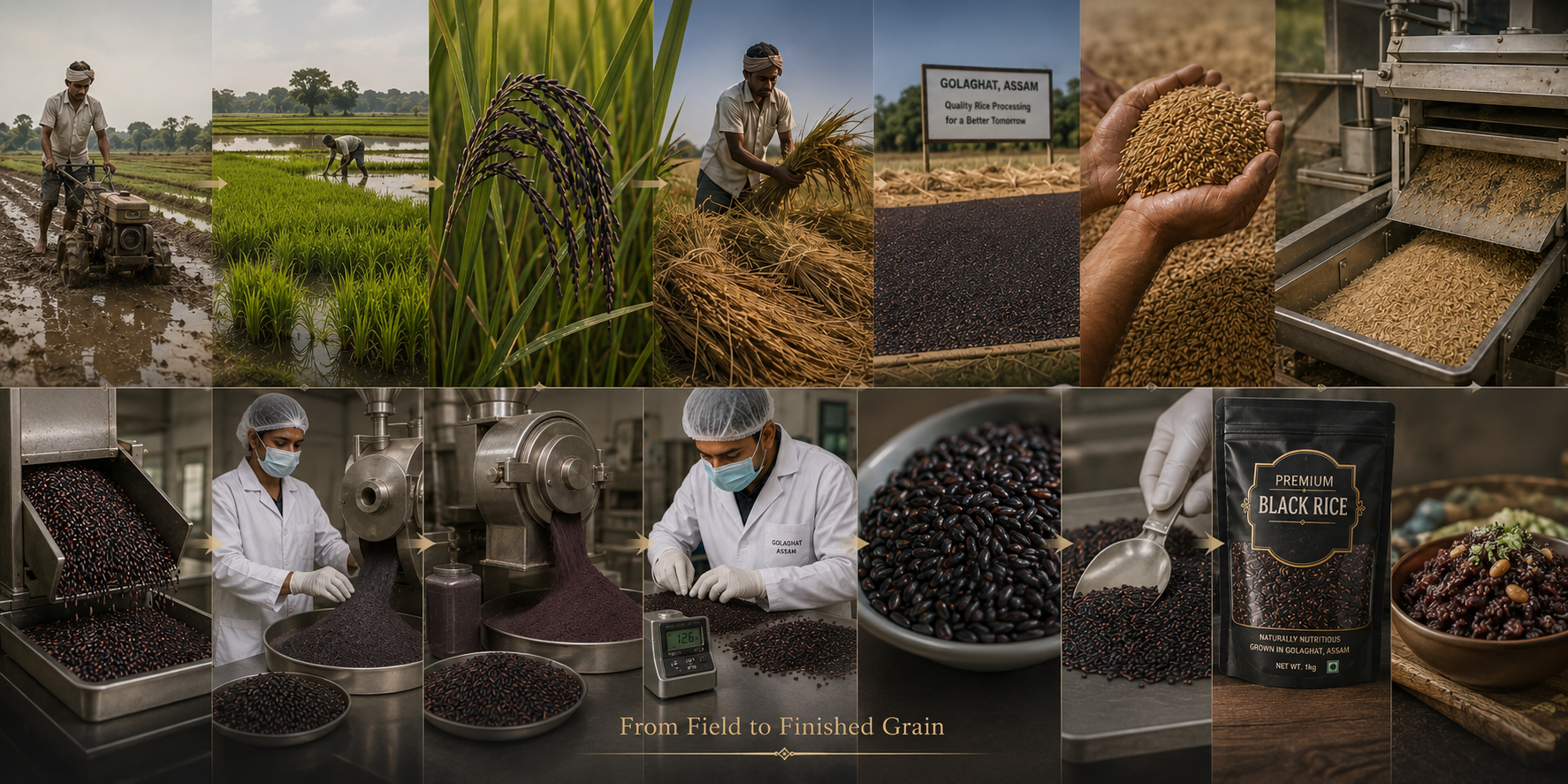
It is quite obvious that there is something unique about black rice.
Prior to cooking, black rice appears differently from the widely used white rice variety of India. The colour of the grains is naturally dark – sometimes even black – and after cooking, it turns into a purple hue.
However, it is only the tip of the iceberg. Black rice produced in Golaghat, Assam, is not only produced and delivered to retailers, but the process starts much earlier than the moment when the package of this product lands at the shelves of the local stores. In order to get black rice, first of all, farmers should prepare fields, choose seeds, grow rice plants and wait until the grains are ripe. Later, the process requires further stages of drying, cleaning and milling of the paddy before the final product emerges.
In contrast to polished white rice, black rice preserves the layers of pigmented skin that gives the rice its color and makes the post-harvest handling and milling extremely important.
Then, how does black rice get from paddy field of Golaghat to the consumer? Let us take a closer look at its journey.
Why Is Black Rice Different?
The unique dark colour of black rice is given to it by pigments occurring naturally in the rice, particularly anthocyanin pigments, that give colour to some other products like blueberries and purple-coloured crops. The grains are not dyed.
The appearance of black rice depends entirely on its natural composition.
After the harvest time comes, the farmer does not get the product ready for consumption right away. Instead, he or she will get the paddy – the rice enclosed into its outer hull.
This fact is very important.
The general sequence is:
Seed → Rice plant → Paddy → Harvest → Drying → Cleaning → Milling → Grading → Packaging → Black Rice
And every step can affect the result.
Step- 1. Preparing the Field for Black Rice
This process begins from the field. Before planting the first seed, farmers prepare the land where rice will be cultivated. According to the agricultural method used, this may consist in the preparation of soil, water management, and removal of weeds. Rice requires such an environment in which the growing plants will manage to develop healthily and grow panicles.
For the people in Assam, agriculture is associated with the seasonality of rainfalls and water. This means that the field is not just a piece of land. It is the basis for the whole process of production. The well-organized field provides good conditions for plant development.

2. Selection and Preparation of the Seed
High-quality rice requires proper planting material. Prior to cultivation, farmers should prepare adequate seeds for the particular black rice variety. Selection of the seed is vital for successful growing. Damaged or of low quality seeds can provide uneven germination and poor crop. Seeds will help create a stronger crop. Depending on the way of cultivation, rice can be grown by nursery planting and transplanting or by direct seeding. Method of growing may vary from farm to farm. What doesn’t change is the main goal: to grow healthy crop, capable of yielding well-developed grains.
3. Growing of the Rice Crop
After being planted, the field is changing. Young seedlings are turning into tall rice plants. Leaves get greener, and, after some time, plants start producing panicles—the parts of rice carrying the grains. During this time, farmers check the crop and perform weeding, watering and other field tasks. Most of the job is done by the rice plant itself. Below green leaves, grains are developing. When growing, their colouration becomes clearer and clearer. Finally, the farmer reaches the point where the field is ripe for harvesting.
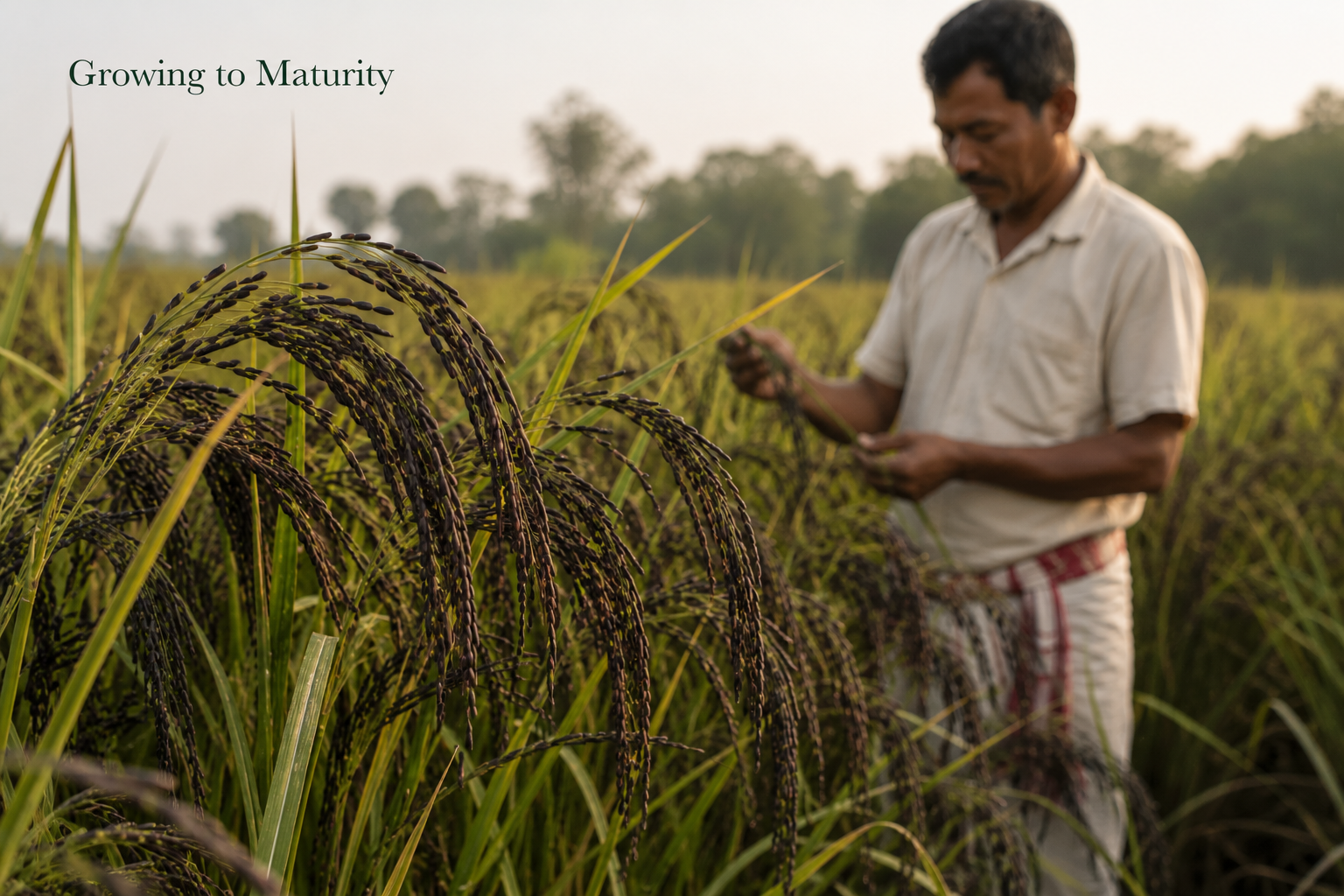
4. When to Harvest Black Rice
Timing of harvest is important. If harvested early, grains may not develop properly. If harvesting is delayed, the crops become susceptible to losses in the field, to weather and to grain dropping. Checking maturity of panicles and state of the grains is important. Green field gets the features of a mature rice field. Now the farmer’s goal is changing. Trying to grow the plant is not the case anymore. Now the goal is: to harvest the crop successfully.
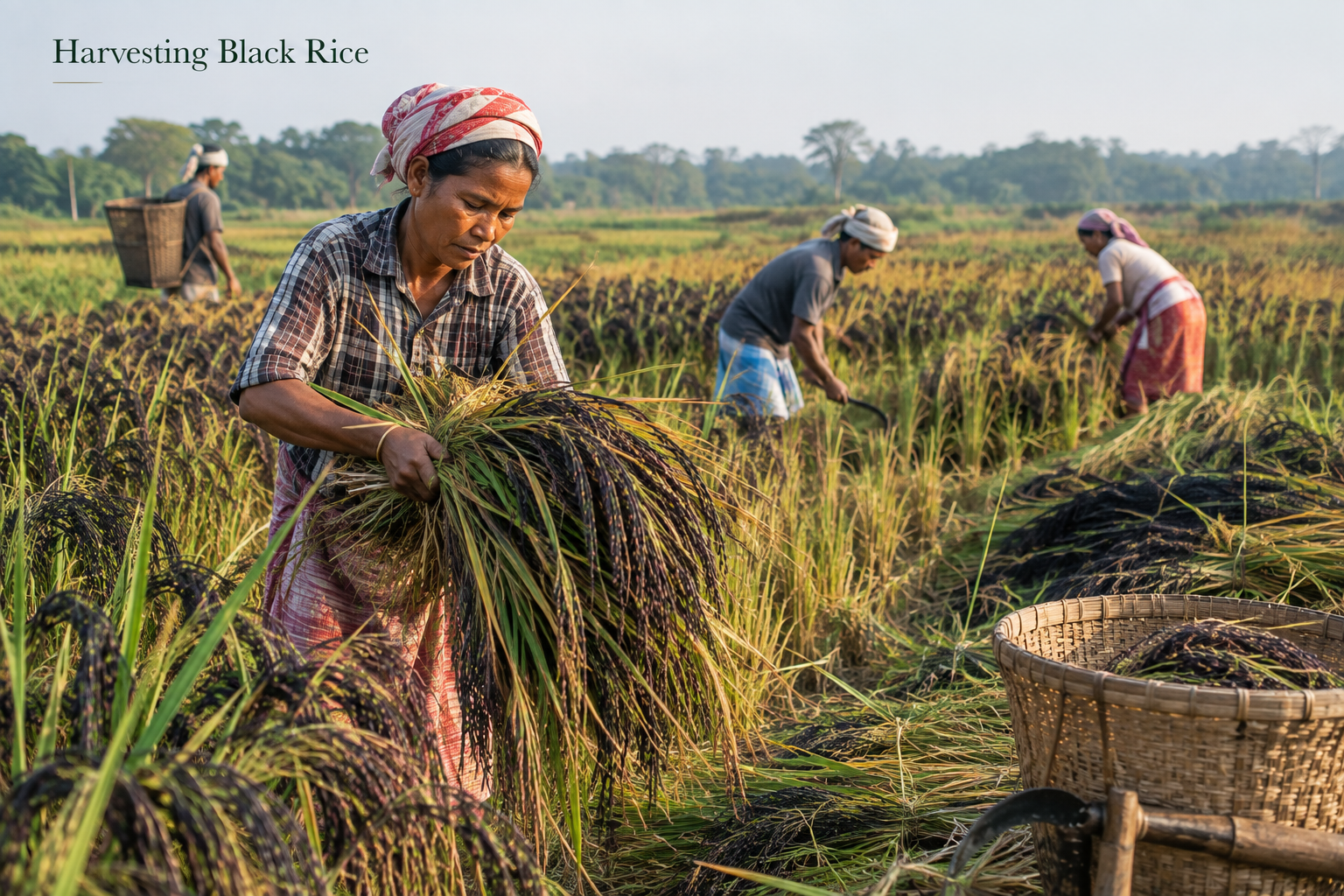
5. Harvesting the Black Rice
Harvesting is definitely the most physically demanding part of the process. The matured rice plants are harvested from the fields using suitable harvesting practices for the farm. For small-scale farms, manual harvesting would be required while machinery can be used if available. The next step involves gathering of the harvested crop. By this time, the grains are still covered with husks. The substance that leaves the field is thus paddy and not the black rice that is finally sold. One of the main points to keep in mind in processing of the rice is this. The stunning black grains that we see in food packages have undergone many changes before getting there.
8. Removal of the Husk
Now the real transformation takes place. The paddy contains a layer of husk covering the rice grain. It needs to be removed. This step is called dehusking or husk removal. Rice mills use special equipment to remove husks from the grains of rice. At this point, the product ceases to be paddy. It becomes rice. However, processing is not over yet. Black rice requires special care during milling since too much polishing removes outer layers of the grain which are responsible for the peculiar colour of the grain.
Here comes the major difference between black rice and the conventional white rice which is polished to get the maximum degree of whiteness. The goal is not to get the whitest and most shiny grains of rice. The goal is to get the clean, usable grain while preserving its natural properties.
9. Special Processing of Black Rice
After the removal of the husk, further milling of the rice is possible depending on the end-product required. In case of black rice, the degree of milling is important. The high level of polishing means removal of the bigger number of the outer layers of the grain. As mentioned above, black rice gets its colour from these outer layers. So, excessive polishing of black rice reduces its colour. This means that the processor should find the golden mean. Clean the grain. Remove the husk. Maintain the acceptable quality. Do not destroy the pigmented outer layers of the grain. This is one of the reasons why the processing of black rice cannot be reduced to the processing of the same crop by a conventional rice miller.

10. Whole Grain from Broken Grains
Once the rice is milled, the grains have to be sorted. There are some grains that are whole grains. Then there are other grains that are broken due to harvesting or milling. A grading machine separates grains based on size and quality. Whole grains are usually used for making quality products as they give a consistent appearance. Broken grains are not always waste material. Sometimes, they can be used in other food items.
11. Quality Check
After this step, the product has to be inspected again before packing.
The processor inspects for:
- foreign material
- damaged grains
- broken grains
- cleanliness
- appearance
- moisture level
- quality
Since the product here is unique, the appearance becomes very important. Consumers will demand that the grains have their characteristic black appearance. Also, the grains have to be clean and dried properly. Quality control makes sure that an agricultural product becomes a food product.

12. Packaging of the Black Rice
Once the rice is successfully quality checked, it is now ready for packaging. Packaging does not only serve the sole purpose of making the product presentable.
It acts as a means of protecting the grain from the following:
- Moisture
- Dust
- Contamination
- Insects
- Damage during handling
Moreover, packaging allows the producer to make communication about the identity of the product. An appropriately designed package can inform the consumer:
- What is this?
- Where did it come from?
- How do I prepare it?
- How do I store it?
For regional products such as the Assam black rice, the concept of origin-based branding could help increase recognition outside the region. Using a label on the package with information of origin as Assam and appropriate production area can connect the consumer with the agricultural background of the grain.
13. Whole Grain to Packaged Food Ingredient
This brings the whole transformation process very close to the end. Starting from a field full of rice plants and ending up in a packaged food ingredient.
This can be summarised in the following order:
Field
↓
Rice Production
↓
Fully grown crops
↓
Harvesting
↓
Paddy
↓
Drying
↓
Cleaning
↓
Dehusking
↓
Careful Milling
↓
Grading
↓
Quality Check
↓
Packaging
↓
Black Rice
While the process appears simple in the above diagram, every arrow indicates work, equipment, knowledge and quality assurance.

Importance of Careful Processing of Black Rice
Black rice is not only ordinary rice with a different colour. Its naturally dark outer layers make up part of its essence. It means the process of its processing has to differ from highly polished white rice. Over-processing of the grains could cause loss of certain features of black rice. Therefore, milling intensity and conditions of storing the grains are crucial. At the same time, it makes an extra burden but provides additional opportunities for farmers and processors. First, they have to deal with quality preservation.
Second, there is an opportunity to produce and sell unique regional agricultural product in the markets outside their region.
Black Rice as Value-Added Agricultural Product
The greatest opportunity does not only lie in sales of the paddy itself. Through the process of its processing, it is possible to create different products:
- whole black rice
- traditionally milled black rice
- premium packaged rice
- black rice flour
- rice-based food ingredients
- and other value-added food products
With the beginning of rice processing, there is an opportunity to develop different products for different consumers.
It would lead to the creation of the value chain around the product.
In case of Assam, it becomes particularly important.
Instead of talking about “How much rice can we produce?”
The question may become, “How much value can we generate with the produced rice?”
14. Black Rice Flour and Other Added-Value Products
The story does not have to end with whole grains. Black rice can also be milled down into flour for food processing purposes. The grain is cleaned and processed to produce flour.
Depending on what the product will be used for, the flour could be utilised in preparing various food products. This presents another avenue for making money from agriculture. A farmer grows the crop.
A food processing firm takes the raw crop material and transforms it into an ingredient. The food manufacturer uses the ingredient to manufacture yet another product. This is how agriculture can move from production to food processing in stages.

The People Behind the Rice Product
It is quite natural to examine any packaged product without going into details. But behind each product there is a number of people involved in its making. First, there is the grower of the crop. Then there are workers engaged in the harvest process. Also, there are drying and cleaning personnel. Then, there are milling specialists. Further on, there are quality control workers. Moreover, there are packaging and distribution teams. Each step plays its role in creating the final product. And this is what makes regional agricultural products so unique. They are not made in one factory. The story starts much earlier than that.
From Golaghat Farms to Consumers
When packed, black rice can start entering various markets.
In case the product is moving outside the region of its production, it becomes even more important to have good packaging and consistent quality.
While the name ‘Assam’ can become part of the product description, the link to ‘Golaghat’ can tell consumers the beginning of the agricultural journey.
But at all times the origin must be stated correctly.
A product must not pretend to be completely manufactured in Golaghat in case if only the raw material originates from there and the rest is done elsewhere.
For regional food stories, truthfulness is key.

Future of Black Rice Processing in Assam
There is not just an issue of growing more black rice.There is also the improvement of post-harvest processing. Improving drying helps reduce post-harvest losses. Improving milling enhances the grain quality. Improving grading ensures consistency.
Improving packaging increases the product’s reach in the market. And improving branding ensures consumer awareness of the special qualities of the product. Therefore, value addition is equally important for the farmers, processors and food businesses as growing the field crops. The field provides raw materials. The processing makes a product.
A Basic Description of Full Black Rice Processing Process
For those who are interested in seeing the full process, it is presented below.
1. Field Preparation
The agricultural field is prepared for rice cultivation.
2. Seed Selection
Proper seeds of black rice are chosen and cultivated on the field.
3. Crop Management
Farmers care for their crops until rice matures.
4. Harvesting
Rice is matured, then harvested and collected as paddy.
5. Drying
Drying of the harvested paddy is done.
6. Cleaning
Any foreign objects are cleaned up.
7. Dehusking
The outer covering of the paddy is stripped.
8. Milling
Careful milling preserves special appearance of the grain.
9. Grading
Whole and broken grains are sorted out.
10. Quality Control
Quality control is performed on the processed rice.
11. Packaging
The processed rice is packed in proper food packages.
12. Distribution
The product can be distributed now.
Conclusion: The Journey behind Assam’s Black Rice
The tale of black rice in Golaghat, Assam does not end at the consumer level. It starts in the beginning with the preparation of the field and planting of the crop.
A few months down the line, matured rice will be harvested as paddy. This is followed by drying, cleaning and processing of the harvested grain. Processing involves removing the husks from the grain, milling and grading and inspection of the finished rice products which are packed for sale. Black rice’s uniqueness is evident in the naturally occurring pigmented layers on its outer surface.
Processing of such rice is not just about getting rid of all the exterior portions. It entails balancing between making the grain usable and maintaining its natural features in terms of cleanliness and preservation.
This is the true essence of processing.
A crop produced in Assam’s field may not be just paddy. Through processing, it may be converted to a regional food product, flour ingredients or basis for adding other value to food products. Every grain of rice comes from a whole range of activities involving many players and processes from the farmers in the field to workers in the rice mill and those packaging the final product. So next time you see a bag of black rice from Assam, do not forget that there is much more to it than its dark colored grains.
The journey of black rice is from:
- Seed to field.
- Field to paddy.
- Paddy to grain.
- Grain to finished product.
Frequently Asked Questions (FAQs)
1. What is black rice and why is it different from regular rice?
Black rice is a naturally dark-coloured rice variety. Its deep purple-black appearance comes from natural pigments in the outer layers of the grain. Unlike highly polished white rice, black rice is generally processed more carefully to retain its characteristic colour and grain properties.
2. Is black rice grown in Golaghat, Assam?
Yes, black rice is cultivated in parts of Assam, and Golaghat can be discussed as part of Assam’s agricultural and rice-producing landscape. However, the exact varieties, acreage and production levels can vary by location and season.
3. How is black rice produced in Assam?
The general process begins with field preparation and seed selection, followed by cultivation, crop management and harvesting. After harvesting, the paddy is dried, cleaned, dehusked, carefully milled, graded and packaged as finished black rice.
4. How is black rice harvested?
Black rice is harvested when the rice plants and grains reach maturity. Farmers cut and collect the mature plants, after which the harvested material is handled as paddy and prepared for drying and post-harvest processing.
5. How is black rice processed after harvesting?
After harvesting, black rice paddy generally goes through several stages, including drying, cleaning, dehusking, milling, grading, quality inspection and packaging. The exact process can differ depending on the scale and equipment used by the processor.
6. Why is drying important when processing black rice?
Drying reduces moisture in freshly harvested paddy and helps prepare the grain for safe storage and milling. Proper drying and storage are important for maintaining grain quality and reducing the risk of spoilage.
7. Why does black rice need careful milling?
Black rice gets its characteristic colour from naturally pigmented outer layers of the grain. Excessive polishing can remove some of these layers, so careful milling can help retain the visual and nutritional characteristics associated with black rice.
8. Is black rice polished like white rice?
Black rice can be milled to remove the outer husk, but it does not need to be heavily polished like many conventional white rice varieties. Processing requirements depend on the desired final product and the variety being used.
9. What products can be made from black rice?
Black rice can be sold as whole grain and can also potentially be processed into black rice flour and other value-added food products. The possibilities depend on the variety, processing equipment and intended market.
10. What happens during black rice quality testing?
Quality control can involve checking the rice for cleanliness, foreign materials, grain condition, moisture and overall appearance. Grading also helps separate whole grains from broken grains and improves consistency in the finished product.
Leave a Reply