
State: Assam
District: Morigaon
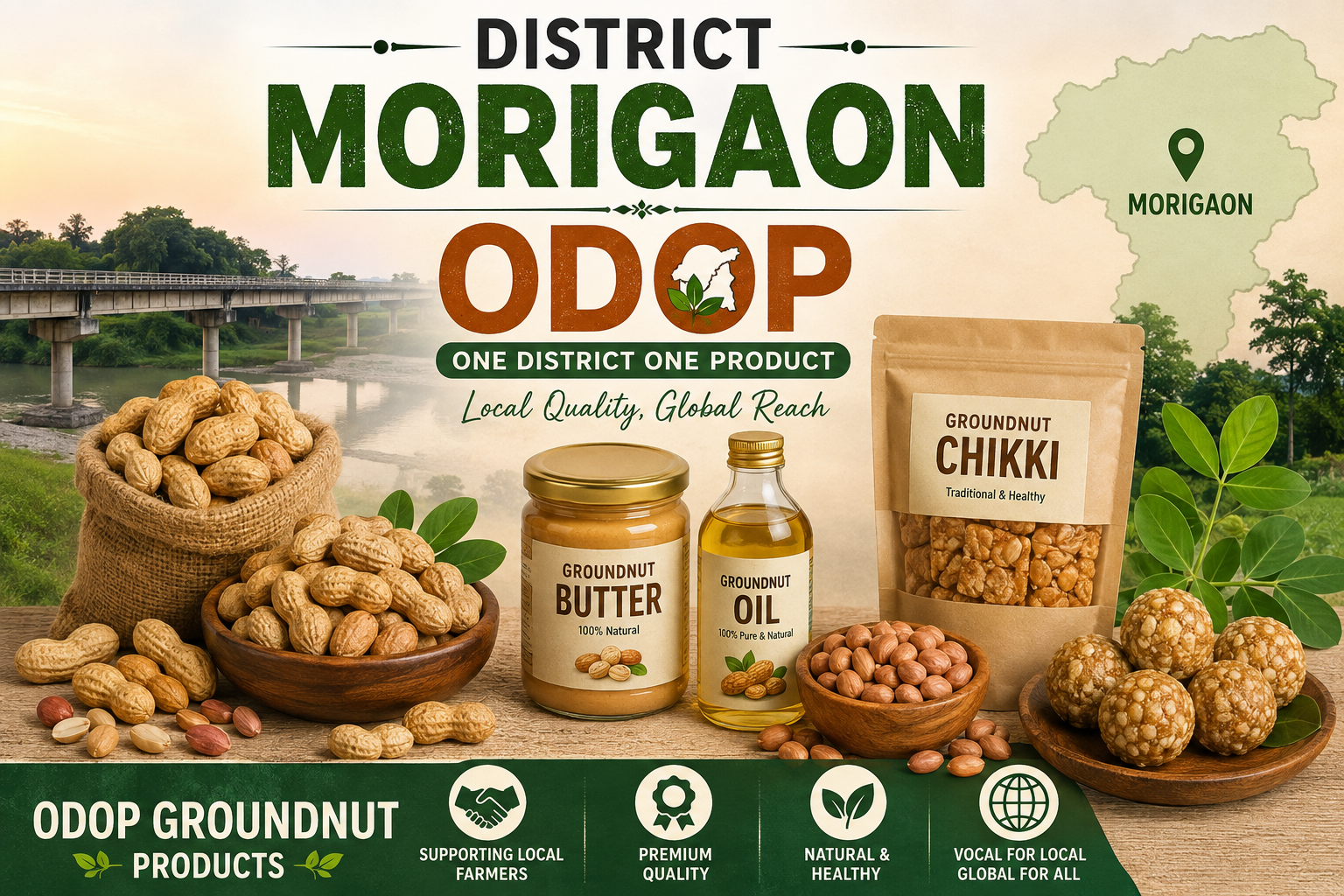
ODOP Product: Groundnut Products
Category: Agriculture, Traditional Food & Food Processing
In Assam, food has always been intrinsically tied to the land. What grows in the local fields finds its way into the local kitchen, and has been passed down through generations in the form of age-old recipes. For the district of Morigaon, this deep connection between the soil and the stirrup can be seen through many examples and is reflected in many ways.
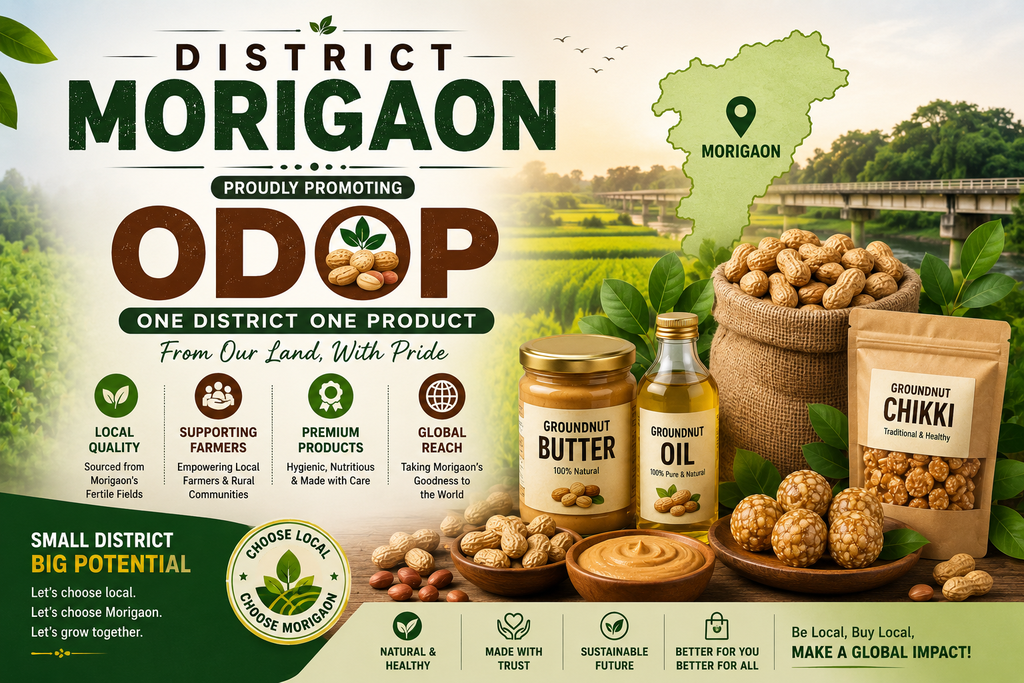
Agriculture has traditionally been the mainstay of Assamese rural life, with farmers cultivating crops suited to the local terrain and climate for livelihood. In Morigaon, the production of a certain crop has had a special significance for the locals and has been given an additional boost as the One District One Product (ODOP) of the district – Groundnut products.
The ODOP initiative seeks to promote products with potential from each district, which will offer opportunities to the farmers, entrepreneurs and food processing units. As per official records, “Morigaon – Groundnut Products” is the chosen ODOP product for the district.
While groundnut has been the chosen crop for Morigaon’s ODOP, it also presents an opportunity to bridge the district’s agricultural and traditional food processing.
Groundnut and the Agricultural Roots of Morigaon:
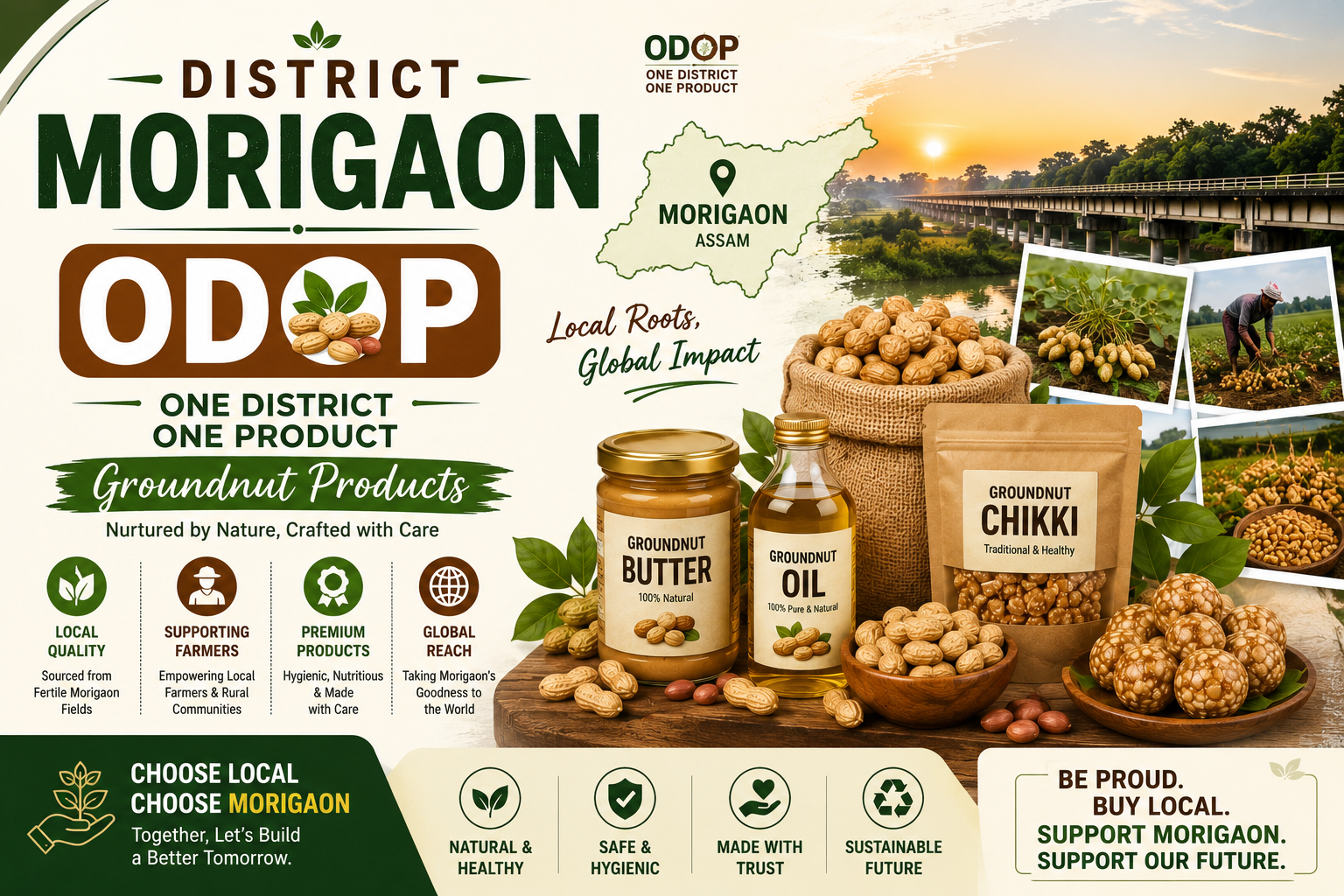
For centuries, Assamese farmers have cultivated a wide variety of crops that were suited to the local climate and landscape. Agriculture has been the backbone of Assamese rural life, and has been central to the livelihood of farmers for centuries. State government agricultural records of Morigaon district mention cultivation of groundnut in the district.
Groundnut, also called peanut, is a legume native to South America, and has been cultivated in the Indian subcontinent for centuries. There is versatility in its usage – the roasted peanut can be consumed as a snack, can be made into a variety of products, as well as used to produce peanut oil.
While Morigaon farmers have the potential to grow high quality groundnuts, the opportunity also exists to create value-added groundnut products within the district.
Instead of the local produce being taken out of the state, local entrepreneurs and farmers can explore the potential of processing groundnut within the district. The processing of groundnut can be done locally within the district in various ways such as cleaning, grading, roasting, processing, and packing it with appropriate branding.
The Simplicity of Traditional Assamese Cuisine
Traditional Assamese food has had an enduring appeal for many. Assamese cuisine has always made use of simple ingredients that were available locally. Recipes are mostly based on a single staple ingredient, which is supplemented with other locally available produce. Cooking food based on local ingredients is one of the reasons for the appeal of traditional Assamese food.
Rice has always been the staple food of the Assamese people, and continues to be so to this day. It has also traditionally been accompanied by a range of side dishes, including dal and leafy vegetables, as well as fish and other locally available produce. Traditional Assamese food also makes use of simple preparation techniques.
Many dishes can be made at home with minimal effort and ingredients, and still be wholesome and delicious. This is one of the reasons why the traditional Assamese cuisine has retained its popularity to this day.
When it comes to value-added groundnut products, the simplicity of traditional Assamese food can be a good guide.
Groundnut in Everyday Traditional Assamese Food:
As mentioned earlier, one of the simplest ways of cooking with groundnut is roasting. The humble roasted groundnut is a staple in many homes, and continues to be a popular snack across Assam. The scent of roasted groundnuts is synonymous for many with Assamese village life.
Groundnut can also be combined with other locally available ingredients in various traditional dishes. Groundnut can also be found in a variety of modern-day preparations, such as chutneys, savouries, and mix snacks, while traditional preparations can simply call for roasted or boiled groundnuts. These preparations are largely simple and are the reason that groundnut can be an excellent addition to Morigaon’s traditional food.
Foods made from groundnuts were largely common across Assam, and the reasons for their popularity continue to resonate to this day. They are largely simple to make and can be prepared with minimal ingredients. Simplicity is often a good guide when it comes to traditional Assamese cuisine.
Traditional Assamese Snacks and Groundnut:
The tradition of home-made snacks has long been an important part of Assamese culture. Snacks made from rice, puffed rice, flattened rice, sesame, coconut, jaggery, and other locally available produce have been popular among the Assamese for generations. Groundnut can be used to enhance the traditional Assamese snack-making tradition.
Roasted groundnuts can be added to puffed rice and other ingredients to make traditional Assamese snacks. Similarly, groundnuts can also be added to preparations made with jaggery in line with the tradition of making snacks with locally available ingredients. Such traditional Assamese snacks can be appealing in today’s day and age when there is a greater appetite for wholesome food.
A home-made Morigaon groundnut snack can also carry two stories – that of the farmer, and that of traditional Assamese food.
Value-Added Groundnut Products: From Farm to Market
The true potential of Morigaon’s ODOP can be unlocked through value-added groundnut products. Groundnut can be made into a variety of value-added products that can find local buyers, as well as potentially have a regional or even national market.
Some potential groundnut products that can be made in Morigaon are mentioned below:
• Roasted groundnuts
• Salted and flavoured groundnuts
• Traditional groundnut snacks
• Groundnut chutney or powder
• Groundnut-based sweets
• Groundnut oil
• Groundnut brittle and jaggery-based snacks
• Cleaned and graded groundnuts
• Packaged traditional snack mixes
• Groundnut-based gift packs
Such value-added products can be prepared by local entrepreneurs, farmer groups, self-help groups as well as small and medium-sized food processing units. The objective should be to value-add without over-processing, and make a product that is wholesome and appeals to the masses.
Enhancing Livelihoods through Farmers’ Produce
Processing groundnut can be an excellent way to enhance farmer livelihoods. Farmers can sell their groundnut to local processors, instead of selling them in the open market. Such value-added groundnut products can also create employment opportunities within the district.
When groundnut is processed within the district, it creates additional employment and economic opportunities, from processing and packaging to marketing and distribution. Morigaon already has farmer producer organisations that deal with agricultural produce. An official list of such organisation can be seen here. According to the State government’s website, Laharighat in Morigaon district has a Farmer Producer Company, which lists groundnut as one of their key focus areas.
Such farmer producer companies can play a significant role in enhancing farmer livelihoods. It can also provide farmers with a reliable market for their produce.
Value-Added Groundnut: Employment Opportunities for Women and Small-time Entrepreneurs
Processing groundnut can also be a viable business proposition for small-time entrepreneurs as well as women self-help groups. The potential for employment in this sector is considerable.
Women self-help groups can be involved in roasting groundnuts, preparing traditional groundnut snacks and chutney as well as packaging. There is scope for such groups to participate in all stages of processing, from cleaning and grading to roasting and packing.
Local entrepreneurs can set up small-scale processing units to make groundnut-based products. Such units can also be set up by women self-help groups. As long as the product is prepared in hygienic conditions and meets quality control standards, such products can find buyers locally as well as pan India.
Imagine a packet of roasted groundnuts that also carries a story. That story can be about the farmers, and the traditions of Morigaon. With that small change in packaging, a humble local snack can gain tremendous value and find new buyers.
Reviving the Traditional Assamese Food Culture
With the changing times, many traditional foods are being lost to the annals of history. Traditional Assamese food is being increasingly replaced by packaged, junk and fast food. However, this is not the end for traditional Assamese food by any means.
While the changing culinary landscape needs to be acknowledged, there is also scope for promoting traditional Assamese food in contemporary ways.
A traditional groundnut snack can be prepared in hygienic conditions and marketed as such. Similarly, jaggery can be combined with groundnut to make sweets inspired by traditional Assamese cuisine. Traditional groundnut snacks can also be creatively packed to appeal to different target audiences, such as tourists, students, and so on.
In fact, a small local business can begin with just a few products, and build a brand around them. A packet of roasted groundnuts can also be creatively marketed to carry the name of Morigaon and be sold as a unique product with an interesting backstory. Such local products can also be promoted on social media to reach out to a larger audience.
Groundnut: The Story behind your Snack
One of the most important aspects of any food product is its story. What does it stand for? Where does it come from? How is it made? What is its connection to your food? The story behind a food product can, in many cases, make or break its popularity.
Morigaon’s groundnut product has a unique story. It has the potential to connect with customers in a deeply personal way by talking about the farmers and their produce. The potential groundnut-based products can be marketed to evoke the feeling of old Assamese village life and connect with the customer on a different level.
With more and more consumers gravitating towards local and traditional products, a story about local produce can be an effective tool to not only market the product but also build a brand around it. For instance, the groundnut packets can carry a short description about Morigaon and its produce. The story and the quality can build a brand, while not overstating claims could ensure authenticity and avoid misleading the consumer.
Leveraging Groundnut Products for Tourism Promotion
Morigaon is also famous for the wildlife habitat in Assam, including the Pobitora Wildlife Sanctuary. Tourism is a growing industry in Assam, and it can be leveraged to promote the local produce as well.
Tourists like to buy souvenirs as mementos of their trip. Promoting local traditional food items can be a good way to leverage the growing interest in Assam’s tourism industry. Local groundnut snacks and sweets can be presented as souvenirs that capture the spirit of Assam.
A local food mart can be set up within Assam to promote local food products. This could feature local groundnut products as well as a variety of other traditional Assamese foods and snacks. This could create a unique opportunity to encourage food tourism in Assam.
Creating a Unique Selling Proposition for Morigaon’s Groundnut Products
The quality, packaging, branding, and marketing of the groundnut product will be integral to its success. For instance, the groundnut products can carry a unique name that reflects the district’s culture, while also distinguishing it from other groundnut-based products in the market. Some suggestions have been mentioned below:
• From the fields of Morigaon
• Morigaon special – a traditional Assamese snack
• Morigaon groundnut – the traditional Assamese way
• A taste of Morigaon
• From the heart of Assam
The potential is vast when it comes to building a brand around Morigaon’s groundnut product.
With proper quality control, the product can build a strong brand image around authenticity and traditional quality. Additionally, digital marketing can help local entrepreneurs reach out to a larger audience. Social media can help local businesses promote their handicrafts, food items and more to a national audience. In fact, many local Assamese products are now being promoted on digital platforms, helping them gain popularity on a much larger scale.
That said, it is also important to leverage local resources and market the product within Assam. A local food market can be set up to promote the local produce, including groundnut products.
From Old Recipes, New Opportunities
It is fascinating to note that some of the most promising opportunities in the ODOP initiative stem from old Assamese food traditions. Morigaon’s groundnut products can be an excellent way to promote local agricultural produce as well as food items made using local ingredients and age-old recipes.
The potential applications of groundnut in Assamese cuisine are vast – it can be made into a variety of dishes and snacks, as well as a wide range of value-added products. Groundnut can be made into chutney powder, sweets or groundnut oil, as well as snacks. The value-added potential is great, provided there is opportunity for proper branding and marketing.
However, it is important to keep in mind that groundnut products must continue to carry the essence of authenticity and tradition. The traditional methods of food preparation can be leveraged to build a unique selling proposition for the local groundnut product.
Conclusion
Morigaon’s Groundnut Products represent the future of Morigaon’s agriculture and food processing sector. They also represent the deep connection between the farmers and the land they cultivate, as well as the rich traditional food culture of Assam. Groundnut fits into the traditional Assamese diet perfectly, as it is simple to incorporate into a variety of dishes. It has also been cultivated across many parts of Assam, and holds promise as a value-added agricultural product.
With the support of the ODOP initiative, local farmers, women self-help groups, as well as small local entrepreneurs and large-scale private players, can work together to create a product that leverages the district’s rich culinary tradition and authentic local produce. It is time to bring traditional Assamese snacks and dishes into the modern era.
After all, it is not always the new products that are successful, but also the old ones that have been forgotten over time, and need to be rediscovered.