
There are some things we see so often that we stop paying attention to them.
An areca palm standing beside a house is one of them.
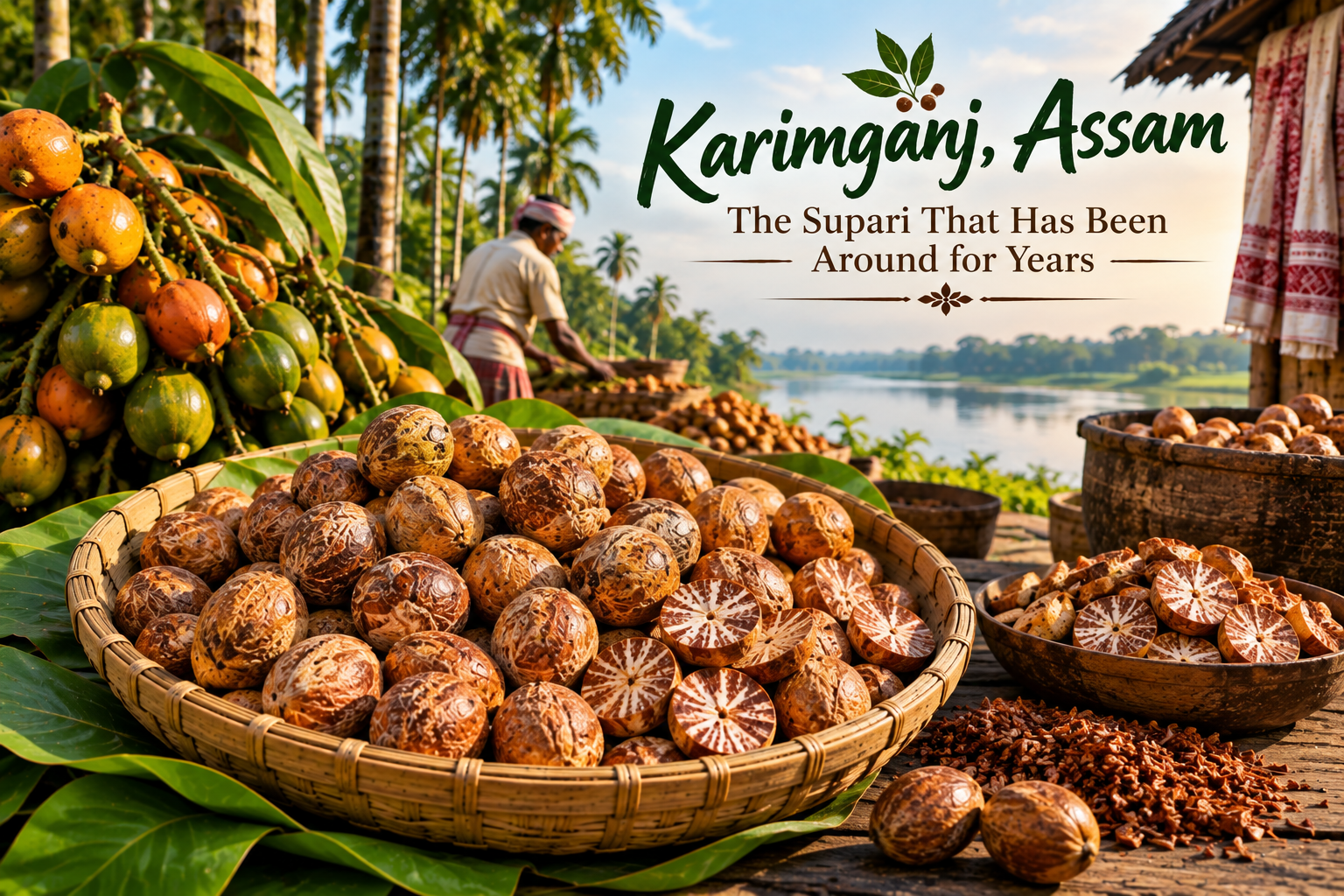
In many parts of Assam, these tall trees have been a familiar sight for years. The fruit they produce gives us arecanut, commonly called betelnut or supari. You can find it in local markets, shops and homes, but its place in Assamese life is older than the packets and brands we see today.
For people in Karimganj, Assam, arecanut can be looked at from two sides. It is an agricultural product, but it is also connected with an older way of eating and spending time with people. Betel leaf, paan and arecanut have traditionally appeared together, particularly when guests came to a home or when a family gathering was taking place.
That part of the story is easy to miss.
If we only see supari on a shop shelf, we see a product. If we look a little further back, we see a small piece of everyday life.
An Areca Palm Beside the House
The areca palm has a very recognisable shape.
It is tall, narrow and usually rises above the plants around it. In suitable parts of Assam, it can be grown around homes and agricultural land.
For an older generation, growing something around the house was not unusual. A household garden could have several useful plants. Some provided food. Some were sold. Others were simply part of the surroundings.
The line between a garden and a small source of income was not always very clear.
Arecanut fitted into that kind of setting.
The fruit could be collected, processed and sold. At the same time, the nut had a place in traditional household use.
This is one reason local agricultural products are interesting. Their story does not stop at the farm.
Before Supari Came in Packets
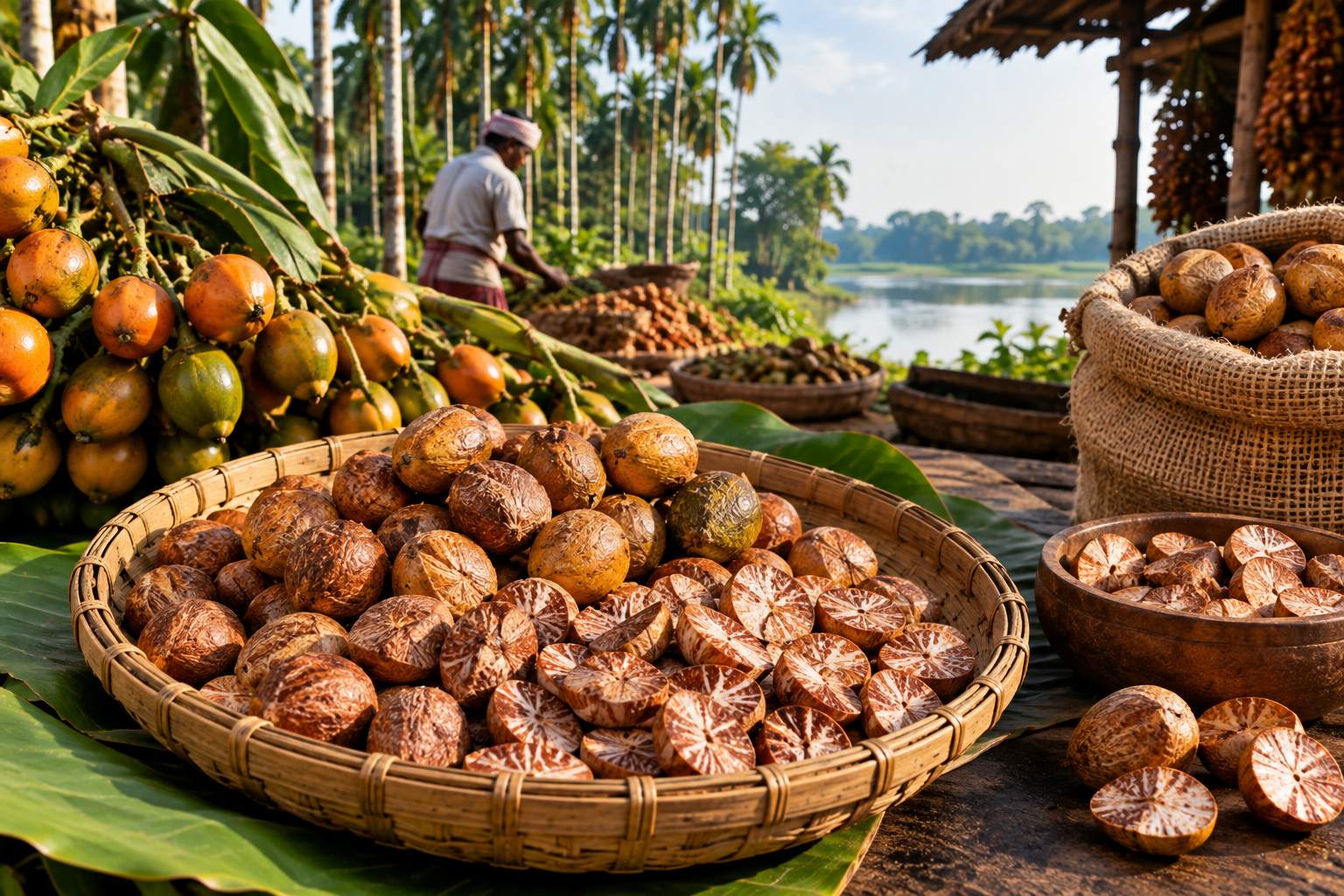
The supari most people see today is often packaged.
There are labels, advertisements and different varieties. Walk into a shop and it is easy to think of arecanut as just another commercial product.
Older households knew it differently.
Arecanut was familiar. It was generally associated with paan and betel leaf, and people did not need packaging to tell them what it was.
Preparation was also more of a household matter.
Someone in the family would know how to prepare paan. Another person would bring the ingredients. Children growing up in the house would see the process and eventually understand it themselves.
Nobody had to write down the instructions.
They simply learned by watching.
A lot of traditional food knowledge was passed on in exactly this way.
Paan After Food
The interesting thing about paan is that it was often connected with what happened after the meal.
People finished eating, but the gathering did not necessarily end there.
Someone might sit down with a cup of tea. Another person might start talking about something that happened in the neighbourhood. A relative might bring up an old family story.
Paan could be prepared during this time.
Betel leaf was folded around the chosen ingredients, with arecanut being one of the traditional additions.
It sounds like a very small thing.
It was.
But small routines can tell us quite a lot about the people who followed them.
The meal was not always treated as something to finish quickly and move on from. Sitting together was part of the experience.
When Someone Came to Visit
Older ideas of hospitality were often straightforward.
If a guest arrived, the family tried to offer something.
Maybe it was tea.
Maybe there was food already prepared.
If the visit continued, paan could be offered as well.
Arecanut became part of this custom because of its connection with paan.
It was not about showing wealth. A simple traditional offering could be enough.
The guest sat down, the family sat nearby and the conversation continued.
In a place like Karimganj, where village and community life have historically played an important role, these little social customs were part of the rhythm of the day.
People visited people.
They talked face to face.
And a visit did not always have a fixed ending time.
Karimganj and the Local Market
Karimganj has a long connection with local trade and agriculture.
Markets have traditionally been important for people living in and around the district. Farmers bring products, sellers arrange them and customers come looking for what they need.
It is easy to forget how important these markets were before modern retail became common.
A market was not only somewhere to buy vegetables or household goods.
It was also where people met.
Someone might recognise a neighbour.
A farmer might speak to a trader.
A customer might stop to ask about someone who had not been seen for a while.
Information travelled through these conversations.
Agricultural products travelled through the same network.
Arecanut could move from cultivation areas into local trade and eventually reach households and shops.
There was nothing complicated about the basic idea.
A crop was grown, collected, sold and used.
A Product Connected With Farming
When we buy a food product today, we often do not think about where it came from.
The shop is the starting point of the story for us.
For a farmer, of course, the story starts much earlier.
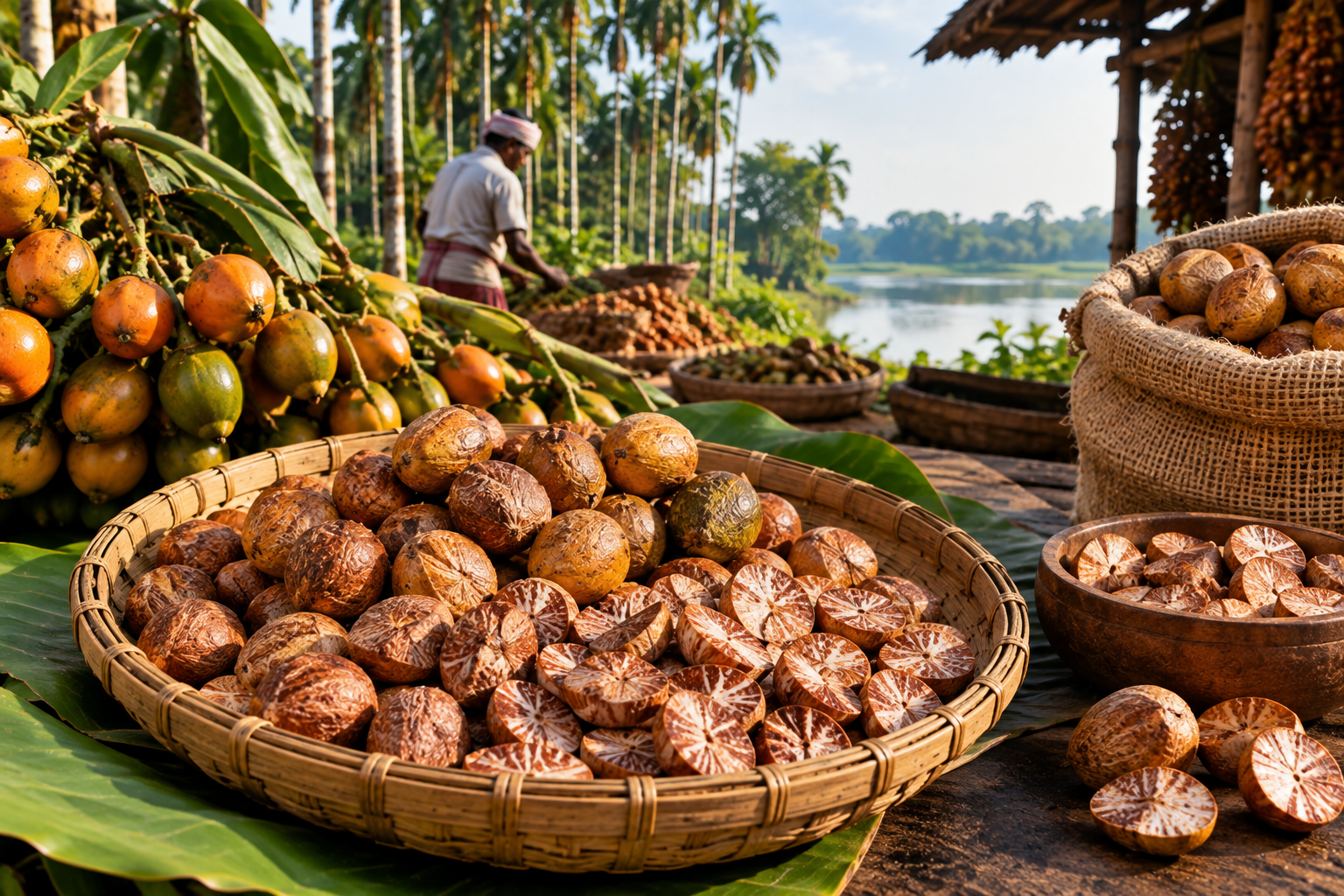
The land has to be prepared. Plants need care. The crop has to grow. Eventually, the produce is collected and taken somewhere for sale or further processing.
Arecanut follows this basic agricultural journey.
This is important when talking about Karimganj because local products are part of the wider relationship between people and the land.
The product in the market may look ordinary.
The work behind it is not.
Why Older People Remember Supari Differently
Ask a younger person about supari and they may simply think of something available at a shop.
Ask someone who grew up several decades ago and the answer may be different.
They may remember it being kept at home.
They may remember betel leaves being washed and prepared.
They may remember relatives sitting together after lunch.
They may remember a wedding where paan was served to guests.
The details will naturally vary from family to family.
That is actually what makes the memories interesting.
There was no single “official” way that every household followed.
Traditions changed from one place to another.
What stayed common was the connection between paan, social visits and hospitality.
Weddings Were Different Too
Family weddings in earlier times had their own atmosphere.
A wedding was usually not limited to a few hours in a decorated venue. Relatives might arrive early and stay for days.
The house became crowded.
The kitchen stayed busy.
There were always people talking somewhere.
Children found their own entertainment.
Older relatives had plenty to discuss.
Food naturally played a big role, and traditional items could be served along with the meal.
Paan and arecanut could be part of the hospitality.
Nobody would probably have written an article about it at the time.
It was simply normal.
That is how many traditions work. People rarely realise that an ordinary habit may become something worth remembering later.
The Old Market Was Also a Meeting Place
There is a reason older people often talk about local markets with affection.
They were useful, but they were also social.
A person could go there for one item and come back much later because of conversations along the way.
This sounds unusual now.
People today often want to finish shopping as quickly as possible.
Earlier, a market visit could take its own time.
Arecanut was one of the many agricultural products that could be part of this system.
The market gave farmers a way to sell what they produced and gave local buyers access to familiar products.
It was a much smaller system than the modern food supply chain.
That does not mean it was always easier or better. It was simply different.
The Meaning of “Traditional”
The word traditional is used very easily.
But what does it really mean?
Something becomes traditional because people keep doing it for a long time.
A food preparation.
A way of welcoming guests.
A family custom.
A farming practice.
Eventually, people stop thinking about when it started.
It is just something they know.
Arecanut has this kind of history in many parts of Assam.
Its use with paan is not a new fashion. It belongs to an older cultural setting.
At the same time, traditions do change.
The way people use arecanut today is not necessarily the same as it was decades ago.
Things Have Changed in Karimganj Too
No place stays exactly the same.
Karimganj has changed with the rest of Assam.
People have better access to transport and communication. Shops carry products from much farther away. Packaged foods are easier to find.
Phones have changed social habits too.
Instead of sitting together after dinner, people may be watching something on a screen or talking to someone online.
That does not mean older traditions have completely disappeared.
Some are still followed.
Some are mainly seen during family occasions.
And some survive only through stories told by older family members.
That is how change usually happens.
It is gradual.
Arecanut Is Not a Health Recommendation
There is also a modern point that needs to be kept separate from the cultural discussion.
Arecanut consumption is associated with serious health risks, particularly with regular chewing. Its traditional use should therefore not be presented as evidence that it is safe or healthy.
A product can have cultural importance and still have health concerns.
Both facts can be discussed at the same time.
When writing about traditional food, it is better to describe the history honestly rather than turning tradition into a health claim.
Why Local Food Stories Are Worth Writing
Not every interesting food story comes from a famous restaurant or a well-known dish.
Sometimes the better stories are found in ordinary homes and local markets.
A tree in someone’s garden.
A crop sold by a farmer.
A small shop in a local market.
A paan prepared when relatives visit.
These things may never become famous outside the region, but they matter to the people who have grown up around them.
For Karimganj, arecanut is one small example of this.
It gives us a way to talk about agriculture, local trade and older social customs without pretending that the past was something completely different from real life.
What Arecanut Tells Us About the Past
Perhaps the most interesting thing about arecanut is that it connects several parts of life.
The story starts with the areca palm.
Then comes cultivation.
After that, there is collection and processing.
The product reaches a market.
Someone buys it.
Eventually, it may become part of a paan prepared at home.
Then comes the social part.
A guest is offered paan.
People sit together.
They talk.
The product itself is small.
The chain around it is not.
That is what makes a local product worth looking at more closely.
Keeping Old Memories Alive
There is no need to pretend that people should return to the way they lived decades ago.
Modern life has plenty of advantages.
The point is simply to remember what came before.
A younger person may never have seen the way their grandparents prepared traditional paan. They may not know how local agricultural products moved through markets. They may not even recognise the importance of certain small household customs.
Those things can disappear quietly.
Writing them down gives them somewhere to remain.
For a district such as Karimganj, local stories are part of its identity.
DesiBiz.in and the Local Story
This is where DesiBiz.in can play an interesting role.
A website about local products does not have to talk only about prices, availability or business.
There is also room for the story behind the product.
Arecanut gives us a good example.
Behind it is a tree.
Behind the tree is cultivation.
Behind cultivation are farmers and local trade.
And around the product are customs that have existed for a long time.
That wider story makes a familiar item a little more interesting.
It also gives people outside Karimganj a small look at an everyday part of Assam that they might otherwise never notice.
Looking Back Without Making the Past Perfect
It is easy to romanticise old times.
People sometimes say everything was better before smartphones, supermarkets and modern lifestyles.
That is not necessarily true.
Older generations had their own problems. Farming was hard work. Travel was more difficult. Medical and communication facilities were not what they are today.
So the purpose of remembering old food traditions is not to say that the past was perfect.
It is simply to understand it.
The old use of arecanut tells us something about how people ate, welcomed guests and spent time together.
That is enough.
A Small Part of Assam’s Story
Arecanut will probably never be the first thing mentioned when someone asks about Assam.
Tea will come up.
The Brahmaputra will come up.
Nature, wildlife and traditional dishes will come up.
But a place is not made only from its famous things.
It is also made from the ordinary things people see every day.
The areca palm growing near a house.
The local market where agricultural products are sold.
The paan prepared when someone visits.
The older person who still remembers how things were done.
These details may look insignificant from far away.
Up close, they are part of everyday culture.
Final Thoughts
The story of arecanut in Karimganj, Assam is not a complicated one.
It begins with a familiar tree and ends in many different places: farms, markets, homes and family gatherings.
For older generations, arecanut and paan were connected with a slower kind of social life. Guests were welcomed, meals were followed by conversation and small traditional customs were simply accepted as part of the day.
That world has changed.
Karimganj has changed.
Assam has changed.
But the old connections have not disappeared from memory.
Perhaps that is why a simple product like arecanut is worth talking about.
It gives us a small window into everyday life from another time—not a perfect time, and not necessarily an easier one, but a time with its own habits and customs.
And sometimes, those ordinary details tell the most honest stories about a place.
For DesiBiz.in, the story of arecanut is ultimately a story about more than supari. It is about the relationship between a local product and the people who have lived with it for years.