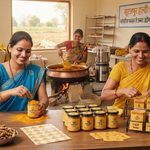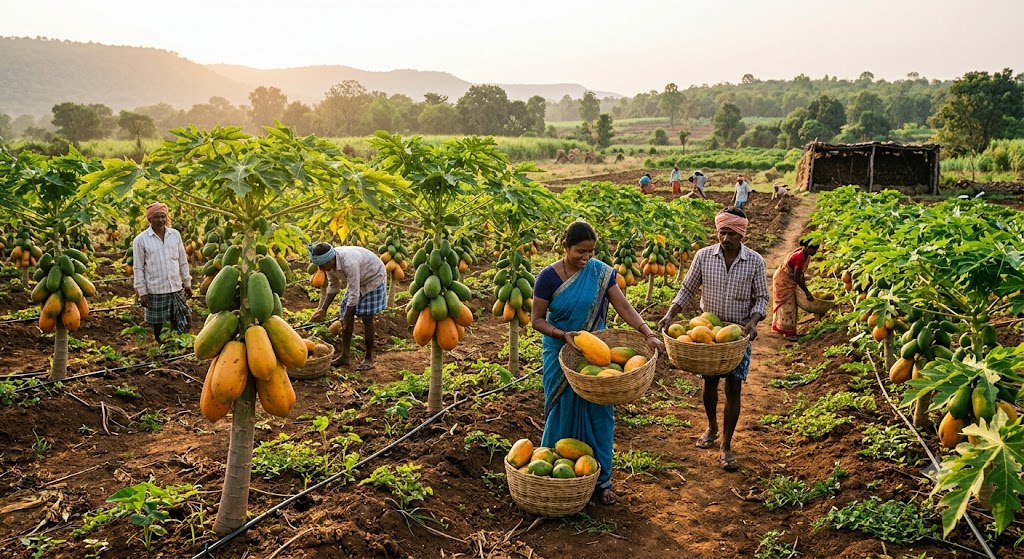

Bemetara Papaya Products show how locally grown papaya in Chhattisgarh can be transformed into useful and market-ready value-added foods. In Chhattisgarh farming is strongly linked to the life of people in villages. The crops grown in the state don’t have to stay in their form. With processing, wrapping and making new products farm goods can become ingredients, snacks, drinks, pickles and other things that add more value.
One example is Bemetara. There products made from papaya have been chosen under the One District One Product (ODOP) plan. The new list from the Ministry of Food Processing Industries says Bemetara has papaya-based products for Chhattisgarh.
This is a chance because papaya is a very flexible fruit. A fresh papaya can be eaten directly. It can also be turned into juice, jam, jelly, syrup, dried fruit, fruit mixtures and other things. Even parts that people usually throw away during processing can be used for purposes.
The story is not about growing papaya.
It is about what happens after the fruit is picked.
Papaya → Sorting → Washing → Peeling → Cutting → Making pulp or drying → Processing → Wrapping → Food with added value
This process can bring farmers with people who process food, business owners and people who buy food. It can also create chances around a product that is important to the local area.
Why Papaya-Based Products Matter in Bemetara
The economy of Bemetara is much linked to farming. The local government says farming is the part of the districts economy.. They also say the area has had problems with droughts.
Under the ODOP plan Bemetaras link with papaya-based products gives a path for making food.
The idea of ODOP is not just to name a district on a product. The PMFME scheme says ODOP is a way to make things more efficient when buying, using services and selling. It also helps build a way to work together and make better support for the whole process.
For Bemetara this means the value of papaya can go beyond just selling it as fruit.
A farmer can sell papaya.
A person who processes food can make pulp from papaya.
Another company can use the pulp to make jam or syrup.
A food company can create papaya or fruit snacks.
A local brand can wrap these products for selling in shops.
The same farming product can then help different parts of the economy.
From Papaya Tree to Processing Place
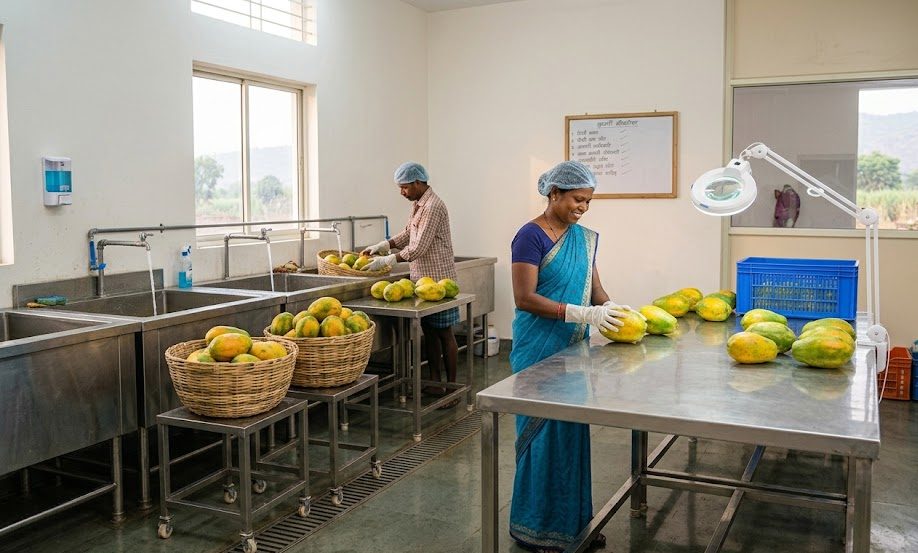
Every product made from papaya starts with the fruit itself.
Papayas are picked when they are ready, for their purpose. The right time to pick can change depending on whether the fruit will be sold as fresh made into pulp, dried or used for something
After picking the fruits need to be handled with care.
Papaya is a fruit. If it is handled roughly it can get bruises. That can change how it looks and how good it is.
This makes the steps of collecting, moving and organizing the fruit very important in the whole process.
Step 1: Harvesting and Collection
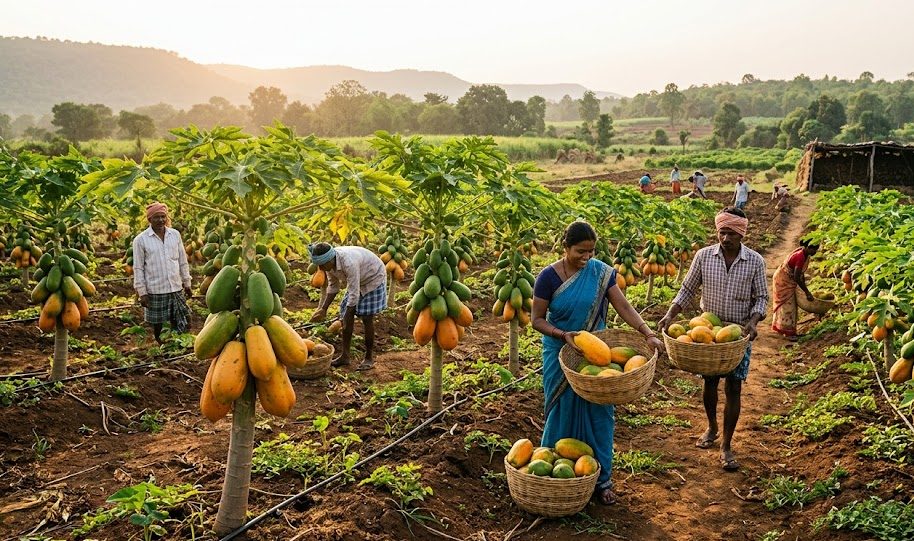
The first step in making quality papaya-based foods is choosing the fruit.
Farmers pick papayas based on how ripe they’re what kind of food they will be used for.
For eating raw the fruit might need to be a level of ripeness than the fruit used for making other things.
After picking the papayas are. Taken to a place where they will be processed or stored.
At this point it is important to handle the fruit because damaged papayas can go bad quickly.
For the people who process the fruit the goal is to get quality raw material that can be turned into a final product.
This is where the process starts moving from growing the fruit on the farm to making food from it.
Step 2: Sorting and Grading
When the papayas arrive at the processing area they are sorted.
The fruit can be separated based on:
- Size
- Ripeness
- Color
- condition
- Any bruising or damage
What kind of product it will be used for
Sorting might look like a simple step but it can have a big effect on how consistent the final product is.
For example a company making papaya pulp needs fruit that’s the right ripeness and quality. A company making dried papaya might choose fruit based on features.
Grading helps the processor decide where each papaya should go in the production process.
Of treating every papaya the same way the processor can send different groups of papayas to the best possible use.
Step 3: Washing and Preparing the Fruit
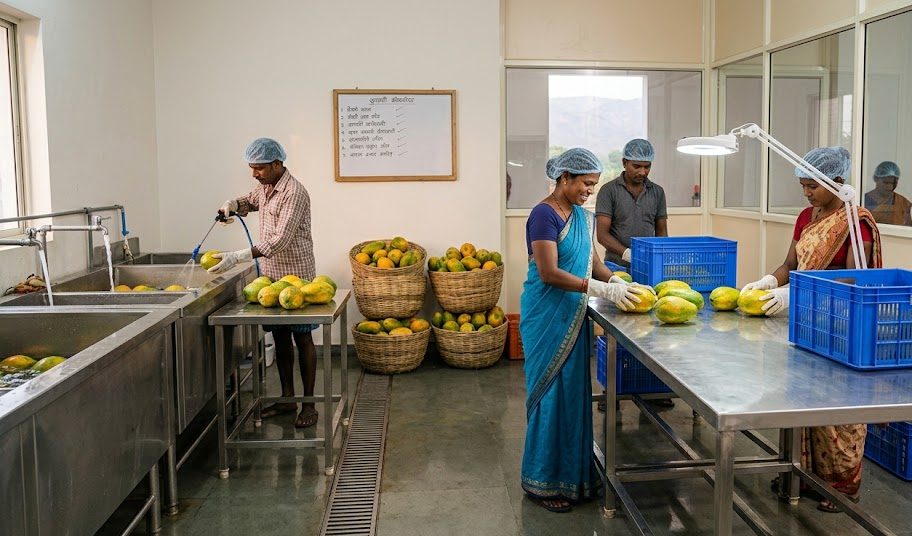
Before the papayas are processed they need to be cleaned
Washing helps get rid of dirt and things on the surface that the fruit picked up during growing, picking and moving.
After washing the fruit is ready for the step, in processing.
Depending on what the product’s this might include:
Washing → Peeling → Cutting → Removing seeds → Making into pulp
For a pulp product the fruit might be peeled and cut before being turned into a smooth pulp.
For dried papaya the fruit can be cut into pieces before being dried in a controlled way.
For jam the prepared fruit can go through pulping and then cooking.
The exact steps depend on what kind of product’s being made.
Step 4: Turning Fresh Papaya into Pulp
Converting papaya into pulp is one of the most useful transformations in fruit processing.
Pulp gives a base for many products.
After washing, peeling and deseeding suitable papaya pieces can be processed mechanically to create a pulp.
The pulp can then be used immediately. Processed further depending on the product.
This is a stage because it changes the physical form of papaya.Of a whole fresh fruit that has a limited shelf life the processor now has an ingredient that can become part of a larger food product.
The pulp can become the foundation for products such as:
- Papaya jam
- Papaya squash
- Fruit beverages
- Papaya‑based desserts
- Fruit spreads
- processed food preparations
The Ministry of Food Processing Industries PMFME material itself provides examples of papaya value‑added products, including papaya jam and papaya squash.
Step 5: Making Papaya Jam
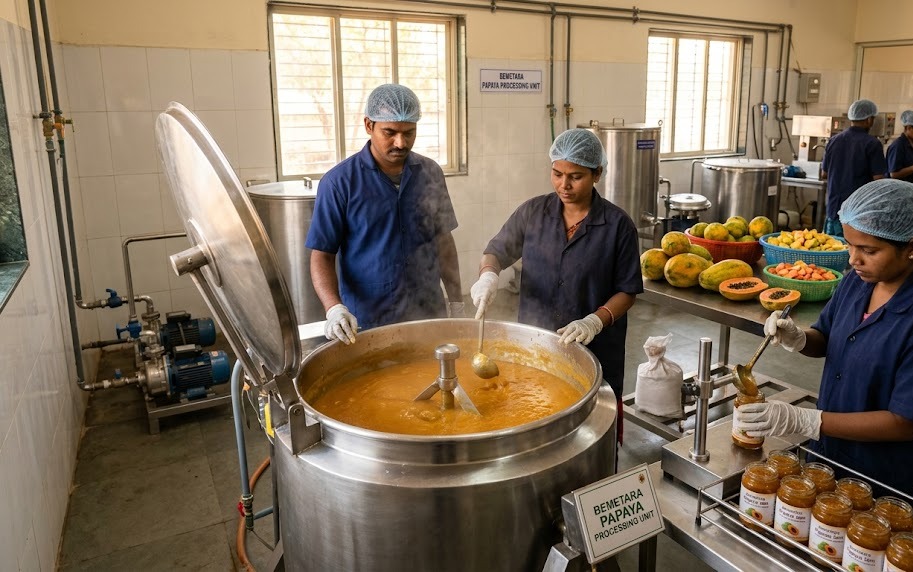
Papaya jam is one of the examples of how a fresh papaya can be transformed into a longer‑lasting processed food.
The basic concept involves preparing papaya pulp and combining it with ingredients such as sugar and an appropriate acidifying agent followed by controlled cooking.
As the mixture is heated, its changes.
The goal is to develop the consistency of jam while keeping an appealing papaya flavour and colour.
The exact formulation and processing conditions depend on the product, recipe and food‑safety requirements.
Once the desired consistency is achieved the product can be filled into food‑grade containers under controlled hygienic conditions.
The result is no longer a papaya.
It is a packaged value‑added food product, with a different market format.
Step 6: Papaya Squash and Fruit-Based Beverages
I notice that Papaya can also be turned into drink products, which’s exciting.
The Ministry of Food Processing Industries papaya processing material includes papaya squash as a value-added product.
In the process the first step is to work with Papaya pulp.
Then the Papaya pulp is mixed with ingredients according to the formulation and after that the mixture goes through controlled processing and packaging.
Unlike a fresh Papaya, a processed beverage product can be portioned, packaged and marketed in a convenient format.
This creates another route for value addition.
The key is that Papayas natural characteristics become part of a consumer experience.
Of eating Papaya directly consumers can purchase it as a prepared fruit-based product.
For processors this diversification can be valuable because different products can target different markets.
Step 7: Drying Papaya for a Kind of Product
Fresh Papaya has a relatively short shelf life compared with many processed products.
Drying offers another way of changing the fruits characteristics.
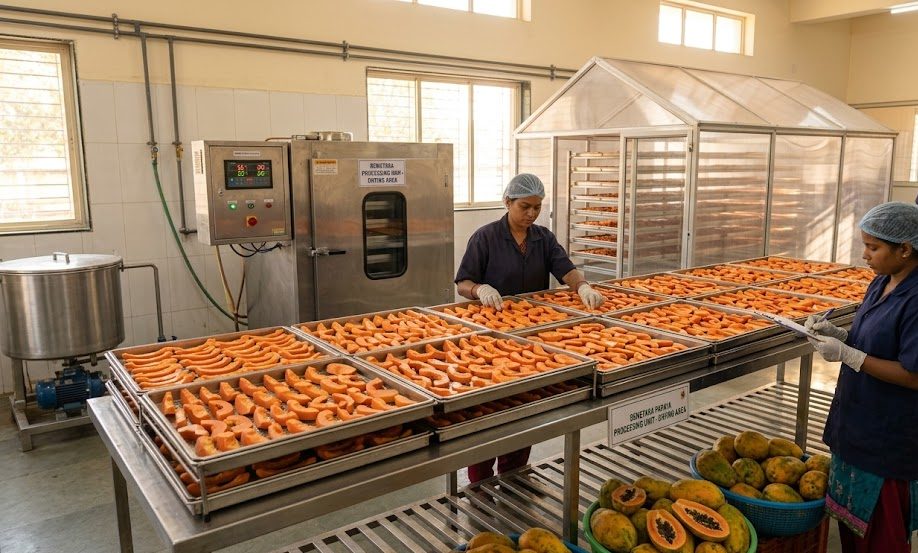
During controlled drying moisture is removed from fruit pieces.
This reduces the water content. Creates a product with a different texture and storage profile.
Solar drying can also be explored as a processing approach where suitable systems and hygienic conditionsre available.
The PMFMEs technical material discusses drying of papaya flesh and seeds as one possible valorisation approach and notes the potential for producing dried fruit ingredients.
The important point is that drying is not, about leaving fruit in the sun.
Commercial food processing requires temperature, hygiene, moisture control and packaging to maintain product quality.
Papaya Is More Than Just the Flesh
One of the interesting things about papaya processing is how much of the fruit you can actually use.
When people do papaya processing they often throw away things like the seeds and the peels.
Food researchers are looking for ways to get more value out of papaya by-products.
The PMFMEs papaya-focused material says that papaya seeds and peels have parts in them and the material discusses ways to make use of papaya processing waste.
This gives an idea for future food businesses:
Waste can sometimes become a resource.
You cannot just use every by-product for food right away. Every single commercial use must be checked for safety, rules, how to process it and if people will actually want to eat it.
The main point is still very important: papaya processors should look for ways to make waste and get the most value possible from papaya.
From Fruit to Multiple Products
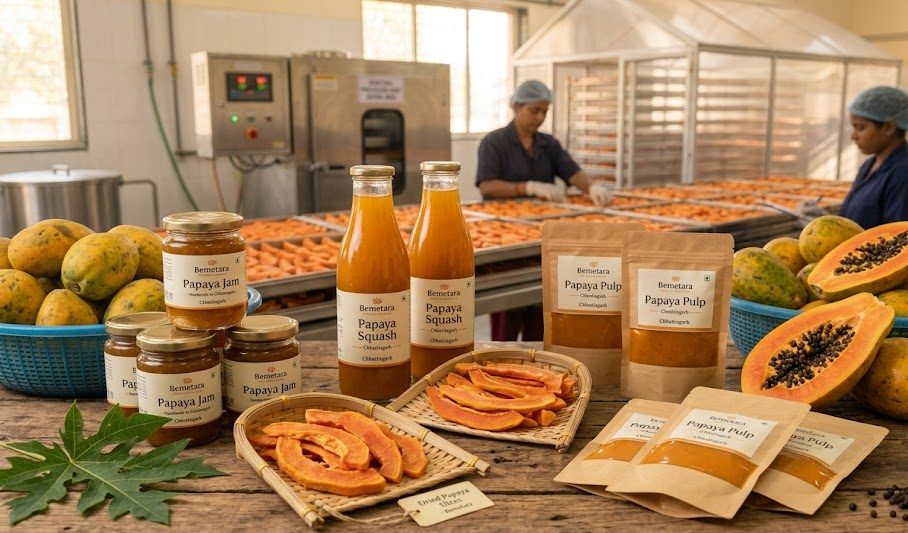
The part about papaya-based processing is that you can make many different things.
One single fruit can help make types of products.
For example:
- Fresh Papaya → Pulp → Jam
- Fresh Papaya → Pulp → Squash
- Fresh Papaya → Slices → Dried Fruit
- Papaya → Processed Ingredient → Food Preparations
This means a business does not have to rely on one finished product.
If a local business has the tools and knows the market that business can make a whole collection of papaya-based products.
Doing this can help build an identity for products, from Bemetara.
Old Ways of Farming Meet New Ways of Making Food
Making products from papaya does not mean we are getting rid of farming ways.
Instead it just adds something to what farmers already do.
Farmers will keep growing the fruit.
People who process food will turn the fruit into things.
Business owners will work on making brands and packaging.
Shop owners will bring these products to people.
This creates a chain where everyone uses their own skills to make a final product.
The big change is how we look at things. We should not just see papaya as a fruit. We should see papaya as a resource for making food.
Looking at it this way can lead to new and exciting ideas.
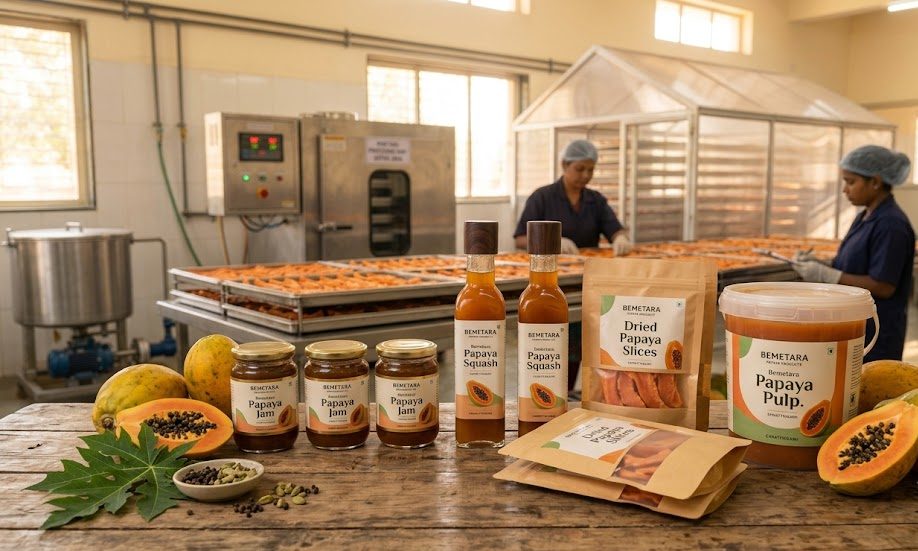
Packaging: Giving Bemetara Papaya Products an Identity
Once the food is made the packaging becomes a big part of the process.
A good package must keep the food safe. Tell people what they need to know.
For a food product made from papaya the packaging can show:
- Product name
- Ingredients
- Net quantity
- Batch information
- Manufacturer/processor details
- Storage instructions
- food-safety information
- Date-related information as required
- Brand identity
- But packaging can do even more than that.
- Packaging can tell a story about a place.
A brand can use its name, colors and pictures of farms to show that the product comes from Bemetara and Chhattisgarh.
This helps turn a food item into something that feels special to its home region.
New Chances for Local Food Businesses
Adding value to food is great because it creates jobs outside of the farm.
A local person could start an unit to process papaya.
A group of women could work together to make fruit products.
A group of producers could gather papaya from different farmers.
A small food business could focus on making jam or squash.
A processor could focus on making dried fruit.
Even businesses that make packaging and brands can help.
This creates a chain:
Farmer → Collection → Processing → Product Development → Packaging → Branding → Distribution → Consumer
Every single step can create new ways to make money.
This is a reason why food processing is so important for farming areas.
The more steps we can build safely and well the local businesses can grow.
Why Adding Value Matters for Chhattisgarh
The food economy in Chhattisgarh is tied closely to farming.
Different areas are known for things—like rice, ginger or papaya. Now the PMFME ODOP list says Bemetara is the place for papaya based products.
Focusing on an area helps local crops stand out in the market.
For Bemetara papaya is a way to show how one fruit can go through many stages of making food.
The lesson for all of Chhattisgarh is simple:
crop + local processing + local business + strong branding = more value.
The Future of Bemetara Papaya Products
The future for papaya processing can be much bigger than jam and squash.
As people change what they like to eat makers can try things.
Ready-to-Use Ingredients
Papaya pulp can be sold as an ingredient for food businesses.
Dried Fruit
Dried papaya is a choice for people who want a quick and easy snack.
Fruit Spreads
People can put papaya into spreads and preserves.
Beverage Products
Drinks made from papaya can open up a new market.
Traditional and Modern Snacks
Processed papaya could even be used to make kinds of snacks.
Institutional Markets
Bakeries and big kitchens can use processed fruit to make their food.
What a business makes depends on what people want and what they can afford to do.
But it all starts with one thought:
Papaya does not have to be sold only as a fresh fruit.
Building a Stronger Papaya Value Chain
For Bemetara the goal is not just to make papaya-based products.
The real goal is to build a chain where everything is connected.
Farmers need tools and ways to grow crops.
People who collect and process fruit need ways to handle it.
Food businesses need a supply of raw fruit.
Processing units need the machines and clean spaces.
Business owners need help with packaging, brands. Knowing the market.
Customers need food that’s safe, good and looks nice.
When all these parts work together a local crop can become a way to support a whole community.
image6
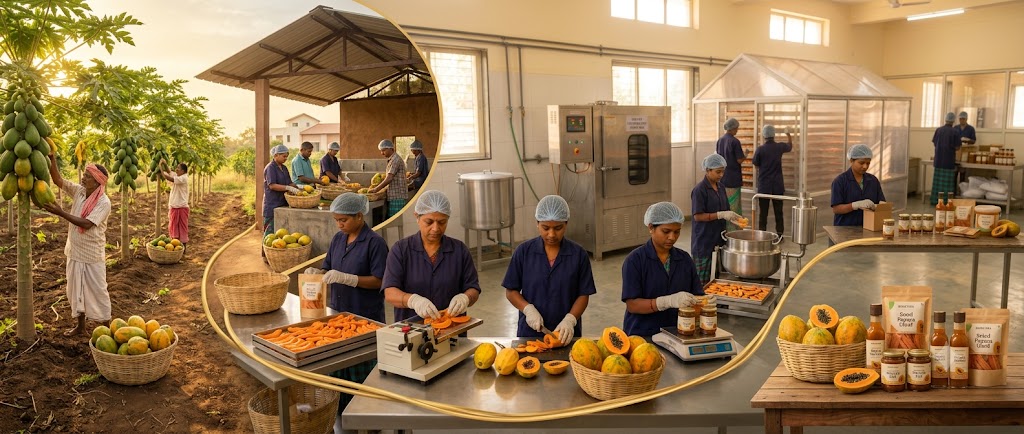
From Bemetaras Fields to the Consumer
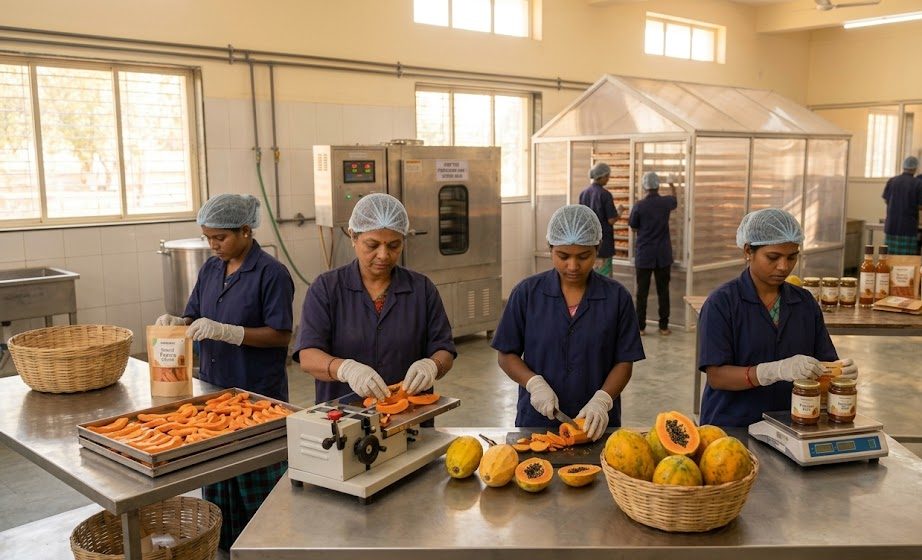
We can see the whole journey now.
A papaya grows in a field, in Bemetara, Chhattisgarh.
It is picked at the time.
The fruit is. Moved.
It is sorted to find the ones.
The best fruit is washed clean.
It is peeled, cut and prepared.
Then the fruit goes on paths.
Some becomes pulp.
Some becomes jam.
Some becomes squash.
Some gets dried.
Finally the finished products are packed, labeled and sent to the market.
This is the story of adding value to a crop.
Conclusion
The story of Bemetara Papaya Products is a story of transformation.
The journey starts with a papaya grown in Chhattisgarh. It then moves through a series of managed stages—harvesting, sorting, washing, preparation, pulping, cooking, drying, packaging and branding.
The result can be more than fresh fruit.
Papaya can become jam. Papaya can become squash. Papaya can become fruit. Papaya can become a processed ingredient.. With product development and appropriate food‑processing systems Papaya can become part of a much wider range of value‑added foods.
Bemetara’s identification with Papaya Based Products under the ODOP framework places this resource clearly within Chhattisgarh’s food‑processing ecosystem.
The real opportunity lies in connecting the parts of the chain: farmers, processors, entrepreneurs, packaging businesses, marketers and consumers.
When local agricultural produce is processed locally and given a product identity more value can potentially remain within the regional economy.
That is what makes papaya important in Bemetara.
Papaya is not a fruit coming from the field—it is a starting point for value‑added food products, local enterprise and a stronger food‑processing story for Chhattisgarh.
Frequently Asked Questions
1. What is Bemetaras ODOP product?
Bemetara is identified with Papaya Based Products under the PMFME One District One Product framework.
2. Why is papaya suitable for value addition?
Papaya can be processed into pulp. Then used to make different products such as jam, squash, dried fruit and other food preparations.
3. What are some papaya-based products?
Examples include papaya jam, papaya squash, dried papaya and papaya pulp‑based products. PMFMEs own papaya‑processing material specifically includes jam and squash.
4. How is papaya prepared for processing?
Generally suitable fruit is selected, sorted, washed and then peeled, cut and deseeded before being processed according to the product.
5. Can papaya be dried?
Yes. Controlled drying can be used to produce dried papaya products. PMFME material also discusses drying as a possible papaya valorisation technique.
6. Why is packaging important?
Packaging helps protect processed food communicate product information and create a brand identity.
7. How can papaya processing help Bemetara?
Processing can create activities beyond farming, including collection, food manufacturing, packaging, branding and distribution.
8. How does ODOP relate to Bemetara?
The ODOP approach is intended to support value‑chain development, common services and marketing, around district‑level products. Bemetaras identified product is papaya‑based products.