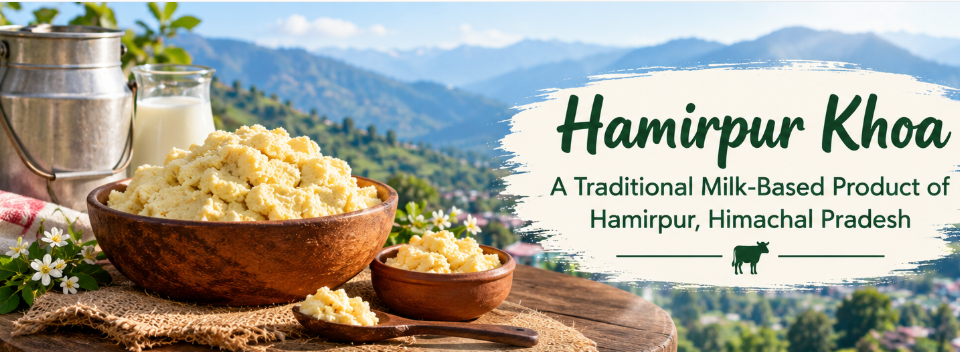

When we think about Himachal Pradesh, beautiful mountains, apple orchards, traditional handicrafts and peaceful villages usually come to mind. But the state also has a rich food culture that is closely connected with farming and dairy activities. Among the many local food products associated with Himachal Pradesh, Khoa, also known as Khoya, is an important traditional milk-based product.
Hamirpur district has a strong connection with dairy activities, and the One District One Product (ODOP) initiative under the PMFME scheme identifies Milk Based Products as the ODOP category for Hamirpur. Khoa is one of the traditional milk products that falls within this broader category.
Made by slowly reducing milk until most of its water evaporates, khoa has a thick, soft and slightly creamy texture. It is widely used in Indian sweets and traditional desserts. More importantly, products such as khoa show how ordinary agricultural resources can be converted into higher-value food products.
In this article, let us explore Hamirpur Khoa, how it is made, why milk-based products are important for the district, its role in local livelihoods, and how such traditional products can find new opportunities through modern branding and marketing.
What Is Hamirpur Khoa?
Khoa, or khoya, is a concentrated milk product prepared by heating milk slowly until much of its moisture is removed. As the milk thickens, its volume reduces and it develops a rich, creamy consistency.
Traditionally, khoa is prepared in a large heavy-bottomed pan or karahi. Fresh milk is heated and continuously stirred so that it does not stick to the bottom. The process requires patience because the milk needs to be reduced gradually rather than cooked at very high heat.
The final product is thick and can be used as an ingredient in several Indian sweets such as peda, gulab jamun, barfi and various regional mithais.
For Hamirpur, khoa is particularly interesting from a local-product perspective because the district’s official ODOP category is Milk Based Products. Therefore, it can be discussed as a traditional and value-added milk product connected with Hamirpur’s dairy economy rather than being described as the district’s individual official ODOP product.
Why Is Hamirpur Known for Milk-Based Products?

Dairy farming is an important part of rural livelihoods in Himachal Pradesh. Milk collected from village-level dairy networks can be processed into several products, allowing milk producers and food-processing enterprises to create more value from their raw material.
The Himachal Pradesh Economic Survey describes a network of milk producers’ cooperative societies and dairy-processing infrastructure across the state. It also records a Milkfed processing plant at Jangal Beri in Hamirpur with a capacity of 5,000 litres per day in the 2023–24 survey.
H.P. Milkfed markets several products under the “Him” brand, including milk powder, ghee, butter, dahi, paneer, flavoured milk and khoa. This provides an example of how milk can be processed into products with a longer or more convenient commercial use than fresh milk alone.
This background makes Hamirpur an interesting district when discussing traditional and value-added dairy products.
How Is Khoa Traditionally Made?

The basic process of making khoa is simple, but it requires time and attention.
1. Fresh Milk Is Collected
The process begins with fresh milk. Traditionally, dairy farmers collect milk from their cattle and buffaloes and supply it for household consumption or through dairy collection systems.
The quality of the milk is important because it directly affects the taste, texture and yield of the final khoa.
2. Milk Is Heated Slowly
The milk is poured into a large, wide vessel and heated. Slow heating is important because khoa is not produced simply by boiling milk quickly.
As the milk heats, water gradually evaporates.
3. Continuous Stirring
The milk needs regular stirring and scraping. As it becomes thicker, it can easily stick to the bottom of the vessel.
This stage requires patience and experience. A skilled maker knows when to increase or reduce the heat and when the milk has reached the right consistency.
4. Milk Becomes Thick
As water evaporates, the milk gradually changes from a liquid into a thick mass.
The colour may become slightly creamy, depending on the milk and cooking method. The final texture can range from soft and moist to firmer varieties.
5. Cooling and Storage
Once the desired consistency is achieved, the khoa is removed from the heat and allowed to cool.
After cooling, it can be used directly for making sweets or packed for sale, depending on the processing and food-safety requirements.
The basic science behind khoa is therefore quite simple: remove much of the water from milk while concentrating its milk solids. The traditional process, however, requires care and experience.
The Taste and Texture of Khoa
Good-quality khoa has a rich dairy flavour with a mildly sweet and creamy taste. It is not necessarily very sweet by itself because sugar is generally added later when khoa is used to prepare sweets.
Its texture is one of its most noticeable features. Fresh khoa can be soft, smooth and slightly grainy depending on the preparation method.
This makes it useful as a base ingredient for traditional Indian sweets.
For someone tasting freshly prepared khoa, the experience can be very different from eating a finished sweet. Instead of being dominated by sugar or flavourings, the natural richness of milk becomes the main feature.
Khoa and Traditional Indian Sweets
One of the biggest reasons khoa is valuable is its versatility.
It is used in many popular Indian sweets and desserts. Some examples include:
- Peda
- Barfi
- Gulab Jamun
- Kalakand-style sweets
- Milk-based ladoos
- Stuffed sweets
- Various regional mithais
During festivals and family celebrations, milk-based sweets have an important place in Indian food culture.
Khoa therefore connects dairy farming with the traditional Indian sweets industry. Milk that begins as a basic agricultural product can eventually become part of a festive food product with much greater value.
Economic Importance of Milk-Based Products in Hamirpur
Milk-based products can create opportunities at several stages of the local economy.
First, dairy farmers can earn income by selling milk. Then, collection centres and cooperatives can help move milk into organised processing systems. Finally, processors, sweet makers, retailers and food businesses can convert milk into products such as khoa, paneer, ghee and sweets.
This creates a chain of economic activity.
The Himachal Pradesh Economic Survey has documented dairy cooperative networks and Milkfed processing infrastructure in the state. Earlier surveys also recorded the development of a 5,000-litre-per-day processing plant at Jangal Beri in Hamirpur.
For a district like Hamirpur, strengthening value-added milk products can therefore provide opportunities beyond simply selling raw milk.
Supporting Local Farmers
A major advantage of value-added dairy products is that they can increase the possibilities available to milk producers.
Selling fresh milk provides regular income, but processing milk into products can open additional markets.
For example, milk may be converted into:
- Khoa
- Paneer
- Ghee
- Dahi
- Butter
- Milk powder
- Flavoured milk
- Traditional sweets
H.P. Milkfed’s product range demonstrates the variety of products that can be developed from milk.
At the village level, better collection, testing, chilling, processing and packaging systems can help improve the overall dairy value chain.
Role of Women in Dairy Activities
Dairy farming is often closely connected with household-level work in rural areas. Feeding animals, maintaining cattle, collecting milk and managing dairy-related activities can involve considerable participation from women.
Organised dairy systems can create opportunities for women to become more economically active.
The Himachal Pradesh Economic Survey has reported women dairy cooperatives within the state’s Milkfed network. For example, the 2020–21 Economic Survey reported 215 women dairy cooperatives among the Milkfed cooperative network at that time.
This highlights an important point: milk-based local products are not only about food. They can also be connected with rural employment, cooperative activity and household income.
From Traditional Khoa to Modern Packaging
Traditionally, khoa was mainly prepared for immediate use or for making sweets. Today, food businesses have more opportunities to package and market traditional products.
Good packaging can make a local product more suitable for modern consumers.
For example, a packaged Hamirpur Khoa product could focus on:
- Hygienic production
- Clear ingredient information
- Manufacturing and expiry dates
- Proper food-grade packaging
- Storage instructions
- Attractive local branding
- Appropriate food-safety compliance
- Easy-to-understand product information
The goal should not be to change the traditional identity of khoa completely. Instead, modern packaging can help present the traditional product in a way that today’s consumers can trust.
Branding Hamirpur Khoa as a Local Product
Local food products often have a story behind them. Khoa has a particularly strong connection with Indian food traditions, dairy farming and festive sweets.
A local brand could use Hamirpur’s identity to create a stronger connection with consumers.
For example, branding could highlight ideas such as:
“Traditional Dairy Heritage of Hamirpur”
or
“Made from Milk, Inspired by Himachal”
However, branding should always be supported by accurate product information. A business should not claim that a product is made in Hamirpur unless that is actually true.
This is especially important for local-product marketing because consumers increasingly want to know where their food comes from.
Opportunities Through Digital Marketing
Traditional products such as khoa can also benefit from digital marketing.
A small food business in Hamirpur could use Instagram, Facebook, Google Business Profile and its own website to tell the story of its products.
Content ideas could include:
- Short videos showing how khoa is prepared
- Stories about local dairy farmers
- Behind-the-scenes processing videos
- Traditional Himachali sweet recipes
- Festival-related khoa recipes
- Product packaging videos
- Customer reviews
- Local food photography
Search-engine optimisation can also help.
A website could target keywords such as “Hamirpur Khoa,” “Khoa in Hamirpur,” “milk based products of Hamirpur,” “Hamirpur dairy products,” and “traditional milk products of Himachal Pradesh.”
This can help people searching online discover local businesses and products.
Tourism and Hamirpur’s Food Identity
Himachal Pradesh attracts visitors throughout the year, and food is an important part of the travel experience.
Tourists often look for products that feel connected to the place they are visiting. A well-packaged local dairy product or a traditional sweet made using khoa could become part of this experience.
Instead of selling only a product, local businesses can tell a story about:
- Hamirpur’s villages
- Dairy farming
- Traditional food habits
- Local processing
- Himachal’s culinary culture
This type of storytelling can make a simple food product more memorable.
Challenges in Khoa Production

Despite its potential, traditional milk-based products also face several challenges.
Short Shelf Life
Fresh khoa contains considerable moisture and can spoil if it is not handled and stored properly. Maintaining the correct temperature and hygiene is therefore important.
Quality Control
The quality of khoa depends heavily on the quality of milk and the production process. Consistency becomes especially important when a product is sold commercially.
Packaging
Traditional products need packaging that protects them from contamination and helps maintain quality during transportation.
Competition
Consumers have access to many branded dairy and sweet products. Local businesses therefore need to compete through quality, freshness, trust and a strong local identity.
Modernisation Without Losing Tradition
One of the biggest challenges is finding the right balance between traditional preparation and modern food-processing practices.
The solution is not necessarily to replace traditional methods completely. Instead, businesses can improve hygiene, quality control, packaging and marketing while preserving the character of the product.
Future Potential of Hamirpur Khoa
The future of Hamirpur’s milk-based products depends on how effectively traditional dairy knowledge can be combined with modern business practices.
The PMFME scheme uses the ODOP approach to support value-chain development, common infrastructure, capacity building, branding and marketing for micro food-processing enterprises. It also provides support mechanisms for eligible groups and enterprises involved in food processing.
This creates possibilities for local entrepreneurs to develop better dairy products, improve packaging and explore wider markets.
Khoa could also become part of a larger product range rather than being sold alone. For example, entrepreneurs could develop traditional sweets, festive gift boxes and other dairy-based products using khoa as an ingredient.
With proper quality standards and branding, local milk-based products can move beyond local markets and reach consumers in nearby cities as well.
Why Hamirpur Khoa Matters
At first glance, khoa may appear to be a simple dairy product. But when we look more closely, it represents something much bigger.
It connects farmers, milk collection systems, processing facilities, traditional food knowledge, sweet makers, retailers and consumers.
Hamirpur’s identification under the PMFME ODOP framework for Milk Based Products gives the district an opportunity to strengthen this value chain.
Khoa is one example of how milk can be transformed into a traditional, useful and commercially valuable product.
Conclusion
Hamirpur Khoa is a traditional milk-based product that represents the connection between dairy farming, food traditions and local economic opportunities in Himachal Pradesh.
Although Khoa itself should not be described as Hamirpur’s individual official ODOP product—the official category is Milk Based Products—it fits naturally within the district’s broader milk-processing identity.
From slowly reducing fresh milk to using khoa in traditional sweets, the product carries a strong connection with Indian food culture. With better hygiene, packaging, branding and digital marketing, traditional dairy products can become more accessible to modern consumers while retaining their local character.
For Hamirpur, the opportunity lies in turning its milk-based-product identity into a stronger local food economy—one where farmers, small processors, women-led cooperatives and food entrepreneurs can all participate.
In the end, Hamirpur Khoa is more than just concentrated milk. It is an example of how a simple local resource can become a valuable traditional food product when knowledge, processing and entrepreneurship come together.
Frequently Asked Questions (FAQs)
1. What is Hamirpur Khoa?
Hamirpur Khoa refers to khoa or khoya discussed as a traditional milk-based product associated with Hamirpur’s broader milk-based-product ecosystem. Khoa is made by slowly reducing milk until much of its water evaporates.
2. What is the ODOP product of Hamirpur?
Under the Government of India’s PMFME ODOP list, Hamirpur’s ODOP category is Milk Based Products. Khoa is one of the milk products that falls within this broader category.
3. How is Khoa made?
Khoa is traditionally prepared by heating milk slowly and continuously stirring it until most of the moisture evaporates and the milk solids become thick and concentrated.
4. What is Khoa used for?
Khoa is commonly used to prepare Indian sweets such as peda, barfi, gulab jamun and other traditional milk-based desserts.
5. Why are milk-based products important for Hamirpur?
Milk-based products provide opportunities for value addition to milk and can support dairy farmers, processors, cooperatives, sweet makers and local food businesses.
6. Is Khoa the official ODOP product of Hamirpur?
Not exactly. The official ODOP listing identifies Milk Based Products as Hamirpur’s ODOP category. Khoa is one of the products within this broader category.