
Handwoven Paithani Sarees Maharashtra: A Complete Buyer’s Guide
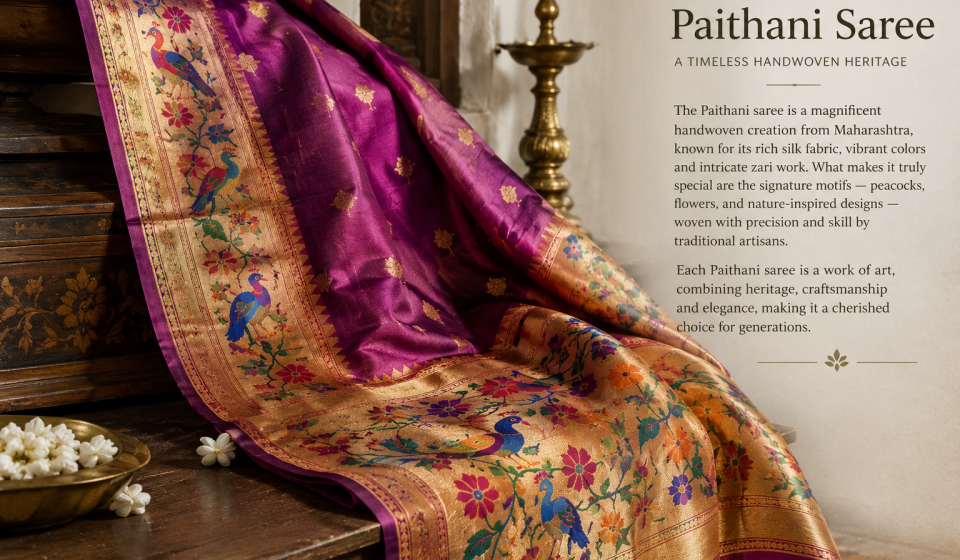
Few sarees carry as much history as a Paithani. Weavers spend months, sometimes years, on a single piece. Yet many buyers can’t tell a genuine silk-and-zari Paithani from a power-loom copy. If you want to buy one, gift one, or simply understand the craft, this guide helps. Here you’ll learn what handwoven Paithani sarees Maharashtra is known for, how they are made, what they cost, and how to spot the real thing.
Introduction
India is famous for its beautiful traditional clothing, and Paithani sarees hold a special place in its rich textile heritage. Known for their colorful designs, detailed weaving, and luxurious silk, these sarees represent the artistic skills of Maharashtra’s weavers. Handwoven Paithani Sarees Maharashtra is a popular search for people who want to explore authentic Indian craftsmanship and traditional ethnic wear.
Paithani sarees are more than beautiful garments. They reflect generations of weaving knowledge, cultural traditions, and the creativity of skilled artisans. Their bright colors, peacock motifs, and rich borders make them a popular choice for weddings, festivals, and family celebrations.
However, choosing an authentic Paithani saree can be challenging. Buyers often struggle to understand the difference between handwoven and machine-made designs, identify quality silk, and select a saree that suits their budget.
This guide explains the history, weaving process, key features, benefits, and buying tips for Paithani sarees. It will also help you understand how to care for these traditional garments and make an informed purchase.
What Are Handwoven Paithani Sarees Maharashtra Is Famous For?
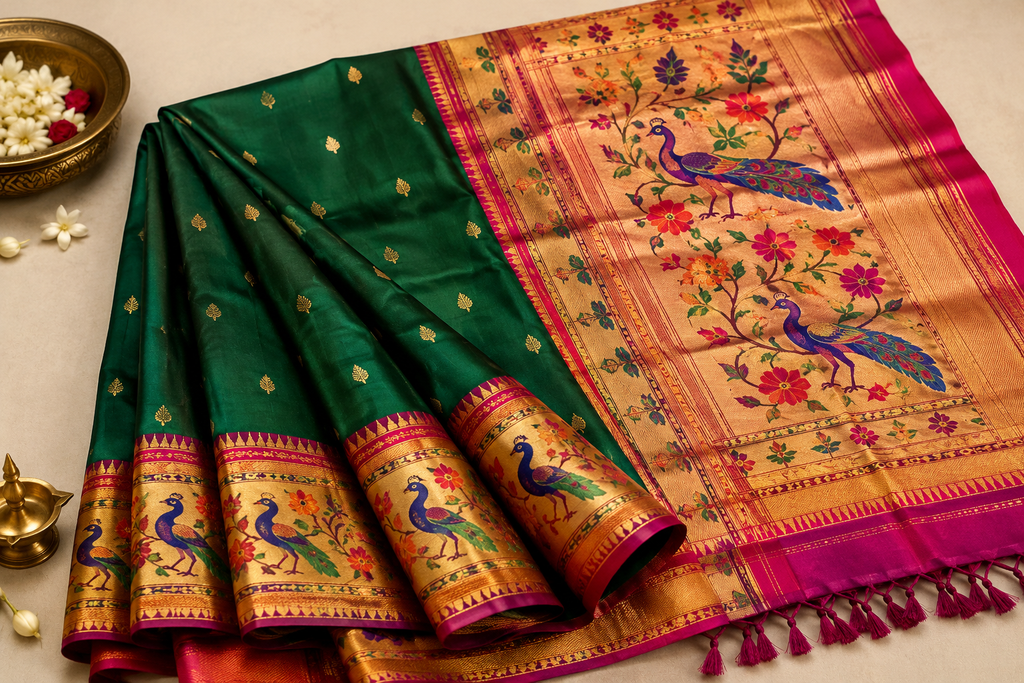
Quick Definition: Handwoven Paithani sarees are silk sarees made on handlooms in Maharashtra, mainly in Paithan and Yeola. Weavers use the tapestry-style kadiyal technique to interlock gold or silver zari motifs into pure silk. The result looks identical on both sides, and one saree can take months to finish.
Detailed Explanation
The saree takes its name from Paithan, an ancient town near Chhatrapati Sambhajinagar (formerly Aurangabad). Historians link the craft to the Satavahana period, when Paithan traded fine textiles with Rome. Under the Peshwas, Paithani weaving flourished again. Royal families of Maharashtra wore it for weddings and festivals.
Today, Paithan and Yeola, near Nashik, are the two main weaving centres. The craft holds a Geographical Indication (GI) tag, which protects its regional identity.
Key Components
- Silk: Pure mulberry silk forms the base. Weavers often source it from Karnataka.
- Zari: Real Paithanis use gold- or silver-coated thread. Imitations use plastic-coated metallic yarn.
- Kadiyal technique: Each motif is woven with its own small shuttle, not carried across the whole width.
- Border (kinar): Wide, ornate borders are a signature of the saree.
- Pallu: The end piece usually carries the richest design, such as a peacock or a lotus.
Why Are Handwoven Paithani Sarees Important?
Direct Answer: Paithani sarees matter because they preserve a 2,000-year-old textile tradition, support thousands of artisan families, and hold lasting value as heirlooms. They are also central to Maharashtrian weddings, where brides traditionally wear them as a symbol of heritage and auspiousness.
Cultural value: A Paithani is part of Maharashtrian identity. Many families pass one down through generations.
Economic value: Handloom weaving supports entire clusters in Paithan and Yeola. Each genuine purchase sustains a skilled artisan.
Investment value: Pure zari holds intrinsic worth, and well-kept Paithanis often keep their value or appreciate.
Current relevance: Interest in slow fashion and heritage textiles is growing. Many younger buyers now choose one authentic piece over several fast-fashion ones.
How Does Paithani Weaving Work?
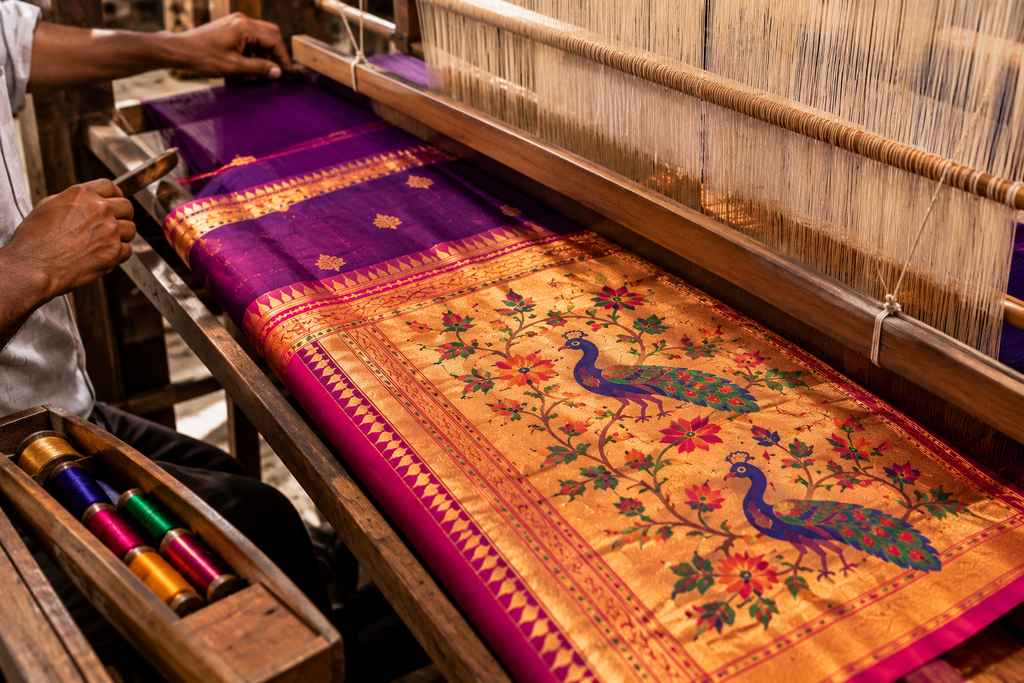
Direct Answer: Paithani weaving happens in three stages. Artisans first prepare silk and zari yarn and set up the loom. Next, they weave the body and border using the kadiyal method, adding each motif by hand. Finally, they finish, inspect, and wash the saree. A single saree can take six months to two years.
Step 1: Design and setup. The master weaver plans the border, body, and pallu on graph paper. Silk warp threads are dyed and stretched across the loom.
Step 2: Weaving with kadiyal. Two weavers often sit side by side. For each motif, they pass small bobbins of zari or coloured silk through the warp. They do this one motif at a time, so no loose threads show on the back.
Step 3: Finishing. The saree is cut from the loom, checked for flaws, and lightly finished. Experienced buyers inspect the reverse side, which should look as neat as the front.
Example: A saree with a full peacock pallu and a Muniya (parrot) border may need two weavers working daily for over a year.
Benefits of Handwoven Paithani Sarees
- Heirloom quality
- What it is: Pure silk and real zari last for decades.
- Why it matters: The saree can be worn by several generations.
- Outcome: One purchase becomes a family asset.
- Reversible beauty
- What it is: The kadiyal technique makes both sides nearly identical.
- Why it matters: It is a quick sign of real handwork.
- Outcome: Easier authenticity checks.
- Cultural significance
- What it is: Motifs such as the peacock, lotus, and parrot carry symbolic meaning.
- Why it matters: The saree suits weddings and religious occasions.
- Outcome: You wear tradition, not just fabric.
- Artisan livelihood
- What it is: Buying handloom pays skilled weavers fairly.
- Why it matters: It keeps the craft alive.
- Outcome: Younger weavers continue the tradition.
- Resale value
- What it is: Genuine zari content gives lasting worth.
- Why it matters: Fakes lose value quickly.
- Outcome: A safer long-term purchase.
Challenges and Common Mistakes
1. Buying a power-loom copy as handwoven
- Problem: Machine-made sarees are sold at “handloom” prices.
- Cause: Real Paithanis are costly, which tempts sellers and buyers alike.
- Solution: Check the reverse side, ask for a handloom mark, and buy from trusted weavers or cooperatives.
2. Ignoring zari quality
- Problem: The saree tarnishes or feels stiff.
- Cause: Low-grade or plastic-coated zari.
- Solution: Ask for the zari type and request a written bill with details.
3. Poor storage
- Problem: Zari blackens and silk weakens at the folds.
- Cause: Humidity and folding in the same place for years.
- Solution: Store in muslin cloth and refold every few months.
4. Judging only by price
- Problem: Very cheap sarees are mislabelled, and expensive ones can be overpriced.
- Cause: Little buyer knowledge of the real cost of silk, zari, and labour.
- Solution: Compare weave time, zari weight, and motif density across sellers.
Best Practices and Expert Tips
- Flip the saree. A true kadiyal weave looks neat on both sides.
- Check the pallu first. It shows the weaver’s skill most clearly.
- Ask about weave time. Months of work should match the design’s complexity.
- Request the zari details. Reputable sellers explain the purity.
- Look for the GI tag. It signals origin from Paithan or Yeola.
- Buy direct when possible. Weaver cooperatives and trusted showrooms in Paithan and Yeola reduce middleman markups.
- Start with a classic. Muniya borders and Asawali (flowering vine) designs suit first-time buyers.
- Dry-clean only. Home washing can damage zari and dyes.
- Keep the bill. It supports insurance, resale, and authenticity claims.
- Air it out. Let the saree breathe in shade every few months.
Comparison Table: Paithani Types
| Feature | Handwoven Silk Paithani | Semi Paithani | Power-Loom Imitation |
|---|---|---|---|
| Base fabric | Pure silk | Silk blend or Tussar | Synthetic or art silk |
| Zari | Real gold/silver | Often real or blended | Imitation metallic |
| Weaving time | 6 months to 2 years | 1 to 2 months | Hours |
| Reverse side | Nearly identical | Slight float threads | Visible loose threads |
| Price (approx.) | ₹25,000 to several lakh | ₹8,000 to ₹25,000 | Under ₹5,000 |
| Resale value | High | Moderate | Very low |
Prices vary by design, zari weight, and seller.
Frequently Asked Questions
1. What makes a Paithani saree special?
Answer: A Paithani is special because it combines pure silk, real zari, and the kadiyal technique, which creates interlocked motifs with no loose threads. Each saree is handwoven in Maharashtra, takes months to finish, and carries designs like peacocks and lotuses with deep cultural meaning.
2. How can I identify an original Paithani saree?
Answer: Check the reverse side first. A genuine Paithani looks almost the same on both sides, with no loose floating threads. Also look for a clean pallu, soft silk, real zari, and a GI tag or handloom mark. A seller who explains weave time is a good sign.
3. What is the price of a handwoven Paithani saree?
Answer: Handwoven silk Paithanis usually start around ₹25,000 and can go beyond several lakh rupees. Price depends on design complexity, zari weight, silk grade, and weaving time. Semi Paithanis cost less, often between ₹8,000 and ₹25,000.
4. Where are Paithani sarees made in Maharashtra?
Answer: Paithani sarees are woven mainly in Paithan, near Chhatrapati Sambhajinagar, and in Yeola, near Nashik. Paithan is the original home of the craft, while Yeola has become a major production hub with many weaving families.
5. How long does it take to weave one Paithani?
Answer: A Paithani takes from about six months to over two years to weave. Time depends on the design, the number of weavers, and the density of zari motifs. Simpler sarees finish faster, while rich peacock pallus take the longest.
6. What are the popular Paithani motifs?
Answer: Popular motifs include the peacock (mor), parrot (popat or Muniya), lotus (kamal), and the flowering vine (Asawali). Borders such as Bangadi Mor (peacock in a bangle) and Narali (coconut-like) are also common. Each carries symbolism tied to nature and prosperity.
7. How should I care for a Paithani saree?
Answer: Dry-clean Paithani sarees only. Store them wrapped in muslin cloth, away from humidity and direct sunlight. Refold them every few months along different lines, and keep them away from perfumes and moth balls that touch the fabric directly.
8. Is a Paithani saree worth the investment?
Answer: Yes, if you buy a genuine handwoven piece with real zari. It keeps its value, can be passed down, and may appreciate over time. Imitations do not hold value, so authenticity is the key factor.
Key Takeaways
- Paithani sarees are Maharashtra’s heritage silk, woven mainly in Paithan and Yeola.
- The kadiyal technique makes both sides look nearly identical.
- A real Paithani takes months or years to weave.
- Check the reverse side, zari quality, and origin before buying.
- Dry-clean and store with care to protect the zari.
- Authentic pieces hold value; imitations do not.
Final Verdict
A genuine Paithani is worth the price if you value craftsmanship and heritage. It suits weddings, festivals, and family traditions better than most silks. If your budget is tight, a semi Paithani is a fair starting point. Avoid very cheap “handloom” offers, since they are rarely what they claim to be. Buy from trusted weavers, ask questions, and keep your paperwork.
Conclusion
Handwoven Paithani sarees Maharashtra is proud of are more than clothing. They are slow, skilled art, shaped by centuries of royal patronage and village craftsmanship. You’ve seen how the weave works, what makes it valuable, and how to avoid common buying mistakes. Your next step is simple: visit a trusted weaver or cooperative, or shop from a verified seller, and inspect the reverse side before you pay. A well-chosen Paithani can stay in your family for generations.