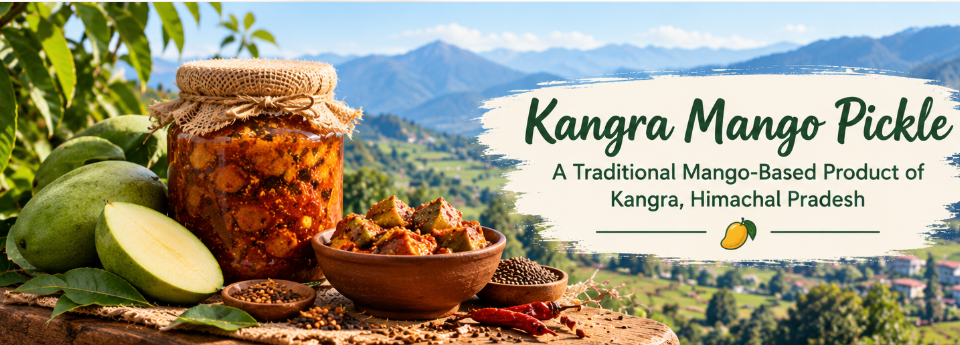
Kangra Mango Pickle – A Traditional Mango-Based Product of Kangra, Himachal Pradesh

When summer arrives in Himachal Pradesh, mangoes become a familiar part of local life. From enjoying fresh mangoes at home to preparing traditional pickles and chutneys, the fruit has found a special place in the food culture of many households. In Kangra district of Himachal Pradesh, mango is also important from a local food-processing perspective.
The Government of India’s PMFME One District One Product (ODOP) framework identifies Mango/Mango Based Products as the ODOP category for Kangra. This creates an opportunity to turn locally available mangoes into value-added products such as pickles, chutneys, jams, beverages and other preserved foods.
Among these products, Kangra Mango Pickle is particularly interesting because it combines the seasonal taste of mango with traditional Indian methods of preservation.
A good mango pickle is not simply a side dish. It carries memories of homemade food, summer preparation, family recipes and the distinctive combination of spices, salt and oil. At the same time, modern local food businesses are bringing these traditional recipes into organised processing and packaging.
So, what makes Kangra Mango Pickle interesting as a local product? Let us explore its preparation, connection with Kangra, economic importance, traditional character and future possibilities.
What Is Kangra Mango Pickle?
Kangra Mango Pickle is a traditional-style pickle prepared using raw mangoes and a combination of spices, salt and other ingredients. The exact recipe can vary from one household or producer to another.
Depending on the recipe, mango pieces may be combined with ingredients such as mustard seeds, fennel, fenugreek, chilli, turmeric, salt and mustard oil. Some recipes are spicy and tangy, while others may have a stronger sour or aromatic flavour.
The most important ingredient, of course, is the mango.
Raw mangoes are particularly suitable for pickling because their naturally sour and firm character works well with salt, spices and oil. Over time, the mango pieces absorb the flavours of the pickle mixture and develop a distinctive taste.
This traditional preservation method also allows seasonal mangoes to be enjoyed beyond the short fresh-fruit season.
Why Is Mango Important in Kangra?

Kangra is known for its diverse agricultural and horticultural activities. Official district-level production data from the Himachal Pradesh State Agricultural Marketing Board records mango production in Kangra, showing that mango is a significant fruit crop in the district.
This availability of mango creates opportunities not only for selling fresh fruit but also for developing mango-based products.
This is where value addition becomes important.
Instead of selling every mango only as fresh produce, some of the harvest can potentially be converted into products such as:
- Mango pickle
- Mango chutney
- Mango jam
- Mango squash
- Mango pulp
- Mango powder
- Aam papad
- Mango murabba
- Dried mango products
The PMFME programme specifically promotes the ODOP approach to strengthen value chains, common infrastructure and marketing for food products. Pickles are among the types of food products that can be included in the ODOP approach.
Kangra Mango Pickle and the ODOP Initiative
It is important to understand the ODOP connection correctly.
The official ODOP listing identifies Kangra – Mango Based Products in the revised list. Earlier government listings simply used “Mango” for Kangra.
This means mango is the identified product category for the district, while products such as mango pickle can be considered value-added products made from that local agricultural resource.
Therefore, it is more accurate to describe Kangra Mango Pickle as a traditional mango-based product of Kangra rather than saying that mango pickle alone is the official ODOP product.
This distinction is useful when writing about local products because it keeps the information both attractive and factually accurate.
How Is Traditional Mango Pickle Made?
The process of preparing mango pickle may differ depending on the recipe, but the basic method follows a few familiar steps.
1. Selecting Raw Mangoes
The first step is choosing firm, mature raw mangoes.
Soft or overripe mangoes are generally not suitable for a traditional chunky pickle because the pieces need to maintain their structure during preparation and storage.
2. Washing and Cutting
The mangoes are cleaned properly and cut into pieces.
At this stage, hygiene is important, especially when the pickle is being produced commercially.
3. Adding Salt and Spices
The mango pieces are mixed with salt and selected spices.
Traditional recipes may use ingredients such as mustard seeds, fenugreek, fennel, chilli and turmeric. The combination creates the familiar spicy, sour and aromatic character associated with Indian mango pickle.
4. Adding Oil
Mustard oil is commonly used in many traditional mango pickle recipes.
The oil contributes to the flavour while also forming an important part of the preservation process in traditional preparations.
5. Maturing the Pickle
After mixing, the pickle may be allowed to mature for a period of time.
During this stage, the mango pieces gradually absorb the spices and oil. The flavour becomes deeper and more balanced.
The final result is a tangy, spicy and aromatic product that can be served with everyday meals.
What Does Kangra Mango Pickle Taste Like?

The taste of mango pickle is difficult to describe with just one word.
It can be sour, spicy, salty, aromatic and slightly pungent at the same time.
The raw mango provides the tanginess, while spices contribute warmth and aroma. Mustard oil can add a characteristic sharpness.
The final flavour depends on the mango variety, spice mixture, oil, preparation method and maturation period.
That variation is actually one of the most interesting things about traditional pickles. A homemade mango pickle prepared in one family can taste completely different from another family’s recipe.
This gives local pickle products an opportunity to develop their own identity while still remaining connected to traditional food culture.
Why Mango Pickle Is a Useful Value-Added Product
Fresh mangoes are seasonal. This means farmers and traders have a limited period in which fresh mangoes are harvested and sold.
Processing mangoes into products such as pickle can help create additional opportunities around the fruit.
Instead of looking at mango only as fresh produce, entrepreneurs can think about the entire value chain:
Mango → Processing → Pickle → Packaging → Branding → Marketing → Consumer
This process can create opportunities for farmers, food processors, packaging suppliers, retailers and small businesses.
For a district like Kangra, developing mango-based products can therefore help strengthen the connection between agriculture and food processing.
Local Businesses Bringing Mango Pickle to Consumers
The connection between Kangra and mango pickle can also be seen in the activities of local food businesses.
For example, Him Organics, based in Kangra district, lists mango pickle among its products. Its website describes the company as being rooted in the valleys of Kangra and focused on traditional products including pickles.
Another Kangra-based food business, KPU Food, lists mango pickle in its seasonal product range and says its products are made in small batches using ingredients sourced within the Kangra belt where the season allows. The company is based in Nagrota Bagwan, Kangra.
There is also evidence of Kangra Valley mango pickle being marketed through the Khadi India platform, showing that the product can reach consumers beyond the local market.
These examples show how traditional food products can move from local kitchens into organised businesses and online markets.
Supporting Farmers Through Mango Processing
One of the biggest opportunities associated with mango-based products is the possibility of creating additional demand for mangoes.
A farmer normally has to depend heavily on the fresh-fruit market. Processing creates another route through which mangoes can enter the food economy.
When local processors purchase mangoes for products such as pickle, chutney or pulp, they become part of the agricultural value chain.
This does not mean that processing automatically solves every problem faced by farmers. Quality, pricing, transport, storage and market demand still matter.
However, a stronger local processing industry can create more options for agricultural produce.
Women and Traditional Food Processing
Traditional pickling has historically been closely connected with household food preparation.
In many Indian homes, preparing mango pickle is a seasonal activity that involves family recipes passed from one generation to another.
This traditional knowledge can become valuable when small food businesses are developed around local products.
Women-led self-help groups and small enterprises can potentially participate in activities such as:
- Cleaning and sorting mangoes
- Preparing spice mixes
- Pickle processing
- Packaging
- Labelling
- Selling through local markets
- Online marketing
With appropriate training and food-safety practices, traditional food knowledge can become part of a more organised micro-food-processing business.
From Homemade Pickle to Modern Packaging

One of the biggest changes in the food industry is the shift from homemade-style products to professionally packaged products.
Consumers today want convenience, but they also want authenticity.
This creates an interesting opportunity for Kangra Mango Pickle.
A local brand can maintain the traditional identity of the product while improving:
- Hygiene
- Packaging
- Labelling
- Shelf-life management
- Product consistency
- Storage instructions
- Online ordering
- Customer communication
Glass jars, food-grade containers and attractive labels can make a traditional product more suitable for retail and e-commerce markets.
However, packaging should not make unrealistic claims. Product ingredients, manufacturing details, dates and other mandatory information should be presented according to applicable food regulations.
Branding Kangra Mango Pickle
A strong local product needs more than just a good recipe.
It also needs a story.
A brand selling Kangra Mango Pickle could focus on the connection between:
Kangra + Mangoes + Traditional Recipes + Himachal Pradesh
The packaging could use subtle elements inspired by the region, such as mountain landscapes, local patterns or illustrations of mangoes.
The product story could focus on traditional preparation rather than making exaggerated claims.
For example, phrases such as “Traditional Mango Pickle from Kangra” or “Inspired by the Flavours of Kangra” can communicate the local connection without making unsupported claims.
The goal is to make customers feel that they are buying more than an ordinary pickle—they are experiencing a small part of Kangra’s food culture.
Digital Marketing Opportunities
Digital marketing can play a major role in helping small local food brands reach customers outside Kangra.
A business can use Instagram and Facebook to show how its mango pickle is prepared, packaged and shipped.
Short videos could feature:
- Fresh mangoes arriving during the season
- Mango cutting and preparation
- Spice mixing
- Traditional pickle-making
- Packaging the finished product
- Customer reviews
- Recipes using mango pickle
A website can also target relevant search terms such as:
- Kangra Mango Pickle
- Mango Pickle in Kangra
- Kangra mango products
- Mango-based products of Kangra
- Traditional mango pickle Himachal Pradesh
- Kangra local products
- Himachal Pradesh mango pickle
Using these keywords naturally in product pages, blogs, image alt text and headings can improve online visibility without making the content sound artificial.
Mango Pickle and Himachal Tourism
Food is an important part of the travel experience.
Visitors to Himachal Pradesh often look for products that they can take home as a reminder of their trip. Local pickles, jams, chutneys and other preserved foods can fit naturally into this market.
Kangra Mango Pickle could potentially become part of a broader local-food experience.
Imagine a visitor discovering a locally packaged mango pickle at a small shop, learning about the mango-growing areas of Kangra and taking a jar home.
That is the kind of connection that makes a local product memorable.
The product becomes not only food but also a small representation of the place where it came from.
Challenges in Producing Mango Pickle Commercially
Although the potential is strong, commercial production also comes with challenges.
Seasonal Mango Supply
Mangoes are seasonal, so processors need to plan procurement and production carefully.
Maintaining Consistent Taste
Traditional recipes can vary. Commercial brands need consistency so that customers receive a similar experience with every batch.
Food Safety
Pickles require proper handling, hygiene and storage. Commercial producers must follow applicable food-safety requirements.
Packaging and Transportation
Glass jars can provide a premium appearance but require careful transportation. Packaging must protect the product from leakage, contamination and damage.
Competition
The Indian pickle market already has many established brands. Local businesses therefore need to compete through quality, authenticity, storytelling and strong customer relationships.
Future of Kangra Mango Pickle
The future of Kangra Mango Pickle depends on how well traditional food knowledge can be combined with modern entrepreneurship.
Kangra already has an identified mango-based-product focus under the ODOP framework. This provides a useful foundation for developing value-added products and strengthening the local food-processing ecosystem.
Small businesses can explore different formats such as:
- Traditional mango pickle
- Spicy mango pickle
- Mango pickle with different spice blends
- Gift packs
- Travel-size jars
- Regional food hampers
- Online subscription boxes
- Festival food packages
The opportunity is not simply to sell more pickle. It is to build a stronger identity around Kangra’s mango-based food products.
Why Kangra Mango Pickle Matters
A jar of mango pickle may look like a simple food item, but behind it there can be a much larger story.
There is the farmer growing mangoes, the person selecting and preparing the fruit, the traditional recipe, the spice supplier, the processor, the packaging team and finally the customer.
This creates a connection between agriculture, tradition and entrepreneurship.
Kangra’s identification for mango-based products under the ODOP framework further highlights the potential for value addition around mangoes.
Kangra Mango Pickle is therefore an interesting example of how a seasonal local fruit can become a product with a longer market life and a stronger commercial identity.
Conclusion
Kangra Mango Pickle is a traditional mango-based product that reflects the food culture and agricultural potential of Kangra, Himachal Pradesh.
Kangra’s mango production provides the raw material, while traditional pickling techniques turn raw mangoes into a flavourful product that can be enjoyed long after the fresh mango season.
The Government of India’s ODOP framework identifies Mango Based Products for Kangra, creating a broader platform for value addition, processing, branding and marketing.
At the same time, local businesses are already demonstrating that mango pickle can be produced, packaged and sold beyond the immediate local market.
With better packaging, food-safety practices, digital marketing and storytelling, Kangra Mango Pickle has the potential to reach more consumers while retaining its traditional character.
Ultimately, the appeal of Kangra Mango Pickle lies in its simplicity. It starts with a seasonal mango and ends with a product that carries the flavours of spices, tradition and local food culture.
And sometimes, that is exactly what makes a local product special.
Frequently Asked Questions About Kangra Mango Pickle
1. What is Kangra Mango Pickle?
Kangra Mango Pickle is a traditional-style mango pickle associated with the mango-based food culture of Kangra, Himachal Pradesh. It is generally prepared using raw mangoes, spices, salt and oil.
2. What is the ODOP product of Kangra?
Under the revised PMFME ODOP list, Kangra is identified for Mango Based Products. Earlier government lists referred to the product simply as Mango.
3. Is mango pickle the official ODOP product of Kangra?
No. The broader official category is Mango Based Products. Mango pickle is one type of value-added product that can be made from mangoes.
4. How is traditional mango pickle made?
Raw mangoes are cleaned and cut before being mixed with salt, spices and oil. The mixture is then allowed to mature so that the mango pieces absorb the flavours.
5. Why are mango-based products important for Kangra?
Mango-based products can add value to locally grown mangoes and create opportunities for processing, packaging, branding and marketing.
6. Can Kangra Mango Pickle be sold online?
Yes. Local food businesses can use e-commerce websites, social media and online marketplaces to reach customers outside Kangra, subject to applicable food-safety and business requirements.
7. What makes mango pickle a traditional product?
The use of raw mangoes, spices, oil and preservation techniques passed through generations gives mango pickle its traditional character. Recipes can vary significantly between households and regions.