
Kotpad Handloom Fabric: Traditional Textile of Odisha
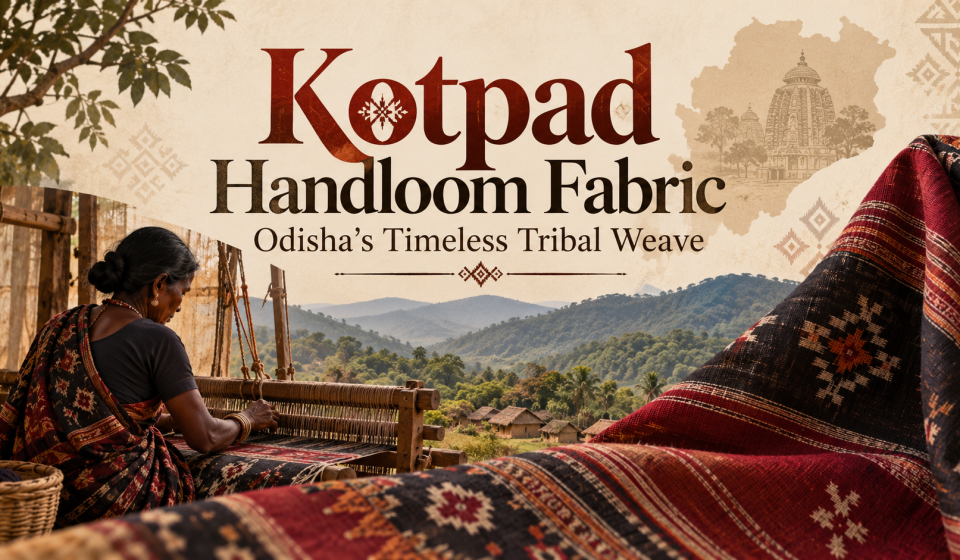
India’s traditional textiles reflect its history, regional identity, and artistic heritage. Among Odisha’s distinctive handloom traditions, Kotpad Handloom Fabric stands out for its earthy colours, cotton weaving, and traditional natural-dye techniques.
Originating in Kotpad, a town in the Koraput district of southern Odisha, this textile is closely associated with the Mirgan weaving community. Its traditional dyeing process uses the roots of the aal tree, which help produce characteristic reddish-brown and maroon shades. Kotpad handloom received a Geographical Indication (GI) registration in 2005, recognising its regional identity and traditional craftsmanship.
Intellectual Property India+1
This article explores Kotpad’s history, materials, manufacturing process, cultural importance, practical uses, and differences from other Odisha textiles. It also includes a table of six businesses and organisations that readers can investigate when purchasing Kotpad products.
3. What Is Kotpad Handloom Fabric?
Kotpad Handloom Fabric is a traditional handwoven textile from Kotpad, Odisha, known for its cotton construction, earthy colours, and association with natural dyeing. Artisans traditionally use aal roots to dye yarn before weaving it into sarees, scarves, shawls, and other textile products.
Sujog Portal+1
Key characteristics of Kotpad handloom
- Origin: Kotpad, Koraput district, Odisha.
- Traditional material: Cotton yarn, with other materials used in some contemporary products.
- Signature dye: A natural dye derived from aal roots.
- Colour palette: Reddish-brown, maroon, brown, black, and undyed or cream shades.
- Designs: Geometric patterns, contrasting borders, and motifs inspired by local surroundings and cultural life.
- Production method: Traditional handloom weaving combined with distinctive yarn-dyeing practices.
Kotpad textiles are recognised for their understated appearance rather than highly elaborate decoration. Their value lies in the relationship between local materials, inherited skills, and regional identity.
Not every product marketed as Kotpad uses identical fibres, colours, or dyeing methods. Buyers should therefore examine individual product descriptions instead of assuming that every variation follows precisely the same process.
4. History and Origin of Kotpad Handloom Fabric
Kotpad handloom developed within the traditional weaving culture of southern Odisha. The Mirgan community has historically played a central role in producing textiles for local communities, making the craft both a source of livelihood and a form of cultural expression.
Sujog Portal+1
The craft is associated with knowledge passed between generations. Weavers develop skills in preparing yarn, operating looms, creating borders, and arranging motifs. Natural dyeing adds another layer of specialised knowledge because colour depends on the materials and the way they are processed.
A major milestone came in 2005, when Kotpad Handloom Fabric received its GI registration. The official registry identifies the Orissa State Handloom Weavers’ Cooperative Society Ltd., popularly known as Boyanika, as the applicant.
Intellectual Property India+1
This recognition helped establish Kotpad’s identity as a textile associated with a particular geographical region and traditional production knowledge.
However, GI registration should not be confused with automatic certification of every item sold under a similar name. Buyers should still check the producer, product description, and available authenticity documentation.
5. Materials and Natural Dyes Used in Kotpad Textiles
Kotpad textiles are traditionally associated with cotton yarn and natural dyes derived from local plant materials. The aal root is particularly important because it produces reddish and maroon shades. Other ingredients and treatments can influence the final colour.
Handicrafts+1
The main materials include:
- Cotton yarn: Used in traditional sarees, scarves, and other woven products.
- Aal roots: The roots provide the characteristic red and maroon tones.
- Iron-based materials: Used in traditional dyeing processes to help produce darker shades.
- Castor oil and other treatments: Documented in descriptions of traditional yarn preparation.
- Water and other processing materials: Used during washing, preparation, and dyeing.
The final colour depends on the yarn, dye ingredients, preparation, and number of dyeing stages. Natural dyeing can create subtle variations between pieces.
It is important not to assume that every modern Kotpad product is entirely naturally dyed or free from chemical treatments. Ask the seller about the actual materials and dyeing process.
6. How Is Kotpad Handloom Fabric Made?
The traditional Kotpad handloom process combines yarn preparation, dyeing, loom preparation, and skilled weaving. The dyeing process is particularly important because the yarn is coloured before it is woven into the finished textile.
Encyclopedia of Intangible Cultural Heritage+1
The following sequence summarises documented traditional practices alongside the general stages of handloom production.
- Cotton yarn preparation: Artisans wash and prepare the yarn to remove impurities and improve its suitability for dyeing.
- Dye preparation: Aal roots and other traditional materials are processed to produce the required dye mixture.
- Yarn dyeing: The yarn undergoes dyeing and drying. Different ingredients and treatments help create different shades.
- Loom preparation: The prepared yarn is arranged as warp and weft threads. The warp runs lengthwise, while the weft crosses it.
- Weaving and pattern creation: The weaver operates a handloom to create the fabric, borders, and decorative motifs. Traditional descriptions also document three-shuttle techniques for contrasting borders.
Handicrafts
- Finishing and inspection: The completed textile is checked for weaving consistency, colour, defects, and overall quality.
This process requires time and specialised knowledge. Unlike printed fabric, a woven motif is created through the arrangement of threads, not simply applied to the surface.
7. Distinctive Features and Traditional Motifs
Kotpad handloom is recognised for its earthy palette, contrasting borders, and motifs linked to its regional weaving traditions. Designs may include geometric forms and representations of animals, fish, flowers, and everyday objects.
Handicrafts+1


14
Common design characteristics include:
- Earthy colours: Maroon, reddish-brown, dark brown, black, and cream.
- Contrasting borders: Borders often provide a clear visual distinction from the main body.
- Geometric and nature-inspired motifs: These reflect local artistic traditions.
- Textured appearance: Handwoven structures can show small differences in thread placement.
- Regional character: Traditional dyeing and weaving give the fabric an identity associated with Kotpad.
Handwoven fabric may contain slight variations in colour or texture. These variations are not automatically defects. However, uneven damage, loose threads, or poor finishing should still be checked before purchase.
8. Cultural and Economic Importance
Kotpad handloom preserves traditional textile knowledge while supporting the livelihoods of artisans in Odisha. The state’s Handlooms, Textiles and Handicrafts Department recognises the handloom sector as an important source of rural employment.
textiles.odisha.gov.in+1
The craft has several forms of cultural and economic value:
- Community identity: The textile is closely connected with Kotpad’s weaving traditions and local cultural life.
- Traditional knowledge: Dye preparation, weaving techniques, and motif design are passed between generations.
- Artisan livelihoods: Production and sales create opportunities for weavers and people involved in preparing and marketing textiles.
- Cultural preservation: Purchasing traceable handloom products can help sustain demand for traditional skills.
- Market development: Cooperative outlets and online sellers can connect regional producers with customers elsewhere in India.
The craft also faces challenges, including competition from cheaper imitations, changing consumer demand, and the need to maintain access to traditional dye materials. Supporting authentic producers is one practical way to help preserve the craft.
9. Benefits and Practical Uses
Kotpad textiles combine traditional design with practical applications. They are used for sarees, scarves, shawls, dress materials, and other textile products. The regional handloom centre is also associated with vegetable-dyed sarees and scarves.
Sujog Portal+1
| Product | Common use |
|---|---|
| Kotpad cotton sarees | Everyday ethnic wear, cultural events, and formal occasions |
| Stoles and scarves | Everyday accessories and gifts |
| Shawls and dress materials | Clothing and tailoring |
| Textile lengths | Custom garments and traditional outfits |
| Selected home-textile products | Decorative or functional uses, depending on the weave |
Benefits: The fabric offers distinctive colours, traditional craftsmanship, and a less mass-produced appearance. Purchasing directly from credible artisan-led businesses can also help maintain demand for regional weaving skills.
Limitations: Authentic handloom pieces can cost more than printed alternatives. Natural colours may vary, availability can be limited, and delicate or naturally dyed items may require special care. Natural dyes alone do not guarantee that a product is chemical-free, hypoallergenic, or environmentally harmless.
10. Challenges and Common Buying Mistakes
Buyers should assess the product, its origin, and the seller’s claims rather than relying on appearance alone.
| Common mistake | Why it matters | Practical solution |
|---|---|---|
| Buying an imitation | Printed fabric can resemble traditional designs | Ask whether the fabric is handwoven and how its patterns are created |
| Assuming all dyes are natural | Modern products may use different processes | Request specific dye and material details |
| Expecting identical colours | Hand-dyed pieces may vary | Review the actual product photographs and description |
| Ignoring seller credibility | Product descriptions may be incomplete | Check business details, return policies, and customer support |
| Treating a GI tag as proof for every item | Registration identifies a product’s regional identity, not automatically every individual sale | Ask for applicable authenticity documentation |
| Washing without checking instructions | Heat, friction, and detergents can affect fibres and colours | Follow the seller’s care instructions |
These checks are especially useful when buying expensive sarees or ordering from an online seller for the first time.
11. Manufacturers, Cooperatives, Producers, and Sellers of Kotpad Handloom Fabric
Buyers can begin with Odisha’s established handloom organisations and sellers that list Kotpad products. The following table distinguishes the documented GI applicant from businesses that market or sell Kotpad textiles. Not every organisation listed is a manufacturer.
Intellectual Property India+3
| Business or organisation | Location | Business details | Website / contact |
|---|---|---|---|
| Boyanika | Bhubaneswar, Odisha | State handloom cooperative and GI applicant for Kotpad Handloom Fabric. Markets Odisha handloom products, including Kotpad. | boyanika.com · 0674-2395387 |
| Society for Artisans of Koraput | Koraput region, Odisha | Listed as the seller of Kotpad cotton sarees on Odisha E-Store. A relevant option for buyers seeking products sourced from Kotpad handloom clusters. | Odisha E-Store |
| Just Odisha Handloom | Odisha; exact business address not verified | Listed as a seller of Kotpad cotton and Tasar sarees on Odisha E-Store. Confirm the specific product’s origin before ordering. | Odisha E-Store Kotpad collection |
| Prahollad Mahonto | Odisha; exact business address not verified | Named as a seller of Kotpad sarees and handwoven stoles on Odisha E-Store. Individual product listings provide a starting point for enquiries. | Odisha E-Store Kotpad collection |
| Bigrayn | Bhubaneswar, Odisha | Retailer with a dedicated Kotpad collection featuring cotton sarees and traditional borders. Its website lists a physical store at 3D, Narula Complex, Sriya Square, Janpath. | bigrayn.com |
| Bidyut Fashion House | Pokhariput, Bhubaneswar, Odisha | Retailer offering Kotpad cotton and Tasar sarees alongside other Odisha handloom products. | bidyutfashion.com · 9438721217 |
Verification note: Business roles and product listings are based on the linked sources. Public listings do not establish that every seller manufactures its own products, and stock can change. Contact the seller to confirm current availability, exact product origin, and authenticity documentation.
Boyanika+3
How to choose a reliable Kotpad seller
- Start with the source: Boyanika is a useful starting point because it is the GI applicant listed in the official registry.
- Ask who made the product: Request the weaver’s, cooperative’s, or producer’s name where available.
- Confirm the dyeing process: Ask whether the product uses aal-root dye and whether other dyes or treatments are involved.
- Check the product description: Confirm the fibre, dimensions, price, and care requirements.
- Review the purchase terms: Check shipping, returns, refunds, and customer support before paying.
A seller listing is a starting point for research, not independent proof that every item is authentic.
12. Kotpad Handloom Fabric Compared with Other Odisha Textiles
Kotpad, Sambalpuri Ikat, Bomkai, and Khandua are distinct Odisha textile traditions. Their differences lie mainly in dyeing, weaving techniques, motifs, and regional associations. Odisha’s Handlooms Department recognises these as separate traditional handloom categories.
textiles.odisha.gov.in+1
| Textile | Regional association | Signature technique | Visual characteristics |
|---|---|---|---|
| Kotpad Handloom Fabric | Kotpad, Koraput district | Traditional natural dyeing of yarn followed by handloom weaving | Earthy colours, contrasting borders, geometric and nature-inspired motifs |
| Sambalpuri Ikat | Sambalpur and western Odisha weaving regions | Tie-dyeing sections of yarn before weaving to create patterns | Detailed, often multicoloured geometric and symbolic designs |
| Bomkai Saree | Bomkai and adjoining weaving regions of Odisha | Traditional handloom weaving with decorative borders and supplementary-weft motifs | Elaborate borders, distinctive pallus, and intricate motifs |
| Khandua Pata | Nuapatna and surrounding areas, Cuttack district | Traditionally associated with ikat-style patterning and auspicious designs | Richly patterned pallus and traditional motifs, often on silk |
Although these textiles may share cotton or silk materials, they should not be treated as interchangeable. Kotpad’s signature is its regional weaving tradition and natural-dye heritage, while ikat relies on resist-dyeing yarn to create patterns.
13. Best Practices for Buying and Maintaining Kotpad Textiles
Use the following recommendations to protect your purchase and preserve the fabric.
- Check the origin: Look for a clear reference to Kotpad, Koraput district, Odisha.
- Verify the seller: Prefer established cooperatives, traceable artisan-led businesses, and sellers with clear contact details.
- Ask about the weaver: Request the name of the producer or weaving organisation where available.
- Understand the dye: Confirm whether aal-root dye is used and whether the product includes other dyes.
- Check the fibre: Verify whether the item is cotton, silk, a blend, or another material.
- Review authenticity documents: Check relevant GI-related or Handloom Mark documentation where applicable. A GI registration alone does not certify every individual item.
- Follow the care label: Use the seller’s washing instructions, especially for naturally dyed textiles.
- Avoid harsh detergents: Unless the care instructions specify otherwise, avoid bleach and aggressive washing methods.
- Protect from sunlight: Avoid leaving the fabric in prolonged direct sunlight, which can affect colour.
- Store carefully: Keep clean, completely dry textiles in a cool, dry place and protect them from moisture and pests.
For a valuable saree, ask the seller whether professional cleaning is recommended before attempting home washing.
14. Frequently Asked Questions (FAQs)
1. What is Kotpad Handloom Fabric?
Kotpad Handloom Fabric is a traditional textile from Kotpad in Odisha’s Koraput district. It is known for cotton weaving, earthy colours, and traditional dyeing techniques associated with aal roots. The craft is closely linked to local weaving communities and received GI registration in 2005.
Intellectual Property India+1
2. Where does Kotpad handloom originate?
Kotpad handloom originates in Kotpad, a town in the Koraput district of southern Odisha, India. The local weaving tradition is historically associated with the Mirgan community, whose knowledge of dyeing and weaving has helped preserve this regional textile craft.
Sujog Portal+1
3. Which natural dye is traditionally associated with Kotpad textiles?
Aal-root dye, derived from the roots of the aal tree, is traditionally associated with Kotpad textiles. It helps create the distinctive reddish-brown and maroon shades. Other ingredients and dyeing treatments can contribute to darker colours. The exact process and colour vary by product and producer.
Handicrafts+1
4. How is Kotpad handloom fabric made?
Kotpad fabric is produced by preparing yarn, applying traditional dyes, drying the yarn, and weaving it on a handloom. Artisans arrange warp and weft threads to create the fabric and its patterns. Contrasting borders and traditional motifs contribute to its distinctive appearance.
Handicrafts+1
5. What makes Kotpad textiles different from Sambalpuri Ikat?
Kotpad textiles are especially associated with aal-root dyeing and earthy colours. Sambalpuri Ikat uses resist-dyeing techniques in which selected sections of yarn are tied and dyed before weaving to create patterns. Both traditions are important Odisha handlooms, but their signature production techniques differ.
Handicrafts+1
6. Which communities are associated with Kotpad weaving?
The Mirgan community has historically been a principal custodian of Kotpad weaving, with other communities also contributing to the textile tradition. The craft involves specialised knowledge of yarn preparation, dyeing, weaving, and motifs. These skills support cultural continuity and local artisan livelihoods.
Sujog Portal+1
7. Where can you buy authentic Kotpad handloom products?
You can begin with Boyanika, Odisha’s state handloom cooperative and the GI applicant for Kotpad Handloom Fabric. Odisha E-Store also lists Kotpad products from sellers including the Society for Artisans of Koraput. Before buying, check the producer, fibre, dyeing process, and available authenticity documentation.
Intellectual Property India+1
8. How should Kotpad cotton fabric be washed and maintained?
Follow the care instructions provided by the seller or artisan. For naturally dyed textiles, avoid bleach, harsh detergents, prolonged direct sunlight, and unnecessary friction. Test any cleaning method cautiously and seek professional advice for valuable pieces. Dry cleaning may be recommended for some Kotpad sarees.
odishaestore.com+1
15. Key Takeaways
- Kotpad Handloom Fabric originates in Kotpad, Koraput district, Odisha.
- The craft is historically associated with the Mirgan weaving community.
- Aal-root dye is a defining feature of its traditional dyeing heritage.
- Earthy colours, contrasting borders, and regional motifs distinguish the textile.
- The fabric is used for sarees, scarves, shawls, and other textile products.
- Kotpad Handloom Fabric received GI registration in 2005.
- Boyanika and traceable sellers are useful starting points for buyers.
- Product descriptions, fibre composition, dyeing methods, and seller credibility should be checked before purchase.
16. Final Verdict
Kotpad handloom is a distinctive example of Odisha’s living textile heritage. Its appeal comes from the combination of traditional dyeing knowledge, handloom weaving, earthy colours, and regional cultural identity.
The fabric is suitable for buyers who appreciate understated designs and traditional craftsmanship. However, it is important to distinguish documented production practices from marketing claims and to recognise that prices, materials, and care requirements vary.
For buyers, the best approach is to choose a traceable producer or credible seller, ask specific questions about the dyeing process, and follow the recommended care instructions. For businesses and textile enthusiasts, Kotpad offers an opportunity to understand and support a traditional craft through informed purchasing.
17. Conclusion
Kotpad Handloom Fabric represents the enduring relationship between regional identity, traditional knowledge, and Indian handloom craftsmanship. Its distinctive colours, aal-root dyeing heritage, and handwoven patterns make it an important part of Odisha’s textile landscape.
As consumer interest in traditional textiles continues, preserving the craft requires more than appreciation. It also requires transparent sourcing, informed buying decisions, and continued support for the artisans who maintain these skills.
Choosing an authentic, traceable Kotpad textile helps buyers connect with Odisha’s cultural heritage while supporting the continuation of traditional weaving practices.