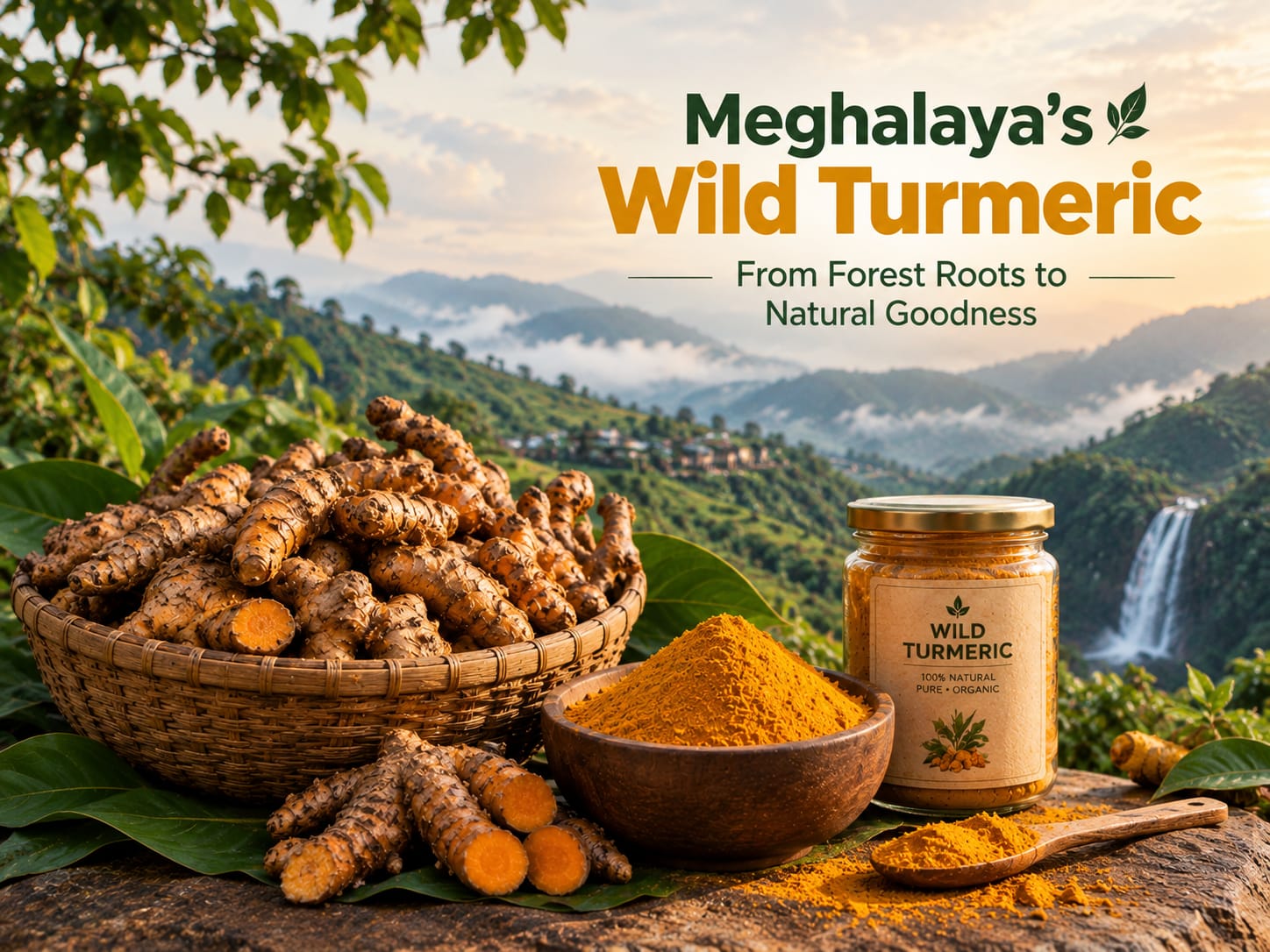

When we think of turmeric many of us are likely to think of the yellow powder in a kitchen jar. It is a common everyday item that few of us think about when it comes to its origins or differences between varieties.
In the hills of Meghalaya turmeric plays a much wider role than just a common spice.
In the hills of West Jaintia Lakadong Turmeric has carved a special place, as an agricultural identity. Renowned for its colour distinctive aroma and naturally high curcumin content Lakadong Turmeric has drawn attention from both within and outside of India for high quality turmeric products.
Its story is closely linked with the One District One Product (ODOP) approach, as an initiative to identify products that reflect the strengths of particular districts.
What Makes Lakadong Turmeric Different?
Lakadong Turmeric is traditionally grown in the Jaintia Hills region of Meghalaya. Unlike turmeric that is largely valued for its colour and flavour Lakadong is particularly valued for its high curcumin content.
Curcumin is one of the compounds responsible for turmeric’s yellow colour. It is also one of the reasons turmeric has attracted so much attention from the food, wellness and nutraceutical industries.
Government sources have reported that Lakadong turmeric can reach up to around 7.5% curcumin content, although the actual level can vary depending on cultivation and processing conditions.
This high curcumin content presents an interesting value proposition, as it enables the product to be branded and marketed as a distinctive variety with a higher curcumin content.
That is where the real opportunity begins.
From a Local Crop to a Regional Brand
For generations farmers in Meghalaya have cultivated turmeric. Much of the value of products is captured after, when the crop leaves the farm.
A farmer may sell raw turmeric and another business may later handle drying, grinding, packaging, branding and distribution. By the time the final product reaches a consumer its value can reach well beyond the price that the farmer received.
The ODOP concept is important, as it builds an economy around products that are naturally associated with a district.
Of looking at just a crop of Lakadong the focus can be turned to developing a Lakadong turmeric value chain.
That could encompass everything from cultivation practices and farmer support to processing, packaging, quality testing, branding and digital marketing. In the context the goal is of transitioning from just selling a raw agricultural product to selling a recognisable regional brand.
The Connection With West Jaintia Hills
West Jaintia Hills is particularly associated with Lakadong production, as most of it comes from the region. The areas of Laskein have been important in the development of the Lakadong turmeric value chain.
The geographical environment of Meghalaya combined with knowledge about farming have contributed to the conditions in which the crop has developed its distinctive characteristics.
The importance of Lakadong goes beyond just an agricultural crop.
For communities a successful business around turmeric can open the door to new income opportunities as well as market access. It can also enable the creation of businesses around processing and packaging.
This is particularly important, for a region where agriculture continues to play a major role.
When a product gains recognition in another market the benefits can extend far beyond just the farmer.
Transporters, processors, packaging businesses, retailers, exporters and small entrepreneurs can all play important roles in such an ecosystem. This is exactly what makes a product like Lakadong turmeric so interesting from an ODOP perspective.
GI Recognition Adds Another Layer of Identity
Another interesting development in the Lakadong story is GI (Geographical Indication) recognition.
A GI tag enables the identification of products that have a geographical origin and possess qualities or a reputation associated with that location.
For Lakadong turmeric, this recognition can enhance the identity of the product, in the marketplace.
Think about how consumers are familiar with certain products from specific locations. Darjeeling is associated with tea, Kashmir with saffron and Kanchipuram with silk.
Similarly, Meghalaya can build a consumer association with Lakadong turmeric.
Simply having a GI tag, however, does not automatically create a brand. The real opportunity is to make that connection with consumers, and create awareness around the product.
People need to know that Lakadong turmeric is a high-curcumin traditional variety which has been associated with a particular geographical region and is different from another turmeric product.
That requires branding, packaging and marketing.
Beyond Turmeric Powder
One of the opportunities for Lakadong is value addition.
Traditionally turmeric may be sold as a rhizome or processed into turmeric and powder. There is much more that can be done, with the crop.
Lakadong turmeric can be processed into products including:
Turmeric powder
Dried slices or flakes
Turmeric food products
Turmeric oleoresin
Curcumin extracts
Nutraceutical ingredients
Other processed turmeric products
A bio-curcumin extraction facility at Laskein represents an example of how processing can take turmeric beyond just agricultural sales.
This kind of infrastructure is significant, as it can enable much of the value of the crop to remain, within the region.
Instead of sending raw turmeric elsewhere for processing local facilities can create new opportunities for processing and manufacturing closer to the source.
Why Processing Matters for Farmers
Imagine two farmers, growing the same amount of turmeric.
The first farmer sells the crop after harvesting. The second farmer has a system where the turmeric can be cleaned, dried, processed, tested, packaged and sold under a recognised brand.
The value creation potential of the second system is clearly much greater.
This does not mean every farmer must become a manufacturer. Rather it means farmers can become part of an ecosystem, where various businesses can handle different aspects of the process. Farmer groups, cooperatives, small processing units and local entrepreneurs can all have their roles to play.
For ODOP to have an impact this connection between farm production and market value is incredibly significant.
The Role of Branding and Marketing
A high quality product still needs a brand.
This is where Lakadong turmeric has a tremendous opportunity, as it has not developed any significant branding so far.
Imagine a packet that simply says Turmeric Powder. There is reason for a consumer to remember it.
Imagine a packet that clearly states:
Lakadong Turmeric
West Jaintia Hills, Meghalaya
High-Curcumin Traditional Variety
Suddenly the product has a story, it has a backstory. The packaging can mention the origin, traditional cultivation and GI recognition. Of competing merely on price the product can compete with other products on authenticity and quality.
Digital marketing can also help take Lakadong beyond retail.
Social media, e-commerce websites, short-form videos and storytelling campaigns can introduce the product to consumers across India. A simple video showing turmeric being harvested in Meghalaya can be more memorable than a general advertisement for turmeric powder. This is where traditional agriculture can meet with modern marketing.
Challenges That Cannot Be Ignored
Of course building Lakadong turmeric into a major regional brand is not without challenges.
One challenge is market access, as farmers may face challenges reaching buyers understanding market demand and responding to it.
Another challenge is processing capacity, as much of the crop may continue to be in relatively low-value forms.
Quality consistency is also significant, as people will need to have confidence that a high-curcumin Lakadong turmeric product actually matches the promised quality standards.
Packaging and storage are also concerns, as agricultural products need handling during transportation and distribution.
There is also the risk of counterfeiting or mislabelling, as a product grows in popularity its authenticity can be questioned. This is why GI recognition traceability, testing and strong branding all matter.
Creating Opportunities for Young Entrepreneurs
The Lakadong story does not need to be limited to just farming.
It can also open the door to entrepreneurs in Meghalaya. A young entrepreneur might build a packaged brand. Another might work in food processing. Someone else might provide marketing services to local producers. There are also opportunities in logistics, e-commerce, export, packaging design and quality testing.
This is one of the strengths of an ODOP approach, as a districts signature product can become the starting point for a network of businesses. For generations this creates alternative opportunities, as opposed to leaving the region in search of other jobs elsewhere.
The Future of Lakadong Turmeric
The future of Lakadong turmeric will depend on how the region can connect farmers, technology, processing, branding and markets.
Government initiatives such as Mission Golden Spice launched in Meghalaya in 2026 with an outlay of ₹175.45 crore over five years show that the government is also keen on the Lakadong turmeric value chain.
Government support, however, will not be a deciding factor in whether or not a consumer brand is able to take off. Farmers need to gain access to knowledge and markets. Processors need to get access to raw materials. Entrepreneurs need to get access to infrastructure and financing. Consumers need to have confidence in the product.
All of these pieces, have to come together.
The opportunity is truly interesting, as modern consumers are increasingly interested in their food. They want to know where it comes from, its authenticity, and its origin. Lakadong turmeric has a powerful story to tell.
It is a geographical region. It has a distinctive identity. And it has a history of cultivation, among farming communities. It has characteristics that can differentiate it from ordinary turmeric.
The challenge is to turn that story into economic value.
More Than a Spice
At a glance Lakadong turmeric may seem like just another agricultural product.
Look closer and it represents something much larger.
It represents the farmers of West Jaintia Hills. It represents Meghalayas heritage. It represents the opportunity to turn resources into brands. Under an ODOP approach it represents how the district can build economic opportunities around something that is already a part of its identity.
The real success of Lakadong turmeric should not be measured by how much turmeric’s produced. It should also be measured by how much value continues to with the people who grew it, how many local businesses are created around it, and how effectively the product can reach consumers who appreciate its origin and value.
From the hills of Meghalaya, to kitchens and markets far removed from the Northeast, Lakadong turmeric has the potential to travel a long way. Its journey is no longer about a spice, it is about turning identity into local opportunity.
Lakadong Turmeric is much more than a spice grown in the hills of Meghalaya. For the people of West Jaintia Hills, it represents an agricultural resource that has the potential to support farmers, create businesses and build the local identity around the region.
Its high curcumin content, distinctive quality, GI recognition and connection with the Jaintia Hills, give Lakadong Turmeric a strong foundation for building a known regional brand. However the real potential lies in going beyond the sale of turmeric.
With processing facilities, quality control, attractive packaging, digital marketing and stronger market connections, Lakadong Turmeric can reach consumers in new forms and markets. Value-added products such as powder, dried turmeric, oleoresin and curcumin-based products can help increase the economic value generated from the crop.
The One District One Product (ODOP) approach provides a framework for this kind of development, by encouraging districts to focus attention on products that reflect their local strengths.
Ultimately the success of Lakadong Turmeric should not be measured by production figures. It should also be measured by the opportunities that are created for farmers, entrepreneurs and local communities.
The journey of Lakadong Turmeric from being a crop cultivated in Meghalaya to a product that has growing national and international potential, shows how a regions local resources can become a source of sustainable economic opportunity.
Lakadong Turmeric can be an excellent opportunity for building a local opportunity ecosystem.
Lakadong Turmeric is much more than a spice grown in the hills of Meghalaya. For the people of West Jaintia Hills, it represents an agricultural resource that has the potential to support farmers, create businesses and build the local identity around the region.