
Introduction
Mungeli is a district of Chhattisgarh but farming has always been important for its economy and the people living in the countryside. The district was formed in January 2012. Has three main tehsils—Mungeli, Patharia and Lormi. The district is mostly made up of areas and has many farmers. Farming remains the way people make money in the district.
Among the farming and growing opportunities in Mungeli tomato-based products have been chosen as the district’s One District One Product. The One District One Product list from the Ministry of Food Processing Industries shows Mungeli with “Tomato based products,” which shows the chance to turn grown tomatoes into better food products.
The choice of tomato-based products is important for more than the tomato. Fresh tomatoes go bad quickly. Farmers can have problems when many tomatoes are sold at the same time. Processing tomatoes into products like puree, paste, ketchup, sauce, juice, pickle and other preserved foods can help keep them longer and make them worth money.
Mungeli therefore has a chance to create a full tomato value chain—from growing and collecting tomatoes to processing, wrapping, naming and selling them. With the tools and people who want to start businesses, tomato-based products can become a major source of extra money and jobs for the farmers and people, in the countryside of the district.
Mungeli’s Agricultural Foundation
The agriculture is the foundation for Mungeli’s food-processing potential. The district’s Agriculture Department says Mungeli has 128,359 hectares of area and 213,631 hectares of crop area. Mungeli also has more than 131,000 registered farmers.
The major crops in Mungeli are rice, wheat, gram, tuvar, linseed, peanut and soybean. Although these crops are important in agriculture Mungeli also has a big horticultural and vegetable sector.
This diversity is valuable for agro-processing industries. Mungeli farmers already know how to grow and market crops. Vegetable production also gives chances for processing businesses to use produce as raw material.
The Mungeli District Export Action Plan highlights Mungelis agro-processing potential. The plan says Mungeli farmers grow a lot of vegetables. Tomatoes, potato, cabbage, pumpkin and gourd give a raw-material base for processing. The report points out tomato products, like pulp, puree and related processed foods as opportunities to add value.
This means tomato processing is an extension of Mungelis current agricultural economy, not a completely new activity.
Why Tomato-Based Products Matter
Tomatoes are among the widely consumed vegetables in India.
Tomatoes are used in household cooking, restaurants, food-service businesses and processed food industries.
However fresh tomatoes are perishable. Cannot be stored indefinitely without appropriate facilities.
This creates both a challenge and an opportunity.
During periods of production farmers may experience lower prices because market supply increases rapidly. Processing surplus tomatoes can help reduce wastage and create products that can be stored and sold over a period. I believe this is a way to keep tomatoes fresh longer.
I see that of selling only fresh tomatoes farmers and entrepreneurs can participate in the production of:
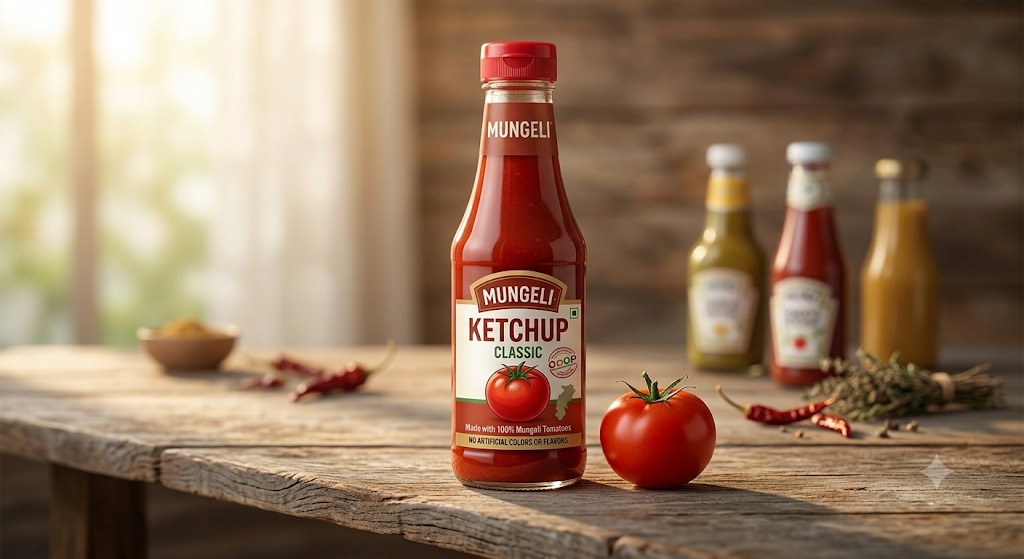
– Tomato ketchup
– Tomato sauce
– Tomato puree
– Tomato paste
– Tomato juice
– Tomato chutney
– Tomato pickle
– Canned tomato products
– Dehydrated tomato products
– Tomato-based ready‑to‑use cooking products
Mungeli District Export Action Plan specifically notes that the district has small and micro processing units involved in products such, as tomato puree, paste, sauces and canned tomato products.
Such diversification can create value at multiple stages of the supply chain. This benefits everyone.
From Farm to Processing Unit
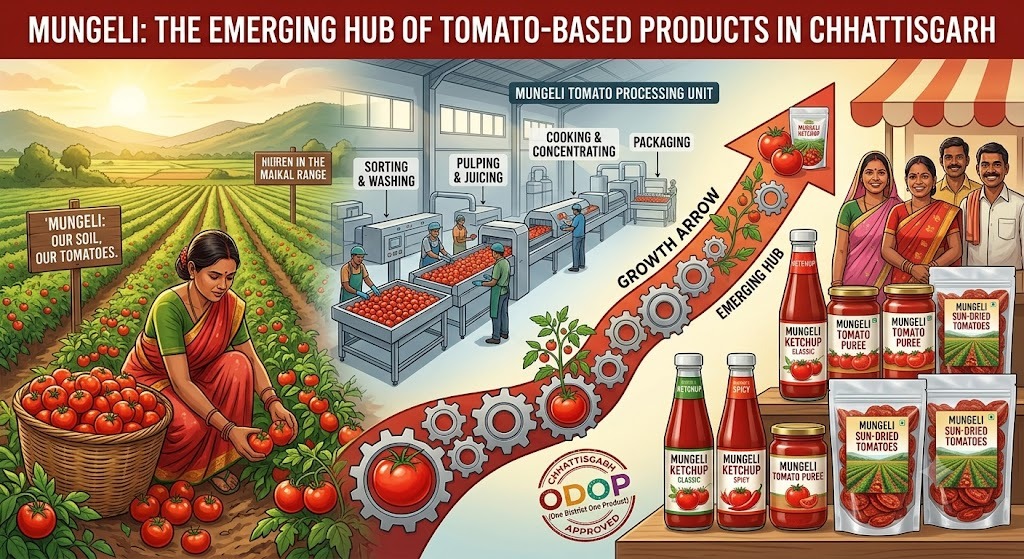
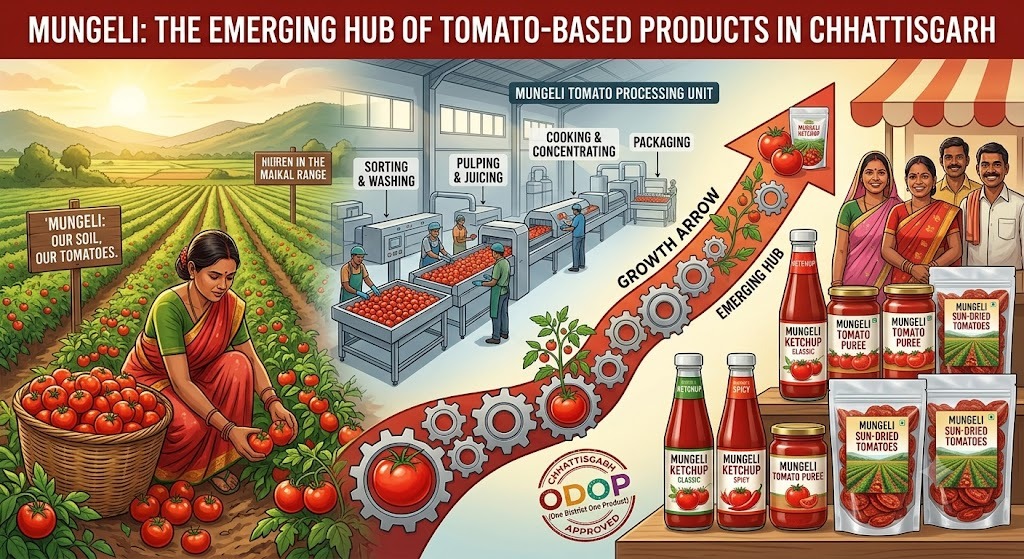
The journey of a tomato-based product starts in the field. Farmers grow tomatoes with seeds, water, fertilizers and careful crop management. After harvest tomatoes must be. Moved fast because their quality can fade if stored too long. An organized value chain links farmers to collection centers, processors and markets. Tomatoes are sorted by quality, size and maturity before they are sent for processing. At the processing unit tomatoes go through steps such as washing, sorting, crushing, pulping, heating and concentrating. The final product may need ingredients and special techniques.
For example tomato puree needs tomatoes turned into a pulp while tomato paste needs more concentration. Tomato ketchup and sauce require the mix of ingredients then processing and packaging.
This opens chances for factories and, for small and micro food-processing businesses alike.
Value Addition and Farmer Income
One of the important advantages of tomato processing is that tomato processing adds value.
A farmer who sells tomatoes receives income when the tomatoes are harvested. However when those tomatoes are processed, packaged and branded tomatoes can create value at more stages.
For example:
Tomato cultivation → Collection → Sorting → Processing → Packaging → Branding → Distribution → Retail
Each stage creates activity.
A stronger local tomato processing industry can therefore benefit farmers, transporters, workers, packaging suppliers, retailers and entrepreneurs. The tomato processing industry can also reduce the dependence of producers on selling raw tomato commodities.
Research conducted on tomato cultivation in the district has found that tomato production can be economically attractive. I read that a 2022 study covering tomato‑growing areas in the Lormi blocks estimated an overall input‑output ratio of 1:2.27 for tomato production in its sample.
This shows the potential of tomato cultivation and also shows why better market linkages and value addition can be important for farmers.
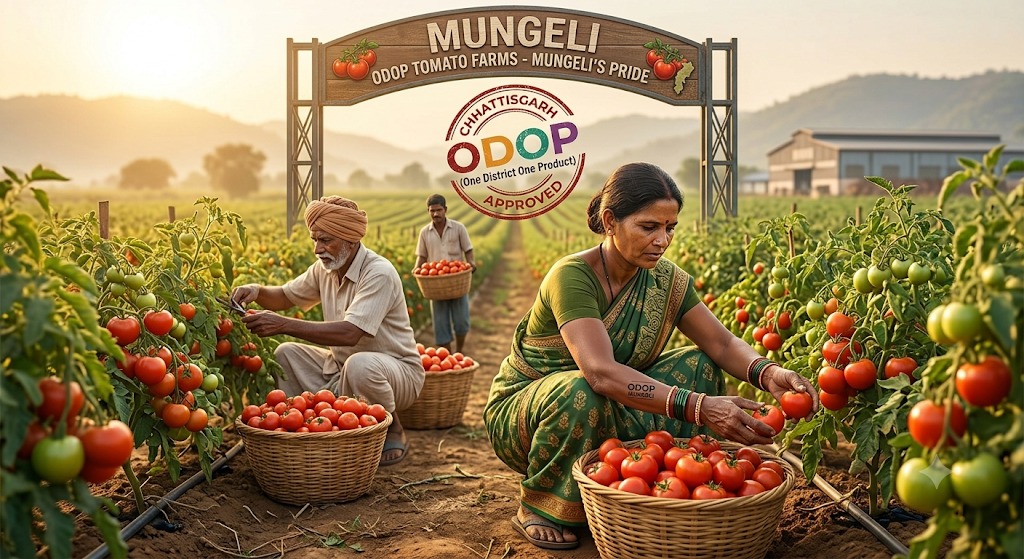
Tomato Processing and Rural Entrepreneurship
Developing tomato-based products can encourage entrepreneurship in areas.
A processing unit need not be an industrial factory. Small businesses, self-help groups, farmer producer organizations and micro-enterprises can start with products such as tomato sauce, ketchup, puree, chutney and pickle.
Small-scale tomato processing has advantages. Tomato processing requires smaller quantities of raw material that can be operated closer to production areas and can provide employment within villages and small towns.
Women-led self-help groups can also participate in tomato processing and packaging. With training in food safety processing techniques, accounting and marketing these groups can develop products for markets.
Developing enterprises can create opportunities, for people who otherwise depend mainly on seasonal agricultural employment.
Role of Food Processing Infrastructure
Infrastructure is one of the important requirements for transforming Mungelis tomato production into a successful ODOP industry. I believe infrastructure is crucial for this transformation.
Tomatoes need collection and transportation systems. Tomatoes also need processing facilities with equipment for washing, pulping, heating, concentration and packaging. Storage facilities are also important for maintaining materials and finished products.
Cold‑chain infrastructure can be particularly useful for reducing losses. Where immediate processing is not possible, suitable storage and transportation can provide processors with flexibility. Infrastructure for cold‑chain helps reduce the loss of tomatoes after harvest.
We read that the Mungeli District Export Action Plan identifies the districts road connectivity and location in relation to Bilaspur as an opportunity for developing collection and primary‑processing activities. It suggests that Mungeli can potentially serve as a collection and primary‑processing hub connected to markets and processing centres, in the Bilaspur–Raipur–Durg region.
Better infrastructure can therefore help local producers move beyond village‑level markets.
Government Support and ODOP
The One District One Product initiative aims to find products that have local potential and to help develop them through branding, market access, infrastructure and capacity building.
In Mungeli, identifying tomato-based products under ODOP gives a framework to strengthen the existing tomato-processing ecosystem.
The District Export Action Plan also points out the Pradhan Mantri Formalisation of Micro Food Processing Enterprises (PM-FME) Scheme as a source of support for food-processing enterprises.
The report says that the scheme offers a 35% credit-linked capital subsidy for individual and group enterprises and gives financial support for branding and marketing to eligible groups.
These schemes can be especially helpful, for entrepreneurs who have the skills and local raw material but do not have enough capital to set up modern processing and packaging facilities.
Government support can help entrepreneurs buy machinery improve hygiene standards develop packaging and reach markets.
Branding Mungeli’s Tomato Products
Making a product is just one part of building a successful ODOP industry. Branding is just as important as making the product.
Mungelis tomato products can be sold with a regional identity. This identity can connect Mungelis tomato products to the farmers and the farming history of the district.
A strong brand could show:
-sourcing
-Quality ingredients
-Hygienic processing
-Farmer participation
-Chhattisgarh’s agricultural identity
-Consistent product quality
Items like ketchup, puree, sauce and pickle can be sold in different sizes for homes, restaurants, hotels and big buyers.
Good packaging can also help small producers compete with national brands. Clear labels, food-safety info, professional design and steady quality can help people trust the brand.
Digital marketing is another chance. Local businesses can show off their products on media, online shops and websites. This way a small producer in Mungeli can find customers away, from the district.
Employment Opportunities
A successful tomato value chain can generate employment far beyond farming.
Employment can be created in:
Agriculture: Seed supply, cultivation, harvesting and farm management.
Collection: Aggregation, sorting and transportation of tomatoes.
Processing: Machine operation, food preparation, quality control and packaging.
Distribution: Warehousing, transportation and wholesale activities.
Marketing: Branding, sales, retail and digital promotion.
Support services: Equipment maintenance, packaging production, financial services and business consultancy.
This makes tomato processing particularly relevant to rural economic development.
Instead of agricultural income ending when the farmer sells the crop, the product can continue generating economic activity within the district.
Women and Self-Help Groups
Tomato-based food processing can also offer opportunities for womens self-help groups and rural micro-enterprises.
Products like tomato pickle, chutney, sauce and dried tomato preparations can be made on a scale. With training, standard recipes and hygienic processing methods these products can become successful businesses.
Women-led businesses can also get involved in packaging, labeling and selling directly.
This can help increase household income while promoting entrepreneurship in areas. As these businesses grow they can hire people and build relationships with local farmers for raw materials.
Challenges Facing the Tomato Value Chain
Even though there is potential, the tomato-processing sector has some challenges.
The first challenge is that tomatoes spoil quickly especially if storage and transport are not good.
The second challenge is that prices change a lot. Tomato prices can go up and down depending on production seasons and market supply. Farmers may struggle when there is a lot of production and prices drop.
The third challenge is that small producers may not have access, to equipment, cold storage, testing labs and proper packaging facilities.
Another challenge is keeping the quality the same. People want packaged food to taste, look and feel the same every time. This needs ways of processing and checking quality.
Finally entrepreneurs need to reach the market. A good product may not do well without branding, good ways to distribute it and people knowing about it.
These challenges show why an integrated ODOP approach is important.
Opportunities for Future Growth
Mungeli has the potential to develop a broader tomato-processing ecosystem rather than focusing on a single product.
Entrepreneurs can diversify into different categories depending on consumer demand. Traditional products such as pickle and chutney can serve local markets, while ketchup, puree and sauce can target urban consumers and restaurants.
Dehydrated tomato products could offer another opportunity because dehydration reduces perishability and can make transportation easier.
There is also potential for institutional markets. Hotels, restaurants, caterers, food-service businesses and packaged-food distributors require processed tomato products in large quantities.
The district can gradually develop specialised facilities for sorting, grading, processing, packaging and storage. Farmer groups can be connected directly with processors through organised procurement arrangements.
Such integration can make the supply chain more efficient and reduce dependence on intermediaries.
Mungeli’s Connectivity and Market Potential
Where a farm is. How easy it is to travel from there matters a lot if farmers want to sell their crops to more people.
Since Mungeli is close to Bilaspur and has roads it is easy for Mungelis farmers to connect with big cities and industrial areas. The District Export Action Plan even says that Mungeli can act as a spot to collect and do the first steps of processing goods for the bigger centers in the Bilaspur–Raipur–Durg corridor.
This setup is great for processed tomato products. It is much easier to move processed tomato products over distances than it is to move fresh tomatoes as long as the processed tomato products are packed the right way.
If we can fix the transport and build brands, Mungeli-made tomato products could reach stores all, over Chhattisgarh and even in nearby states.
Building a Sustainable Tomato Industry
The long‑term development of the Mungeli’s tomato sector should focus on more than raising more tomatoes. The Mungeli’s tomato sector should aim to build a value chain that can stand the test of time. Farmers must have seeds, enough water, solid farming knowledge and honest markets. Processors must own machines and keep food safe. Entrepreneurs should get loans, learn skills and help their brands stand out. Buyers want tomatoes that cost little, are safe and do not change in quality. Managing waste is also a part of this business. Tomato skins, seeds and other leftovers, from processing can be turned into compost, animal feed or other useful things being thrown away. A circular way of working can cut waste. Bring in extra money.
Conclusion
Mungeli has been chosen as a district for Tomato-Based Products under the One District One Product plan. This shows that the farming and garden crops in Mungeli have a lot of potential. The district already has farmers and a strong base for growing vegetables. This makes it a great place to start making things from tomatoes.
The real chance here is to do more than just sell tomatoes. We need to build a system that includes growing, gathering, making, packing, naming and selling the goods.
Making tomato puree, tomato paste, ketchup, sauce, juice or pickles can add more value to the crops. Small food businesses, groups of farmers self-help groups and local business owners can all join in. This will help create jobs and more money for the people living here.
The export plan for the district already says that processing tomatoes is an opportunity. The plan shows how Mungeli can become a spot for gathering and doing the first steps of processing to reach bigger markets.
If we put money into tools, new technology, training and good branding Mungeli can turn the tomato sector into a strong industry for rural areas.
In the end the success of the ODOP plan depends on connecting the farmer in the field to the person buying the food in the market. When the tomatoes grown here are turned into high-quality products with packaging that shows the name of Mungeli, farming can make money long after the harvest is done.
The journey of Mungeli from growing tomatoes to running tomato-based businesses is about more than making food. It is a way to help farmers start businesses in rural areas, create jobs and help the local economy grow. This makes tomato-based products a bright sign of what Mungeli can do, with its farming.