
Introduction
Narayanpur is a gem among the green hills of southern Chhattisgarh. In Narayanpur, forests, hills, rivers and waterfalls weave a world where people live closely with nature. The seven out of ten people in Narayanpur belong to tribal families, such as the Gond, Maria, Muria, Dhruv and Bhatra. For generations these tribal families in Narayanpur have taken food, medicine, wood and income from the forest around Narayanpur.
The close bond between Narayanpur people and forest makes Minor Forest Produce very important to Narayanpur economy. Under the One District One Product plan Minor Forest Produce, Harra and other forest goods was chosen as Narayanpur’s ODOP. The Government of India’s ODOP list names Narayanpur as a home for Minor Forest Produce, Harra and more.
I see how the fruit Harra, also called myrobalan grows in Narayanpur forests. Is prized by doctors and folk healers in Narayanpur. Harra is also a source of tannin for dyes and other uses. The Minor Forest Produce Federation of Chhattisgarh says that Narayanpur could produce fifty thousand quintals of Harra each year but the real amount of Harra changes from year to year.
I see that choosing Minor Forest Produce as Narayanpur’s ODOP links, to Narayanpur’s natural gifts and the old knowledge of Narayanpur’s forest people. If Narayanpur people collect, process, package add value to and market Harra and other forest goods better Narayanpur can gain steadier income.
The Forest Economy of Narayanpur
Narayanpur identity is closely linked with forests. Narayanpur district is home to natural landscapes and forms part of the larger Bastar cultural and ecological region. Narayanpur district administration describes Narayanpur as a land of communities and natural resources surrounded by forests, mountains, rivers, waterfalls and caves.
For communities living in and around forest areas minor forest produce can supplement income. Unlike timber, minor forest produce generally consists of non‑timber products collected from forests, including fruits, seeds, flowers, leaves, medicinal plants, gums and other occurring resources.
Among the products collected in Narayanpur region are tamarind, mahua flowers, sal seed, myrobalan or Harra, chironji, medicinal plants and other forest products. TRIFEDs Chhattisgarh information lists Narayanpur collection areas associated with products such as tamarind, mahua, sal seed, myrobalan, chironji, Malkangani and Tikhur.
This diversity is important because it means Narayanpur forest economy is not dependent, on a commodity. Harra serves as the focus of the ODOP initiative while other forest products can complement the value chain.
Harra serves as the focus of the ODOP initiative while other forest products can complement the value chain.
Understanding Harra
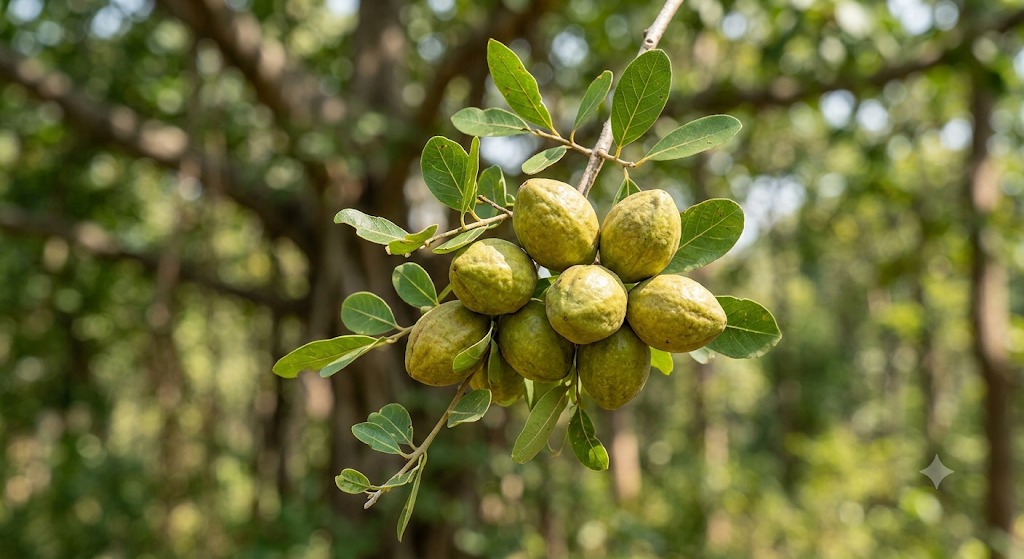
Harra is the dried fruit of Terminalia chebula. It is commonly called myrobalan. Has been connected with traditional systems of medicine for a long time.
According to the Chhattisgarh State Minor Forest Produce Federation Harra is used in the pharmaceutical and tannin industries. It is one of the ingredients of Triphala, a traditional Ayurvedic formulation.
The fruit can therefore reach markets that go beyond local use. Its worth is not in gathering the raw fruit but also in sorting, drying, grading, processing and delivering it to industries that need materials of consistent quality.
This makes Harra a good product around which a bigger value-added forest produce industry can be built.
Traditional Knowledge and Forest Livelihoods
One of the important parts of Narayanpur’s forest economy is the traditional knowledge that the communities have.
Forest-dependent families have learned how to collect things at the time, identify useful plants, harvest them properly and use different forest products in traditional ways. This knowledge has been passed on from one generation to the next. It is a big part of the culture in this area.
The financial worth of this knowledge is especially important when forest products are taken into markets. If those who collect these items get training in how to harvest in a sustainable way in grading, drying and storing they can make the products they sell better.
The goal should not just be to collect more. Instead the focus should be on collecting in a way that does not harm the environment and also getting value from each unit of what is collected.
This way of thinking can help keep the forest environment safe while also making money for the people who depend on the forest.
From Forest to Market: The Harra Value Chain
To build an ODOP ecosystem one must have an efficient ODOP value chain. The flow of steps matters.
For Harra the basic process can be understood as:
Forest → Collection → Sorting → Cleaning → Drying → Grading → Storage → Processing → Packaging → Marketing
Each stage offers an opportunity for value addition. Every step gives room to add value.
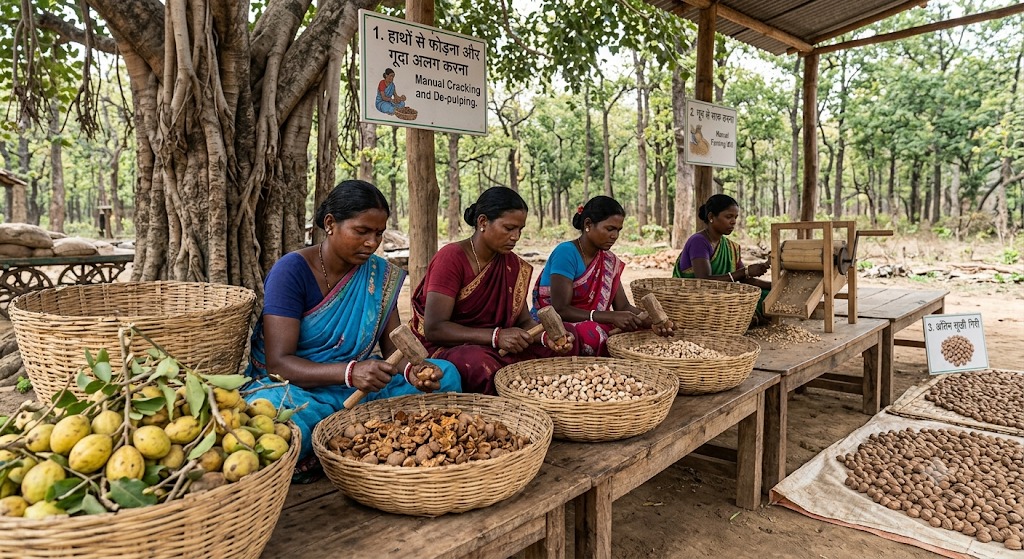
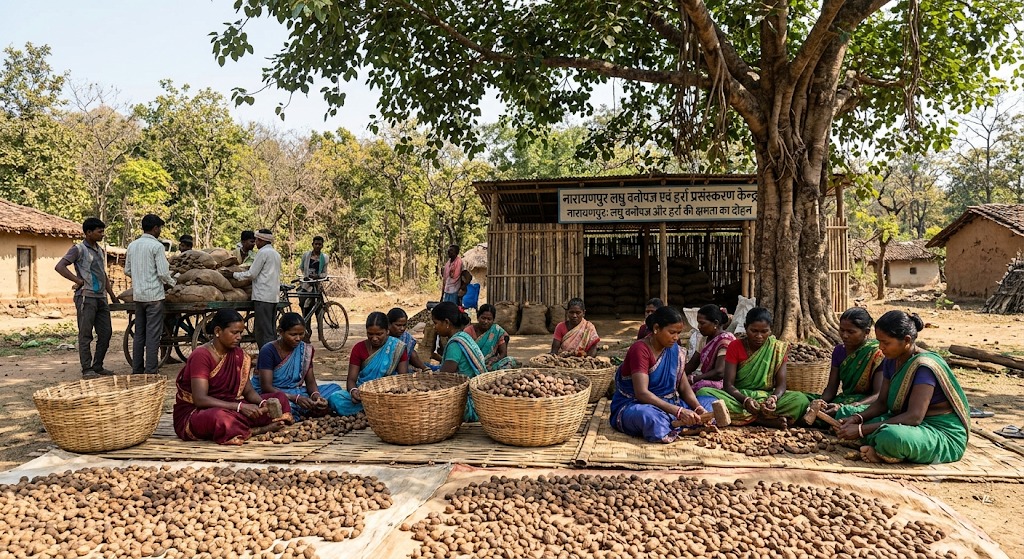
Collectors gather the fruit during the season that’s best for harvest. The produce can then be. Cleaned to remove unwanted material. Proper drying is essential because moisture can affect storage quality and increase the possibility of deterioration.
Once dried, Harra can be graded by quality and size. Better storage can keep the produce safe until the produce reaches processors or buyers.
Processing turns Harra into items for pharmaceutical, Ayurvedic, herbal and other markets. Proper packaging and labelling can then make the products easier to market domestically and even in markets.
A tidy value chain cuts waste, from picking to selling.
Importance of the Minor Forest Produce Federation
The institutional structure around forest produce is a big strength for Chhattisgarh.
The Chhattisgarh State Minor Forest Produce (Trading & Development) Co‑operative Federation works to give prices to MFP collectors and to help MFP value‑chain growth. The federation also supports MFP‑based processing units and the sustainable use of forest produce.
The state has set up mechanisms where selected minor forest products are bought at Minimum Support Prices. Harra is among the products covered by the state’s MFP procurement system. For the 2024–25 collection year the federation lists rates for whole dried Harra and for Harra kachariya.
Such systems are important because forest collectors can be hit by market price swings. Assured procurement gives income security and builds a more organised supply chain.
Harra and Value Addition
Selling dried Harra is only the first step of its economic potential.
Processing can allow Harra to reach markets. Harra can be supplied as a material to pharmaceutical, herbal and Ayurvedic industries. It can also be made into forms that fit uses.
Value addition may involve:
- Cleaning and grading
- Standardised drying
- Powdering
- Extraction
- Herbal formulations
- Ayurvedic products
- Pharmaceutical ingredients
- Natural tannin‑related products
- Packaged herbal products
The exact processing method depends on the target market and on required quality and regulatory rules.
For Narayanpur the main opportunity is to build processing facilities near the source. Then sending all raw produce out of the district more of the initial processing and value addition could happen locally. This would create jobs. Keep more economic value inside the district.
Opportunities for Tribal Entrepreneurs
Minor forest produce can provide an important foundation for tribal entrepreneurship.
Local entrepreneurs can establish small businesses involved in collection, sorting, drying, storage, packaging and marketing. Farmer Producer Organisations and community-based enterprises can also help aggregate produce from multiple collectors.
This collective approach can provide several advantages. Individual collectors often have small quantities of produce and limited bargaining power. When produce is aggregated, it becomes easier to meet the volume and quality requirements of larger buyers.
The district already has institutional structures connected with forest produce collection. A certified list of wild collectors, for example, records the District Minor Forest Produce Cooperative Union in Narayanpur and identifies products including chironji, mahua, tamarind, Baheda, Harar, wild honey and other forest produce.
Such networks provide a foundation on which more organised processing and marketing enterprises can be developed.
Women and Self-Help Groups
The development of minor forest produce can also create opportunities for women in tribal and rural communities.
Women can participate in collection, cleaning, grading, drying, processing, packaging and local marketing. Self-help groups can potentially develop small enterprises around selected forest products.
For example, instead of selling raw forest produce to traders, a community group could undertake basic cleaning, grading and packaging before selling it to organised buyers.
With appropriate training, groups could also explore value-added products based on forest fruits, seeds, herbs and other non-timber products.
This model can create supplementary household income while encouraging greater participation of rural women in local enterprises.
Sustainable Collection Is Essential
The economic potential of forest produce must always be balanced with environmental sustainability. Forests are not sources of raw materials. Excessive or poorly managed harvesting can damage plants, reduce regeneration and affect wildlife and biodiversity. Sustainable collection therefore needs to be a principle of Narayanpur’s ODOP strategy.
Collectors can be trained in harvesting seasons and methods. Certain products should be collected when mature while sufficient plant material should be left behind for natural regeneration. Storage and processing improvements are also important because they allow collectors to earn more from a quantity of high-quality produce rather than depending only on increasing collection volumes.
The Chhattisgarh Minor Forest Produce Federation explicitly lists conservation, development and sustainable utilisation of MFP among its objectives. It also promotes the cultivation of MFP species, including aromatic and dye plants. Thus the future of the sector depends on maintaining the balance between livelihood generation and forest conservation.
Improving Collection and Storage
One of the opportunities for Narayanpur is to improve post-collection infrastructure. Collected forest products often need cleaning, drying and appropriate storage. Poor storage conditions can reduce quality and result in losses. Local collection centres can provide a place where produce from villages is aggregated and sorted. Drying facilities can help improve consistency while warehouses can protect produce from moisture and pests.
The state’s MFP Federation has previously maintained warehousing infrastructure in Narayanpur, including storage facilities at Narayanpur. Expanding facilities and connecting them with producer groups can strengthen the supply chain.
Branding Narayanpur’s Forest Products
Branding can transform the perception of forest produce from a raw commodity into a premium product. A Narayanpur-based brand could emphasise:
- Forest origin
- Participation
- Sustainable collection
- Knowledge
- Natural products
Such an identity could be particularly valuable for natural-product markets. Harra for example can be positioned around its use and natural origin while maintaining compliance with applicable food, pharmaceutical and Ayurvedic regulations.
Packaging can also provide information about the product’s origin, processing method and producer group. This can help consumers understand the connection between their purchase and the communities that collected or processed the product.
Connecting Forest Produce with Modern Markets
Modern consumers are looking more and more for herbal and traditionally sourced products. This trend creates a chance for Narayanpur’s forest products. Yet getting into those markets is not about having a natural product. Narayanpur’s forest products must have quality, a dependable supply, proper packaging, certification when needed and smart marketing. Digital platforms can help local businesses reach people and big buyers outside the district. Social media can share the story behind Narayanpur’s forest products—where they come from the skills that made them and how the community helps. When Narayanpur’s forest products combine quality with a clear story they stand out from the rest.
Challenges in Developing the Sector
Narayanpur’s forest products still face obstacles even though they have great promise. One problem is the geography of many forest areas. Villages that are away often have few roads, storage and market options. The district’s official website tells us that the landscape is forested and mountainous and a few routes link Narayanpur with Kondagaon, Kanker, Bhanupratappur and Jagdalpur. Because of this transportation can become a part of the cost for moving Narayanpurs forest products. Another issue is that many items are only available in seasons. When Narayanpurs forest products are harvested at specific times, good storage and enough working capital become essential. Consistency in quality is also a worry. Different ways of gathering, drying and storing Narayanpurs forest products can lead to differences in the final item. Finally turning Narayanpur’s forest products into finished goods needs technical know‑how and money. Small producers may need help with finance and training before they can move from collection to adding value.
The Role of Farmer Producer Organisations and Cooperatives
Collective organisations can help a lot with these difficulties. Farmer Producer Organisations, cooperatives and self‑help groups can bring together Narayanpur’s forest products, bargain with buyers and get equipment that a single collector could not buy alone. They can also set rules for cleaning, drying and packaging Narayanpur’s forest products. Narayanpur’s current institutions include a Cooperative Department, Forest Department, Rural Industries Department, Commerce and Industry Department and Skill Development Department. All of these can help build a local value chain for Narayanpur’s forest products. By working these institutions can link Narayanpur’s forest collectors to training, money, processing places and markets.
A Future of Value-Added Forest Products
The long-term opportunity for Narayanpur is to move from a collection-based forest economy towards a value-added forest-product economy.
In a collection-based model most of the value is created after the raw produce leaves the district. In a value-added model more activities take place locally.
For Harra this could mean developing facilities for cleaning, grading, drying, powdering and packaging. For forest products opportunities could include processing mahua, tamarind, chironji, honey, medicinal plants and other non-timber resources.
The goal is not to industrialise the forest at the expense of nature. Instead the objective is to build medium-scale enterprises that use forest resources responsibly while increasing the economic returns to local communities.
Narayanpur’s Broader Cultural Identity
Narayanpur’s forest products cannot be separated from its culture.
The district is internationally recognised for its tribal traditions and handicrafts. Its communities have preserved lifestyles, festivals, food practices and artistic traditions. The district administration also highlights Narayanpur’s Dhokra and bell-metal craftsmanship as a part of its cultural identity.
This cultural identity can complement the ODOP initiative.
A future Narayanpur forest-product brand could incorporate the identity and storytelling of Bastar’s tribal heritage while ensuring that cultural symbols are used respectfully and with community participation.
Such an approach can differentiate Narayanpurs products from forest or herbal commodities available elsewhere.
Conclusion
Narayanpur’s selection of Minor Forest Produce, Harra as its One District One Product reflects the deep relationship between the district’s forests, tribal communities and rural economy. The Government of India has specifically recognised Narayanpur’s MFP potential under the ODOP framework while Chhattisgarh’s own forest-produce institutions provide systems for procurement, value-chain development and sustainable utilisation.
Harra stands out as a promising product. Used in medicine, pharmaceuticals and tannin-related industries it possesses value beyond the local market.
The greatest opportunity lies in increasing the value captured locally. Better collection centres, scientific drying, grading, storage, processing, packaging and branding can help transform forest produce from a commodity into a marketable value-added product.
At the time sustainability must remain at the centre of development. Forests provide not only economic resources but also ecological and cultural value. Responsible harvesting, natural regeneration and community participation are therefore essential.
For the people of Narayanpur the ODOP initiative can become more than a scheme for promoting a product. It can provide a pathway towards entrepreneurship, sustainable livelihoods, women’s economic participation, rural employment and local value creation.
The future of Narayanpur’s forest economy lies in bringing three powerful strengths—the richness of its forests, the traditional knowledge of its communities and the opportunities offered by modern processing and markets.
If these strengths are developed together Harra and other minor forest produce can carry the identity of Narayanpur beyond the forests from which they originate while ensuring that a greater share of their economic value remains with the communities that have protected, collected and understood these resources for generations.