
Introduction
Raigarh is one of the prominent districts in Chhattisgarh. Raigarh is famous for its cultural heritage, for the work of farmers, for its growing industry and for its many natural resources. Raigarh sits in the part of the state. In Raigarh both farming and industry grow together. Though Raigarh is well known for its industry and for its Kosa, silk farming is still a key way for many people in the countryside to earn a living.
Among the farming chances in Raigarh the tomato has been chosen as Raigarh’s One District One Product or ODOP. The Ministry of Food Processing Industries lists Raigarh in the tomato product category. The Government of Chhattisgarh also recognises tomato as the ODOP product for Raigarh.
Choosing tomato as the ODOP product shows a chance for Raigarh. Raigarh can turn the tomato, a farm item, into a bigger food‑processing business. By selling only fresh tomatoes, farmers and business people in Raigarh can make tomato puree, paste, ketchup, sauces, juice, chutneys, pickles and other processed foods.
This plan can raise the worth of farm goods, cut waste after harvest, give jobs to people and open new opportunities for small food‑processing companies that use tomatoes.
For Raigarh tomato products can become more, than a food label. Tomato products can build a farm‑value chain that links farmers, makers, business owners, transporters, shop owners and buyers.
Raigarh’s Agricultural Foundation
Agriculture stays a part of Raigarhs rural economy. The district contains rural zones where farming and related work help household incomes.
The agricultural scene in Raigarh gives a base for creating food‑processing activities because agricultural goods can serve as materials for local businesses. The presence of vegetables and other crops offers chances to set up processing units near where the produce’s grown.
Tomatoes fit well for value addition because they are used widely in Indian cooking and have strong demand from households, restaurants, hotels and food manufacturers.
At the time tomatoes are very perishable. When big amounts reach markets during peak production farmers can experience price changes and problems storing their produce.
Processing offers a solution, to tomatoes problem.
Turning tomatoes into longer‑shelf‑life products lets the economic value of the crop keep going after the harvest season.
Why Tomato-Based Products Are Important for ODOP
The basic objective of the One District One Product initiative is to identify products that have a local connection and support their growth through better infrastructure, value addition, branding, market access and entrepreneurship. The Ministry of Food Processing Industries says that the ODOP approach helps create scale in procurement, shared services and marketing. It also supports the development of the value chain. Makes sure infrastructure matches local products.
For Raigarh tomatoes fit well into this model. Fresh tomatoes do not last long.. Processed tomato products can be stored, moved and sold for much longer if they are handled properly and packaged well. So the shift can be seen as:
Tomato cultivation → Collection → Sorting → Processing → Packaging → Branding → Distribution → Retail
Each step in this chain brings chances, for jobs. Adds more value to the product.
From Fresh Tomatoes to Value-Added Products
The most obvious opportunity in Raigarh is to diversify the forms in which tomatoes are sold.
Fresh tomatoes can be processed into:
- Tomato puree
- Tomato paste
- Tomato ketchup
- Tomato sauce
- Tomato juice
- Tomato chutney
- Tomato pickle
- Dehydrated tomatoes
- Canned tomato products
- Ready-to-use cooking bases
Different products can target different consumer groups.
For example, ketchup and sauces can be marketed to households, restaurants and fast-food businesses. Puree and paste can be supplied to hotels, caterers and food manufacturers. Pickles and chutneys can be developed as regional or traditional products.
Dehydrated tomatoes can provide another opportunity because removing moisture can increase shelf stability and make transportation easier.
This variety allows entrepreneurs to select products according to their available investment, technology and target market.
Reducing Post-Harvest Losses
One of the problems with vegetables is the loss that happens after harvest. I have seen tomatoes fall apart quickly because they hold a lot of water and have a structure. Bad handling, long travel, storage that is not right and waits between picking and processing all lower the quality of tomatoes.
Processing food can fix this issue. I think when tomatoes are not good enough for high‑end markets but are still safe they can be turned into puree, sauce, paste or other items. This opens a market for farmers’ produce.
Processing does not replace good farming and post‑harvest care. I know that farmers must still pick tomatoes the way they are, sort them, grade them and move them properly. A smart value chain mixes both ideas: top‑grade tomatoes go fresh to market while the rest can go into processing.
Farmers at the Centre of the Value Chain
The success of Raigarh’s tomato ODOP relies a lot on farmers. I see that farmers begin the chain and when they join buying they give processors a steady supply of raw tomatoes. One farmer alone may struggle to give amounts all the time. Farmer Producer Organisations, cooperatives and farmer groups can pull tomatoes from farms together.
Buying together also gives farmers power to negotiate and cuts travel costs. I think a tighter link between farmers and processors gives farmers a market. By relying only on the daily wholesale price farmers can use extra ways to sell their tomatoes. This helps farmers earn money.
Role of Farmer Producer Organisations
Farmer Producer Organisations or FPOs can play a role in building the tomato-based-products ecosystem in Raigarh.
An FPO can collect tomatoes from its members. Manage grading, transportation and selling. In a developed model it can also get involved in processing.
For instance an FPO could create a processing unit that makes tomato puree, sauce or pickle.
This would help farmers get more involved in the value chain of just getting money from selling raw tomatoes.
Shared ownership can also make it easier to use machines, storage spaces learning opportunities and money from banks.
Opportunities for Small Food-Processing Enterprises
Tomato processing does not always mean that every person who wants to start a business needs to build a factory.
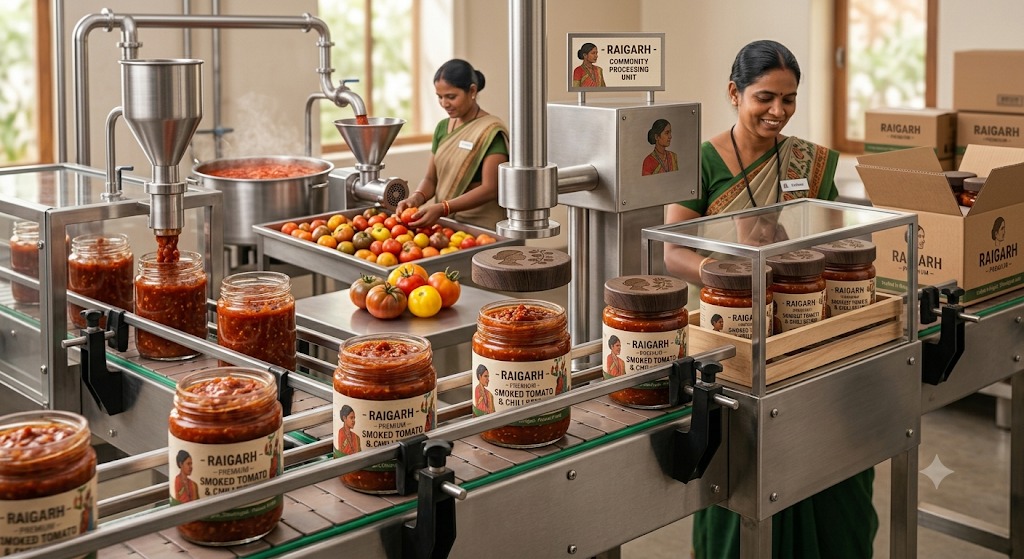
Small and tiny food-processing businesses can begin with products like tomato pickle, chutney, sauce, puree and cooking bases.
These items can be sold in shops, weekly markets, restaurants, hotels and directly to customers.
As more people want these products companies can slowly spend more on machines, packaging and checking quality.
This way of working is very important for people who want to start businesses in areas because processing places can be built near where the farmers live.
Small businesses also have the benefit of trying things and quickly changing what they offer based on what people in the local area like.
Women and Rural Entrepreneurship
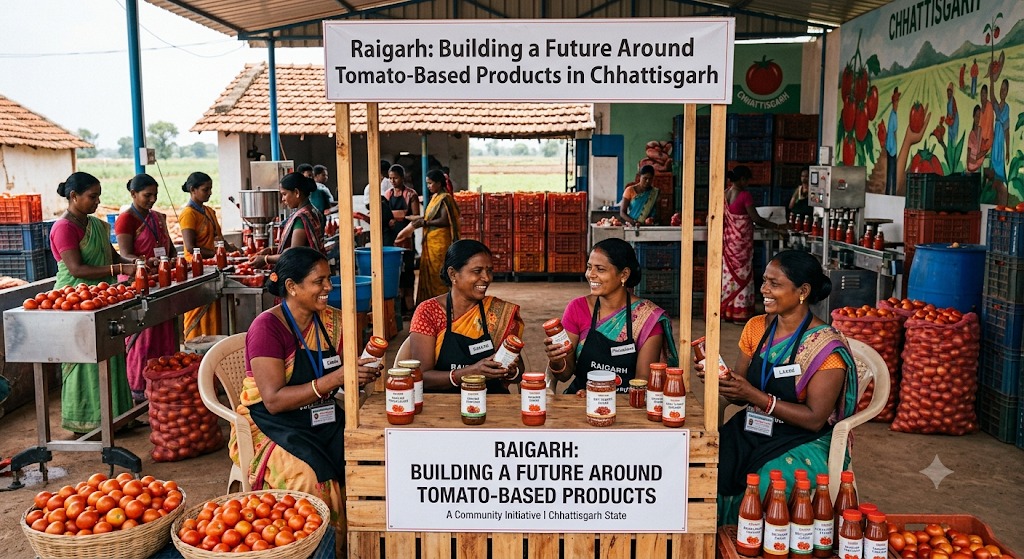
Tomato processing can create chances for women’s self-help groups and people who live in areas and want to start a business.
Products like pickle, chutney, sauce and dried tomatoes can be made on a level if people get the right training and follow proper food-safety rules.
Women-led groups can be involved in parts of the process like processing, putting the products into containers, adding labels and selling them.
A self-help-group business that works well can grow from selling in areas to bigger shops.
These kinds of businesses can give money to families and also help other women in the community find jobs.
So when women start food businesses the ODOP initiative becomes important not for farming but also for helping the economy in rural areas grow in an inclusive way.
Processing Infrastructure
Infrastructure is one of the important things needed to build a strong tomato-processing industry. A good supply chain needs:
- Collection centres
- Sorting and checking places
- Washing places
- Processing machines
- Storage places
- Packaging tools
- Testing places, for quality
- Transportation
- Cold-chain systems where needed
Collection centres can help bring tomatoes from villages. Processing plants can then turn the produce into products that can be kept for a long time.
Packaging places are just as important because the quality of the product depends not only on how it is processed but also on safe storage and moving it around.
For development, shared infrastructure can make it easier for individual business people to invest.
ODOP and the Tomato Production Cluster
Raigarh is not a case within Chhattisgarh’s tomato-processing ecosystem. Raigarh belongs to a network of tomato-processing activities in Chhattisgarh.
The Ministry of Food Processing Industries Chhattisgarh state profile identifies Korea, Mungeli and Raigarh together as a production cluster for tomato-based products under the PMFME framework. This means that Raigarh, Korea and Mungeli are linked together for tomato products.
This creates an opportunity for regional cooperation. Raigarh can work closely with its neighbours for the benefit of all.
Of every district building its own separate supply chain, Raigarh, Korea and Mungeli can complement each other. Raigarh, Korea and Mungeli can share processing technologies, packaging solutions, market connections and technical expertise.
Such clustering can generate economies of scale. Raigarh and its partners can save money by buying in bulk.
For example businesses in Raigarh and the other districts can collectively access equipment suppliers, packaging manufacturers, food-testing laboratories, technical consultants and large buyers.
A regional cluster can also make it easier to promote Chhattisgarh’s tomato-based products outside the state. Raigarh can help spread the word about its tomato products beyond Chhattisgarh.
Government Support for Food Processing
Government support can play a role in converting ODOP potential into actual enterprises. For Raigarh support can turn ideas into businesses.
The Pradhan Mantri Formalisation of Micro Food Processing Enterprises (PMFME) Scheme is designed to support food-processing enterprises through financial assistance, technical support, branding and market development. Raigarh businesses can benefit from this scheme.
The scheme is particularly relevant to ODOP products because it is built around district-level food-processing clusters and value chains. Raigarh can join this network.
For entrepreneurs in Raigarh access to support can reduce financial barriers for buying processing machinery, improving facilities and developing professional packaging.
However financial support alone is not sufficient. Entrepreneurs also need training, in food safety, production planning, accounting, branding and market development.
Quality and Food Safety
As Raigarh tomato products enter markets tomato product quality will become more important.
Consumers expect packaged food products to have taste, texture, colour, hygiene and shelf life. Tomato products must meet these expectations.
Processing units must keep hygiene from raw material handling to final packaging of tomato products.
Important areas include:
- Clean water
- Hygienic equipment
- Proper storage
- Controlled processing
- Appropriate packaging
- Quality testing
- Accurate labelling
- Safe transportation
Standardization is very important if tomato products are sold under a regional brand.
A strong reputation can take years to build. It can be damaged quickly by inconsistent tomato product quality.
Building a Distinct Raigarh Brand
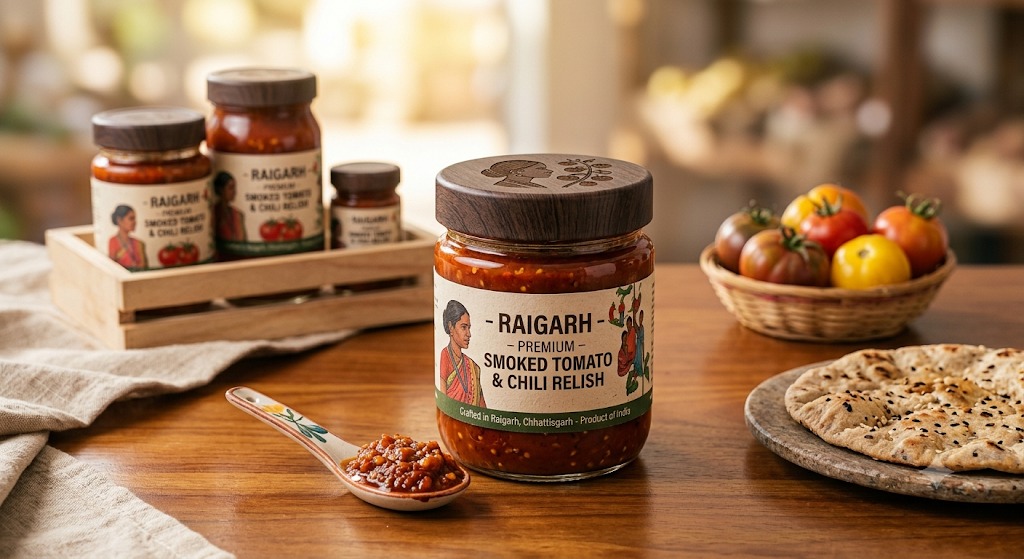
Branding can turn a commodity into a product. By simply selling tomato sauce entrepreneurs could develop tomato products that show their connection with Raigarh and Chhattisgarh.
A regional brand could emphasise:
- Sourced tomatoes
- Farmer-supported production
- Quality processing
- Chhattisgarh origin
Packaging could use elements of Raigarh identity while keeping a modern look, for retail markets. Different tomato product lines could target consumers.
For example traditional tomato chutney and pickle could appeal to consumers who want flavours while tomato puree, paste and sauce could target restaurants and urban households.
A successful brand can help consumers see the tomato product as linked to a place and good quality.
Institutional Markets
Tomato products have institutional buyers.
Restaurants use sauces. Purees a lot.
Hotels and caterers need processed tomato products for cooking.
Food makers can use tomato paste and puree.
Schools, hostels, hospitals and other institutional kitchens can also be markets for processed products if they meet buying and food‑safety rules.
Institutional buyers normally look for consistency, reliability, good price and quality.
This pushes processors to use standardised production systems.
When a business can supply consistently institutional contracts can give a demand, than seasonal retail sales.
Challenges in the Tomato Sector
Even though tomato processing has promise it faces challenges.
Seasonal Production
Tomato supply can change during the year. Processing businesses need raw material to keep their plants running well.
Price Fluctuations
Fresh tomato prices can jump a lot depending on how much’s produced, weather and market demand.
Perishability
Tomatoes must reach processing units fast. Delays can lower quality. Raise waste.
Infrastructure
Small enterprises may struggle to afford modern machinery, cold storage, testing equipment and professional packaging.
Market Competition
Processed tomato products compete with national and regional brands. Local firms need quality, fair price and strong branding.
Technical Skills
Entrepreneurs require knowledge of food processing, hygiene, shelf-life management, packaging and business operations.
Addressing these challenges requires coordination between farmers, processors, financial institutions, government agencies and market players.
Opportunities for Innovation
Innovation can help Raigarh move beyond tomato products.
Entrepreneurs can experiment with products such as
- low-sugar tomato ketchup,
- spiced tomato sauces,
- regional tomato chutneys,
- ready-to-cook tomato bases,
- dehydrated tomato flakes
- tomato powder
- premium tomato puree
The development of inspired products can also provide differentiation. For example a tomato chutney incorporating preferred spices could create a distinct product rather than competing directly with mass-market ketchup brands. Such innovation can make small businesses more competitive.
Sustainable Processing
Sustainability should be incorporated into the development of Raigarh’s tomato-processing industry. Processing generates residues such as tomato skins, seeds and pulp. By treating all waste as garbage enterprises can explore appropriate ways to manage or utilise these by-products. Organic residues can potentially be directed toward composting or other suitable applications depending on conditions and regulatory requirements. Efficient use of water and energy can also reduce production costs and environmental impact. Packaging presents another area for improvement. Businesses can explore packaging designs and responsible material use while ensuring food safety and shelf stability. A sustainable value chain can strengthen the long-term viability of the industry
Connecting Agriculture and Industry
Raigarh’s broader economic identity gives its tomato-processing sector an advantage. The district is already known for activity, which creates an environment where agriculture and industry can potentially interact. Food processing provides a bridge between the two. Farmers produce the material while industrial and entrepreneurial capabilities can provide processing, packaging, logistics and marketing. This creates a model in which agricultural development does not remain separate from development. Instead local agricultural production can become the foundation for medium-scale manufacturing.
The Future of Tomato-Based Products in Raigarh
Raigarh’s future tomato sector relies on an integrated ecosystem. The first priority is to strengthen ties between farmers and processors. The second priority is to improve collection, storage and transportation. The third priority is to grow processing capacity. The fourth priority is to create packaging and branding. The fifth priority is to link businesses with larger domestic markets and when possible export markets. The ODOP framework can give a shared direction for these tasks. Because Raigarh already belongs to the state’s recognised tomato‑based product cluster there is also room to work with tomato‑producing districts like Mungeli and Korea. Over time this can help build a tomato‑processing ecosystem across Chhattisgarh.
Conclusion
Raigarh has been named a district for Tomato‑Based Products under the One District One Product initiative. This gives Raigarh a chance to strengthen the link between farming and food processing. The Government of India lists Raigarh’s ODOP as tomato‑based products and the state’s ODOP framework also says tomato is Raigarh’s product. The biggest opportunity is to move to selling fresh tomatoes. When tomatoes are processed they can become puree, paste, ketchup, sauce, chutney, pickle, juice and other items that last longer and bring value. This change can help groups at the same time. Farmers can reach markets for their crops. Entrepreneurs can start processing businesses. Rural communities can find jobs. Consumers can buy food made. Raigarh’s place in Chhattisgarh’s tomato‑based product cluster with Korea and Mungeli makes regional cooperation and economies of scale more likely. Growing the sector will need money for collection centres, processing plants, storage, packaging, quality checks, training and marketing. Government schemes and ODOP support can help small and micro enterprises break some of these obstacles. In the end Raigarh’s tomato ODOP will succeed if the district can connect farmers, processors and consumers well. A tomato grown in a Raigarh field can become far more than a vegetable. With processing, packaging and branding it can reach markets all over Chhattisgarh and beyond. Thus tomato‑based products can add value to agriculture, spark rural entrepreneurship, create jobs, boost food processing, raise farmer income and grow Raigarh’s economy. Raigarh’s opportunity is clear: turn tomato farming into a recognised value‑added industry while keeping farmers and entrepreneurs at the centre of the journey.