Bilaspur Black Rice Products: Turning Chhattisgarh’s Unique Rice into Value-Added Foods

Bilaspur Black Rice Products show how black rice grown in Chhattisgarh can be processed into a range of nutritious, useful and market-ready value-added foods .In Chhattisgarh rice is much more than a staple food. It is deeply connected with agriculture, local food traditions and the livelihoods of farming communities across the state.. Rice does not always have to reach consumers as ordinary milled grain. Different varieties can be processed into products creating opportunities for local food businesses and entrepreneurs.
One interesting example is Bilaspur, where Black Rice Based Products have been identified under the One District One Product (ODOP) framework. The Ministry of Food Processing Industries revised ODOP list specifically identifies Bilaspur – rice based products for Chhattisgarh.
Black rice stands apart from white rice because of its naturally dark colour and distinctive appearance. Once processed it can become the foundation for food products, including rice flour, traditional preparations, desserts, snacks and other innovative foods.
The real story therefore is not simply about growing rice.It is about how the grain moves from cultivation to processing and finally becomes a value-added food product.
The journey can be understood as:
Black Rice Cultivation → Harvesting → Drying → Cleaning → Milling → Processing → Product Development → Packaging → Market
For Bilaspur and Chhattisgarh this creates an opportunity to give a rice variety a stronger identity through food processing and value addition.
Why Black Rice Matters in Bilaspur
The identification of rice based products as Bilaspurs ODOP product gives the district a clear focus within Chhattisgarhs food-processing ecosystem.
ODOP is designed to help districts build value chains around identified products, including procurement, common infrastructure, processing, marketing and branding. The PMFME programme describes the ODOP approach as a way to achieve economies of scale and develop value-chain infrastructure.
For Bilaspur the focus on rice means the opportunity extends beyond simply selling raw grain.
A farmer can cultivate the crop.
A processor can. Mill it.
A food entrepreneur can turn the grain into flour.
Another business can develop snacks or traditional foods.
A brand can package the product and connect it with consumers.
This creates a value chain around the same agricultural resource.
The Journey Begins in the Rice Fields
Every black rice-based product begins with the grain.Before it becomes flour, a snack or another food preparation the rice first has to be cultivated, harvested and prepared for processing.The quality of the product depends heavily on the quality of the raw grain.
Farmers therefore play the first and one of the important roles in the value chain.After the crop reaches the stage for harvesting the rice is harvested and collected.
The harvested material at this stage is still paddy meaning the rice grain is enclosed within its husk.
This is the beginning of the transformation.
Step 1: Harvesting the Black Rice Paddy
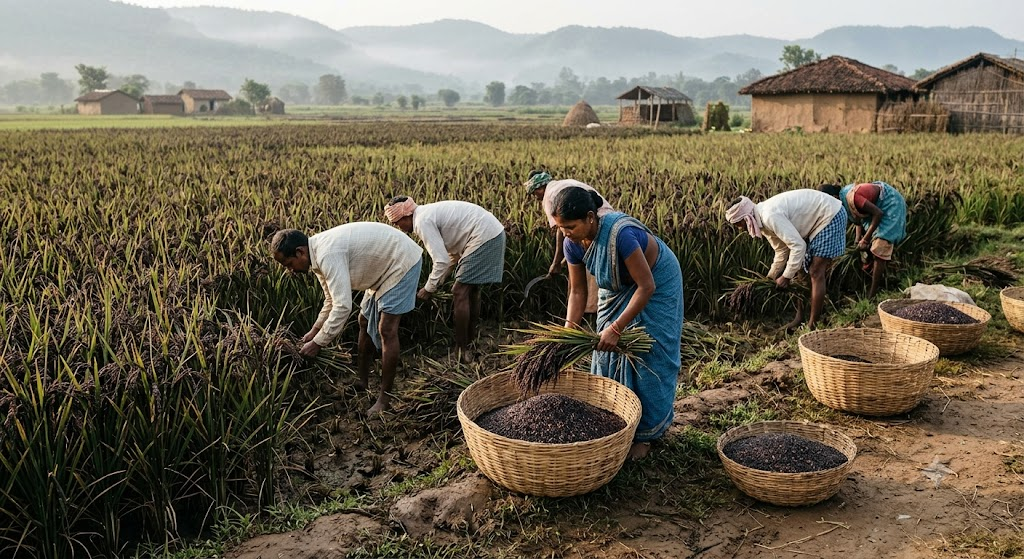
Harvesting is the physical step after cultivation.The mature paddy is collected from the fields. Brought together for further handling.At this stage the grain still contains husk. May contain field debris.Careful harvesting and handling can help minimise grain damage.For a crop such as black rice maintaining raw-material quality is particularly important because the final product depends on the characteristics of the grain.Once harvested the paddy needs to be moved towards drying and cleaning.The objective is to prepare the crop for efficient milling.
Step 2: Drying and Moisture Management
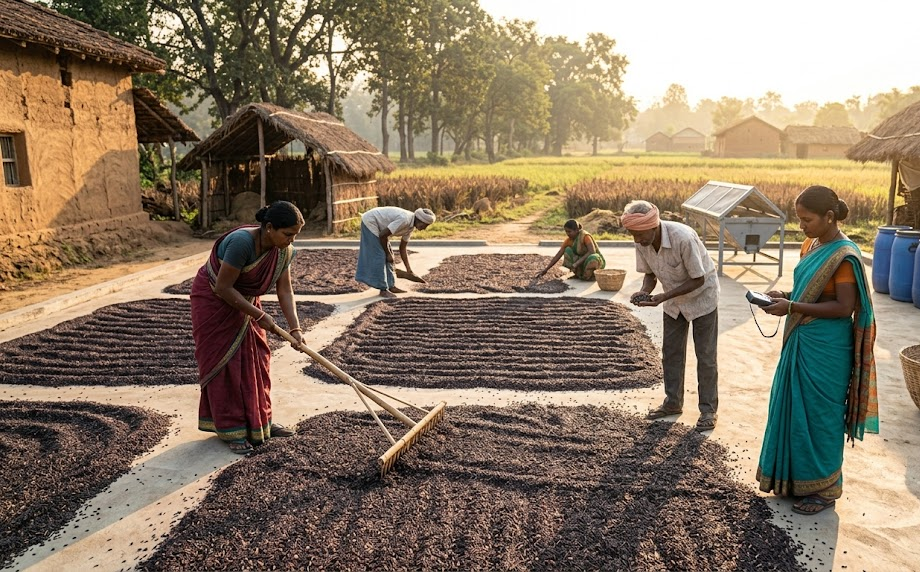
Freshly harvested paddy contains moisture.Before milling it needs to reach a moisture level for processing and storage.Drying can be carried out using traditional or mechanical methods depending on the scale of operation.At a level the process involves spreading the harvested paddy evenly and allowing moisture to reduce under controlled conditions.
However commercial processing requires attention than simply drying grain in the open.
Factors such as:
Moisture content
Drying time
Temperature
Cleanliness
Exposure to contamination
Weather conditions
can influence grain quality.
Proper moisture management helps prepare the paddy for the stages of processing.
Step 3: Cleaning and Removing Impurities
Once the paddy has been appropriately dried it goes through cleaning.
Harvested agricultural material can contain materials such as:
Small stones
Dust
Straw
Leaves
Broken plant material
Other foreign particles
Cleaning equipment can separate these materials from the grain.
At scale some sorting may also be carried out manually.
The purpose is simple:
Only suitable paddy should move into the milling process.Good cleaning improves processing efficiency. Helps maintain the quality of the finished rice.
For a branded black rice product cleanliness is especially important because consumers expect the final product to be consistent and safe.
Step 4: Milling. Removing the Husk
The cleaned paddy is now ready for milling.Paddy is not yet the rice that consumers normally cook.Its outer husk must first be removed.A rice milling system can separate the husk from the grain.Depending on the processing setup additional stages can remove impurities, separate grains and improve the consistency of the finished rice.For rice careful milling is important because the characteristic dark colour is part of the products visual identity.The aim is not simply to remove the husk.
The goal is to produce usable black rice grains while maintaining the desired quality.
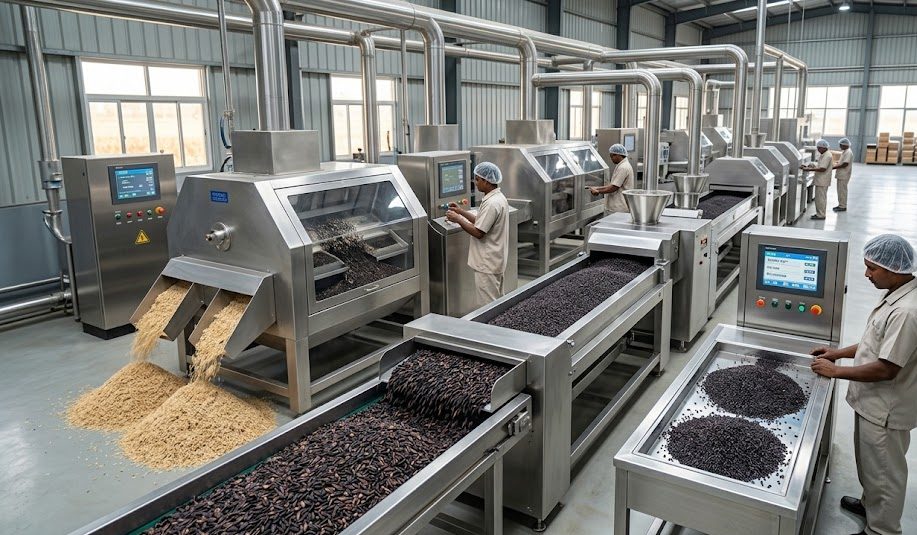
Step 5: Sorting and Grading the Finished Rice
After milling the rice can undergo another round of sorting.The objective is to create a consistent batch.Modern processing units may use optical sorting systems while smaller operations can use manual inspection.
The rice may be separated according to:
Grain quality
Size
Broken grains
Colour consistency
material
This stage becomes particularly important for products intended for premium retail packaging.A consumer buying a packet of rice expects the grains to have a consistent appearance.Good sorting therefore adds another layer of value.
Black Rice as a Food Ingredient
The exciting part of the value-addition process begins after milling.Of selling all the rice as whole grains processors can explore different food formats.
Rice-based processing is already a category in India. The PMFMEs rice-processing material lists products such as rice flour, puffed rice, flattened rice, rice-based snacks, breakfast cereals, noodles, pasta and other processed foods among value-added products.
For Bilaspurs rice-focused product ecosystem the same broad principle can be applied specifically to suitable black rice formulations.
The grain can become more than a staple.It can become an ingredient.
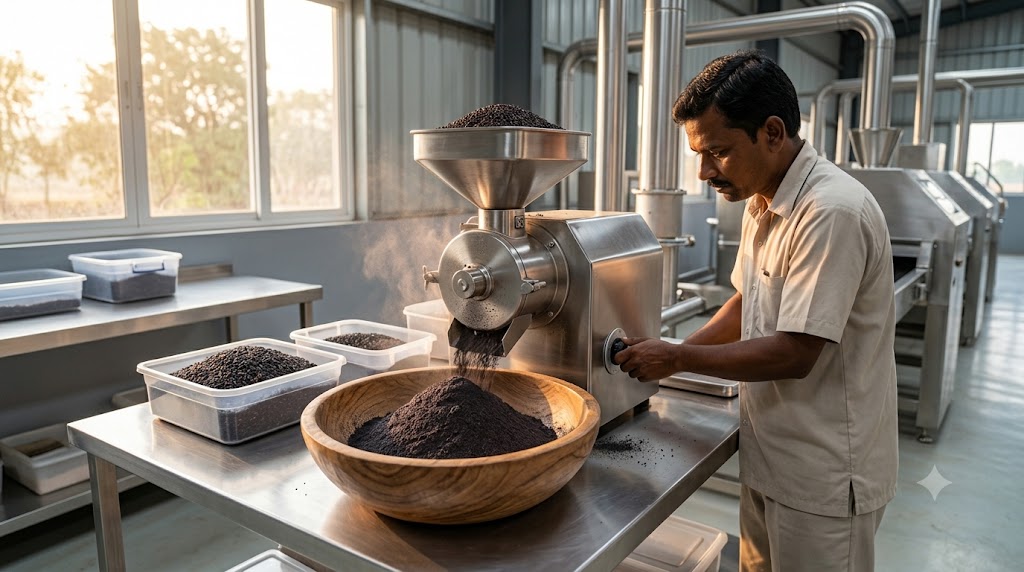
Step 6: Making Black Rice Flour
One of the ways to add value to rice is to convert it into flour.Suitable black rice grains can be. Milled further into a fine powder.The resulting flour can be used in food preparations.
Depending on the formulation black rice flour can be explored for:
Baked products
Pancakes and similar preparations
Traditional rice-based foods
Desserts
Snack formulations
flour-based recipes
The advantage of flour is convenience.Consumers do not need to perform the milling themselves.
The processor has already converted the grain into a to-use ingredient.
Step 7: Developing Traditional and Modern Foods
Black rice can also become the foundation, for a range of food products.The product-development stage is where food entrepreneurs can experiment with formats.
Possible categories include:
Black Rice-Based Desserts
Black rice can be used in selected modern dessert preparations.
Black Rice Snacks
The grain or flour can be incorporated into snack formulations.
Bakery Products
Black rice flour can be used as an ingredient in breads, cookies and other baked foods depending on the recipe.
Breakfast Foods
Processed rice ingredients can be used in breakfast preparations.
Ready-to-Cook Products
Black rice products that are properly processed can be made for people who want easy-to-use foods.
The exact way to make the product depends on what the product needs to be how it is. What food-safety rules must be followed.The main idea is to have types of products.
Of one grain making one item the same raw material can be used to make many different kinds of products.
Step 8: Black Rice Snacks and Convenience Foods
Modern people want foods that’re easy to use and have special ingredients.This gives a chance for black rice products.
For example makers can try making:
- Rice crackers
- Expanded rice products
- Snack mixes
- Ready-to-cook meals
- Rice-based breakfast foods
The PMFME says that dry rice-based products like puffed rice flattened rice and rice snacks can be sold because they are easier to use and last longer than fresh foods. For Bilaspur making these products with rice can help create a special local identity.
Why Packaging Matters
Once a black rice product is made the packaging is a part of the process.
A good package protects the food from moisture, things and damage.
Packaging also tells people about the product.
A Bilaspur black rice brand can connect the product with:
- Bilaspur
- Chhattisgarh
- Black Rice
- Local food processing
The packaging can use natural colors, pictures of rice grains and small farming elements to show the product without making false claims.
Labels should have the information required by food rules.
This might include what is in the product how much is there who made it how to store it batch details and other needed information.
Placement: After “Why Packaging Matters.”
Creating a Strong Regional Identity
A product is easier to remember when people know where it comes from.For Bilaspur the link between rice and Chhattisgarh can be a key part of the product story.
Of showing black rice as just another packaged grain brands can tell the story:
Grown in Chhattisgarh → Made in the region → Developed into different foods → Packaged for people
This creates a local identity without making the product about tourism.
- The focus is on the food.
- The field.
- The grain.
- The processing.
- The finished product.
From Farmers to Food Entrepreneurs
Adding value gives chances than just farming.
A black rice chain can involve:
Farmer → Collecting → Drying → Cleaning → Milling → Making products → Packaging → Branding → Shipping
Different people and companies can be involved at steps.Farmers give the material.
Processing places handle cleaning and grinding.
Food makers create products.Packaging companies make the products ready for sale.
Brands take care of selling.Retailers and shippers bring the products to people.
This is how one food can support an economy.
The PMFME programme also helps with training, shared facilities and help with selling and branding for groups.
Black. The Future of Food Processing in Chhattisgarh
The black rice story in Bilaspur fits into a change happening in Indias food industry.People are more interested in grains, old foods and easy-to-use processed items.At the time local business people are looking for ways to do more than just sell raw crops.Adding value brings these two ideas together.
Of asking:
“How can we sell more rice?”
the question becomes:
“How many useful food items can we make from this rice?”
This way of thinking can open up new chances.
Local Processing Can Reduce the Distance Between Farm and Consumer
When crops are processed near where they’re grown more of the value stays in the area.
The trip gets shorter:
Bilaspur Farm
↓
Local Processing
↓
Local Product Making
↓
Local Packaging
↓
Chhattisgarh Brand
↓
Indian Consumer
This does not mean every step must be in one place.
Rather it shows the chance to build local processing networks.
For rice this is useful because the products identity is tied to its special grain and local story.
Building a Diverse Black Rice Product Range
A black rice system should not rely on just one product.
Instead companies can try different types.
Whole Black Rice
The way for people who want to cook the grain themselves.
Black Rice Flour
A handy ingredient for recipes.
Black Rice Snacks
A type for packaged food markets.
Traditional Foods
Products inspired by rice-based traditions.
Ready-to-Cook Foods
A convenient choice for people.
Bakery and Dessert Items
Black rice flour or processed grain can be used in recipes.
This variety gives entrepreneurs chances to try different kinds of customers.
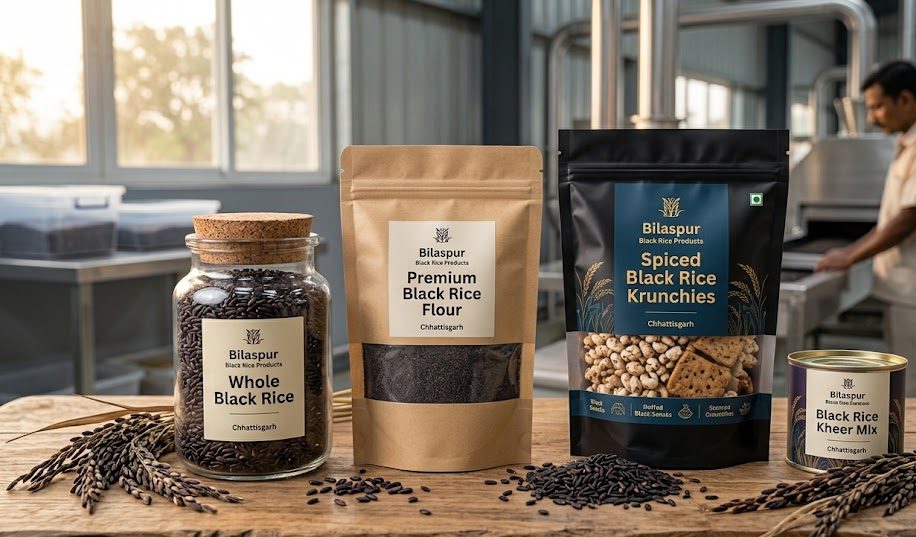
Quality Control from Grain to Finished Product
A good food product needs to be the same at every step.Quality starts with the grain.
It continues through:
- Cleaning
- Drying
- Grinding
- Sorting
- Making the product
- Cooking or processing
- Packaging
- Storing
Food businesses must also follow food-safety and labeling rules.
The PMFME training material talks about things like GMP, GHP, testing, safe storage FSSAI rules, packaging and labels as parts of food-processing training.This is important because nice packaging alone cannot make a food product.The product must also be safe. Handled properly.
The Role of Branding
Branding gives a processed food an identity.
For Bilaspurs rice products branding can focus on three main ideas:
The Grain
The special black rice itself.
The Region
Bilaspur and Chhattisgarh.
The Transformation
The journey from rice field to finished food.
A strong brand can show these ideas with how the packaging looks how the pictures are taken and how the story is told.The goal is to make people remember not the product but also where it came from.
Creating Opportunities for Local Entrepreneurs
Rice can help businesses at different levels.
A small business can start with packaged black rice.
Another can make rice flour.
A food business can create snacks.
A local place can offer grinding services to farmers.
A group of women can make value-added foods.
A bigger company can build a processing and packaging plant.
This flexibility makes adding value interesting.
Not every business needs to start with a factory.
Small-scale processing, training, quality systems and understanding the market can also help develop the product system.
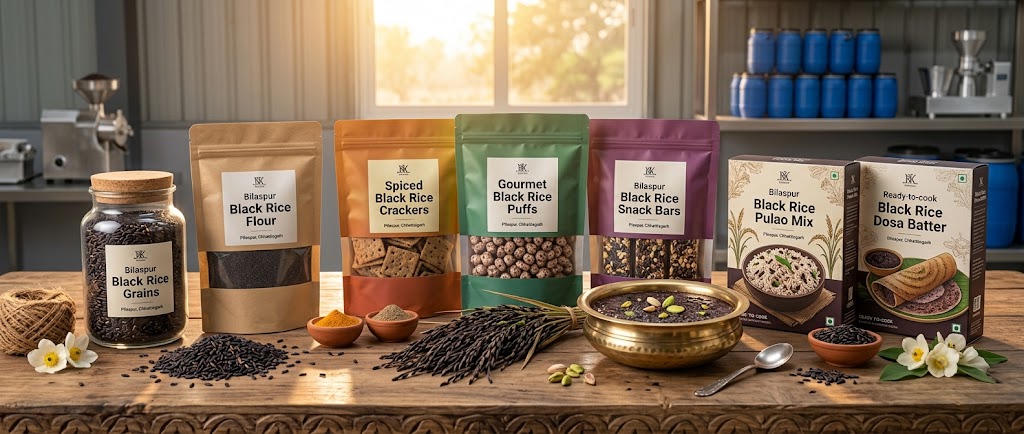
The journey can now be seen as one complete story.
It starts with black rice growing in the fields of Bilaspur, Chhattisgarh.
The mature rice is gathered.
It is dried to the level.
The grain is cleaned.
The outer part is removed during grinding.
The rice is. Divided.
Some of it stays as grain.
Some is made into flour.
Some becomes ingredients for snacks, desserts or other foods.
The final products are then packed and ready, for sale.
This is the meaning of value addition.
The product begins as a crop.
It ends as a consumer- food.
Conclusion
The story of Bilaspur Black Rice Products is a story of transformation.It starts with a grain and continues through harvesting, drying, cleaning, milling, sorting, product development, packaging and branding.
The Ministry of Food Processing Industries identifies Bilaspur – rice based products as the districts ODOP product giving the category a clear place within Chhattisgarhs food-processing framework.
The real opportunity lies beyond the designation itself.
Black rice can move from being an agricultural commodity to becoming a wider range of value-added foods.
It can be sold as grain.
It can become flour.
It can become part of snacks.
It can be developed into modern food preparations.
It can be packaged under an identity.
It can create opportunities for farmers, processors, entrepreneurs, packaging businesses and local food brands.For Chhattisgarh this demonstrates how a distinctive agricultural resource can become the foundation of a value chain.For Bilaspur black rice provides a product around which cultivation, processing, innovation and branding can come together.
The journey is simple to understand:
Paddy field → rice grain → Processing → Value addition → Packaging → Consumer
And that is what makes Bilaspurs black rice story more than a story about rice.
It is a story about how Chhattisgarh can turn a local agricultural product into a modern food-processing opportunity.
Frequently Asked Questions
1. What is Bilaspurs ODOP product?
Bilaspur is identified with Black rice based products under the PMFME One District One Product framework.
2. What makes black rice different?
Black rice has a dark appearance and can be used as a distinctive grain or ingredient in different food products.
3. What are black rice-based products?
Potential value-added formats include rice flour, snacks, traditional preparations, desserts and other suitable processed foods.
4. What is the basic black rice processing process?
A general process is harvesting → drying → cleaning → dehusking/milling → sorting → packaging or further processing.
5. Can black rice be converted into flour?
Yes. Suitable black rice can be further milled into flour for use in food preparations.
6. Why is value addition important?
Value addition allows agricultural produce to be converted into products potentially creating additional economic activity and market opportunities.
7. How does ODOP support food processing?
The PMFME ODOP approach is designed to support value-chain development, common infrastructure and marketing around identified district products.
8. Why is Bilaspur important for rice products?
Bilaspur has been specifically identified in the Chhattisgarh ODOP list, for rice based products giving the product a defined regional focus.