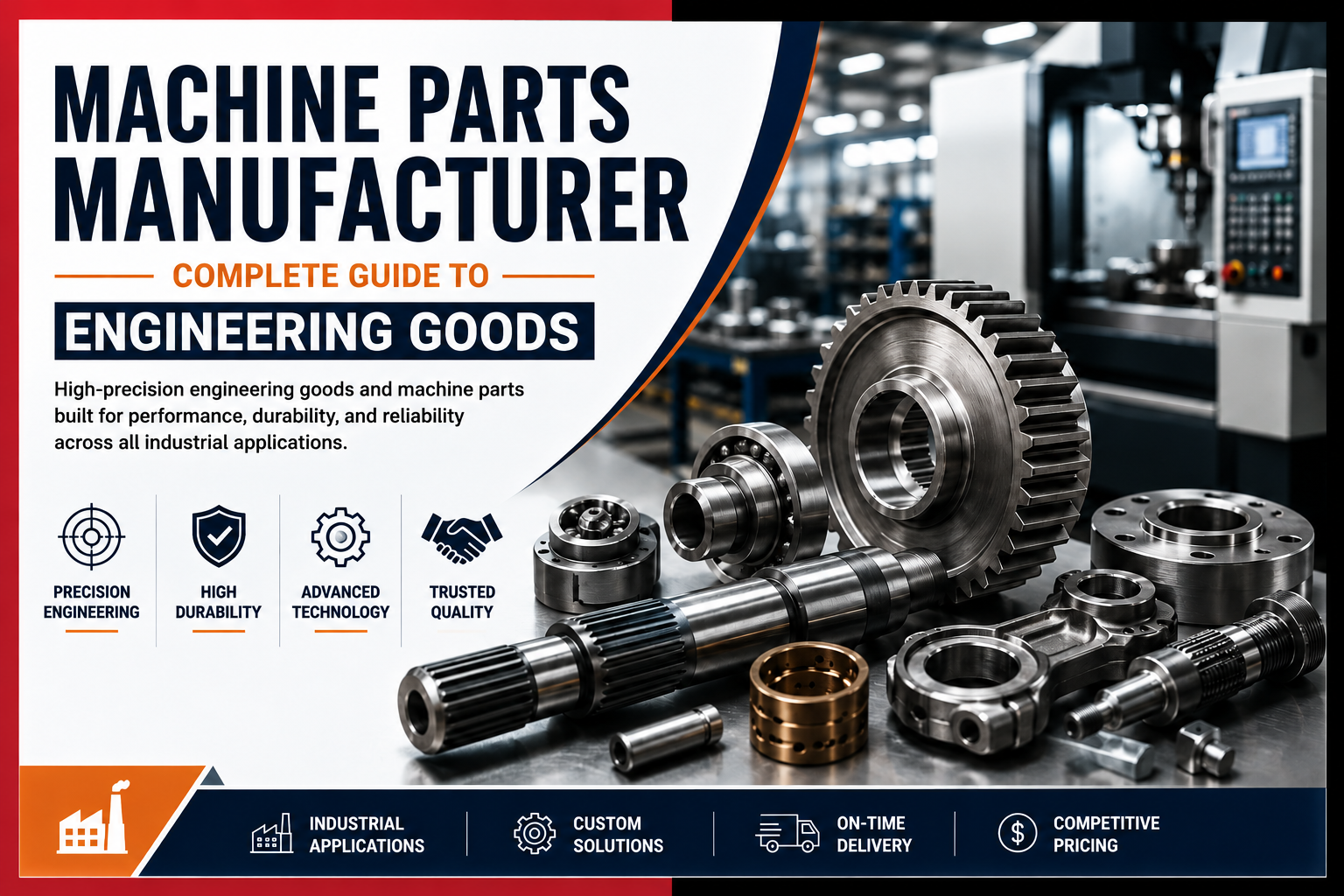
Machine Parts Manufacturer: Complete Guide to Engineering Goods and Industrial Components
Introduction
Engineering goods form the backbone of modern manufacturing, construction, automotive, aerospace, and industrial production. Whether it’s precision-machined components, fabricated assemblies, or custom industrial parts, choosing the right Machine Parts Manufacturer plays a vital role in ensuring product quality, operational efficiency, and long-term reliability.
Businesses today require manufacturers that can deliver precision-engineered components while maintaining consistent quality, competitive pricing, and timely delivery. This guide explains engineering goods, the role of machine parts manufacturers, manufacturing processes, benefits, applications, and expert tips for selecting the right manufacturing partner.
What Are Engineering Goods?
Quick Definition
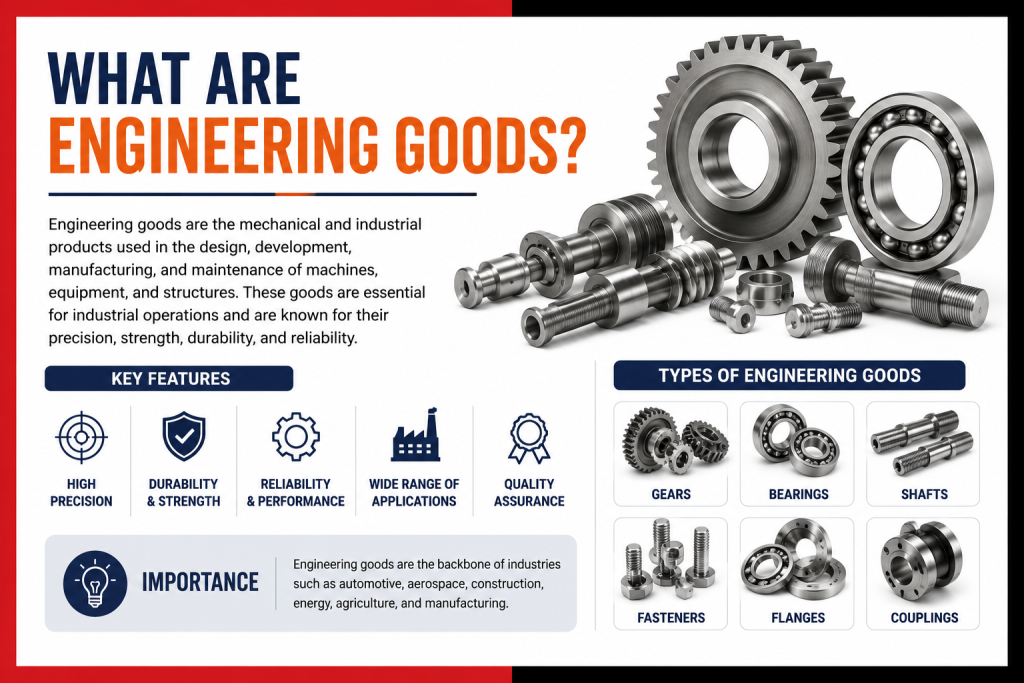
Engineering goods are industrial products and mechanical components manufactured for use in machinery, automobiles, construction equipment, industrial plants, electrical systems, and various engineering applications. A Machine Parts Manufacturer produces these precision components using advanced machining, fabrication, casting, forging, and assembly processes.
Detailed Explanation
Engineering goods include a wide range of products manufactured to precise technical specifications. These products are designed to withstand mechanical stress, high temperatures, heavy loads, and continuous industrial operation.
Machine parts manufacturers produce components using materials such as:
- Carbon Steel
- Stainless Steel
- Aluminum
- Brass
- Copper
- Cast Iron
- Alloy Steel
- Engineering Plastics
Depending on customer requirements, manufacturers also provide custom machining, CNC manufacturing, fabrication, finishing, surface treatment, inspection, and packaging services.
Key Components of Engineering Goods
- CNC Machined Parts
- Industrial Machine Components
- Precision Turned Parts
- Shafts
- Gears
- Bearings
- Flanges
- Couplings
- Fasteners
- Hydraulic Components
Why Are Engineering Goods Important?
Answer
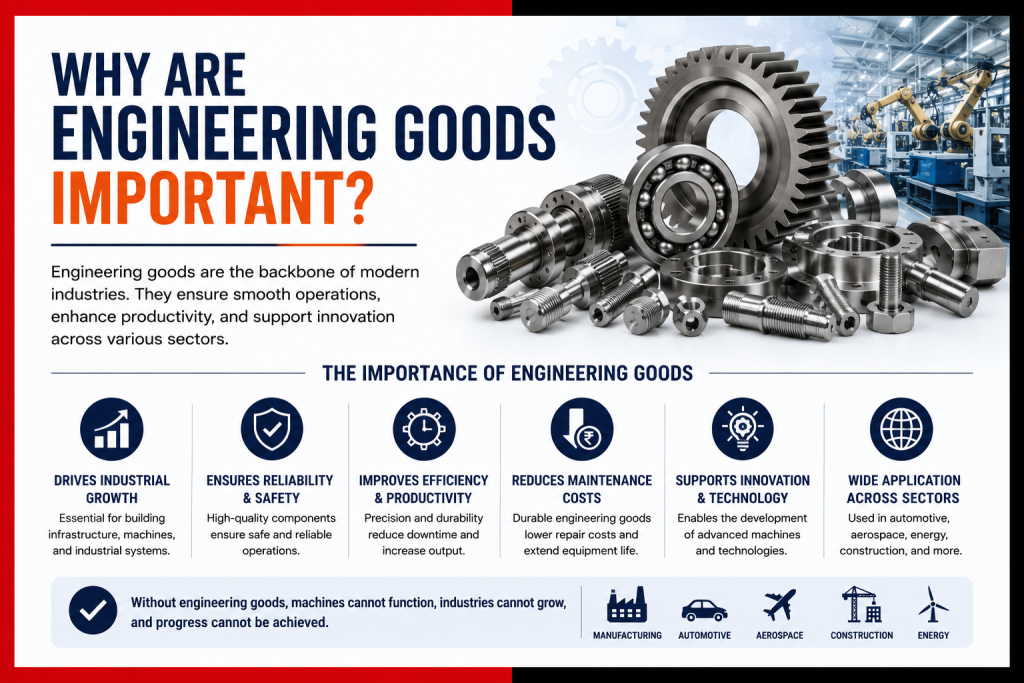
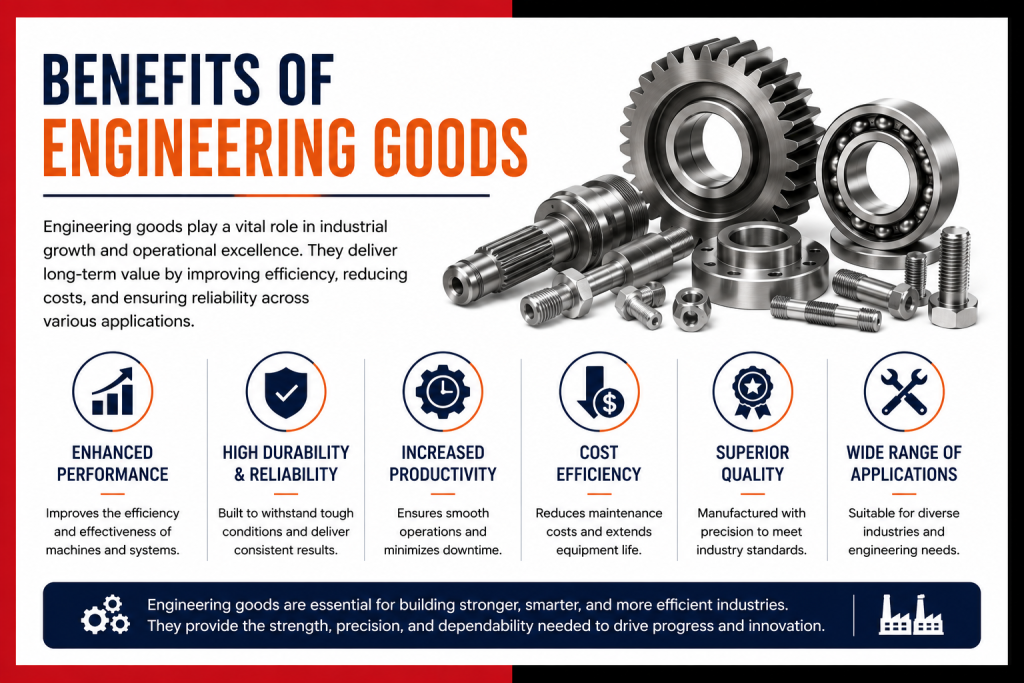
Engineering goods are essential because they enable machines, industrial equipment, and manufacturing systems to operate safely and efficiently. High-quality components improve productivity, reduce maintenance costs, enhance equipment performance, and support long-term operational reliability.
Detailed Explanation
Every manufacturing industry depends on precision-engineered components. Poor-quality machine parts can lead to equipment failure, production downtime, and increased operating costs.
Engineering goods are widely used in:
- Automotive Industry
- Construction Equipment
- Textile Machinery
- Food Processing
- Pharmaceutical Manufacturing
- Power Generation
- Oil & Gas
- Mining
- Agriculture
- Heavy Engineering
Reliable engineering goods contribute to improved machine performance and longer service life.
Top 10 Machine Parts Manufacturers in India
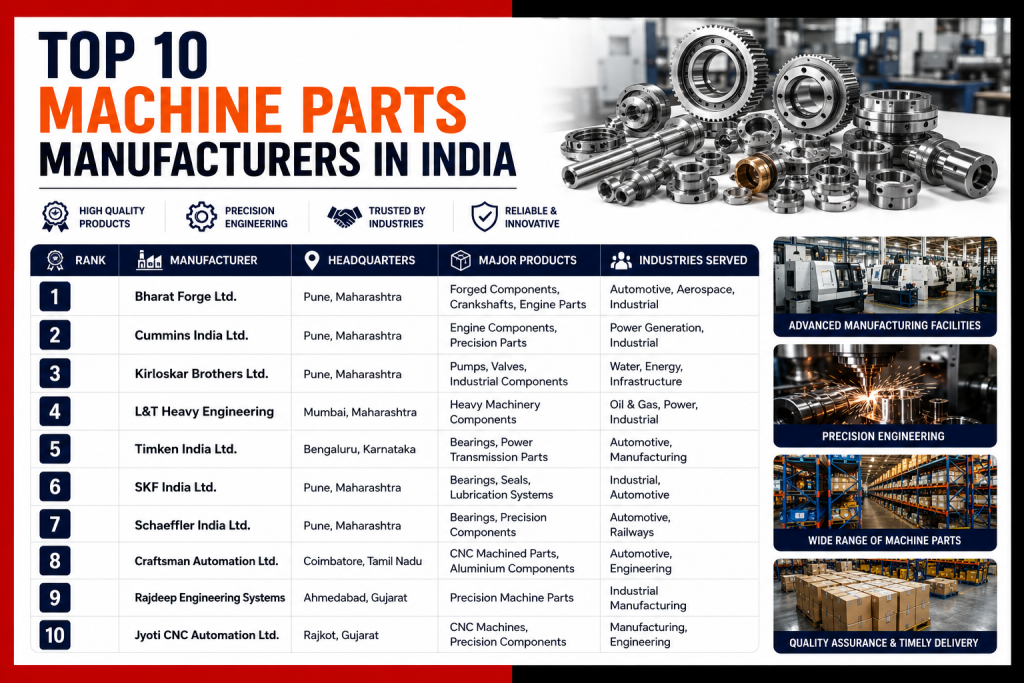
India is home to several reputed manufacturers specializing in precision engineering goods and industrial machine components. These companies serve domestic and international markets across multiple industries.
| Rank | Manufacturer | Headquarters | Major Products | Industries Served |
| 1 | Bharat Forge Ltd. | Pune, Maharashtra | Forged Components, Crankshafts, Engine Parts | Automotive, Aerospace, Industrial |
| 2 | Cummins India Ltd. | Pune, Maharashtra | Engine Components, Precision Parts | Power Generation, Industrial |
| 3 | Kirloskar Brothers Ltd. | Pune, Maharashtra | Pumps, Valves, Industrial Components | Water, Energy, Infrastructure |
| 4 | L&T Heavy Engineering | Mumbai, Maharashtra | Heavy Machinery Components | Oil & Gas, Power, Industrial |
| 5 | Timken India Ltd. | Bengaluru, Karnataka | Bearings, Power Transmission Parts | Automotive, Manufacturing |
| 6 | SKF India Ltd. | Pune, Maharashtra | Bearings, Seals, Lubrication Systems | Industrial, Automotive |
| 7 | Schaeffler India Ltd. | Pune, Maharashtra | Bearings, Precision Components | Automotive, Railways |
| 8 | Craftsman Automation Ltd. | Coimbatore, Tamil Nadu | CNC Machined Parts, Aluminum Components | Automotive, Engineering |
| 9 | Rajdeep Engineering Systems | Ahmedabad, Gujarat | Precision Machine Parts | Industrial Manufacturing |
| 10 | Jyoti CNC Automation Ltd. | Rajkot, Gujarat | CNC Machines, Precision Components | Manufacturing, Engineering |
How Does a Machine Parts Manufacturer Work?
Answer
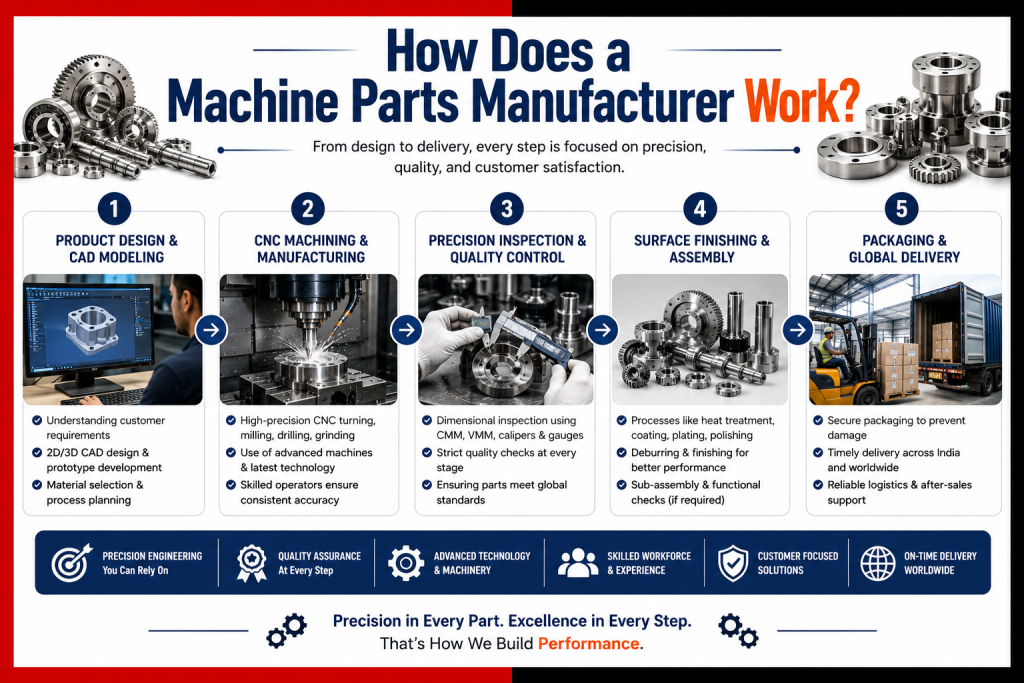
A machine parts manufacturer follows a systematic production process that begins with engineering design and material selection, followed by machining, inspection, finishing, and final delivery. This process ensures every component meets precise quality and performance standards.
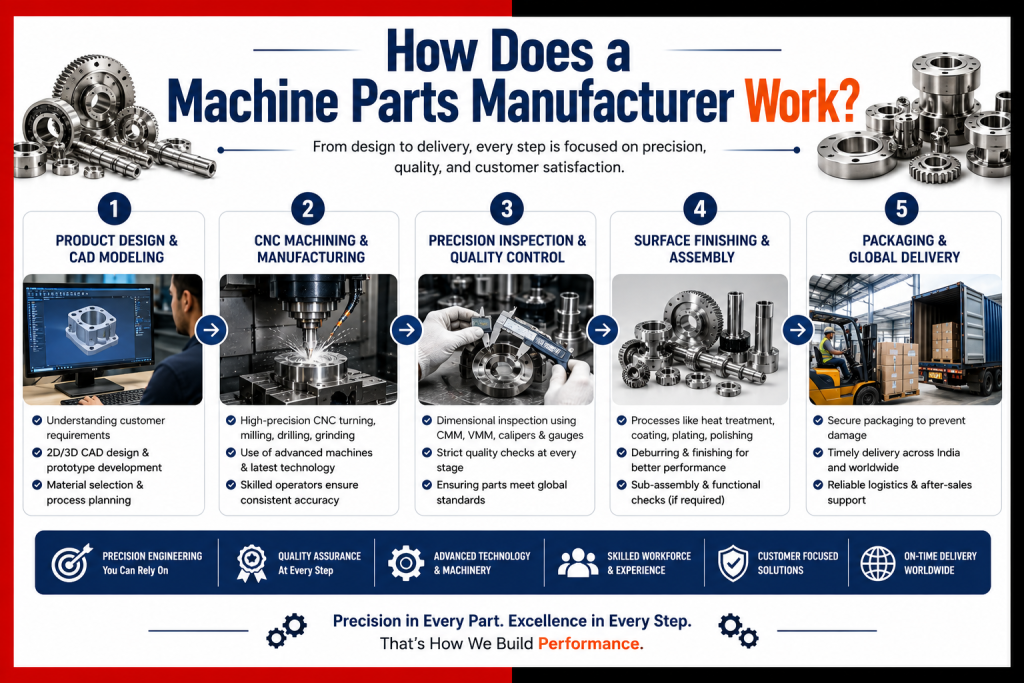
Step 1: Design and Material Selection
Manufacturing starts with technical drawings, CAD models, or customer specifications.
Materials are selected based on:
- Strength
- Wear Resistance
- Corrosion Resistance
- Heat Resistance
- Machinability
- Cost
Proper material selection directly influences product performance.
Step 2: Precision Manufacturing
Manufacturers use advanced production technologies such as:
- CNC Turning
- CNC Milling
- Grinding
- Drilling
- Forging
- Casting
- Laser Cutting
- Fabrication
Modern CNC machines ensure high accuracy and repeatability.
Step 3: Inspection and Finishing
Every component undergoes quality inspection before shipment.
Inspection includes:
- Dimensional Accuracy
- Surface Finish
- Hardness Testing
- Material Verification
- Performance Testing
Approved components are cleaned, coated if required, packaged, and delivered.
Types of Engineering Goods
1. CNC Machined Components
Precision-manufactured parts used in industrial machinery, aerospace, automotive, and medical equipment.
2. Forged Components
High-strength parts manufactured through forging processes.
Applications include:
- Crankshafts
- Connecting Rods
- Shafts
- Heavy Machinery
3. Cast Components
Used where complex shapes are required.
Industries include:
- Construction
- Pumps
- Valves
- Mining Equipment
4. Fabricated Engineering Products
Custom metal structures manufactured through cutting, welding, and assembly.
Applications include:
- Industrial Equipment
- Storage Systems
- Machine Frames
- Structural Components
5. Fasteners
Essential machine components including:
- Bolts
- Nuts
- Screws
- Washers
- Studs
6. Bearings and Power Transmission Parts
Help reduce friction and transfer mechanical power efficiently.
Used in:
- Motors
- Pumps
- Conveyors
- Gearboxes
Benefits of Choosing a Reliable Machine Parts Manufacturer
Answer
An experienced machine parts manufacturer provides precision engineering, consistent product quality, efficient production, timely delivery, and technical expertise. These advantages help businesses improve operational efficiency, reduce downtime, and enhance equipment performance.
Precision Manufacturing
Advanced CNC technology produces highly accurate components.
Why it matters
Improves machine efficiency.
Expected outcome
Reduced operational errors.
Consistent Product Quality
Manufacturers follow strict inspection procedures.
Why it matters
Ensures reliable machine performance.
Expected outcome
Fewer product failures.
Faster Production
Automated machinery increases production speed.
Why it matters
Shortens project timelines.
Expected outcome
Timely deliveries.
Custom Manufacturing
Components can be produced according to client drawings and specifications.
Why it matters
Supports specialized industrial applications.
Expected outcome
Better equipment compatibility.
Cost Efficiency
Efficient production methods reduce manufacturing costs.
Why it matters
Improves return on investment.
Expected outcome
Competitive pricing.
Improved Durability
High-quality materials extend component life.
Why it matters
Reduces maintenance expenses.
Expected outcome
Longer equipment lifespan.
Technical Support
Experienced manufacturers assist with design improvements and material selection.
Why it matters
Optimizes product performance.
Expected outcome
Higher customer satisfaction.
Scalable Production
Manufacturers can increase output as business demand grows.
Why it matters
Supports expansion without compromising quality.
Expected outcome
Long-term manufacturing reliability.
Challenges and Common Mistakes When Choosing a Machine Parts Manufacturer
Answer
Selecting the wrong Machine Parts Manufacturer can lead to poor product quality, production delays, increased maintenance costs, and equipment failures. Evaluating technical expertise, manufacturing capabilities, quality standards, and supplier reliability helps businesses avoid these issues.
1. Choosing Based Only on Price
Problem: Low-cost components may not meet quality standards.
Cause: Buyers prioritize price over performance.
Solution: Compare quality, certifications, manufacturing processes, and supplier experience before making a decision.
2. Ignoring Material Specifications
Problem: Components wear out quickly or fail under load.
Cause: Incorrect material selection.
Solution: Select materials based on operating conditions, strength requirements, and environmental exposure.
3. Skipping Prototype or Sample Approval
Problem: Finished parts do not meet design expectations.
Cause: Bulk production begins without testing.
Solution: Approve prototypes or first-article samples before full-scale manufacturing.
4. Overlooking Quality Control
Problem: Defective components affect machinery performance.
Cause: Inadequate inspection procedures.
Solution: Work with manufacturers that perform dimensional inspections, material testing, and performance verification.
5. Poor Communication
Problem: Misunderstandings lead to production delays and incorrect parts.
Cause: Incomplete technical documentation or lack of regular updates.
Solution: Share detailed engineering drawings and maintain continuous communication throughout production.
Best Practices and Expert Tips
Answer
Choosing a reliable Machine Parts Manufacturer requires careful planning, technical evaluation, and long-term collaboration. Following proven manufacturing practices helps improve product quality, reduce operational risks, and ensure consistent supply.
1. Define Technical Requirements Clearly
Provide detailed engineering drawings, material specifications, tolerances, and surface finish requirements before production begins.
2. Verify Manufacturing Experience
Select manufacturers with experience in your specific industry, such as automotive, aerospace, industrial machinery, or heavy engineering.
3. Check Manufacturing Capabilities
Ensure the manufacturer has advanced CNC machines, precision measuring equipment, and skilled engineers to meet your production needs.
4. Review Quality Certifications
Look for compliance with recognized standards such as ISO 9001, IATF 16949 (automotive), or other industry-specific quality systems where applicable.
5. Request Samples or Prototypes
Evaluate machining accuracy, dimensions, and finishing before approving mass production.
6. Confirm Production Capacity
Choose a manufacturer capable of handling both current orders and future business expansion.
7. Discuss Delivery Schedules
Agree on realistic production timelines and shipping commitments to avoid project delays.
8. Compare Total Cost
Consider machining quality, durability, maintenance savings, and long-term value instead of focusing only on the initial price.
9. Maintain Regular Communication
Review production progress regularly to resolve issues before they affect delivery schedules.
10. Build Long-Term Partnerships
Long-term relationships often lead to better pricing, priority production, and continuous technical support.
Comparison Table: CNC Machining vs Conventional Machining
| Feature | CNC Machining | Conventional Machining |
| Precision | Very High | Moderate |
| Production Speed | Faster | Slower |
| Repeatability | Excellent | Limited |
| Human Error | Minimal | Higher |
| Complex Designs | Easily Manufactured | Difficult |
| Labor Requirement | Lower | Higher |
| Initial Setup Cost | Higher | Lower |
| Best For | Mass Production & Precision Parts | Small Repairs & Simple Jobs |
Frequently Asked Questions (FAQ)
Answer
A Machine Parts Manufacturer designs, manufactures, machines, and supplies precision components used in industrial machinery, automotive systems, construction equipment, power plants, and engineering applications. Many manufacturers also provide custom machining, fabrication, inspection, and assembly services.
Detailed Explanation
Their expertise ensures machine parts meet exact technical specifications, improving equipment performance and reliability.
Answer
Engineering goods are used across automotive, aerospace, construction, power generation, oil and gas, agriculture, mining, pharmaceuticals, textiles, food processing, and manufacturing industries.
Detailed Explanation
These industries depend on precision-engineered components for safe and efficient operations.
Answer
Machine parts are commonly manufactured from carbon steel, stainless steel, aluminum, brass, bronze, cast iron, alloy steel, and engineering plastics. Material selection depends on strength, wear resistance, corrosion resistance, and operating conditions.
Detailed Explanation
Choosing the correct material improves durability, efficiency, and maintenance performance.
Answer
CNC machining delivers exceptional accuracy, repeatability, and production efficiency. It enables manufacturers to produce complex machine parts with tight tolerances while reducing errors and increasing productivity.
Detailed Explanation
Modern industries rely on CNC machining for high-quality precision components.
Answer
Evaluate manufacturers based on experience, production capabilities, certifications, quality control, technical expertise, delivery performance, and customer support before making a final decision.
Detailed Explanation
Requesting samples and reviewing previous projects can help verify manufacturing quality.
Answer
Quality inspections ensure every component meets dimensional accuracy, material specifications, and performance standards before shipment. Effective inspections reduce defects and improve machinery reliability.
Detailed Explanation
Inspection reports provide confidence that components meet project requirements.
Answer
Yes. Most machine parts manufacturers provide custom manufacturing based on engineering drawings, CAD models, prototypes, or customer specifications.
Detailed Explanation
Custom machining is widely used for specialized industrial equipment and replacement components.
Answer
Experienced manufacturers provide technical guidance, consistent quality, reliable delivery schedules, advanced production capabilities, and long-term support that help businesses improve operational efficiency.
Detailed Explanation
Strong manufacturing partnerships reduce risks and contribute to long-term business success.
Key Takeaways
- Engineering goods are essential for industrial and manufacturing operations.
- A reliable Machine Parts Manufacturer improves product quality and equipment performance.
- Material selection directly affects durability and reliability.
- CNC machining provides high precision and repeatability.
- Quality inspections reduce defects and improve consistency.
- Technical expertise and certifications are important when selecting a manufacturer.
- Custom machining supports specialized engineering applications.
- Long-term supplier partnerships often deliver better value and operational efficiency.
Final Verdict
Choosing the right Machine Parts Manufacturer is a critical business decision that affects productivity, equipment performance, and operational costs. Manufacturers with advanced machining capabilities, experienced engineers, robust quality systems, and dependable delivery schedules provide the best long-term value. Investing in a trusted manufacturing partner helps ensure precision, reliability, and sustainable business growth.
Conclusion
Engineering goods play a vital role in powering industries ranging from automotive and construction to energy and manufacturing. Selecting an experienced Machine Parts Manufacturer ensures access to high-quality components, precision engineering, and dependable production support. Before placing an order, evaluate manufacturing capabilities, certifications, quality assurance processes, and technical expertise. A well-informed decision will improve operational efficiency, reduce maintenance costs, and support long-term industrial success.
| Manufacturer | Contact |
| Kisan Engineering | Visit Website |
| SKD Filtration Engineering Industry | Location |
| PK Mechanical Engineers | Location |
| Darbara Engineering Works | Location |
| Kamal Engineering | Location |
| Shri Vishwakarma Manufacturing | Location |
| R S N Agri Eng. Works | Location |
| Balaji Welding Works | Location |
| Panchal Truck Body Maker | Location |
| Hindustan Fabrication And Body Maker | Location |
Leave a Reply