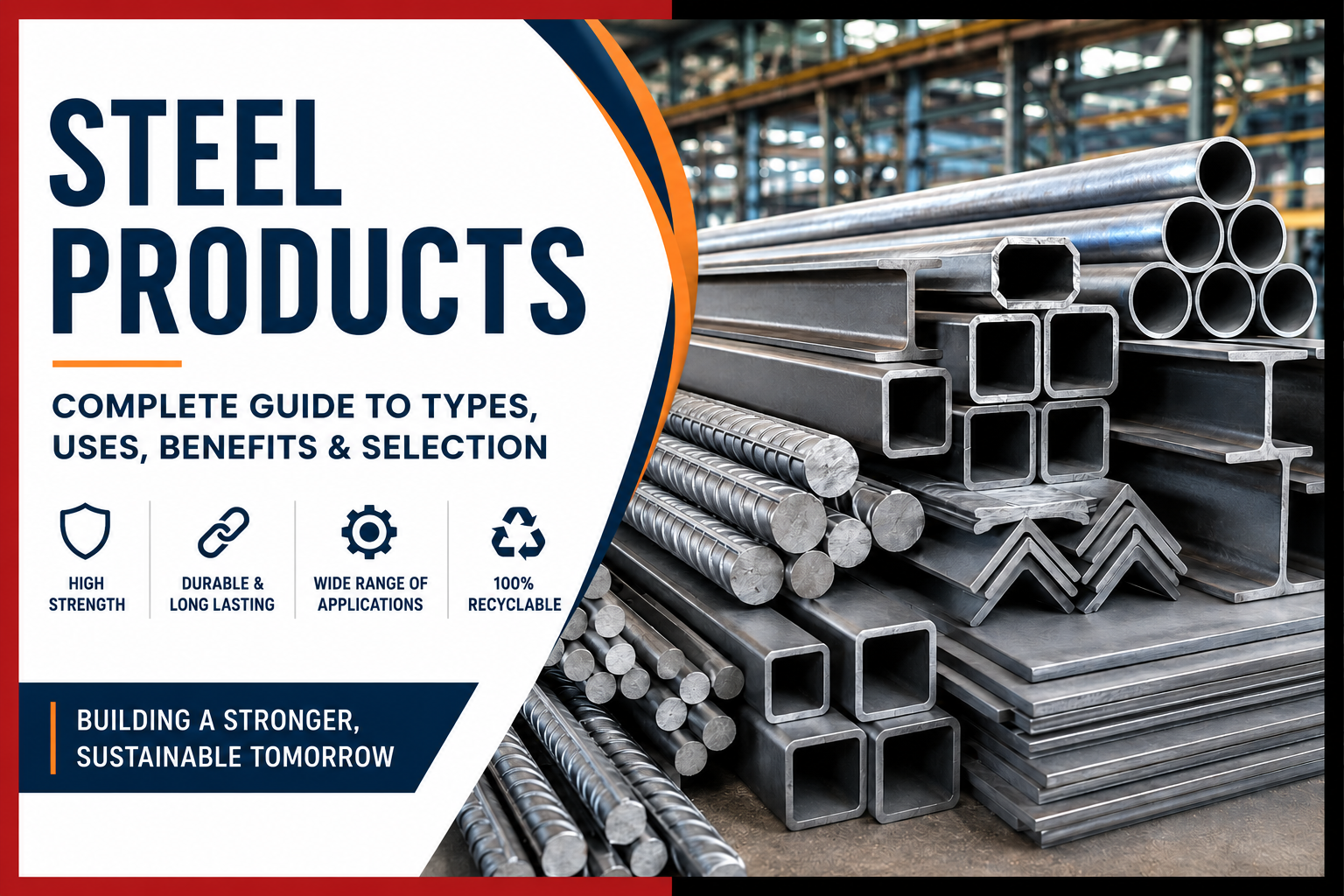
Steel Products: Complete Guide to Types, Uses, Benefits, and Selection
Introduction
Steel is one of the most widely used engineering materials in the world. From skyscrapers and bridges to automobiles and household appliances, Steel Products play a vital role in modern infrastructure and manufacturing. Their exceptional strength, durability, and versatility make them the preferred choice across industries.
Whether you are a contractor, manufacturer, builder, or business owner, understanding different steel products can help you make better purchasing decisions. This guide explains the types of steel products, their applications, benefits, selection criteria, and industry best practices.
Modern Steel Products are available in different grades, sizes, and finishes to meet the needs of construction, manufacturing, infrastructure, and engineering industries. Choosing the right steel product improves safety, durability, and long-term performance.
What Are Steel Products? Complete Guide
Quick Definition
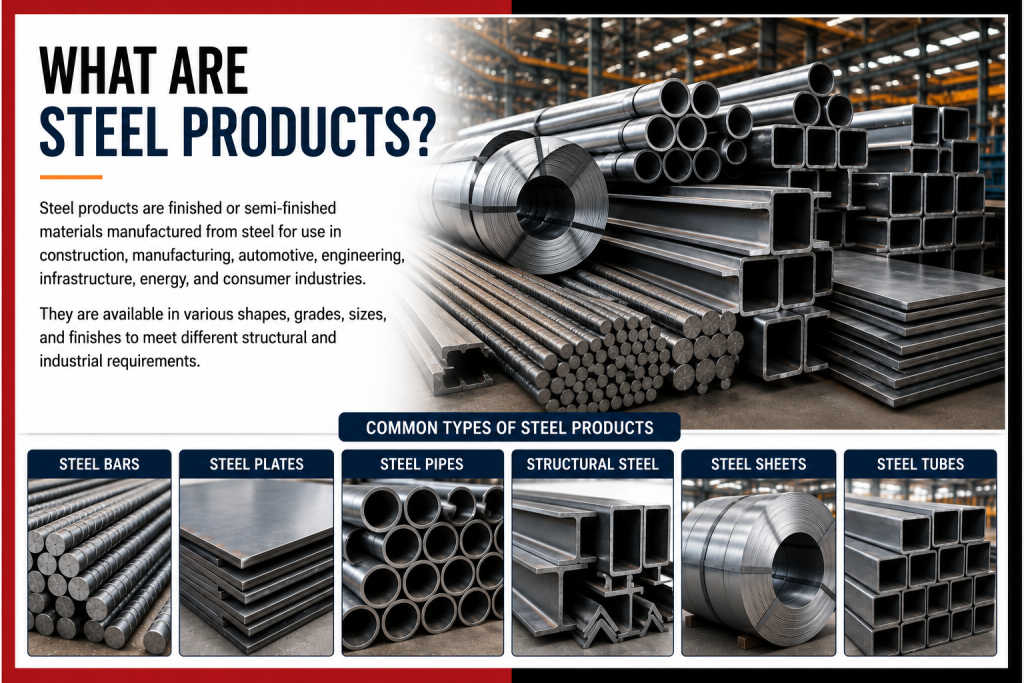
Steel Products are finished or semi-finished materials manufactured from steel for use in construction, manufacturing, automotive, engineering, infrastructure, energy, and consumer industries. They are available in various shapes, grades, sizes, and finishes to meet different structural and industrial requirements.
Detailed Explanation
Steel products are manufactured by processing raw steel into standardized forms that can be used for fabrication or direct installation. Depending on the application, manufacturers produce structural sections, sheets, coils, pipes, bars, wires, plates, and specialized components.
Different steel grades offer varying levels of:
- Strength
- Corrosion resistance
- Heat resistance
- Weldability
- Machinability
- Durability
Selecting the appropriate steel product depends on the intended application, environmental conditions, load requirements, and budget.
Key Components of Steel Products
- Structural Steel
- Steel Bars
- Steel Sheets
- Steel Plates
- Steel Pipes
- Steel Tubes
- Steel Coils
- Wire Rods
- Stainless Steel Products
- Alloy Steel Products
Why Are Steel Products Important?
Answer
Steel products are essential because they provide high strength, long service life, excellent durability, design flexibility, and cost-effective performance. They support industries such as construction, transportation, manufacturing, energy, and infrastructure while remaining highly recyclable and sustainable.
Detailed Explanation
Steel has become one of the most trusted industrial materials due to its unique combination of mechanical strength and versatility.
Major industries depending on steel products include:
- Building construction
- Automotive manufacturing
- Railway infrastructure
- Shipbuilding
- Oil and gas
- Renewable energy
- Heavy engineering
- Agriculture
- Consumer appliances
- Industrial equipment
Because steel can be recycled multiple times without significant loss of quality, it also contributes to sustainable manufacturing practices.
How Do Steel Products Work?
Answer
Steel products perform by providing structural support, load-bearing capacity, durability, and resistance to mechanical stress. Their properties depend on the steel grade, manufacturing process, surface finish, and intended application.
Step 1: Step 1: Steel Products Manufacturing Process
Raw materials such as iron ore or recycled steel are processed into molten steel.
The composition is carefully controlled by adding alloying elements like:
- Carbon
- Chromium
- Nickel
- Manganese
- Molybdenum
These elements determine the final mechanical properties.
Step 2: Manufacturing
The molten steel is converted into usable forms through processes such as:
- Rolling
- Casting
- Forging
- Extrusion
- Drawing
- Welding
- Heat Treatment
Each process creates products designed for specific applications.
Step 3: Fabrication and Installation
Steel products are then fabricated into finished components for buildings, bridges, machinery, pipelines, vehicles, furniture, industrial plants, and countless other applications.
Proper fabrication ensures safety, longevity, and structural performance.
Types of Steel Products
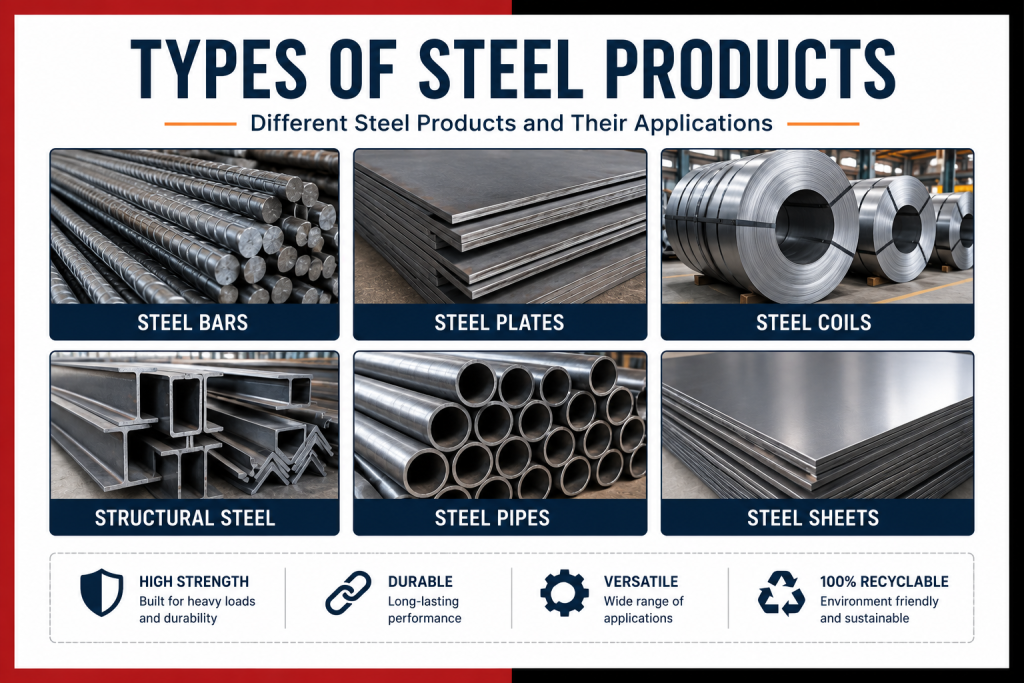
1. Steel Bars
Steel bars are widely used for reinforcement, machining, construction, and manufacturing.
Common examples include:
- Round bars
- Square bars
- Flat bars
- Hex bars
Applications:
- Construction
- Industrial machinery
- Fabrication
- Engineering
2. Steel Plates
Steel plates are thick, flat steel sections used where strength and durability are required.
Applications include:
- Bridges
- Heavy equipment
- Shipbuilding
- Pressure vessels
- Industrial machinery
3. Steel Sheets
Steel sheets are thinner than plates and are commonly used in manufacturing.
Applications include:
- Appliances
- Automotive parts
- Roofing
- Furniture
- Cabinets
4. Steel Pipes and Tubes
Steel pipes transport liquids and gases, while steel tubes are commonly used for structural applications.
Industries include:
- Oil & Gas
- Water Supply
- Construction
- Chemical Plants
- HVAC Systems
5. Structural Steel
Structural steel includes:
- I-Beams
- H-Beams
- Channels
- Angles
- T Sections
These products provide the framework for commercial and industrial buildings.
6. Stainless Steel Products
Stainless steel contains chromium, providing superior corrosion resistance.
Applications include:
- Food processing
- Pharmaceutical equipment
- Kitchen products
- Medical devices
- Marine industries
Benefits of Steel Products for Construction and Industry
Answer
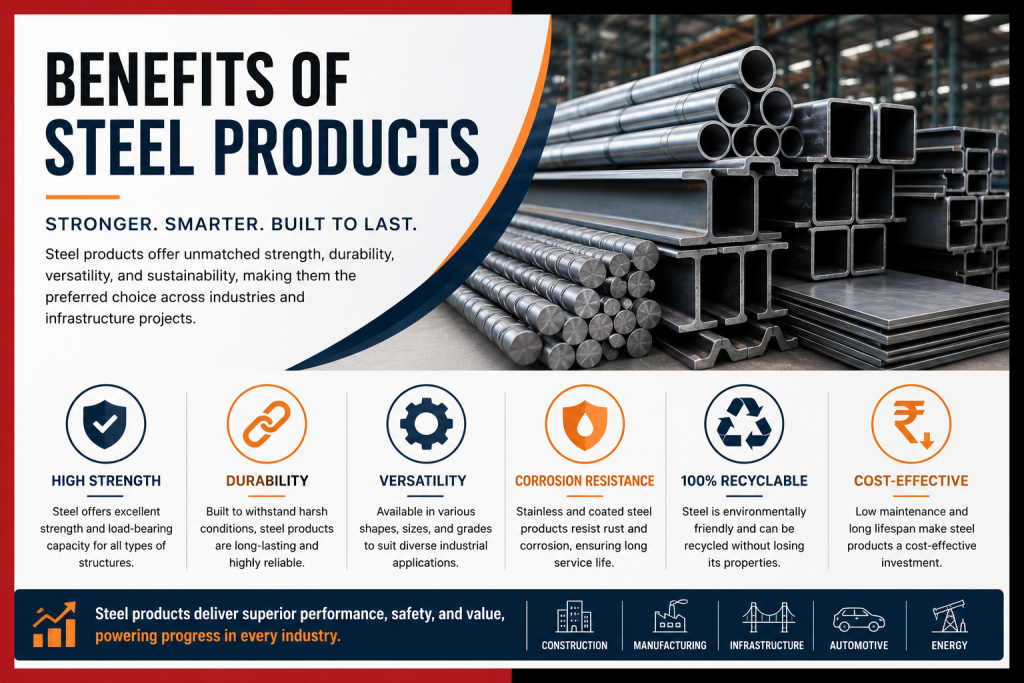
Steel products offer exceptional mechanical strength, long service life, excellent recyclability, design flexibility, and reliable performance under demanding conditions, making them suitable for nearly every industrial sector.
High Strength
Steel supports heavy structural loads without excessive deformation.
Why it matters
Improves building safety.
Expected outcome
Long-lasting structures.
Excellent Durability
Steel performs well under harsh environmental conditions.
Why it matters
Reduces maintenance costs.
Expected outcome
Longer product life.
Recyclability
Steel is among the world’s most recycled materials.
Why it matters
Supports sustainable construction.
Expected outcome
Reduced environmental impact.
Cost Effectiveness
Although initial costs may vary, steel offers excellent lifecycle value.
Why it matters
Lower maintenance and replacement expenses.
Expected outcome
Better long-term investment.
Design Flexibility
Steel can be cut, welded, bent, and fabricated into numerous shapes.
Why it matters
Supports innovative architectural and industrial designs.
Expected outcome
Greater engineering flexibility.
Fire Resistance
Many structural steel systems are designed with fire protection measures.
Why it matters
Enhances building safety.
Expected outcome
Improved compliance with construction standards.
Faster Construction
Prefabricated steel components simplify on-site installation.
Why it matters
Reduces project timelines.
Expected outcome
Lower labor costs and faster project completion.
Wide Industrial Applications
Steel products are suitable for countless industries and engineering projects.
Why it matters
Provides universal usability.
Expected outcome
Consistent performance across multiple sectors.
Challenges and Common Mistakes When Selecting Steel Products
Answer
Choosing the wrong Steel Products can lead to structural failures, corrosion, increased maintenance costs, and reduced service life. Evaluating steel grade, quality certifications, application requirements, and supplier reliability helps ensure safe and cost-effective performance.
1. Selecting the Wrong Steel Grade
Problem: The material does not perform as expected.
Cause: Lack of understanding of mechanical and chemical properties.
Solution: Match the steel grade to the intended application and environmental conditions.
2. Ignoring Corrosion Resistance
Problem: Steel rusts prematurely.
Cause: Using carbon steel in corrosive environments without protective coatings.
Solution: Choose galvanized or stainless steel for humid, coastal, or chemical-exposed areas.
3. Buying from Unverified Suppliers
Problem: Poor-quality steel affects safety and durability.
Cause: Suppliers may not follow recognized quality standards.
Solution: Purchase from reputable manufacturers that provide material test certificates and quality documentation.
4. Overlooking Load Requirements
Problem: Structural components fail under stress.
Cause: Incorrect sizing or insufficient strength.
Solution: Work with engineers to calculate load-bearing requirements before selecting products.
5. Ignoring Maintenance Needs
Problem: Frequent repairs increase long-term costs.
Cause: Lack of protective coatings or regular inspections.
Solution: Follow maintenance schedules and apply protective treatments where required.
Best Practices and Expert Tips
Answer
Choosing high-quality steel products involves understanding project requirements, verifying supplier credentials, reviewing certifications, and selecting the appropriate steel grade. These practices improve safety, durability, and overall project performance.
- Define Your Application Clearly
Understand whether the steel will be used for construction, manufacturing, pipelines, automotive components, or machinery. - Choose the Correct Steel Grade
Different grades provide varying strength, corrosion resistance, and weldability. - Verify Quality Certifications
Look for compliance with recognized standards such as ASTM, IS, EN, or ISO where applicable. - Inspect Material Before Purchase
Check dimensions, surface finish, thickness, and overall quality. - Consider Environmental Conditions
Coastal, industrial, and chemical environments require corrosion-resistant materials. - Request Material Test Certificates (MTC)
Certificates confirm chemical composition and mechanical properties. - Evaluate Supplier Experience
Experienced manufacturers often provide better technical guidance and consistent product quality. - Compare Total Cost, Not Just Price
Consider durability, maintenance, transportation, and lifecycle costs. - Plan for Future Maintenance
Proper coatings and periodic inspections extend service life. - Build Long-Term Supplier Relationships
Reliable suppliers help ensure consistent quality, timely deliveries, and better technical support.
Comparison Table: Carbon Steel vs Stainless Steel
| Feature | Carbon Steel | Stainless Steel |
| Strength | High | High |
| Corrosion Resistance | Moderate | Excellent |
| Maintenance | Higher | Lower |
| Cost | Lower | Higher |
| Weldability | Good | Very Good |
| Appearance | Industrial Finish | Premium Finish |
| Common Uses | Construction, Machinery | Food Processing, Medical, Marine |
| Lifespan | Long with Maintenance | Very Long |
Frequently Asked Questions (FAQ)
Answer
Steel Products are manufactured materials made from steel and used in construction, engineering, automotive, manufacturing, energy, and infrastructure projects. Common examples include steel bars, plates, sheets, pipes, tubes, coils, and structural sections.
Detailed Explanation
Each product is designed for specific applications based on strength, durability, and performance requirements.
Answer
The main types include structural steel, steel bars, plates, sheets, pipes, tubes, coils, wire rods, stainless steel products, and alloy steel products. Each serves different industrial and commercial purposes.
Detailed Explanation
Selecting the correct type depends on load requirements, environmental conditions, and fabrication methods.
Answer
Steel products are widely used because they combine strength, durability, versatility, recyclability, and cost-effectiveness. They perform well in demanding environments and support a wide range of engineering and construction applications.
Detailed Explanation
Their long service life and adaptability make them one of the most trusted industrial materials worldwide.
Answer
Steel products are used in construction, automotive manufacturing, shipbuilding, railway infrastructure, energy, oil and gas, aerospace, agriculture, heavy engineering, and consumer goods manufacturing.
Detailed Explanation
Their broad application range demonstrates steel’s importance in modern economic development.
Answer
Consider the intended application, load capacity, environmental exposure, required strength, corrosion resistance, fabrication process, and applicable industry standards before selecting a steel product.
Detailed Explanation
Consulting experienced suppliers or engineers helps ensure the best material choice.
Answer
Yes. Steel is one of the world’s most recycled materials and can be reused repeatedly without significantly reducing its mechanical properties. Recycling conserves natural resources and reduces environmental impact.
Detailed Explanation
Many new steel products contain recycled steel as part of their manufacturing process.
Answer
Carbon steel offers high strength at a lower cost, while stainless steel contains chromium that improves corrosion resistance and provides a cleaner appearance. The best choice depends on the intended application.
Detailed Explanation
Stainless steel is ideal for humid or corrosive environments, whereas carbon steel is commonly used for structural applications.
Answer
Quality certifications confirm that steel products meet recognized manufacturing and testing standards. They help ensure safety, reliability, and consistent performance across industrial and construction projects.
Detailed Explanation
Certified materials reduce the risk of defects and support compliance with project specifications.
Key Takeaways
- Steel products are essential for construction, manufacturing, transportation, and infrastructure.
- Different steel grades are designed for different applications.
- Selecting the correct product improves safety, durability, and cost efficiency.
- Corrosion resistance is an important factor in material selection.
- Quality certifications help verify product performance.
- Reliable suppliers contribute to consistent quality and timely delivery.
- Steel is durable, recyclable, and suitable for a wide range of industries.
- Proper maintenance extends the lifespan of steel structures and components.
Final Verdict
Steel Products remain the backbone of modern construction, engineering, and industrial manufacturing. Their unmatched combination of strength, durability, versatility, and recyclability makes them an excellent investment for projects of every scale. By selecting the right steel grade, verifying product quality, and working with trusted suppliers, businesses can improve operational efficiency, reduce maintenance costs, and ensure long-term structural reliability.
Conclusion
Whether you are planning a commercial building, manufacturing equipment, or developing infrastructure, choosing the right Steel Products is critical for long-term success. Understanding different product types, applications, quality standards, and selection factors helps you make informed purchasing decisions. By partnering with reputable manufacturers and following industry best practices, you can maximize performance, safety, and value while ensuring your project meets both present and future requirements.

| Manufacture | Contact |
| Hisar Steels Pvt. Ltd. | Visit Website |
| JNB Steel Industries Pvt. Ltd. | Visit Website |
| Rawalwasia Steel Plant Pvt. Ltd. | Visit Website |
| Rawalwasia Ispat Udyog Pvt. Ltd. | Visit Website |
| Hisar Stainless Steel Pipes Company | Visit Website |
| Bharat Stainless Steel Pipes & Coils Hisar | Location |
| Ramsons Stainless (Pipes Division) | Visit Website |
| Swastik Stainless Steel Industry | Visit Website |
| JIYO Stainless Private Limited | Location |
| Hissar pipes Pvt. Ltd. | Location |
Leave a Reply