
State – Assam
District – Majuli
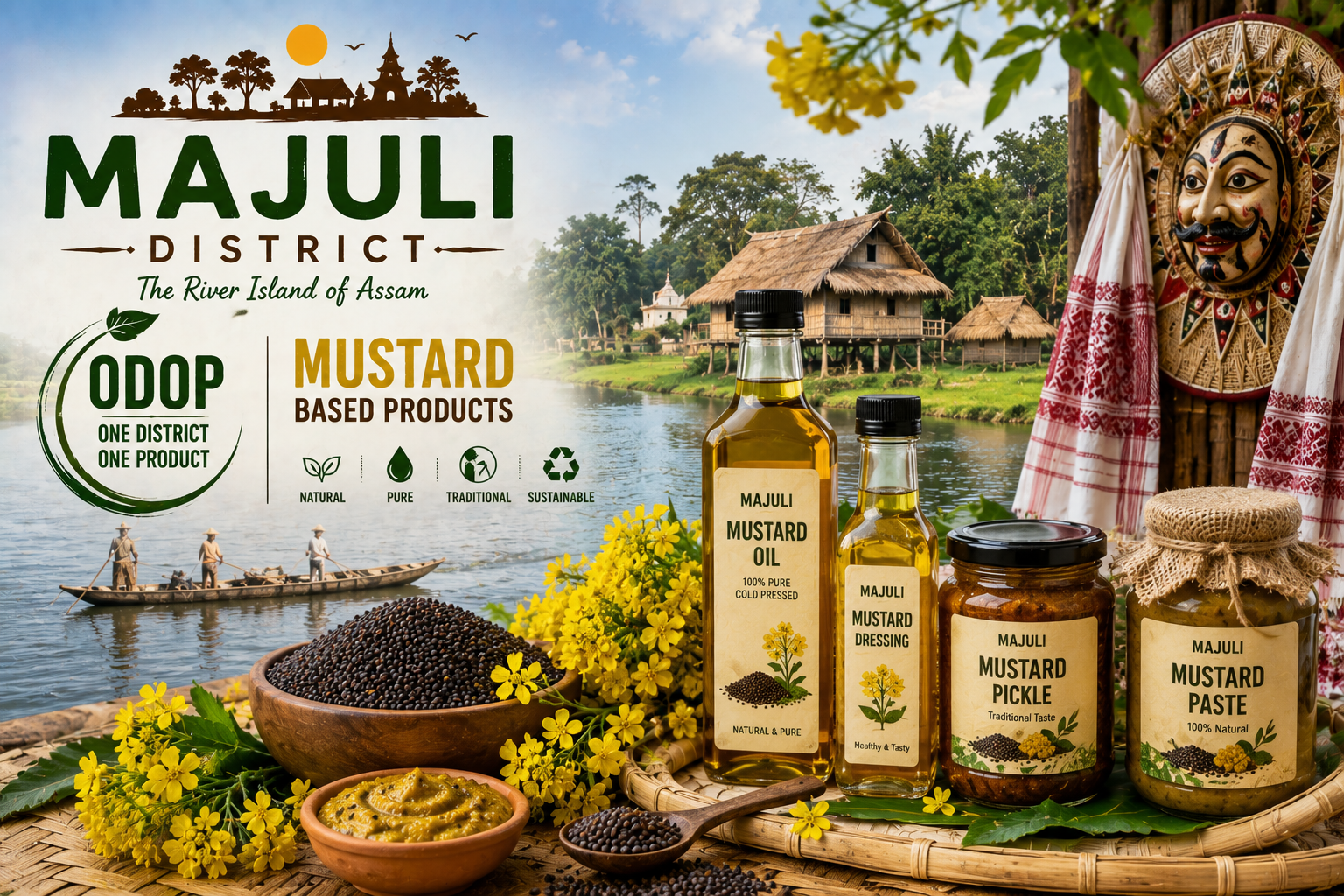
ODOP Product – Mustard Seeds & Mustard-based Products
There are places, where food is not the end or means but a legacy. Where food is a continuum of people, land, and seasons, the traditional, cultural, and agricultural practices. Majuli is one of those beautiful places in Assam, a district known for its landscape, cultural diversity, age-old traditions, and festivals.
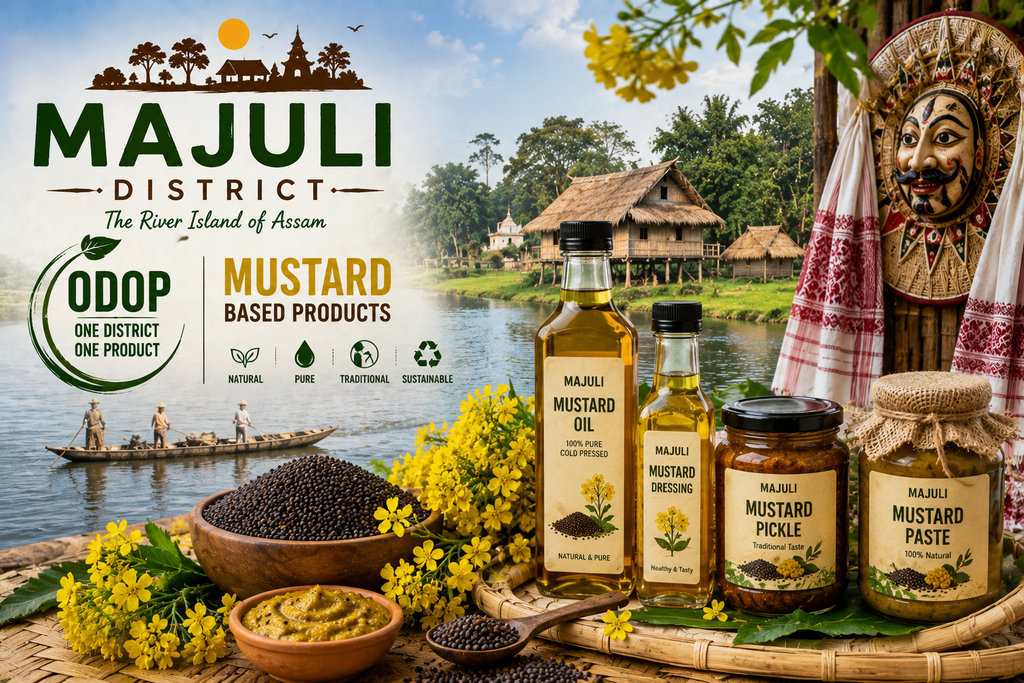
But not many know that the food here is a reflection of this cultural diversity, and it is impossible to imagine this land without its local produce, local seasons, local recipes, and traditional Assamese cuisine.
And that is where mustard fits in.
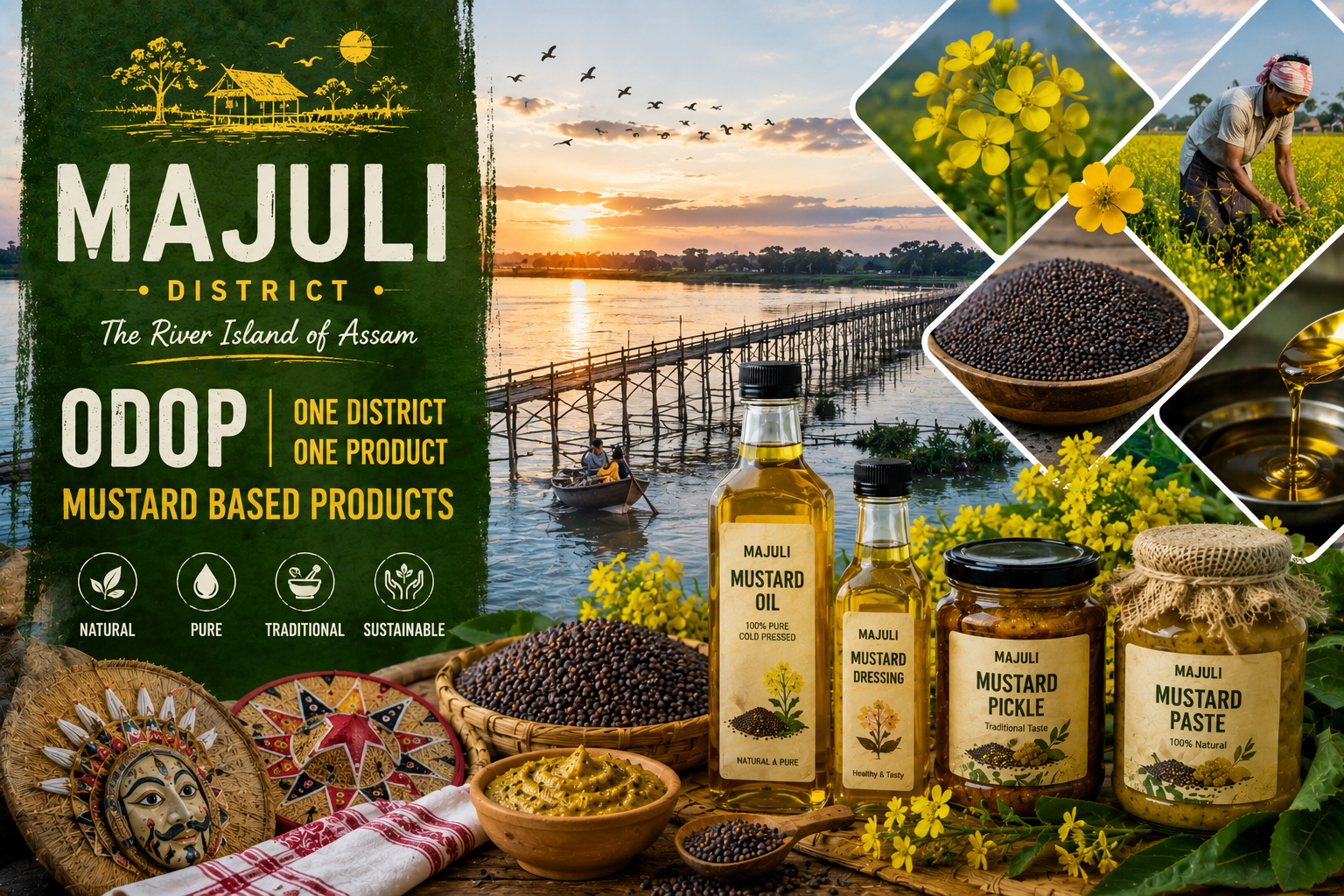
Mustard is the proud produce of this river-land district and has been given special recognition under the state’s flagship program, ‘One district One Product.’
Mustard, for the people of Majuli has been a traditional agricultural crop that has been a part of this land for ages. This land, known for its wide variety of produce has been home to mustard cultivation as well. For the locals, nothing is more traditional than their own produce, and mustard fits right in with its association with traditional Assamese cuisine.
So let us take a closer look at this product that is the pride of Majuli and how it has been an essential part of the lives of its people for generations.
Yellow Mustard Fields of Majuli
Mustard cultivation is one of the most integral a part of local Assamese culture. The yellow mustard fields make for an image that is iconic for any visitor to this district.
But for the locals, these mustard fields are a source of a livelihood, and they toil in this land to bring in the produce, for which Assam is now famous for. Mustard cultivation is an activity closely associated with the Assamese culture and tradition, for it has been a part of the Assamese lifestyle for years.
For centuries, mustard has been planted in the fertile Brahmaputra basin and later been extracted to make edible oil.
Mustard cultivation is traditional, and so is the extraction, and it is the association of this local produce with local recipes that makes mustard an epitome of Majuli.
A Whiff of Traditional Mustard Oil
If you ask any Assamese person about mustard oil, you can be sure you will hear a long-winding story of its fragrance and unique flavor.
Mustard oil is traditionally used and is famous for the distinct smell it adds to Assamese dishes. Almost all traditional Assamese dishes use mustard oil in one way or another. There was a time, when cooking at home was simple and straightforward with every ingredient being sourced out from nearby places.
The Assamese homes then were a perfect example of sustainable living and self-sufficiency.
Mustard oil has traditionally been used by Assamese people for its rich flavor and fragrance.
The staple diet of rice, vegetables, and fish was complemented by the mustard oil, which made every dish tastier and more appetizing. These traditional methods of cooking are now being rediscovered as they are the perfect example of a healthy and sustainable lifestyle. The unique and rich flavor of mustard oil is now being recreated and is being sold across the country as a specialty food item, famous for its unique aroma.
Mustard, being an integral part of this traditional Assamese culture fits in perfectly within the local Assamese cuisine. Most traditional Assamese dishes are known to have been cooked in mustard oil with the fragrance being distinct to each dish.
Now, if you think the traditional Assamese cuisine is only about the unique flavor, then you are in for an exciting surprise. The simplicity of this cuisine is what has drawn food connoisseurs from across the globe.
Old Assamese Cuisine – The Simplicity and the Tradition
Unlike the complex and elaborate dishes of other cuisines, traditional Assamese cuisine has been all about letting the natural flavors speak for themselves.
There is no overload of gravies and spices that mask the true taste of the ingredients used in cooking. In fact, most traditional Assamese dishes are all about the simple ingredients that are locally available.
Take rice, for example, that has been the staple diet of Assamese people for centuries.
It was accompanied by simple dal, veggies, fish, and other locally available produce. Mustard oil was the binding element that added to the flavor and fragrance of the dish. It may sound simple, but the taste is incomparable. In fact, that is the main reason why this traditional Assamese cuisine is being recognized globally now. But what makes this cuisine special is its unique association with local products like mustard.
Mustard oil has been the integral part of traditional Assamese cuisine.
And it is not just about the oil; traditional Assamese cuisine also has a wide variety of mustard-based preparations, with mustard seeds playing the starring role. Fish, a traditional delicacy of Assamese people has been prepared in various traditional Assamese ways using mustard seeds and mustard oil.
Traditional Assamese Recipes – The Legacy of Generations
Fish, a traditional delicacy of Assamese people has been prepared in various traditional Assamese ways using mustard seeds and mustard oil. Each preparation has a unique flavor, and the tangy fragrance of mustard is unmistakable.
For generations, these traditional Assamese preparations have been the favorite of Assamese people, with almost every household having its unique recipe that has been passed down through generations. Even today, these preparations are made in exactly the same way as they have been made centuries ago.
There is no written recipe to follow, but the knowledge is passed on from one generation to another. So, the preparation of mustard-based Assamese recipes have been the staple diet of Assamese people for centuries.
Another traditional Assamese dish that has been a favorite of Assamese people for generations is ‘Pitha’. Traditionally made of rice, Pitha has been an integral part of Assamese culture and is also closely associated with the Assamese festivals. Similar to the Assamese cuisine, each family prepares the Pitha in its unique way.
Pitha is more than just a snack for the Assamese people. It is a celebration of tradition and culture that is handed down from one generation to another. Even today, making Pitha is the favorite activity of families living in Assam, with the elders passing on their invaluable knowledge to the younger ones. It is the unique culture of Assam that makes these traditional dishes a favorite among locals and a must-try for visitors.
Traditional Assamese dishes are a reflection of this land and its rich cultural legacy. And with a strong agricultural background, Majuli has been home to a variety of traditional dishes that have been cooked with a mix of local produce.
Majuli’s unique mustard has played a significant role in these traditional recipes, from being a key ingredient to a vital component in traditional Assamese cuisine. Traditional Assamese cuisine, in turn, has been a vital part of Assamese culture, with its unique legacy being handed down from one generation to another.
Why Mustard is a Winner for Majuli
Mustard is a winner for Majuli as it has a number of applications and can cater to the needs of almost all stakeholders.
For farmers, it is an agricultural crop that has immense potential to increase their income. For the local people, it is a staple diet. And for the local entrepreneurs, it is an opportunity to establish their own brands and sell value-added products.
And that is where the ODOP tag comes in handy as it will facilitate the process of branding.
Mustard-based products have immense potential in the local as well as the national market, with entrepreneurs being able to create a wide variety of products that can cater to the local as well as the global market. These products can range from traditional oil to cold-pressed oil, cleaned and graded mustard seeds, mustard powder, traditional cooking masala, and even small retail packs of mustard seeds. Local mustard oil can be packaged in small and attractive retail packs that can create an image of a specialty product.
Even local products like Pitha can be marketed as regional specialties and can find their way into the national and even the international market. So yes, there are huge opportunities for local entrepreneurs who wish to build a brand around local mustard-based products. And since these products are mostly made from locally available resources, it makes them even more special. So, let us take a comprehensive look at all the business opportunities that come with promoting a district’s product.
One of the major benefits of creating value-added products is that it adds to the value of the local resources. Take mustard, for example, which has a wide application, but only a few people are aware of it. The product has an immense amount of potential, which is yet to be explored.
So, as a local, you can help promote your district’s product by not only selling the raw material but by creating a wide variety of value-added products that can fetch a higher price in the market. You can explore the local opportunities and create products that are in demand and are suitable to your budget and skills. For instance, you can clean and grade mustard seeds, which is a laborious task but can yield great profits. You can sell mustard oil in small and attractive retail packs, market it as a specialty product.
So, you can explore the local opportunities, add value to local resources and reap the benefits.
Another great thing about value-added products is that they have a wide market reach. If we take the example of mustard again, a single crop can result in a wide variety of products that can target different segments of the market.
Products like mustard oil, mustard powder, mustard seeds, cold-pressed mustard oil, etc., all target different market segments. Local farmers can tie up with local processors who can help them create value-added products that can help them earn better prices for their produce.
Local farmers can also tie up with local transporters and marketers to help them promote their products at the local level.
And for local people who have the skill of making traditional Assamese dishes, they can explore the option of selling their products online or set up their own small-scale processing units. Thus, by leveraging the concept of value-added products, local farmers, transporters, marketers, and even local artisans can explore a plethora of business avenues.
Women and Small-Scale Business Promotion
Women can play a big role in promoting local products by engaging in small-scale business promotion. Women self-help groups can be formed, and these groups can tie up with local manufacturers and promoters who can help them sell their local products. By investing in proper training, hygiene, and packaging, these products can be taken to a much larger audience.
Take mustard, for instance, which is one of the most common agricultural products in the region. Local farmers can set up small processing units that can help them clean, grade, and even extract oil from mustard seeds. Local women can engage in small-scale production of mustard-based products like pickles, chutneys, and curry powders. These products can later be sold online and can target a much larger audience. So with proper training and support, women self-help groups can be engaged in small-scale business promotion that can help them earn a livelihood.
Women can also be involved in the packaging and labeling of locally available agricultural products and even engage in small-scale manufacturing and marketing activities. Thus, women self-help groups can play a big role in small-scale business promotion.
But when it comes to local resources, the real value addition starts at the grassroots level. So when it comes to promoting local food products, local women can help in the following ways:
• Create awareness of the product in the local area
• Encourage local production
• Set up small-scale manufacturing units
• Market and sell the products
• Promote the local product at the regional as well as the national level
Thus, with the right awareness and training, local women can play a big role in the promotion of local food products.
It is always a great idea to use local resources to create value-added products. And when it comes to local resources in Majuli, the most common agricultural product is mustard. While local mustard has immense potential, its value is yet to be explored. And that is where local entrepreneurs can step in and utilize this local resource to promote their business. Local mustard can be used to create a wide variety of products like local mustard oil, cold-pressed mustard oil, mustard powder, etc. Thus, there is a lot of scope for local business development in this field.
But for a budding entrepreneur, which business model should they choose? There is no doubt about the huge business potential that local mustard offers, and it can be a great idea to set up a small-scale processing unit. The local unit can process mustard seeds and create a wide variety of products.
With the booming e-commerce space these days, these value-added local products can be marketed online to a much bigger audience. This will not only help in brand promotion but will also add to the value of the local resource. With the right branding and marketing strategies, local mustard oil can be sold across the country as a specialty product.
Thus, local entrepreneurs can utilize the ODOP tag to promote local mustard-based products.
Majuli’s Mustard and Tourism Potential
Majuli is an important tourism district, drawing in thousands of visitors every year. And with such a vast number of tourists, there is an immense business potential for local marketers. Majority of these tourists are interested in shopping for local products and gifts, and it is only natural for them to seek out local specialties, instead of conventional tourist souvenirs. Local mustard-based products like traditional mustard oil, mustard seeds, and local delicacies like Pitha and various other local specialties can help attract customers from around the country.
Thus, local food-based entrepreneurs can take advantage of the tourism potential that Majuli has and promote their local products under the ODOP tag.
In fact, even a small food market showcasing local products made of local Assamese produce can attract a number of tourists. And what better way to promote local products than to sell them directly to the customer. So, in case you are wondering what to do with your local food specialties in Majuli, the tourism potential definitely deserves your attention.
From Local Specialty to Regional Product
There are huge business potentials for local food entrepreneurs who can market their local product not just locally but even nationally. Local entrepreneurs can explore the local market and tie up with local marketers who can then promote the local product regionally, across the country, and even internationally.
Thus, local mustard-based products from Majuli can be sold at a much larger platform with proper branding and marketing strategies. Local mustard oil can be packaged creatively to attract customers, and local mustard seeds can be sold in various sizes at competitive prices. The local label can be used as a promotional tool to advertise the local specialty. Thus, this local resource can soon be famous across the country under the ODOP tag.
But before jumping to conclusions, it is important to keep in mind that quality is what fetches you customers. A catchy tagline or attractive packaging can help you sell your local products at a better rate. But it is the quality of the product that will keep them coming back for more. So, when it comes to local mustard-based products like mustard oil, it is important to keep in mind that the value lies in its unique fragrance and flavor. And so while you can brand and market your local product, it is imperative not to compromise with the quality.
Majuli’s Mustard and its Legacy of Old Taste
Mustard is a humble agricultural crop, but it has a legacy that runs deep. It originates in the yellow fields of Majuli, is cultivated by hardworking farmers, and is eventually made into traditional oil in Assamese kitchens. It has been an integral part of Assamese cuisine and has been a staple in Assamese diet. It has been used in traditional Assamese recipes to prepare some of the most sought-after Assamese delicacies. And it has helped to create some of the most unique Assamese products like Pitha, which are still famous among Assamese people. Thus, the journey of this humble agricultural product from the fields to the Assamese kitchen runs deep. But now with ODOP recognition, this local resource has the potential to make a mark in the national market. Thus, with proper branding and marketing strategies, this product from Assam has the potential to reach you too.
From traditional Assamese cuisine to a specialty product, mustard has a legacy of old taste that deserves to be passed on to the future generations.