
While some food items become popular due to their novelty,
others acquire prestige because of being old.
Smoked meats fall into the latter category.
The connection of Assam with smoking pork is related to traditional methods of food preservation.
Prior to the appearance of modern-day refrigerators and other devices, people had to resort to processing methods that would allow them to store food for a longer period of time.
Smoking was, and still is, one of such methods.
In the context of the Lakhimpur district, Assam, this method of meat preparation plays a significant role.
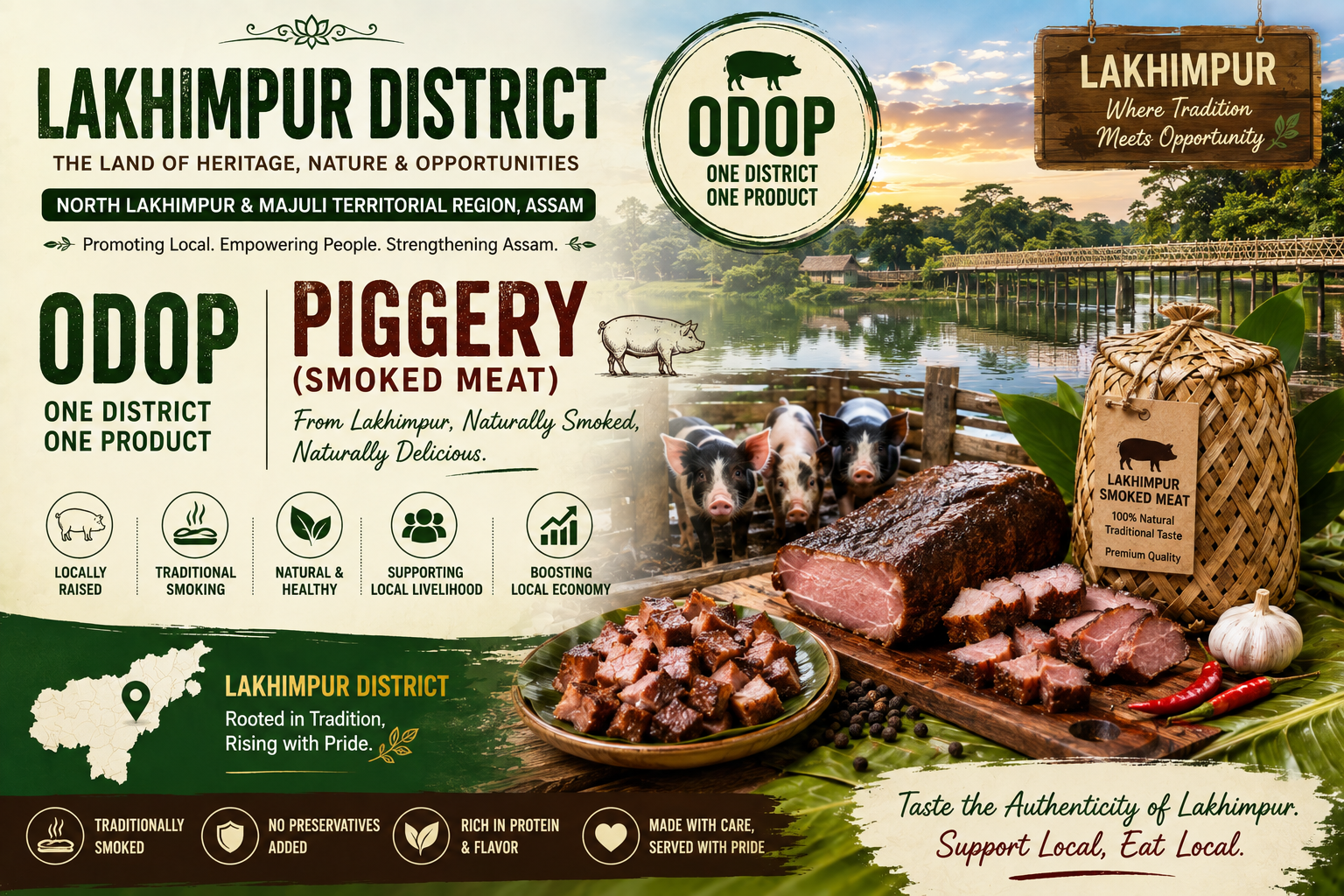
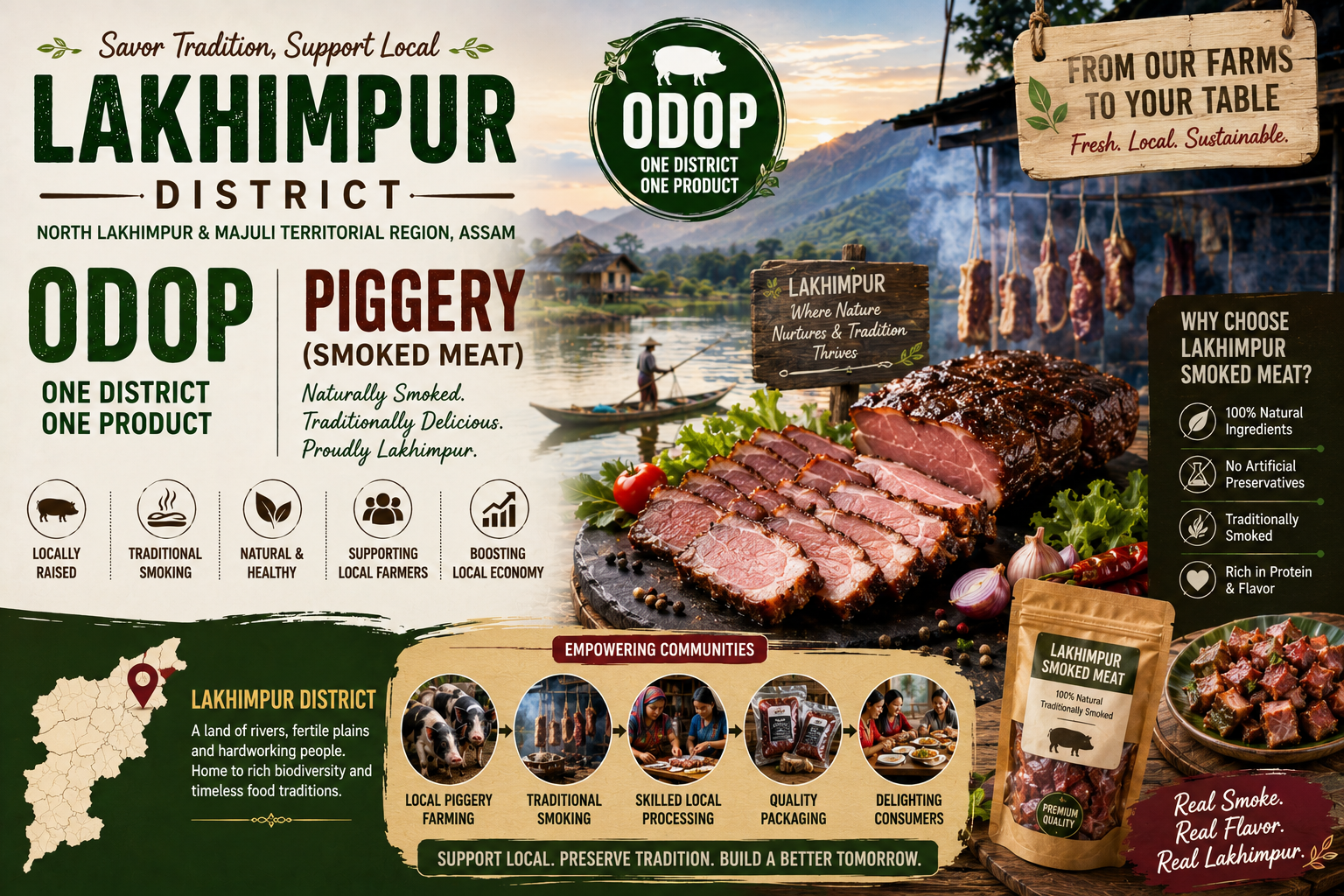
Indeed, the Government of India, in its updated list of the One District One Product (ODOP), highlights Piggery (smoked meat) as the official product of the district.
Therefore,
this article will explore this item in detail, focusing on both the traditional aspects of smoked meat and its status as an ODOP item.
Smoky Flavors of Traditional Cooking
Older kitchens are filled with memories.
The advent of modern-day technologies allowed people to reduce their dependence on seasonal produce and eat a wider variety of food items.
However, certain products could only be procured at specific times of the year.
As a result, people resorted to processing methods to store food for later use.
Meat was one of such products that required special treatment.
Smoking was one way to do it, allowing to both prolong the period of storage and enhance the flavor of the product.
The smoky aftertaste of such meat became a hallmark of traditional cuisine.
For many, eating smoked meats and other products is strongly associated with the atmosphere of home cooking.
The traditional preparation and subsequent consumption of the item have been, and still are, linked with memories.
It is unlikely that such a product would gain popularity as a novelty because it lacks such uniqueness.
Rather, the connection of smoked meats with the traditional flavors of old kitchens is one of the factors that contribute to its popularity.
Lakhimpur: Agricultural District
Lakhimpur district is largely rural.
The website of the district administration reports on wide agricultural activity in the region, specifically paddy cultivation.
It is also noted that meat, fish, vegetables, and milk are widely produced in the area.
Therefore, it is not surprising that pork is deeply ingrained in the local cuisine.
Indeed, piggery as a source of livelihood is widespread in the district.
Moreover, piggery development projects were initiated by the Government of Assam, including those addressing the organizational, technological, and marketing aspects.
Therefore, when speaking of smoked meats and their popularity in the district, it is necessary to focus on both the food product itself and the local agricultural production.
Why Was Smoking Necessary?
Smoking is not only a way to improve the flavor of the meat – it is a traditional method of preserving it.
Prior to the invention of newer technologies, people had to resort to methods of extending the shelf-life of their food products.
Smoking allowed to separate the meat from the air, thereby removing one of the main causes of its rapid decomposition.
It may require several days of smoking, which can be done in specialized smokehouses.
The exact timing and other nuances of the process are difficult to say, as it has been changed according to the needs and possibilities of the population.
It is possible that the smoking process was invented by one individual, but it became improved through the collective effort over generations.
Indeed, each member of the family knows how to prepare smoked meat according to the traditional recipe, even though it may have varied across different families.
Taste of Nostalgia
Smoked meats have one unique quality – they taste different from the fresh ones.
The presence of smoke, together with other changes caused by the prolonged exposure to high temperatures, endows the dish with a unique flavor.
The taste of smoked meat is more intense and the aroma is different.
Moreover, the consistency can vary depending on both the fat content of a particular cut and the preparation technology used.
These differences are the reason why smoked meats have remained popular despite the advent of newer technologies.
Indeed, once a person discovers the unique taste of smoked meats, it is unlikely for them to give it up in favor of something else.
The reason why they are so popular is due to both the preparation technology and the unique flavor that distinguishes this dish from other meals.
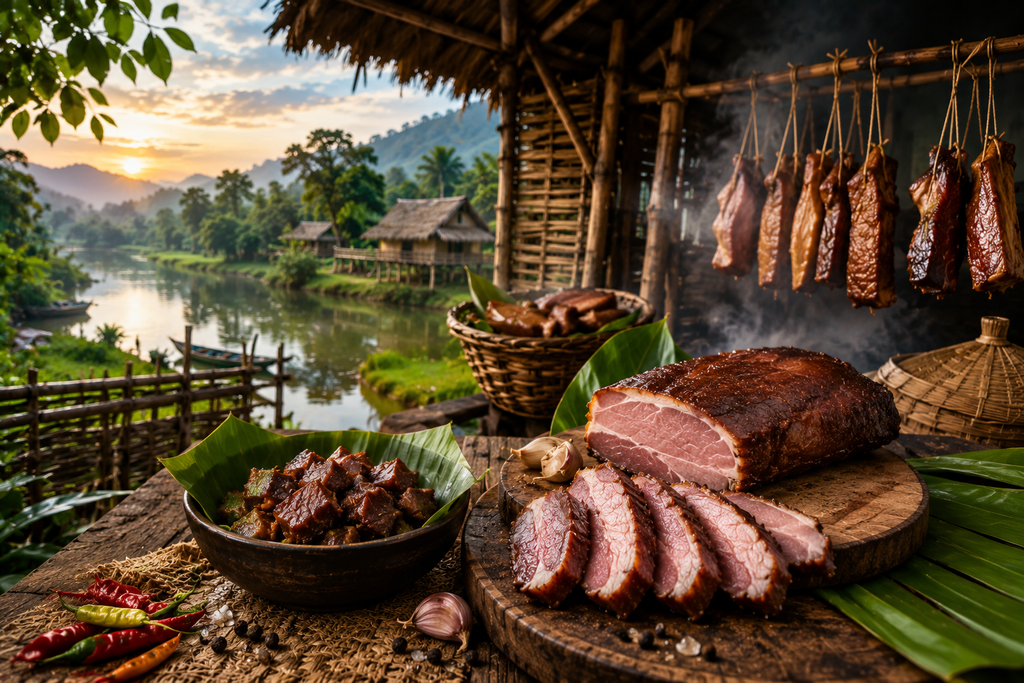
Piggery and Pork in Assam
Piggery has always been an important part of Assam’s rural economy.
The state government strongly supports the development of this sector, implementing various programs to improve both the technological and managerial capacity of local farmers.
Agriculture department’s reports note that piggery has the potential to provide additional income to the people of Assam.
It has become a major initiative of the state, as reflected in the number of organizational and marketing activities undertaken to improve this sector.
It is useful to understand that for an item to have demand, there must be a supply.
When the government decided to promote Piggery (smoked meat) as an ODOP item, this meant that there was a need to create additional opportunities for local farmers.
Therefore, in addition to providing training, support in marketing and finding new markets, it was necessary to discuss the quality of processing and packaging of the product to meet the requirements of local and external customers.
From Farm to Table
The journey of smoked meat begins in the farm.
It is there that the farmer who will eventually sell the product either lives or works.
Piggery is an integral part of the local economy and the livelihood of the population.
It is this sector that provides the raw material for the creation of the final product.
Smoking is only one of the steps in the long way from the pig to the plate of the consumer.
The next stage is the kitchen, whether it is in a home or in a restaurant.
However, the image of the home kitchen is the one that evokes the most memories, if any.
It is there that a person spends a lot of time with the people they love.
The preparation of food is a process in which the whole family can participate.
It may seem that there is no particular technology in the way the dish is being prepared.
Some members of the family can add certain ingredients in a more generous amount than others.
Not everyone likes the dish to be spicy, so the amount of chili added to the sizzling pan can vary from kitchen to kitchen.
It is hard to single out specific proportions, as this is a personal choice of every household.
The preparation of food is not as systematic as it may seem at first glance.
Every family has its own way of doing things.
The Old Kitchen
There is something special about the old kitchen.
It is there that people used to gather when they had spare time.
Someone was busy washing rice, while another person prepared vegetables.
Maybe someone was sitting in the kitchen, watching over the simmering pot.
Children ran around the room, playing.
There was no particular rush, but everything was ready in its due time.
The whole family sat around the same table to eat, sharing daily experiences and following the routine that hardly ever changed.
Smoked meat, with its unique flavor and aroma, has always been part of this atmosphere.
It was not cooked with any particular festive occasion in mind, but as a dish that symbolized home and the family.
The memories of traditional cooking and its unique tastes and smells are what made people fall in love with smoked meats.
The Difference That Makes a Difference
Fresh meat is very different from the one that has been subjected to the smoking process.
Not only does it taste unique, but it also looks different from the fresh one.
Smoked meat has a more intense aroma, a darker color and, depending on the preparation technology, a different texture.
The difference in flavor is what many people appreciate, as this unique taste is unlikely to be found in other dishes.
It can be assumed that what makes this dish so special is precisely its uniqueness.
The fact that smoked meats have been a staple of the diet for a long time also speaks of its desirability.
If everything tastes the same, there is no reason for different dishes to exist.
Traditional Cooking Meets ODOP Item
It is necessary to remember that the idea of One District One Product is to promote and support the development of local products.
For the district of Lakhimpur, the product of choice is Piggery (smoked meat).
According to the Ministry of Food Processing Industries website, the item is included in the list of the ODOP initiative of the Government of India.
This allows to take a closer look at this product, discussing both its traditional attributes and its status as an ODOP item.
It is important to highlight the difference between food that is cooked at home and one that is produced as a business.
A family that decides to raise a pig, process and smoke its meat, and make traditional meals out of it is not the same as a business that does it for a living.
The latter needs to focus on organizing the work process, finding new clients and partners, and ensuring the stable supply of raw materials.
Local Processing
If a district has the status of the ODOP item producer, it is necessary to invest efforts into developing and improving this product.
The local processing plants need to be able to create value-added products out of agricultural raw materials.
It can be said that for the local economy of the district, this is a great opportunity, as it allows not only to promote local produce but also to ensure its stable supply.
Regarding the ODOP item of Lakhimpur, the focus should be on ensuring the quality of both smoked meat and the local agricultural products.
It is necessary to follow the safety regulations, paying special attention to processing and storage conditions.
The unique flavor of traditional meats should be retained.
However, if the product is to gain popularity among the consumers, its presentation and packaging should be taken into account.
Small-Scale Production Meets Modern Markets
This is where the story of the smoked meat and the local small-scale producers begins.
It is no longer the case that the products of the local farmers and businesspeople are only found in the regional markets.
The development and implementation of modern technologies allow for finding buyers both locally and outside the district.
It is necessary to ensure a stable supply of high-quality raw materials, which will allow to improve both the processing technology and the quality of the finished product.
It can be said that a small producer has good opportunities for growth and development.
At the same time, it is important to remember that modern-day markets demand stability.
The reputation of an item made according to traditional recipes can be ruined by a single batch of spoiled goods.
Therefore, when speaking of smoked meats and local producers, it is essential to remember that it is the quality of the final product that determines its popularity and future.
The Importance of Farmers
When discussing the production of smoked meat, it is necessary to mention farmers.
Piggery as a business is not only linked with meat processing, it is also connected with the people who raise the pigs.
Farmers play an important role in this system, although their work can be physically demanding.
The state supports rural families and promotes the development of this sector of the economy.
It can be assumed that the development of the local piggery sector will have a positive impact on the residents of the Lakhimpur district.
A stable supply of raw materials is vital for the success of a business, which also speaks of the importance of promoting this sector.
Rural Roots of Lakhimpur
Lakhimpur district is characterized as an agricultural region.
The website of the district administration reflects its rich agricultural heritage and lists paddy as the crop that plays the greatest role in the local economy.
At the same time, other resources are produced in the area, including meat, fish, vegetables, and milk.
It is clear that food production plays a major role in the economy of the region.
However, it is not the only one.
Piggery is one of the initiatives that were launched by the Assam government to improve the quality of life of the local people.
It is this sector that is directly related to the ODOP item of the district.
Smoked meats are only one step in the long process of creating this dish, which begins when the local farmers raise pigs.
Traditional Flavors Carry Memories
Ask an old person to tell a story about traditional food and they might respond with a recollection from the past.
They might describe an old kitchen, a winter morning, and talk of the smell that came from it.
A family used to gather there to share food and stories, sitting around the warm kitchen stove.
It is hard to capture this atmosphere in words.
Perhaps, this is why traditional dishes are not described in detail.
Many people can recall the taste of certain traditional meals, but not their exact consistency or preparation technology.
The preparation of food was a ritual that was unique to a particular household.
The ingredients were measured roughly, spices were added to taste, and the meat was taken out of the pan when it seemed appropriate to the cook.
Smoked meats belonged to the foods that people loved and remembered.
The Importance of Traditional Technologies
Modern-day food producers and scientists often discuss the benefits of the traditional technologies of the past.
While it is true that many of them ensured the survival of the population, they were not developed to improve the quality of food.
Meat smoking, for example, was invented to prolong the shelf-life of the product.
It is important to focus on the technological aspect of this process rather than its nutritional benefits.
Smoking was the invention of one person who realized that the meat needed to be kept away from the air and exposed to high temperatures for an extended period of time.
It took years of research to perfect the technology, which involved both experimentation and the accumulation of knowledge from others’ experience.
Traditional Methods Are Not Always Safe
When discussing traditional methods, it is important to separate their cultural value from practical concerns.
Smoking of meats is not a safe technology, as it cannot guarantee food safety.
The preparation of this dish requires special attention to hygiene, which is difficult to ensure when working with pork.
The traditional methods of meat preservation were sufficient in the past, but in the modern environment of growing demands and quality requirements, they may seem inadequate.
Therefore, it is necessary to view the technology in the context of its application to the local product.
Smoked meats should be handled with care, with specific attention to processing, storage, and other technological aspects.
It is important to ensure that the traditional recipe is followed in order not to miss any key components.
Food Safety Standards
To say that smoked meats are healthy and beneficial is inappropriate.
Traditional technologies do not necessarily imply safety or nutritional benefits.
This applies to all foods, including those that are considered healthy.
When the product is aimed at a larger audience, following the food safety standards is essential.
The quality of the final product depends on the conditions of storage and processing, which must be taken into account when establishing a business.
For the local producers of smoked meats, it is important to develop and adhere to these conditions, thus ensuring the highest quality of their product.
Traditional Flavors in a Modern Economy
It is no longer the case that the production of local agricultural products only takes place within the district.
The development and application of modern-day technologies provide new opportunities for business, including the potential for entering new markets and engaging in trade.
Smoked meats can become a popular product among the local and regional customers.
In this regard, it is important to ensure a stable supply of raw materials, as their quality will directly impact the business.
It can be said that both the traditional technologies and modern business practices play a significant role in the life of the local economy.
The Unique Opportunity of ODOP
At this point, it is worth noting the importance of the ODOP initiative.
It creates new opportunities for both the local producers and the people of the district.
Indeed, it is not enough to raise pigs and prepare smoked meats.
The local farmers and producers in the sphere of meat processing need support and special attention.
The state can provide these opportunities by helping to establish connections with local markets, identifying new buyers, and securing a stable supply of raw materials.
The promotion of local products is a complex task, but it is vital to ensure that the needs of the community and the local businesses are met.
DesiBiz.in: Highlighting the Value of Local Business Opportunities
It is now possible to speak of the significance of the local product.
Smoked meats is only one of the components of food production, as behind every dish is the local market.
The processing industry, with its unique opportunities and challenges, is one of the vital sectors of the local economy.
It connects farmers who raise crops and animals with the people who purchase these products.
Moreover, the business environment helps to create employment opportunities, which further strengthens the economy.
It is also important to raise awareness about the unique qualities of local agricultural products and their importance to the people.
It is this idea that underlies this article, which was written in order to introduce the audience to the local item that has gained popularity beyond the district.
A Unique Flavor of Traditional Cooking
It is interesting to recall the old-style meal that used to be prepared in the kitchen for the whole family.
Fresh rice is steaming in a pan, the meat is browned to a nice shade and is almost done.
The vegetable stew is ready to be eaten, some of the green chili is left to be added to taste.
The whole house smells of a traditional dish that is now on the table for the whole family to enjoy.
It is hard to describe this moment precisely because it is the memory of a home-cooked meal that people try to recreate as often as possible.
The business opportunities associated with this product are being explored, aiming to satisfy the growing customer demand.
However, the essence of this dish is the comfort and simplicity of a home-cooked meal, regardless of the technologies of preparation.