Bijapur Minor Forest Produce: How Chhattisgarh’s Forest Resources Become Value-Added Products

Bijapur Minor Forest Produce represents the valuable forest resources of Chhattisgarh, where products such as Mahua, Harra and Aonla are collected, processed and transformed into useful value-added products. In Chhattisgarh some of the unique food and ways to earn a living come not from farmland but from the forests.
This is especially true in Bijapur district, which’s in the southern part of the state. The district is known for having a lot of forest land and a wide variety of forest resources. The official district report lists trees and forest resources such as Mahua, Tendu, Harra, Aonla, Char and other species showing the richness of the forest environment.
Under the One District One Product (ODOP) plan Bijapur is linked with Minor Forest Produce (Mahua and others).
The importance of this category is that it is more than one product. Minor Forest Produce, often called MFP includes different natural resources from the forest that can be gathered prepared and turned into items with more value in the market.
Mahua is one of the well-known examples.
A flower that comes from the forest can be carefully dried, cleaned, stored and used as a base material. Other forest resources can go through steps of gathering, sorting, drying, preparing, packing and selling.
The process can be seen as:
Forest Resource → Collection → Sorting → Cleaning → Drying → Processing → Value Addition → Packaging → Market
This is the story of how the forest-based resources of Bijapur can become products with added value while staying connected to the farming, cultural and economic life of Chhattisgarh.
Why Minor Forest Produce Matters in Bijapur
The geography of Bijapur gives a background for understanding its forest-based product system.
The district administration says that Bijapur is a place with a lot of forests with forest areas covering a large part of the district. The official report talks about forest species such as Mahua, Tendu, Harra, Aonla, Char, Sal, Teak and other trees.
This natural resource base creates a chance for people who rely on the forest to collect and use different products.The district’s official information also says that traditional industries include activities based on forest products like bamboo and Mahua.
Collecting a forest product is only the first step.The bigger chance comes after that.
If a product is sold without being changed the chain of value may stay short.
If it is cleaned dried, prepared, packed and sold properly more steps of value can be added.
That is the idea of adding value.
From Forest to Finished Product
Imagine a basket filled with forest products.
At first it may seem like a collection of natural items.
Before it can become a good product for sale a lot needs to happen.
The raw material must be. Collected in a good way.
It needs to be sorted.
Unwanted things need to be taken out.
The product might need to be washed or cleaned if needed.
Moisture might need to be reduced through drying.
The prepared material then needs storage.
Finally it can be made into a product for people to buy and packed for the market.
Each step is important.
The quality of the product depends a lot on what happens in these early steps.
Step 1: Responsible Collection
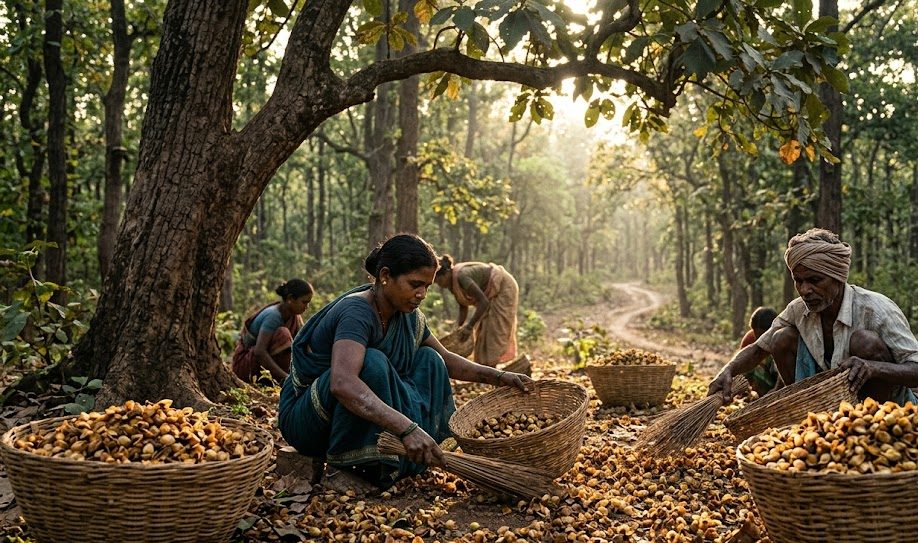
The first step is collection.For products from the forest responsible collection is very important because the raw material comes from a place not from a traditional farm.Mahua flowers for example are often collected after they fall naturally from the trees.The goal is to collect material without harming the environment.This makes sustainable collection practices a part of the value chain.A strong forest product business cannot just depend on how much’s collected.
It also depends on whether the forest can keep producing and support people in the future.
Because of this forest-based value addition should be done with care for:
- Responsible harvesting
- Seasonal timing
- Resource renewal
- collection methods
- Proper storage
- Reducing waste
The forest is the start so protecting the source is essential.
Step 2: Sorting and Removing Impurities
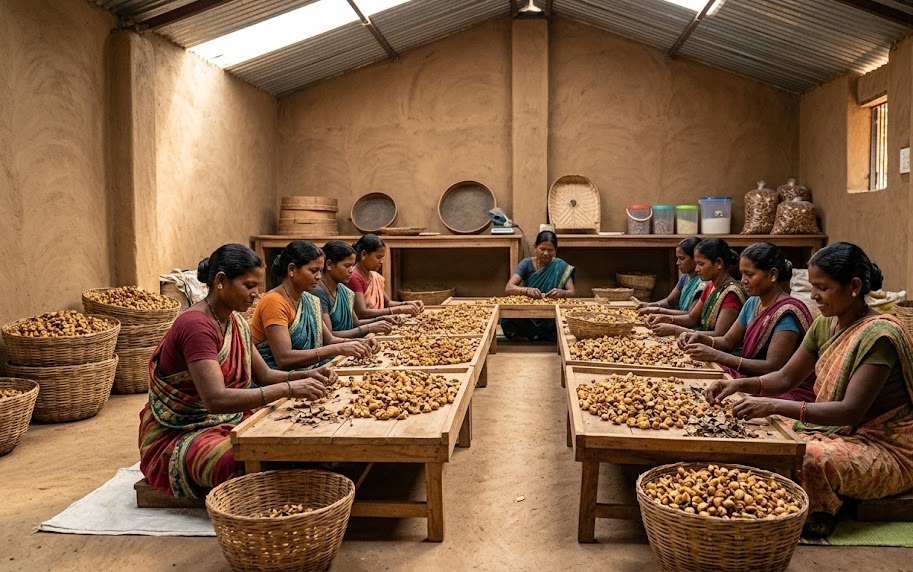
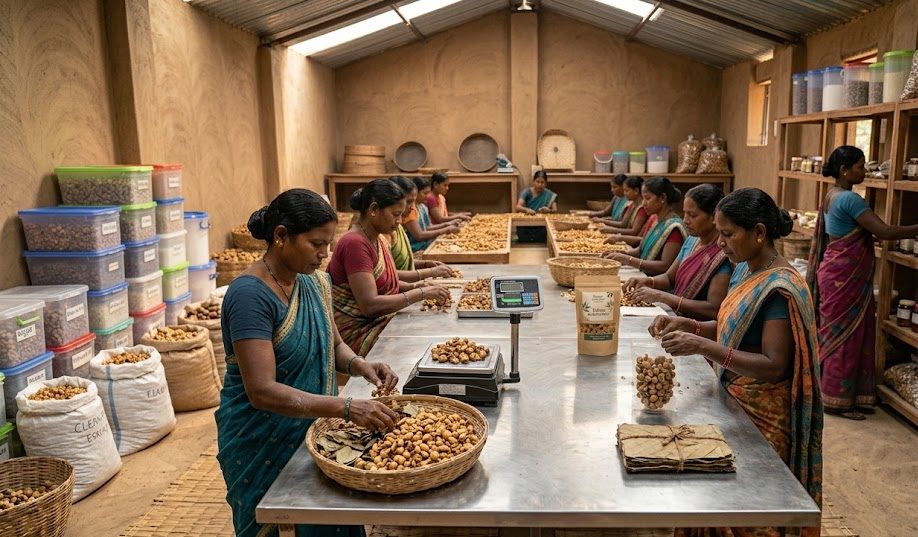
Once forest products arrive at a collection or processing place they need to be sorted.
Gathered material can have:
- Leaves
- Small branches
- Dirt
- Small stones
- Broken pieces
- Other plants
These unwanted things need to be taken out.Sorting can be done by hand at a scale while bigger processing might use tools for separating.For something like dried Mahua flowers sorting is very important because the quality of the material affects the product.Good sorting also makes the next steps easier.
This step may seem simple. It is one of the basics of making a product that can be sold.
Step 3: Cleaning and Preparation
After sorting the material might need to be cleaned depending on what it’s how it will be used.The cleaning method should match the forest product.Not all forest products are treated the way.
For example a product meant for drying may need a preparation than one that will be used as a food ingredient.
The idea is the same: clean material starts with a product.Hygiene becomes more important when the final product is for people to eat.As forest produce moves from collection to organized food processing the people making it need to pay more attention to cleanliness how they handle things, storage and packaging.
Step 4: Drying. One of the Important Stages
Drying is a very important part of many forest product value chains.For Mahua flowers drying is especially important because fresh flowers need to be handled after being picked.Controlled drying lowers moisture. Helps prepare the material for storage and more processing.
Traditional sun-drying has been used for a time with many agricultural and forest products.
For businesses more consistency is needed.
Factors like:
- Drying temperature
- How long it takes
- Cleanliness
- Moisture level
- Exposure to bad things
- Storage conditions
- can all change the product.
Modern drying systems can offer control while better traditional methods can also help small producers keep the quality.
The main point is that drying is not just leaving something outside.It is a step in processing that directly affects the quality and storing.
Step 5: Grading and Quality Control
After drying forest products can be sorted by how they will be used.
Grading may look at:
- Color
- Size
- Cleanliness
- Moisture
- How it looks
- If it is damaged
Better grading makes things more consistent.
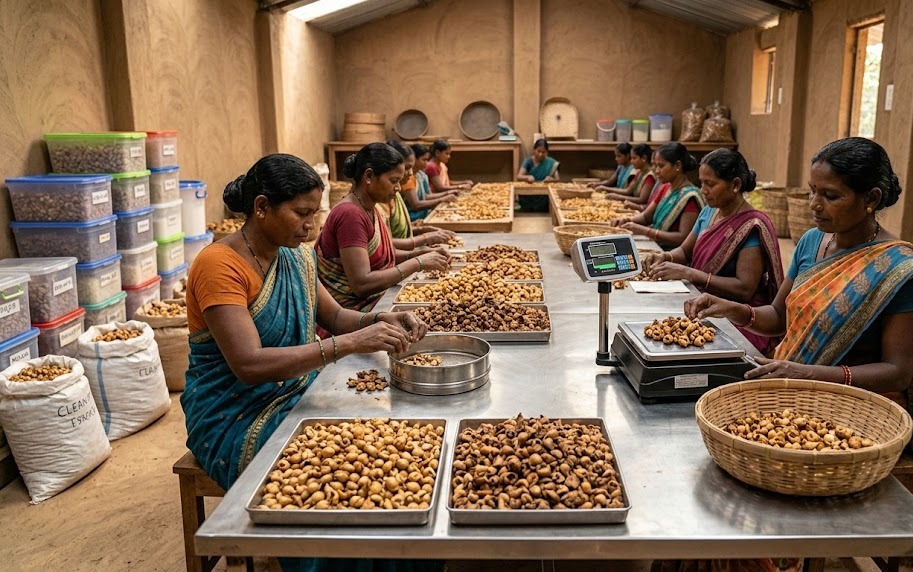
This becomes very important when products are sold in branded packages.A person buying a packaged product expects the inside to be the same each time.
For business people grading is an important step in moving from informal trade to organized food processing.It also helps separate high-quality parts from parts that might be used in a way.
Mahua: From Forest Flower to Value-Added Resource
Mahua is one of the important examples in the story of forest-based products in Bijapur.The tree is closely connected with the lives of people who rely on the forest in central India.In Bijapur the districts official report lists Mahua as one of the trees found in the area.
The ODOP label also specifically mentions Minor Forest Produce (Mahua and others) making Mahua an important example when talking about added value in forest products, from Bijapur.
The chain of value can include picking, cleaning, drying, grading, storage and more processing.The key point is that the value does not stop after picking.Processing and showing the product can create chances.
Step 6: Turning Forest Produce into Marketable Products
What the final product is depends on the material.Minor Forest Produce is a group so different resources can follow different ways of processing.Mahua flowers for example can be cleaned, dried and packed as a forest product.
Other forest resources might be used for:
- Dried ingredients
- Powders
- Food items
- Natural products
- Herbal or traditional uses
- Oils or other processed items
Each product needs its own way of processing and safety rules.
It is therefore important not to treat Minor Forest Produce as if it were one product.
It is a category of forest resources.That diversity is also its strength.
A district with a forest resource base can potentially support multiple product lines rather than depending on a single agricultural commodity.
From Traditional Collection to Modern Processing
For generations forest products have been. Used by communities.Modern food processing does not necessarily replace this knowledge.Instead it can add capabilities.
Traditional knowledge can contribute an understanding of:
- Seasonal availability
- species
- Collection practices
- Traditional uses
- Storage methods
- Local food culture
Modern processing can contribute:
- Standardisation
- Hygiene
- Quality control
- Better storage
- Packaging
- Branding
- Market access
When these strengths come together forest produce can move into new markets without losing its connection to its origin.
Step 7: Storage. Protecting the Product After Processing
Storage becomes extremely important once forest produce has been dried.Improper storage can lead to moisture absorption, contamination, pest damage or deterioration.For dried products storage conditions should therefore be carefully managed.Products should be kept in food-grade containers or packaging protected from excessive moisture and handled in hygienic conditions.
For enterprises organised storage facilities can help maintain quality between processing and distribution.For producers even simple improvements in storage practices can make a meaningful difference.
The objective is straightforward:
The quality achieved during processing should not be lost during storage.
Step 8: Packaging Forest Produce for Modern Consumers
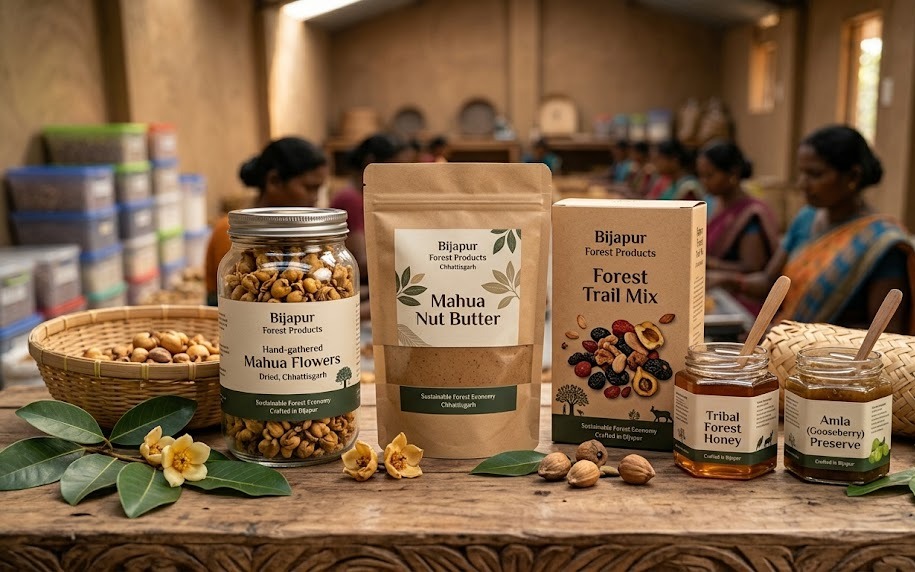
Packaging is where a traditional forest resource begins to look like a consumer product.A designed package can protect the product while communicating its identity.
For a Bijapur forest-based product packaging could highlight:
Product: Mahua or another approved forest-based product
- Origin: Bijapur, Chhattisgarh
- Category: Minor Forest Produce
- Ingredients: As applicable
- Net quantity: As applicable
- Storage instructions: As applicable
- Processor/brand: Relevant business information
Packaging should also include all legally required food information where applicable.
The visual identity can use forest-inspired elements—Mahua flowers, leaves, natural textures or illustrations of the forest ecosystem.The aim is not to make the packaging look exotic.It is to communicate the story behind the product.
Building Value Around Mahua Without Losing Its Identity
A regional product does not need to hide where it comes from.In fact the origin can become part of its identity.
A package of dried Mahua flowers from Bijapur can communicate a story:Collected from the forest ecosystem of Chhattisgarh. Carefully cleaned. Properly processed. Responsibly packaged.
This creates a connection between the product and its source.Branding must remain accurate.
A producer should not make claims about health benefits organic status, traditional certification or geographical origin.
The strongest branding is often based on something simpler:
Real product. Real place. Real process.
Forest Produce and Local Livelihoods
The economic importance of forest produce goes beyond the final packet on a shop shelf.
A forest-product value chain can involve people:
Forest-dependent collector → Collection centre → Sorter → Processor → Packaging worker → Brand → Distributor → Retailer → Consumer
Each stage represents a potential economic activity.
For communities that depend on forest resources better value addition can potentially create opportunities to earn from the products they already collect.
The districts official website notes that traditional industries in Bijapur include industries based on forest produce such as bamboo and Mahua.
This existing connection between forest resources and local economic activity provides a foundation for developing more organised product processing.
The Importance of Responsible Value Addition
There is a difference between using forest resources and overusing forest resources.A sustainable forest-product economy must keep both sides in balance.If demand increases collection practices need to remain responsible.Processors and businesses need raw material but the forest ecosystem also needs protection.
That means future development should consider:
Sustainable collection
harvesting
Regeneration of resources
Avoiding unnecessary damage to trees
Responsible handling
Reduction of processing waste
Appropriate storage
Long-term community participation
The strongest value chain is one that can continue year after year.
Creating a Product Range from Forest Resources
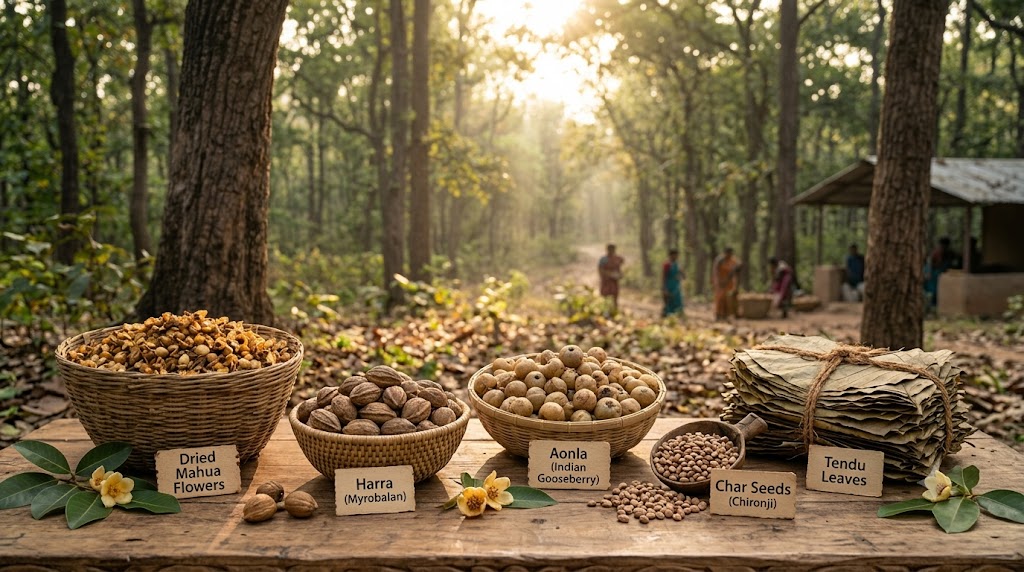
Bijapurs ODOP category is particularly interesting because Minor Forest Produce represents a group rather than a single item.The official district profile identifies forest species, including Mahua, Tendu, Harra, Aonla and Char. That means the potential product ecosystem can be diverse.
One resource may be sold as a dried ingredient.
Another may be processed into a powder.
Another may become part of a food preparation.
Another may have a different non-food application.
This diversification can help local enterprises avoid dependence on one product.
Each product should be developed separately according to its own processing requirements, safety standards and market demand
From Village-Level Processing to Wider Markets
A forest product does not have to remain limited to a local market.With processing, packaging and branding products can potentially move through regional and national distribution networks.
The journey could look like:
Bijapur Forest Resource
↓
Local Collection
↓
Cleaning & Processing
↓
Packaging
↓
Regional Brand
↓
Chhattisgarh Markets
↓
Wider Indian Markets
Digital commerce can also create opportunities for small producers to present their products beyond their area.However reaching markets requires more than attractive packaging.
Businesses need to meet food-safety, labelling, quality and regulatory requirements.Market expansion should therefore happen alongside improvements in production standards.
Local Entrepreneurs Can Add the Next Layer of Value
The future of Bijapurs forest-product ecosystem can include medium-sized enterprises.A local entrepreneur could develop a packaged dried Mahua product.A womens group could create forest-based food products.A producer organisation could aggregate materials.A processing unit could provide cleaning, drying and grading services.A regional brand could handle packaging and marketing.This creates opportunities at scales.
The important point is that value addition does not always require a factory.
Appropriate small-scale processing, when combined with quality control and market knowledge can also contribute to a value chain.
Why This Matters for Chhattisgarh
The story of Bijapurs forest produce is part of a larger story in Chhattisgarh.The states ODOP list includes districts associated with minor forest produce and specific forest-based products. Bijapur is identified with Minor Forest Produce (Mahua etc.) while other districts have their forest-product specialisations.This reflects the diversity of Chhattisgarhs natural-resource economy.
The important opportunity is not simply to collect more.It is to create value from responsibly collected resources.
That can mean:
- cleaning
- Better drying
- Better storage
- Better processing
- Better packaging
- Better branding
- Better market access
Each improvement can strengthen the products journey from forest to consumer.
The Future of Bijapurs Forest-Based Products
The future can move in the direction of organisation and greater value addition.
Of selling raw forest produce immediately communities and local businesses can explore suitable processing options.
Possible directions include:
Improved Dried Products
Better drying and moisture control can help improve consistency.
Packaged Forest Ingredients
Clean and processed products can be offered in consumer-friendly packs.
Traditional Food Products
Forest-based ingredients can become part of traditional and contemporary food preparations where appropriate.
Product Diversification
Different forest resources can support product categories.
Regional Branding
Products can communicate their connection with Bijapur and Chhattisgarh.
Better Market Linkages
Local products can potentially reach regional and national markets when quality and regulatory requirements are met.
The objective should always be value addition rather than extraction alone.
From Forest, to Market: The Complete Journey
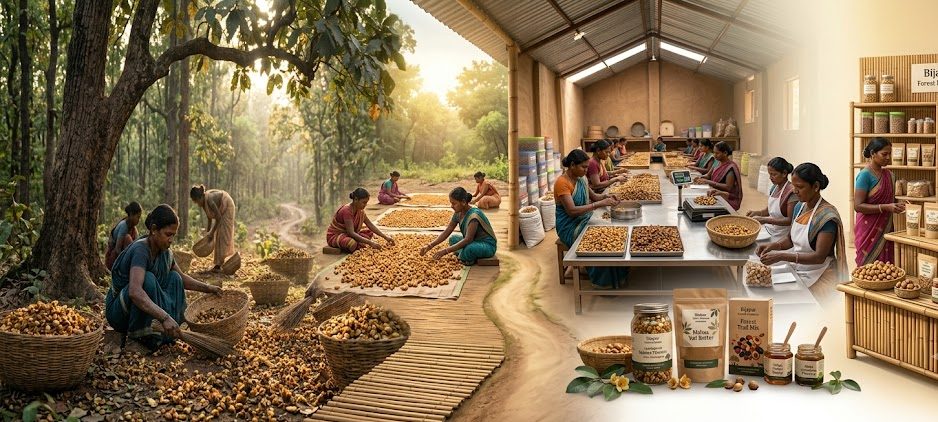
The story can now be seen as one chain.A Mahua flower falls under a tree in a forest in Bijapur, Chhattisgarh.It is gathered in a way.The material is sorted out.Things that do not belong are taken away.The flowers are cleaned when needed.They are dried with care.
The dried item is. Divided into different levels.It is kept in a place that’s right for it.
Conclusion
The story of Bijapur Minor Forest Produce starts in the forests of Chhattisgarh.This is different from a farm product that starts in a planted field. Forest products start with a place and the people who work with it.Mahua and other forest things found in Bijapur is a chance to make value through picking, careful handling and better selling.The districts official information says that the forests there have a lot of resources, including Mahua, Tendu, Harra, Aonla and Char.With the ODOP system Bijapurs focus on Minor Forest Produce (Mahua and others) gives the product chain a clear identity.
The real story is not just about picking forest things.
It is about what happens after picking.
Sorting can make things better.
Drying can help keep things longer.
Checking can make things more the same.
Processing can make things.
Packaging can help people know what it is.
Branding can tell the story of the place.
Responsible business people can bring forest products to people.
For Bijapur and Chhattisgarh this is a chance: taking things from the forest and making them into products that are better made better sold and still keeping the forest as the main idea.From a Mahua flower under a tree to a package on a store shelf every step adds a new part, to the journey of Bijapurs forest products.
Frequently Asked Questions
1. What is Bijapurs ODOP product?
Bijapur is listed under the Chhattisgarh ODOP list with Minor Forest Produce. Mahua and other minor forest products are included in this designation.
2. What minor forest produce is associated with Bijapur?
Mahua is the minor forest produce linked to Bijapur in the ODOP list. The district also has forest resources such as Tendu, Harra, Aonla and Char.
3. What is the basic process for adding value to forest produce?
The basic process includes collection, sorting, cleaning, drying, grading, processing, storage, packaging and marketing. The steps may vary depending on the type of forest produce.
4. Why is drying important?
Drying helps reduce moisture content in forest produce. This makes it easier to store and ready for processing. Proper drying also helps keep the product quality high.
5. Can Mahua be turned into packaged products?
Yes Mahua can be cleaned, dried and processed into packaged products. The final form depends on the product type and the food safety rules that apply.
6. Why is Bijapur suitable for forest produce?
Bijapur has forest areas, with many types of trees and plants. The districts official profile mentions forest species, including Mahua and other useful ones.
7. How can value addition benefit communities?
Adding value through processing, packaging and marketing can create jobs. It also gives people more income opportunities beyond just collecting forest produce.
8. Why is collection important?
Forest produce comes from forests. Collecting in a way ensures the forests stay healthy and can keep producing in the long run.