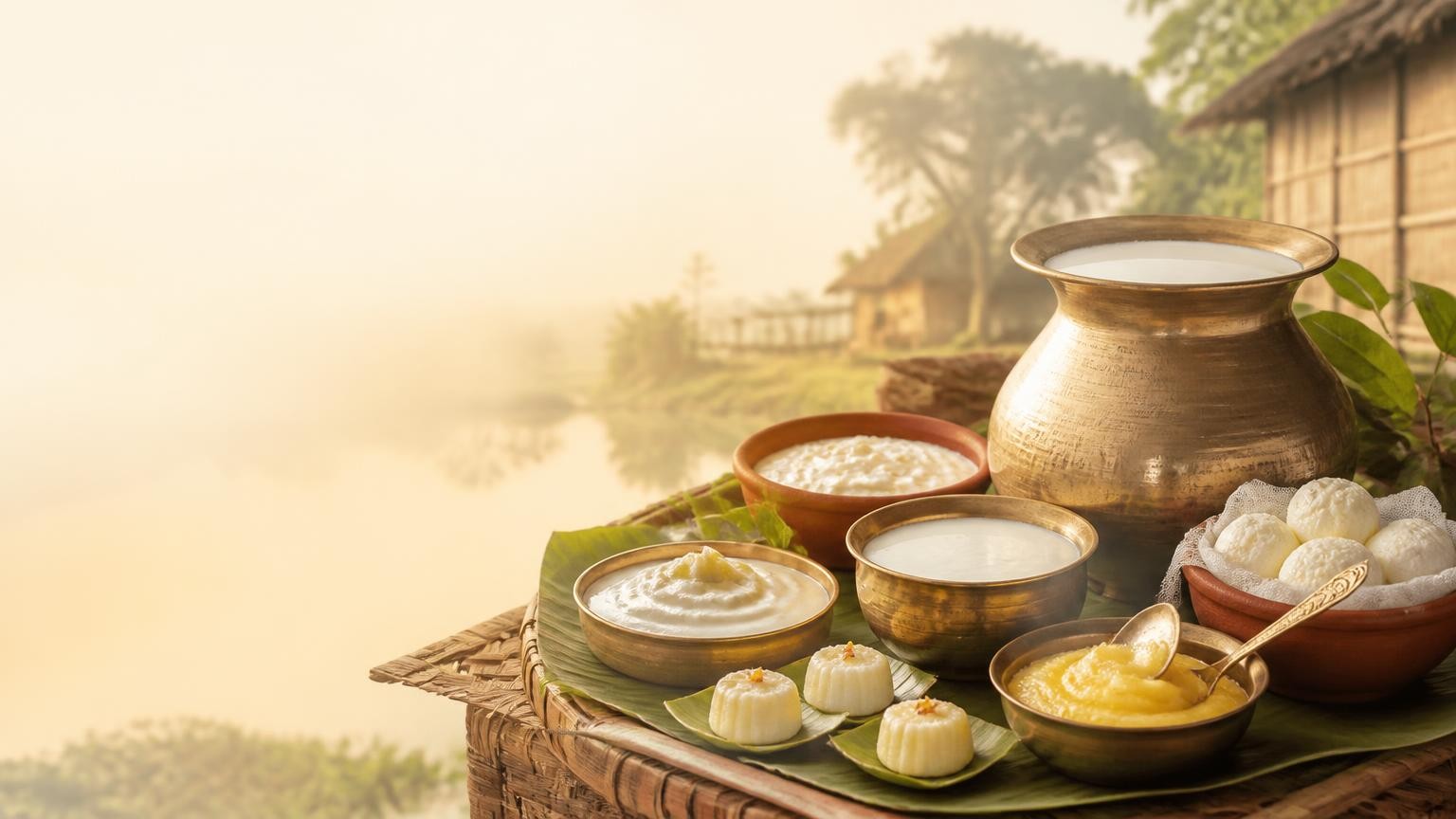

Barpeta, one of the culturally and naturally rich districts in Lower Assam, bears a distinct significance in the region’s cultural and culinary legacy, as it is known for its Vaishnavite traditions, satras, handloom products and handicrafts. At the same time, it would be a mistake to overlook the deep connection between the region’s food culture and local agriculture. Local milk production plays a particularly important role, as the area has thrived in dairy farming for centuries and dairy products are staples in local cuisine.
Milk-based products are integral to the diet in Barpeta, with local inhabitants utilising the resources of their own livestock to produce curd, chhana/chekka, paneer, ghee, and other dairy products. Local dairy farmers have been supplying the region’s markets with fresh milk for centuries, and Barpeta is famous for its chhana/chekka that has been in demand in the city of Guwahati. Thus, the dairy-based cuisine of Barpeta holds an important place in the local culture and history.
Barpeta: A District Full of Cultural and Rural Traditions
Barpeta is home to numerous sacred and cultural traditions, many of which were introduced by saint Sankardeva and his followers. Following his Vaishnavism philosophy, Sankardeva propagated many traditions and beliefs. This cultural and spiritual legacy is deeply embedded in the region’s cuisine.
Many traditional Assamese dishes are based on simple locally available ingredients. Milk is one of these staples, as dairy farming has been at the heart of the local economy for centuries. The morning routine in Barpeta traditionally begins with obtaining fresh milk from the local cows. Villagers can use the fresh produce to make tea, curd, or local sweets. For those who do not have the means to utilise fresh milk, it can be processed into other dairy products with extended shelf life.
Local food traditions and simple lifestyles inspired local farmers to engage in dairy activities. Thus, traditional methods of dairy product manufacturing have evolved alongside the local cuisine and culture.
Dairy Farming in Barpeta: Opportunities and Resources
The dairy-based resources of Barpeta have a significant impact on the local economy. The district’s cattle artificial insemination centre reported that dairy farming is a major activity in Barpeta with significant activity in districts of Bajali, Pathsala, Barpeta Road, Howly and Nityananda, among others. Dairy farms in Barpeta are found primarily in the Bajali district, where dairy farming provides sources of employment for many farmers. Cooperatives play an essential role in the local dairy economy, as they enable milk collection and supply to other regions.
The traditional milk production methods are being supplemented by modern techniques that provide an opportunity to make the local dairy products more competitive.
The local economy benefits considerably from dairy-based activities. Farmers sell their produce to local markets, while some cooperatives ensure a stable supply of milk to other regions. Thus, local dairy farmers in Barpeta play an essential role in the local economy while participating in traditional methods of dairy product manufacturing.
Doi: Simple Curd with Complicated History
Curd, known as ‘doi’ in Assamese, is one of the most popular dairy products in Assam, and Barpeta is not an exception. Doi is a fermented milk product with a tangy flavour and a consistency similar to that of natural yoghurt. The simplest way to make curd is to boil milk and cool it down to a suitable temperature, adding a small amount of curd as a starter. The result is a mixture with a creamy texture and a slightly sour taste.
According to the Assam Directorate of Dairy Development, dahi or curd is a traditional dairy product in Assam, which is produced by souring boiled or pasteurised milk by harmless lactic acid bacteria or cultures. Thus, making curd at home is a simple process, requiring only basic equipment such as an earthen pot or a metal tin.
Doi can be eaten on its own, added to rice or other dishes. The product is especially popular in Assam due to its light and sour taste, which helps to combat the tropical heat of the region. More importantly, traditional doi embodies the spirit of the Assamese cuisine, being a simple product made from locally available resources without complex processing.
Chhana and Chekka: Versatile Dairy Products of Barpeta
Chhana or chekka is another traditional dairy product that has been a staple of the local diet for centuries. According to a NABARD report on Barpeta district, the region has traditionally been famous for its dairy products, including chhana/chekka, part of which is supplied to Guwahati and other nearby districts. The same report confirms that the production of chhana and chekka has been using traditional methods for centuries.
Chhana is a fresh milk product produced by boiling milk and separating the curds and whey. The curds obtained from this process can then be used to produce various dairy products.
Thus, by processing excess milk, farmers can obtain a product with a longer shelf life and a rich taste. This has been particularly important for rural areas, where milk has been a major source of nutrition. Such methods have enabled farmers to ensure a constant supply of dairy products for their families’ nutrition.
Paneer: From Local Cuisine to National Supermarkets
Paneer has become a popular dairy product in recent years and is now commonly found in Assam’s local markets. Paneer is a fresh cheese that can be produced by boiling milk with food-grade acids such as citric, lactic, and acetic. The resulting mixture is carefully stirred to allow the curds to form and separate from the whey. The curds can then be pressed into blocks to make paneer.
The traditional Assamese cuisine incorporates paneer into various local dishes. While the local markets of Barpeta offer a wide variety of paneer products, modern restaurants have taken the lead in producing this dairy product. Paneer is a versatile cheese that can be cooked with vegetables and spices, making it a popular ingredient in modern Assamese cuisine.
Modern technologies have enabled the local dairy farmers to make cheese products that meet the demands of local and national markets. Thus, by adopting new techniques, local farmers can build on their traditional knowledge to further improve the quality of their produce. Making paneer allows farmers to satisfy the existing demand for dairy products while contributing to the development of the local economy.
Ghee: Traditional Method to Extend Shelf-life of Milk Products
Traditionally, ghee is one of the most sought-after dairy products in India. Ghee or clarified butter is made from butter or cream through a process of boiling and removing the water content. The Assam Directorate of Dairy Development notes that ghee is a traditional Indian dairy product that is made from cow or buffalo milk.
Clarified butter has been an essential product for centuries, in part because it lasts longer than other dairy products.
According to traditional practices, to produce ghee, one needs to remove the butter from the cream or milk and subject it to a slow heating process until the water evaporates. As a result, one gets thin liquid gold, which can be used for cooking or as a substitute for oil. By using local resources and simple technologies, families could ensure a steady supply of dairy products.
In addition, ghee has been an essential part of the traditional Assamese cuisine. The distinctive flavour of ghee has been associated with Indian food and Indian cooking for centuries. The traditional preparation method made it possible to obtain high-quality dairy products with a long shelf-life.

Cream and Butter: Local Products with Global Appeal
One of the simplest dairy products that can be produced at home is cream, which is obtained from milk. According to the Assam Directorate of Dairy Development, cream is the fatty layer that rises to the top of milk, which can be used in food production. In Barpeta, local farmers have been using traditional techniques to produce butter and other dairy products.
While in other districts cream is obtained as a separate product, in Barpeta, farmers often use it as an ingredient in the production of other dairy products. This approach has helped local producers to ensure a stable supply of high-quality butter, ghee, and other dairy products.
Thus, the traditional methods of dairy product production are examples of how people used the resources of their locality to meet their material needs. In Barpeta, farmers have been making full use of local resources, as evidenced by the wide range of dairy products: from fresh milk, cream, and butter to ghee and other products. These traditional methods of food preparation have demonstrated remarkable efficiency.
Dairy Products and Local Culinary Traditions of Barpeta
The cultural significance of dairy products, particularly milk, is difficult to overestimate. Milk has shaped the lives of Barpeta’s farmers and villagers, being at the center of their culinary traditions. In addition, local milk producers have been essential in ensuring the prosperity of the local economy. Many traditional dishes include local dairy products, which has in turn stimulated the development of a wide range of traditional and modern delicacies.
The local food traditions are passed down from generation to generation. While the traditional recipes may vary, the simple preparation techniques allow for the preservation of the unique taste and qualities of local dairy products. As such, local products made from milk are an integral part of the cultural heritage of Barpeta.
Milk, Markets, and Rural Prosperity
The dairy-based economy plays a major role in the local economy of Barpeta. As mentioned earlier, dairy farms have long been the backbone of the local economy. Individual farmers, milk vendors, dairy farms, cooperatives, and other local producers all play an important role in supplying the local market with dairy products. The government has facilitated the creation of dairy cooperatives that help organise the collection and supply of milk. Government resources report that local cooperatives play an essential role in milk collection in Barpeta district, particularly in the districts of Pathsala and Nityananda.
Thus, local farmers have the opportunity to sell their produce to cooperatives, which ensures a steady source of income for the producers. The production of value-added dairy products has further enhanced the role of dairy farming in the local economy. In fact, Assam Animal Husbandry and Veterinary Department notes that apart from raw milk, local dairy producers sell a variety of value-added dairy products, including curd, paneer, cream, and ghee.
These products enable local farmers to satisfy the dairy demand of local markets and achieve greater success in regional markets. Women can also actively participate in local dairy product manufacturing. The government resource mentions that women Self Help Groups in Barpeta district run milk by-product shops.
Traditional Approaches and Knowledge
Traditional knowledge plays a crucial role in dairy product manufacturing. Local producers utilise their extensive knowledge and experience to produce high-quality dairy products. Traditional approaches to dairy product manufacturing have developed over centuries, enabling farmers to make the best of local resources. As such, many traditional methods allow for the production of high-quality dairy products without the use of modern equipment.
Prior to the introduction of modern technologies, farmers had to rely solely on their knowledge and experience to determine the optimal time to separate butter from cream or to make ghee. This knowledge was passed down from older generations to younger farmers and became an integral part of local traditions.
Modern technologies have played an important role in dairy product manufacturing by enabling producers to meet the needs of a growing population. New approaches to dairy product manufacturing have enhanced food safety, extended the shelf life of dairy products, and enabled local producers to supply their goods to national markets. However, the use of new technologies and equipment should not undermine the rich traditional knowledge that has long been at the heart of dairy product manufacturing.
Barpeta’s Milk-Based Products in a Changing World
The biggest challenge for traditional dairy producers is striking a balance between traditional and modern approaches. While modern equipment and technologies have enabled local producers to enhance product quality and access new markets, there is a need to preserve traditional knowledge. Thus, it may be beneficial to embrace the advantages of modern technologies while ensuring that traditional approaches are not entirely abandoned. A wide range of dairy products can be produced using modern technologies while ensuring high quality and food safety standards.
A competent combination of traditional know-how and modern equipment will allow Barpeta’s dairy producers to take their products to national and even global markets. A growing number of consumers are actively seeking authentic dairy products with unique flavours and traditional preparation methods.
Such an approach will help local producers to differentiate themselves from competitors while supplying the local markets with high-quality dairy products.
Digital technologies can play an essential role in promoting traditional dairy products. DesiBiz, a digital marketplace that promotes local products, can help Barpeta’s dairy producers to market their goods both locally and internationally. By utilising the resources of DesiBiz, local producers will be able to find new customers and promote their authentic products.

Value Added Local Products for Barpeta’s Markets
Local dairy producers can diversify their product offerings by making value added dairy products. Apart from curd, ghee, paneer, and other traditional delicacies, local manufacturers can also develop new products, such as:
– Traditional and flavoured doi
– Fresh chhana and paneer
– Pure ghee
– Cream and butter
– Traditional sweets made with milk
– Packaged dairy products
– Special gift sets presenting Barpeta’s traditional dairy products
By offering a wide range of high-quality dairy products, local producers will be able to satisfy the rising demand for local products while enhancing their brand image on a regional and national level.
Cultural Heritage Resources and Barpeta’s Dairy Tradition
The preservation of cultural heritage requires collective efforts. Traditional satras in Barpeta have helped preserve India’s cultural legacy for centuries, passing their unique traditions and cultural customs from generation to generation. Similarly, local food traditions can only be maintained with the support of local populations. Many traditional dishes and delicacies contain dairy products, which have become an integral part of Barpeta’s local cuisine.
It is hard to imagine a traditional Assamese breakfast without doi or curd. Villagers appreciate local dairy products for their unique taste and health benefits. Local dairy producers have been making traditional products using time-tested methods. Thus, the production of these products not only helps to satisfy the local demand for healthy food but also helps to preserve the cultural heritage of the region.
Culinary traditions are passed down from generation to generation through home cooking and traditional methods. While these traditions may seem mundane, they form the foundation of the local food culture. The unique tastes and aromas of traditional Assamese cuisine are created with the help of simple, yet traditional methods of cooking.
While the traditional methods of dairy product manufacturing have remained the same for centuries, young people are increasingly looking for new ways to improve them. New approaches can help to make traditional dairy products more appealing to a modern consumer.
Food and milk-based products are essential elements of our daily lives. The traditional methods of dairy product manufacturing have long been at the heart of Barpeta’s local economy. The cultural significance of traditional dairy products can hardly be overestimated, as they form the foundation of the local cuisine. These products are often synonymous with local markets and traditional food culture. Thus, the legacy of Barpeta’s traditional dairy products and cuisine is truly unique.
Why Barpeta’s Milk-Based Products are Special
Barpeta’s milk-based products have significant cultural and economic importance, as they:
– Help to support dairy farmers and contribute to their livelihood;
– Preserve traditional knowledge and methods;
– Are an essential part of local cuisine;
– Enable local producers to obtain additional income;
– Have the potential to meet the demand of a wider audience;
– Help to ensure the sustainability of the traditional economy.
This dairy-based legacy encapsulates the cultural significance of Barpeta’s traditions and the spirit of the local community. While dairy farming has enabled the local farmers to sustain their livelihood and support their families, local cuisine has played an important role in preserving the cultural heritage of Barpeta. Moreover, the traditional methods of dairy product manufacturing have helped to create a local product with unique taste and aroma.
The current state of the local dairy economy shows that local producers have an incredible opportunity to take their traditional products to national markets. By leveraging modern technologies and equipment, local producers can ensure that their dairy products meet the highest quality and safety standards. At the same time, local producers must remember the traditional knowledge and methods that have been the backbone of the local dairy economy for centuries.
In order to ensure the long-term economic and cultural sustainability of Barpeta’s dairy products, local producers should invest in research to improve their products and meet the needs of a wider audience. Young people have the responsibility to continue preserving the cultural traditions of their ancestors while promoting the values of the local economy at the national and international levels.
References
Traditional food and its impact on the economy. (2018). Barpeta District Website, 1-4.
Barpeta: A district with ancient cultural legacy. (2017). Barpeta District Website, 5-8.
NABARD. (2016). Barpeta district profile. Barpeta website. Web.
Assam Directorate of Dairy Development. (2019). Traditional dairy products of Assam. Assam dairy development website. Web.
Assam Animal Husbandry and Veterinary Department. (2012). Overview of dairy in Assam. Assam dairy development website. Web.
FAQs
Barpeta is famous for its milk-based products such as milk, doi or curd, chhana/chekka, paneer, cream and ghee. Government resources report on the dairy production activity in the district, while other regional sources document the production of traditional chhana/chekka that has been in demand in the city of Guwahati.
The dairy economy plays a major role in the local economy of Barpeta, providing farmers with an additional source of income. Moreover, cooperative milk collection has also developed in Barpeta.
Chhana or chekka is a traditional dairy product made from cow or buffalo milk, with local producers using traditional methods of manufacturing. Barpeta has traditionally been famous for its chhana/chekka, with many local producers supplying the city of Guwahati.
Traditional Assamese curd or doi can be made by boiling or pasteurizing milk and allowing it to sour by harmless lactic acid bacteria or starter cultures. The result is a thick liquid dairy product with a slightly tangy flavor.
The traditional dairy products of Barpeta can indeed be sold online. Modern technologies such as cold chain storage, food safety certifications, appropriate packaging and other tools can facilitate the selling process and open up new markets for local producers. The online marketplace DesiBiz helps local and traditional manufacturers to promote and sell their products to a wider audience.