
Assam is a region where agriculture, food and culture intersect. The rich plains, rivers, forests and village lifestyles have contributed to an abundance of crops and traditional products. Local cuisine and customs are deeply rooted in the local produce and natural resources. Turmeric is one such crop that has been an integral part of not only Assamese cuisine but also the cultural and traditional practices of Assam.
Turmeric has found a special place in the Bongaigaon district of Assam. The Union Government has identified Bongaigaon’s ODOP (One District One Product) as Turmeric, signifying its unique potential for value addition and branding.
For DesiBiz, a platform that spotlights local businesses, products and entrepreneurs it is particularly heartening to see how the famed Bongaigaon Turmeric has the potential to carry forward not only the legacy of the region’s traditional wisdom but also offer exciting value addition and branding avenues for local businesses and startups.
But let’s take a closer look at the story and the potential of Bongaigaon Turmeric.
Bongaigaon: A District of Agriculture and Cultural Diversity
The Bongaigaon District is a region in the Lower Assam division. It has a rich and diverse terrain comprising of plains, rivers, forests and hills. This district covers an area of about 1,093 square kilometres. As per the district survey report, Bongaigaon used to be a part of the erstwhile Bijni and Sidli estates and the Eastern Duars.
The district has had a rich legacy of agriculture. As per the District Survey report, “The alluvial tract is well suited to cultivation and has an agricultural economy, mainly dependent on rice as the staple food crop, with mustard, legumes, cereals, wheat, and jute also grown in the district.”
Turmeric has been one such crop with immense potential in the district. Government agricultural statistics bear out the claim:
“The area under cultivation of Turmeric in Assam for 2015-16 is 310 hectares with a produce of 253 tonnes.” (Source: Assam State Agricultural Statistics).
While the figures are a few years old, it demonstrates that turmeric cultivation has a long-standing history in the Bongaigaon district.
This gives the ODOP product, Turmeric added potential to scale value addition and branding avenues.
Turmeric: Beyond the Kitchen
Turmeric is one of those ubiquitous ingredients that seem to find their way into everything in the Indian kitchen. From adding the distinctive golden hue to a curry, to being combined to extract the earthy flavour from veggies, turmeric adds a unique depth to almost everything that goes into Indian cooking.
But turmeric has had an even more special place in Assam.
Being a land of plenty, Assam has a distinct set of traditional food habits and customs. Unlike heavily spiced North Indian cuisine, Assamese cooking has been described as relatively mild. According to Assam Tourism, “The Assamese cuisine is a unique blend of indigenous tribal food with an influence of Mughal, Chinese and Nepalese cuisines. However, traditionally, the Assamese food is less spicy and less oily leaving the true taste of the fresh vegetables, herbs, roots and tubers used in the preparation of Assamese dishes.”
Thus, while turmeric is a staple Assamese ingredient, it does not overpower a dish. Instead, it complements the other ingredients to bring out the earthy tones in them.
Further, turmeric is an everyday kitchen staple.
And that is what makes it so special. It belongs to the traditional Assamese household and has been a part of Assamese homes for centuries. It is this unique combination of cultural and culinary legacy, availability across the district and local acceptance that makes Bongaigaon’s turmeric a prized local product with massive potential for value addition.
Halodhi: Turmeric’s Traditional Assamese Name
The popular Assamese name for turmeric is Halodhi. And just like any good regional product, it has a unique local name that has its roots in centuries-old traditional wisdom. An ethnobotanical survey of the traditional plant knowledge and usage in Assam lists the scientific name of
turmeric as ‘Curcuma Longa’ with the local name as ‘Halodhi’. This is one example of such knowledge systems from Assam, and there are several such traditional plant knowledge systems that exist across India.
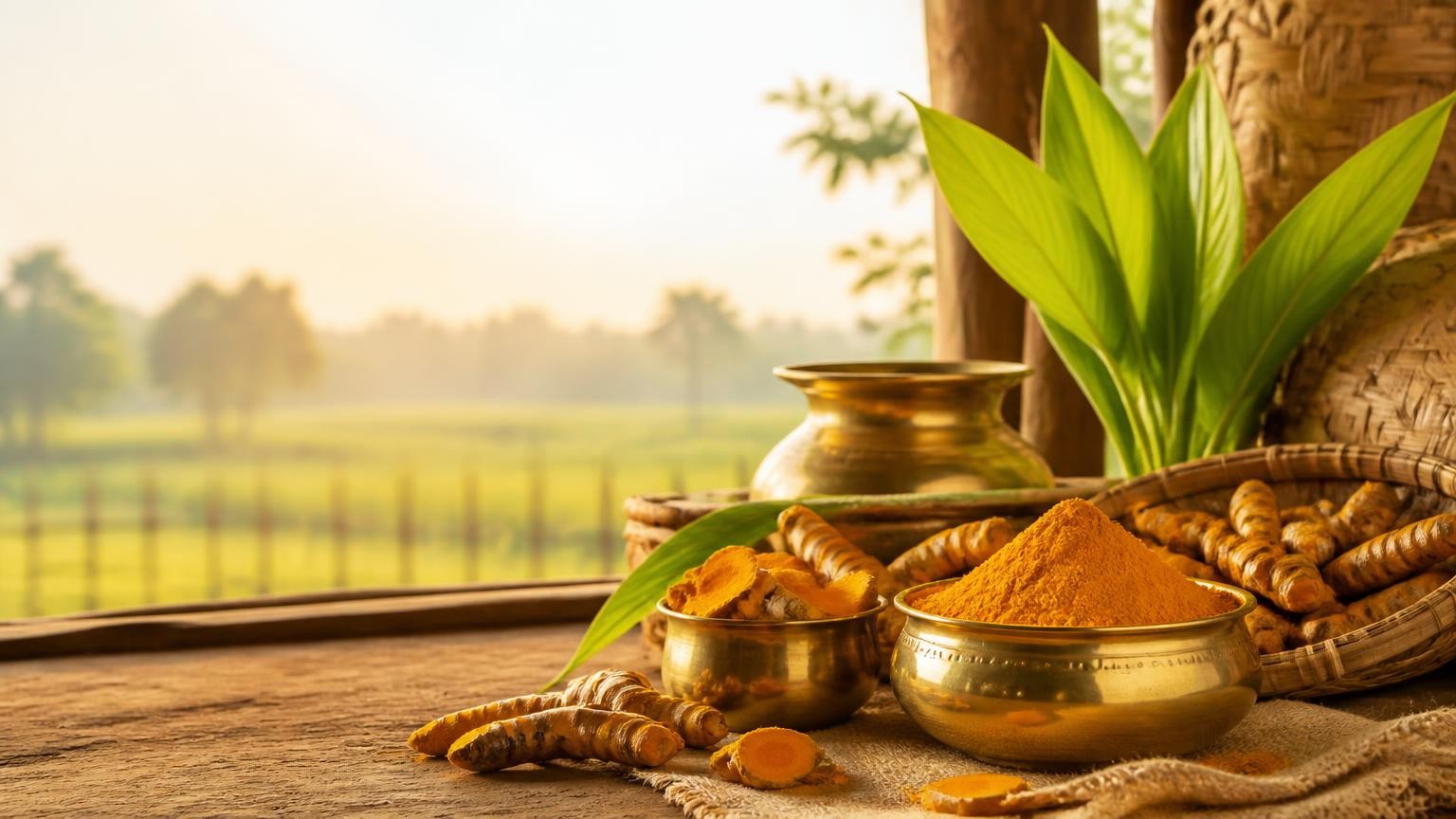
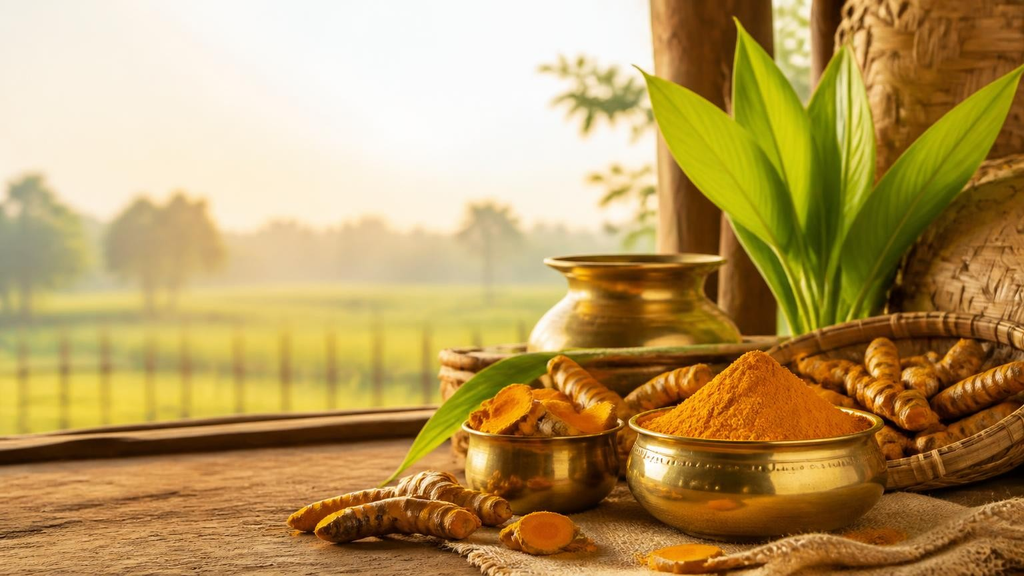
These kinds of traditional wisdom are passed on from generations, and represent centuries of accumulated knowledge on which plant species grow where and when to harvest them. It includes knowledge of how to prepare and process plant material for storage, preservation and consumption. Turmeric is a unique example of a plant whose processing involves a meticulous series of steps before it reaches the desired consistency and texture. After being harvested, the rhizomes are cleaned and dried. These dried rhizomes are then ground to get the familiar golden-yellow powder that we know and love.
Turmeric, as a plant, has thus been an important part of local knowledge and processing systems. It has a rich history of being a part of the traditional lifestyle, spanning from the plant’s roots (literally) to the powder form that we use in the kitchen.
From Rhizome to Powder: Turmeric’s Processing History
Turmeric processing has had a long-standing history, stretching back hundreds of years. While traditional processing of turmeric is similar to the way it has been done for centuries, modern-day value addition has given this humble spice a much-needed makeover.
Traditional processing of turmeric involves the careful cleaning of the fresh rhizomes. The cleaned rhizomes are then dried and ground to make the familiar golden-yellow powder For the local farmers, who spend years cultivating this crop, the process begins much earlier, involving preparation of the fields and sowing. Hence, the next time you see a packet of turmeric powder, remember that it has come a long way from the farms and represents months of hard work and dedication by local farmers.
A packet of turmeric represents:
• Agricultural land
• Farming wisdom
• Hard work and dedication
• Processing skills
• Local markets
• Family food habits
• Rural entrepreneurship
This represents the entire value chain that has contributed to bringing this cherished product to you. Hence, it is only natural that Bongaigaon’s famed turmeric has the potential to carve out a unique niche for itself in the local as well as the global marketplace.

Turmeric in Assamese Food Culture
Turmeric finds its way into many Assamese dishes, varying from fish curries to vegetable preparations. Turmeric is one of the integral ingredients used in Assamese cuisine.
As per Assam Tourism’s website, one of Assam’s famed dishes – Patot Diya Maas (fish wrapped in a banana leaf and cooked over an open fire), “…requires turmeric powder, ginger, garlic, onion and mustard paste…”
Thus, turmeric is a staple in Assamese cuisine. Further, Assamese cuisine has been described as one where minimal spices are used to bring out the authentic flavour of the ingredients. Turmeric, in its characteristic earthy manner, compliments the other ingredients, giving the dish its distinctive yellow hue.
Further, the Assamese method of cooking with banana leaves and open wood fires adds its own unique aroma. All of this combines to create a dish that is not just healthy but also a unique reflection of the Assamese landscape and lifestyle.
Thus, every dish has its own story, bearing out in its ingredients, preparation methodology and the unique combination and proportion of spices. This unique combination is responsible for the distinct taste of every Assamese dish.
Turmeric and the Assamese Kitchen
In an Assamese home, cooking has often been a reflection of the local produce. Just as Assam is rich in natural produce, Assamese cuisine makes liberal use of the region’s vegetables, fruits, fish, herbs and other locally available produce. Turmeric has been an everyday ingredient in Assamese kitchens for centuries.
Whether it has been a simple vegetable curry or fish preparations, turmeric has always enhanced the dish with its unique golden hue and flavour. Even meat dishes have made use of this distinctive spice. While a pinch of turmeric may seem minuscule, it has always been an important part of Assamese cuisine. Even today, the yellow spice lends its unique colour and aroma to many Assamese dishes, both vegetarian and non-vegetarian.
Turmeric’s yellow hue has also made it a household favourite. The characteristic aroma of turmeric when fried in mustard oil, along with onions and ginger, is a treat for the senses. Turmeric’s unique contribution to Assamese cuisine is one reason why it holds a special place in the Assamese kitchen.
Turmeric and Traditional Assamese Celebrations
Perhaps one of the most unique aspects of turmeric’s deep cultural legacy in Assam is reflected in the traditional Assamese celebrations. Turmeric has often been a part of Assamese rituals and beauty regimen as well. Maah-halodhi, a traditional beauty preparation, is an illustrative example. This is a traditional Assamese beauty regime that has been prepared using black lentils (maah) and turmeric (halodhi). This preparation has been documented in the recent studies on Assamese beauty practices, and the preparation is recommended especially during Manuh Bihu.
This reflects turmeric’s deep cultural legacy and its connection to the Assamese identity. Beauty and body care regimes have often been a part of traditional Assamese practices. The use of local produce like turmeric and black lentils in these traditional remedies showcases the rich cultural and spiritual history of the region’s practices. Turmeric has not only been used as a food ingredient, but it has also found its way into the traditional beauty and cultural practices, showcasing its unique and deep connection to the Assamese identity.
Turmeric and Traditional Wisdom
Traditional wisdom has often been passed down generations through oral traditions and anecdotal evidence. Turmeric is one such example of traditional wisdom that has seen centuries of rich history. A grandmother’s knowledge of how much turmeric to add to a curry is passed down to her granddaughter. Similarly, a farmer’s knowledge of when to sow and harvest turmeric gets passed down through generations. Even the unique way families have of preserving turmeric is reflective of traditional wisdom. While none of this is documented formally, it continues to be passed down, surviving the test of time because it has been found to work.
This is one reason why traditional knowledge is invaluable, for it reflects a deep-rooted connection between people and their practices. And nowhere is this better showcased than in the rural communities where traditional knowledge is intertwined with the local economy. Thus, it is not surprising that Bongaigaon’s turmeric has such a rich legacy that it can draw upon for its branding and value addition efforts. This is also the reason why Bongaigaon’s turmeric presents exciting avenues for value addition.
Why Bongaigaon Turmeric is an Important ODOP Product
The Government of India’s initiative of One District One Product aims to identify products peculiar to a certain district as well as promote their value addition, branding and marketing. As such, the state of Assam has identified the following products for ODOP:
Bongaigaon – Turmeric
The selection of turmeric as Bongaigaon’s ODOP product is significant since it reflects the crop’s deep connection to the locale. The Government of India’s ODOP initiative focuses on developing the product’s value addition chain, with an emphasis on branding, marketing and market development. Thus, for Bongaigaon, the selection of turmeric as its ODOP product has tremendous potential. It would enable value addition at multiple levels while supporting local businesses. It would also enable the development of a unique identity for the ODOP product.
Potential Products that can be Made from Bongaigaon Turmeric
Turmeric has tremendous potential as a value addition crop across various stages. Some of the potential products that could be developed from Bongaigaon Turmeric are:
• Traditional turmeric powder
• Organic turmeric powder
• Dried turmeric fingers
• Turmeric spice mix
• Ready-to-cook turmeric mix
• Turmeric tea
• Turmeric pickle
• Wellness products made from turmeric
• Natural food products with added turmeric
• Assamese spice mix with turmeric
• Gift packs featuring Assamese spices and local produce
However, it is important to bear in mind that while some of the aforementioned products may find their roots in traditional recipes, others could be developed as modern products, leveraging on the traditional legacy of the Bongaigaon Turmeric.
Supporting Bongaigaon’s Farmers
One of the most significant advantages of focusing on Bongaigaon’s turmeric is its potential for supporting local farmers. Farmers play a crucial role in the value chain, and by promoting the ODOP product, they stand to benefit massively. Turmeric’s value addition potential ranges from local collection and sorting to drying and grinding to packaging and marketing. Thus, a local initiative focusing on the Bongaigaon Turmeric could benefit a large number of local farmers.
Further, a large number of women in the Bongaigaon district could potentially be involved in turmeric collection, sorting and processing. Their involvement could be leveraged to establish Self Help Groups that would support women’s empowerment through livelihood promotion with turmeric value addition.
Similarly, local farmers can form Farmer Producer Companies that could potentially scale their efforts at value addition while branding their local produce as the official ODOP product of the district. Such initiatives would create employment as well as support local entrepreneurship.
The Role of Women in Preserving Turmeric Traditions
Women have played a crucial role in preserving traditional knowledge and food habits. Just as women were responsible for processing and preserving local produce, they also passed on the traditional knowledge of food habits to subsequent generations. Turmeric is one such product that has been processed and preserved using traditional methods. From preparation of traditional spice mix, to preserving turmeric using local methods, it has always been the women who have ensured that traditional knowledge and methods survive.
Modern-day entrepreneurship could potentially leverage on such traditional knowledge, showcasing it as authentic and unique. Women-led Self Help Groups can create value-added products from turmeric while promoting their local identity. Such initiatives would not only preserve traditional methods but also help pass on this knowledge to the younger generations while supporting women’s economic empowerment.
Bongaigaon’s Turmeric and the “Local to Global” Framework
One of the most exciting aspects of local products is their potential to scale up while retaining their authenticity and unique identity. In this regard, perhaps one of the most crucial initiatives that could be undertaken for Bongaigaon Turmeric is to highlight its unique story as well as its connection to the Assamese culture and geography. In an age where customers are increasingly interested in learning more about the products that they purchase, it is essential to invest time and effort in telling a brand’s story. For instance, instead of simply stating the product as ‘turmeric powder’, the product could be marketed as ‘Bongaigaon Turmeric – the golden spice of Assam’.
Such a framework could be used to showcase the product’s unique selling points, from its geographical location to the regional culture. This would enable better branding and marketing for the ODOP product. For DesiBiz, which aims to promote local businesses, products and entrepreneurs, such a strategy could be extremely valuable. The potential for a ‘local to global’ marketing framework is extremely viable for Bongaigaon’s famous turmeric, for it offers a unique blend of traditional wisdom, local produce and rich Assamese culture that can appeal to a global customer base.
Authenticity is Key for Regional Products
As much as authenticity is important for branding and marketing, it is also vital to ensure that authenticity is not compromised for the sake of branding. At present, many regional products are being marketed as ‘herbal’, ‘organic’, or ‘medicinal’, when in reality they may not be entirely so. As such, it is extremely important to ensure that authenticity is maintained, even when it comes to marketing a product. While Bongaigaon’s turmeric could potentially leverage on the region’s traditional knowledge as well as the authenticity of local produce, it is important to ensure that authenticity is not sacrificed for the sake of branding. A strong brand position could be built by emphasising on turmeric’s unique qualities – such as its local origin, traditional processing methods, traceability and so on.
At the end of the day, a regional brand will always have its unique story. As much as the brand’s legacy needs to be highlighted, exaggerating the product’s authenticity should be avoided.
Protecting the Cultural Legacy of Turmeric
When it comes to commercialisation, it is essential to ensure that commercialisation does not dilute a product’s cultural legacy. When it comes to turmeric, it is important to ensure that its rich cultural legacy is safeguarded. Turmeric’s deep connection to the Assamese culture is best showcased by focusing on its intrinsic value. Highlighting the Bongaigaon farmers and the local Assamese kitchens makes the product authentic and unique to its origin. Further, showcasing its traditional processing methods offers customers an insight into the product’s unique legacy. By focusing on such aspects, commercialisation becomes much easier while ensuring that the product’s rich cultural legacy remains intact. By doing so, the product can continue to serve its purpose of being not just a spice but also as a representation of Bongaigaon’s Assamese culture.
The Golden Color of Assam’s Rural Economy
Turmeric’s bright, golden hue is instantly recognizable. But what many people fail to realize is that this spice has the potential to brighten up rural Assam’s economy. From farmers to processors and from marketers to consumers, everyone has a stake in turmeric’s success. Local entrepreneurs can take advantage of turmeric’s popularity to develop value-added products. Digital media can showcase the spice’s rich cultural legacy. And even traditional Assamese kitchens can play their part by preserving turmeric’s traditional use. Together, these efforts can go a long way in promoting an entire regional economy, from local entrepreneurship to rural employment and even to the preservation of traditional Assamese cuisine.
Bongaigaon’s Turmeric: A Cultural Food Story
When we think of traditional foods, the first things that come to mind are traditional dishes. However it is also necessary to acknowledge the traditional ingredients that have formed an indelible part of the traditional cuisine. Turmeric is one such traditional ingredient that has, over several centuries, found itself woven into the traditional Assamese cuisine. Bongaigaon’s famed turmeric has the potential to carve a niche for itself in the ODOP arena by capitalizing on its traditional roots. The cultural legacy linked to turmeric offers exciting avenues for value addition, branding and marketing. Turmeric’s traditional legacy can be showcased while the product itself can see value addition at multiple levels. While turmeric may have been a traditional ingredient, it has now found its way into a contemporary setting where it can flourish as a valued regional product with a unique identity. Turmeric’s legacy can be preserved while entrepreneurs can benefit immensely by leveraging on this traditional product.

Building a Sustainable Future for Bongaigaon’s Turmeric
Bongaigaon’s turmeric has the potential to be much more than just a local product. However, it is extremely important to ensure that steps are taken to build a sustainable future for this local crop. Farmers need to be supported so that they can focus on cultivating high-quality turmeric. Local businesses need to be assisted in promoting their local produce while ensuring food safety and value addition. Customers need to be educated so that they can make informed choices about their purchases. And local cultural practices need to be preserved so that they can be passed on to future generations. If these steps can be taken, turmeric can truly evolve from being a local product to a renowned regional product with an impressive legacy.
Conclusion: The Golden Legacy of Bongaigaon
Bongaigaon’s turmeric has come a long way from being a local produce to becoming the famed ODOP product of the district. Turmeric has deep roots in not only Assam’s economy but also in its cultural legacy. The Government of India has identified turmeric as Bongaigaon’s ODOP product, thereby giving it a much-needed boost in terms of branding and marketing. Assam’s agricultural statistics bear testimony to turmeric’s long-standing legacy in Assam, with turmeric cultivation taking place across the region and especially in Bongaigaon. But it is Assam’s rich cultural legacy that makes turmeric such an important part of the local economy.
Turmeric, referred to as ‘halodhi’ in Assamese, has found its way into Assamese cuisine as well as Assamese traditions. It is a significant part of Assamese culinary traditions and is used in a variety of Assamese dishes. Not only that, turmeric also has a significant place in Assamese traditions in the form of traditional beauty regimens. Thus, Bongaigaon’s famed turmeric finds itself at the crossroads of Assam’s culinary and cultural legacy.
For DesiBiz, Bongaigaon’s famous turmeric represents not only the opportunity to showcase local businesses but also the opportunity to promote local products and entrepreneurs. Turmeric’s immense potential lies in its long-standing legacy, which can be leveraged to create exciting avenues for value addition and branding. Therein lies the future value of Bongaigaon’s famous turmeric.
FAQs
1. What is Bongaigaon famous for under the ODOP initiative?
Bongaigaon district of Assam is officially identified with Turmeric under the One District One Product initiative.
2. What is turmeric called in Assamese?
Turmeric is commonly known as Halodhi in Assamese traditional plant knowledge.
3. How is turmeric used in Assamese cuisine?
Turmeric is used in various fish, vegetable and meat preparations. Assam Tourism, for example, includes turmeric powder in its description of Patot Diya Maas.
4. Does turmeric have cultural significance in Assam?
Yes. Besides culinary use, turmeric appears in traditional Assamese practices. Maah-halodhi, made from black lentils and turmeric, has been documented as part of traditional practices associated with Bihu.
5. What products can be made from Bongaigaon turmeric?
Potential value-added products include turmeric powder, dried turmeric fingers, spice blends, pickles and other packaged food products. New products should be clearly presented as modern value-added products rather than incorrectly described as ancient local traditions.
6. Why is Bongaigaon turmeric important for local businesses?
ODOP recognition provides a framework for improving value addition, branding, marketing and market access for district-specific products. This can create opportunities for farmers, processors, Self Help Groups and local entrepreneurs.