Assam is often introduced to the world through its tea gardens, mighty Brahmaputra and rich wildlife, but the cultural identity of the state is much broader. Across its villages and hills, agriculture has shaped food, livelihoods, traditions and community life for generations. In southern Assam, Cachar district has developed a particularly strong identity around one tropical fruit—the pineapple.
Known especially for the pineapples grown around Lakhipur and the Hmarkhawlien area, Cachar has a long agricultural association with the fruit. Assam’s official agricultural records identify Cachar as an important pineapple-producing district, while the Ministry of Food Processing Industries lists Cachar – Pineapple Based Products as a production cluster under the PMFME framework.
The story of Cachar pineapple, however, is not simply a story about a sweet fruit or a food-processing opportunity.
It is a story about farmers, indigenous knowledge, hill agriculture, traditional food habits, local communities and the changing face of rural entrepreneurship.
The pineapple grown in Cachar travels a fascinating journey—from green fields and hill slopes to village markets, family kitchens, juices, jams, squashes and other value-added products. In recent years, efforts to connect Cachar pineapple with larger national markets have also increased, creating new possibilities for growers and local food businesses.
For a platform such as DesiBiz, which highlights India’s local businesses, products, artisans and traditional enterprises, Cachar’s pineapple offers a perfect example of how a regional agricultural product can carry both cultural heritage and commercial potential.
Cachar: Where the Barak Valley Meets Pineapple Country
Cachar is located in the Barak Valley of southern Assam. Its landscape is different from the broad riverine plains associated with much of the Brahmaputra Valley. The district contains plains, low hills, forests and agricultural areas, creating a diverse environment for cultivation.
Agriculture remains an important part of life in Cachar. Official district information identifies rice as the principal cereal crop while also listing pineapple, areca nut, coconut, banana, jackfruit and citrus among important crops. The district’s agricultural system includes intercropping, with pineapple grown alongside crops such as areca nut, banana, Assam lemon, potato, French beans and black pepper.
This agricultural diversity is important to understanding Cachar’s pineapple tradition.
Pineapple is not simply planted in isolated commercial farms. In several areas, it has historically formed part of broader farming systems where farmers make use of the land, trees and seasonal crops together.
The Lakhipur area is particularly associated with pineapple. The Government of Assam’s Mission Organic Value Chain Development programme identifies Lakhipur, Cachar, as a 500-hectare pineapple cluster, showing the importance of the crop in the district’s agricultural landscape.
The Sweet Pineapple of Hmarkhawlien
When discussing Cachar pineapple, the name Hmarkhawlien deserves special attention.
Located in the Lakhipur area, Hmarkhawlien has long been associated with pineapple cultivation and the Hmar community. Historical accounts describe the area as producing exceptionally sweet pineapples, while research supported by the Government of India has documented the traditional pineapple agroforestry systems practised by Hmar communities in Cachar.
This makes the pineapple story particularly interesting from a cultural perspective.
The fruit is connected not only with agriculture but also with indigenous farming knowledge.
For generations, Hmar communities have cultivated pineapple using systems adapted to the local landscape. Research on traditional pineapple agroforestry in southern Assam notes that the Hmar people have practised this form of cultivation for centuries and developed indigenous methods that provide both economic and ecological benefits.
This is an important reminder that traditional agriculture is often much more sophisticated than it appears.
Farmers understand their soil, slopes, rainfall, vegetation and seasonal cycles through experience.
That knowledge becomes part of the cultural heritage of the community.
Pineapple and Traditional Agroforestry
One of the most fascinating aspects of Cachar’s pineapple story is its connection with agroforestry.
Agroforestry involves growing crops alongside trees and other vegetation rather than treating farmland as a completely open monoculture.
Research on Hmar pineapple cultivation in Cachar describes an indigenous pineapple agroforestry system that has been maintained through traditional knowledge. The study found that such systems can maintain ecosystem carbon stocks while also providing economic and other benefits to local communities.
This makes Cachar pineapple more than an agricultural commodity.
It becomes an example of how traditional communities have adapted agriculture to their natural surroundings.
In many cases, modern sustainability discussions are returning to ideas that traditional farming communities have practised for generations: maintaining tree cover, using land efficiently and combining different crops.
For a modern regional brand, this agricultural heritage can become an important part of the story.
From Pineapple Field to Family Kitchen
A traditional food story begins with the farmer.
During the growing season, pineapple plants develop their distinctive spiky leaves and eventually produce the fruit that consumers recognise.
Harvesting is labour-intensive. Farmers traditionally enter plantations and manually collect mature fruits. A study of Assam’s pineapple value chain notes that harvesting can involve manual collection and transportation using baskets, reflecting the labour-intensive nature of pineapple cultivation in the Northeast.
Once harvested, pineapples can be sold fresh in local markets.
This is still the most familiar form in which people enjoy the fruit.
A ripe Cachar pineapple can be peeled, sliced and eaten fresh, allowing consumers to experience its natural sweetness and aroma without complicated preparation.
But when production is high, fresh fruit markets alone may not be enough.
That is where processing becomes important.
Pineapple as a Traditional Food Ingredient
Pineapple is naturally suited to both sweet and savoury preparations.
Its sweet-and-sour character makes it useful in chutneys, preserves and other preparations.
In Northeast Indian food culture, local fruits often become part of household food preservation traditions. Seasonal fruits can be transformed into products that extend their usability beyond the harvest period.
This idea is particularly relevant for pineapple.
Instead of consuming the entire harvest immediately, fruit can be converted into:
- Juice
- Squash
- Jam
- Jelly
- Pickle
- Chutney
- Candy
- Dried fruit
- Canned pineapple
- Other preserved products
The Ministry of Food Processing Industries identifies these types of pineapple products as suitable opportunities for micro-enterprises, including canned pineapple, bottled juice, jams, candies, dry snacks, pickles and chutneys.
These should not all be described as ancient traditional Cachar recipes. Rather, they represent modern value addition built around a fruit that has deep local agricultural roots.
That distinction helps preserve the authenticity of the cultural story.
Pineapple Juice: Capturing the Freshness of Cachar
One of the simplest ways to process pineapple is to turn it into juice.
Fresh ripe pineapple is crushed or pulped and the juice is separated before being served chilled.
For a region known for sweet pineapple, juice offers an opportunity to capture the flavour of the fruit in a convenient form.
Local entrepreneurs can potentially develop bottled pineapple juice using fruit sourced from nearby growers.
A regional label could tell consumers where the fruit comes from and introduce them to Cachar’s agricultural landscape.
The idea is simple:
Fresh fruit from Cachar → locally processed juice → regional brand → wider market.
This creates additional value while reducing dependence on fresh-fruit sales alone.
Pineapple Squash: A Traditional-Style Preservation Opportunity
Pineapple squash is another important value-added product.
The PMFME pineapple-processing guidance describes squash as a concentrated fruit drink that can be diluted with water and served chilled. It also provides a processing method based on pineapple juice, sugar, water and permitted preservatives.
Squash has particular relevance for small food businesses because it provides a way to preserve seasonal fruit and sell it beyond the immediate harvest period.
A locally produced Cachar pineapple squash could combine modern food processing with regional branding.
The bottle could carry an Assamese-inspired visual identity, perhaps featuring the Barak Valley landscape, pineapple farms and local cultural motifs.
In this way, packaging itself becomes a form of storytelling.
Pineapple Jam: From Orchard to Breakfast Table
Pineapple jam is another established value-added product.
It is made by cooking pineapple pulp with sugar and other ingredients until it reaches the desired consistency. PMFME guidance lists pineapple jam among the products that micro-enterprises can produce.
For Cachar, jam production has an important economic advantage.
Fruit that may not be ideal for premium fresh-fruit presentation can potentially be diverted into processing, subject to food safety and quality requirements.
This can help reduce wastage while creating another revenue stream.
A jar of pineapple jam carrying a label such as “Made with Pineapple from Cachar, Assam” can turn an agricultural commodity into a recognisable regional product.
Pineapple Jelly and Preserves
Jelly is another possibility for value addition.
The bright colour and naturally fruity character of pineapple make it suitable for preserved products.
Traditional preservation has always been connected with the practical need to extend the life of seasonal foods.
Modern processing simply provides better consistency, packaging and shelf life.
For rural entrepreneurs, products such as jelly and preserves can become small-scale business opportunities, particularly when supported through training and food-processing schemes.
The important point is that the product should retain a clear connection with its place of origin.
The story should begin with the Cachar pineapple, not simply with generic fruit processing.
Pineapple Pickle and Chutney: Sweet Meets Savoury
Perhaps the most interesting opportunity is the use of pineapple in savoury products.
Pineapple’s natural acidity and sweetness can complement spices, salt and other ingredients.
Pineapple pickle and chutney can therefore create a product that combines the tropical character of the fruit with Indian culinary traditions.
The PMFME pineapple newsletter specifically identifies pickles and chutneys as product lines that micro-enterprises can explore.
For a DesiBiz audience, such products are particularly interesting because they can represent the meeting point of regional agriculture and Indian food innovation.
A locally made pineapple chutney could be marketed alongside other Assamese products, creating a broader regional food basket.
Pineapple Candy and Dried Fruit
Pineapple candy offers another way to extend the fruit’s shelf life.
Small pieces of pineapple can be processed and preserved to create a sweet snack.
Dried pineapple can also be developed as a convenient product for modern consumers.
The Ministry of Food Processing Industries identifies pineapple candies and pineapple-based dry snacks among the possibilities for micro-enterprises.
These products are particularly suitable for modern retail and online marketplaces because they are easier to package and transport than fresh fruit.
This creates a direct connection between traditional agricultural production and modern e-commerce.

The Cultural Story Behind the Fruit
A product becomes much more meaningful when its story is understood.
Cachar pineapple is connected with communities that have cultivated the fruit within traditional agricultural systems.
The Hmar community’s pineapple agroforestry practices demonstrate how indigenous knowledge can support both livelihoods and environmental benefits.
This cultural dimension should be respected when building a regional pineapple brand.
Instead of presenting the fruit as simply “another pineapple,” businesses can explain:
- Where it is grown
- Who grows it
- How traditional farming practices developed
- How the landscape influences cultivation
- How local communities earn livelihoods
- How the fruit becomes value-added products
This kind of storytelling gives consumers a reason to remember the product.
Pineapple and the Hmar Community
The Hmar community’s relationship with pineapple is one of the strongest cultural elements in Cachar’s pineapple story.
Research documented by the Government of India notes that Hmar communities in southern Assam have cultivated pineapple for centuries using indigenous pineapple agroforestry systems.
Agriculture in Hmar society has historically included crops such as rice, maize, chilli, pumpkin, ginger, brinjal, mustard, pineapple and orange. Cultural documentation also records Bishu, an important Hmar festival associated with the winter harvest, religious rituals, traditional dances, music and cuisine.
This demonstrates how agriculture and culture are deeply connected.
The crop is part of a larger community landscape.
The farm is connected to food.
Food is connected to festivals.
Festivals are connected to identity.
And identity is what gives a regional product its soul.
The Role of Traditional Farming Knowledge
Traditional farming is based on close observation.
Farmers learn when to plant, how to maintain the crop and how to work with the local environment.
In the hills and uplands of Cachar, pineapple cultivation has adapted to the landscape.
This knowledge cannot always be replaced by machinery.
Modern technology can certainly improve productivity, irrigation, post-harvest handling and processing, but local knowledge remains valuable.
The strongest future for Cachar pineapple is therefore not necessarily a choice between “traditional” and “modern.”
It is a combination of both.
Traditional knowledge + scientific support + better infrastructure + modern branding = stronger local enterprise.
Why Processing Matters for Cachar Farmers
Fresh pineapple is highly perishable.
If farmers are forced to sell the entire harvest quickly, they may have limited bargaining power.
Government and industry studies have highlighted challenges such as scattered production, weak processing infrastructure and market difficulties in Assam’s pineapple sector.
Processing can help change this situation.
When fruit is converted into jam, squash, juice, candy or other products, its market life can be extended.
This does not eliminate the need for fresh-fruit markets.
Instead, it creates another route for the harvest.
A stronger value chain could look like:
Farmer → Collection Centre → Grading → Fresh Market / Processing Unit → Packaging → Brand → Retail / Digital Marketplace → Consumer
Such a system can potentially create greater value within the district.
Cachar Pineapple and the ODOP Opportunity
Cachar is officially listed as an ODOP pineapple district, and the PMFME production-cluster list specifically identifies Cachar – Pineapple Based Products.
This recognition is significant.
It means pineapple is not simply a crop grown locally. It has been identified as a product around which a district-level food-processing ecosystem can be developed.
The Government of Assam’s organic value-chain programme has also identified Lakhipur as a pineapple cluster.
These initiatives create opportunities for farmer groups, Self Help Groups, micro-enterprises and local entrepreneurs.
The real challenge is turning recognition into sustainable business.
Opportunities for Local Entrepreneurs
A young entrepreneur in Cachar does not necessarily need to build a large factory to participate in the pineapple economy.
Small businesses can explore:
Fresh Pineapple Branding
Selling graded, carefully packed Cachar pineapples under a regional identity.
Pineapple Juice
Creating locally processed beverages for regional and national markets.
Pineapple Squash
Developing concentrated fruit beverages for households and hospitality businesses.
Pineapple Jam and Jelly
Creating shelf-stable products suitable for retail.
Pineapple Pickle
Combining local fruit with Indian spice traditions.
Pineapple Chutney
Creating a sweet-and-spicy accompaniment for contemporary consumers.
Pineapple Candy
Developing a convenient regional snack.
Dried Pineapple
Targeting consumers interested in portable fruit snacks.
These are opportunities rather than claims that every product is already traditionally produced in Cachar.
That distinction is essential for responsible regional branding.
Women and Rural Entrepreneurship
Food processing can create opportunities for women in rural areas.
Small-scale preparation, packaging, labelling and marketing can be organised through Self Help Groups and community enterprises.
A pineapple-processing business can therefore extend beyond the farmer.
It can involve:
Growers → Women’s groups → Processors → Designers → Packers → Digital marketers → Retailers
This creates a broader rural ecosystem.
Traditional household skills in cooking and preservation can also become commercial skills when combined with training in hygiene, food safety, packaging and business management.
This is how cultural knowledge can become economic empowerment.
From Cachar to the National Market
The potential for wider markets is no longer theoretical.
In July 2026, Cachar’s Lakhipur pineapple received a national-market push through a buyer-seller meet organised by APEDA in collaboration with the district administration. Farmers, exporters, agri-entrepreneurs and institutional buyers participated, with discussions focused on post-harvest management and market opportunities.
This is an important development.
It shows that Cachar pineapple is increasingly being viewed not only as a local fruit but as a product with wider market potential.
The next step is building a strong identity around it.
DesiBiz and the Local-to-Global Story
This is where a platform like DesiBiz becomes relevant.
DesiBiz focuses on helping Indian local businesses, artisans and traditional products gain digital visibility and access to wider markets.
Cachar pineapple fits naturally into this idea.
Imagine a customer in Delhi, Mumbai, Bengaluru or another city discovering a packaged pineapple product and learning:
“This pineapple comes from the hills and farms of Cachar, Assam, where generations of local communities have cultivated the fruit.”
Suddenly, the product has a story.
The consumer is not only buying jam or squash.
They are buying a small connection to Assam.
This is the power of digital storytelling.

Preserving Tradition While Embracing Innovation
The commercial future of Cachar pineapple should not erase its cultural identity.
Instead, traditional knowledge should become one of its strongest assets.
Modern processing can provide:
- Better hygiene
- Consistent quality
- Improved packaging
- Longer shelf life
- Better transportation
- Wider market access
Traditional culture can provide:
- Regional identity
- Agricultural heritage
- Indigenous knowledge
- Community stories
- Authenticity
Together, these create a stronger product.
The Future of Cachar Pineapple-Based Products
The future could see Cachar becoming better known not only for fresh pineapple but also for a family of regional products.
A single pineapple cluster could support brands producing:
Cachar Pineapple Juice
Lakhipur Pineapple Squash
Cachar Pineapple Jam
Traditional-Style Pineapple Chutney
Pineapple Pickle
Dried Pineapple Snacks
Pineapple Candy
The branding could use Assamese-inspired patterns, Barak Valley landscapes and stories of local farming communities.
However, businesses should maintain proper food-safety compliance, accurate labelling and honest claims.
The goal should be to create a brand that consumers trust because the story is genuine.
Conclusion: The Sweet Heritage of Cachar
Cachar’s pineapple is more than a fruit. It is a symbol of agriculture, indigenous knowledge, community and the evolving entrepreneurial spirit of Assam.
The district has a long-established association with pineapple cultivation, particularly in areas around Lakhipur and Hmarkhawlien. Official Assam records identify pineapple as an important crop in Cachar, while government programmes recognise Lakhipur as a pineapple cluster.
The cultural dimension makes the story even more special.
Hmar communities in southern Assam have practised traditional pineapple agroforestry for generations, developing farming systems adapted to their environment. Research has also highlighted the ecological and livelihood benefits associated with these traditional systems.
At the same time, Cachar has enormous potential for pineapple-based products. The PMFME framework identifies the district specifically for pineapple-based products, while government guidance highlights products such as juice, squash, jam, jelly, candy, dried snacks, pickles and chutneys as possibilities for micro-enterprises.
The future, therefore, lies in bringing these two worlds together.
Tradition can provide the identity.
Farmers can provide the raw material.
Modern processing can create value.
Entrepreneurs can build brands.
Digital platforms can connect those brands with the world.
For DesiBiz, Cachar pineapple represents exactly the kind of Indian local-business story that deserves a larger audience—a product born from Assam’s soil, nurtured by communities and capable of becoming a modern food-processing opportunity.
The sweetest part of Cachar’s pineapple story is not only the taste of the fruit.
It is the story behind it.
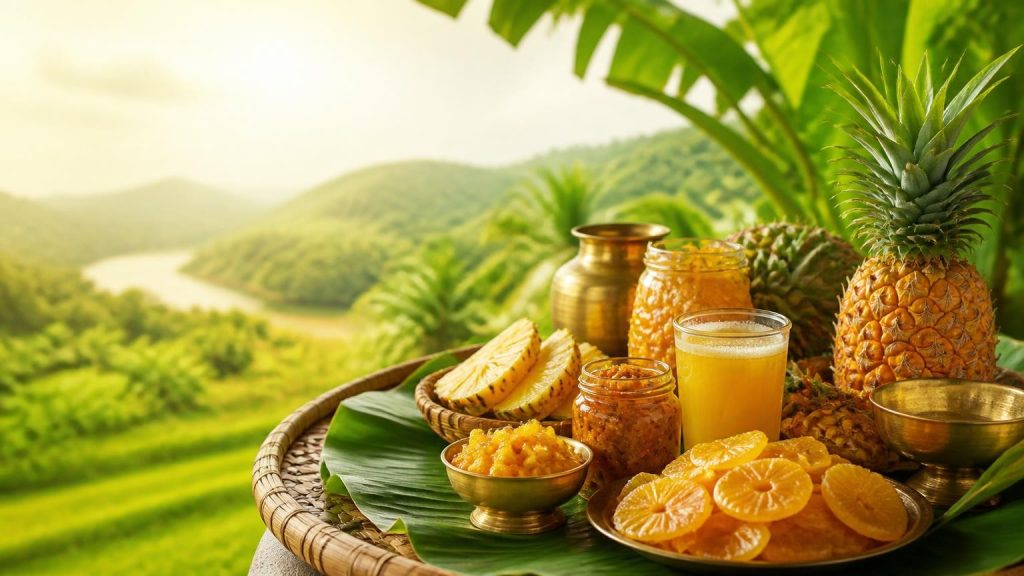
A story of hill slopes, farmers, bamboo baskets, traditional agroforestry, village life, local markets and generations of knowledge.
From the green fields of Lakhipur to the tables of consumers across India, Cachar pineapple carries a little piece of Assam wherever it goes.
And with thoughtful value addition, responsible branding and digital entrepreneurship, that sweet local heritage can find its place in a much larger world.
Frequently Asked Questions
1. What is Cachar famous for under the food-processing ODOP initiative?
Cachar is identified as an ODOP district for pineapple, and the PMFME production-cluster list identifies pineapple-based products for Cachar.
2. Which area of Cachar is especially known for pineapple?
The Lakhipur area, including Hmarkhawlien, is particularly associated with pineapple cultivation. The Assam Government’s organic value-chain programme identifies Lakhipur as a pineapple cluster.
3. What pineapple-based products can be made in Cachar?
Potential products include pineapple juice, squash, jam, jelly, candy, dried pineapple, pickle, chutney and canned pineapple. These are recognised possibilities for pineapple micro-processing enterprises by PMFME guidance.
4. Is pineapple part of traditional culture in Cachar?
Pineapple has a significant agricultural and community connection, particularly among Hmar communities, who have practised indigenous pineapple agroforestry systems for generations.
5. Why is value addition important for Cachar pineapple?
Fresh pineapple is perishable, and processing can help create longer-lasting products and additional market opportunities. Government studies have identified processing, post-harvest management and market access as important areas for strengthening Assam’s pineapple value chain.
6. Can Cachar pineapple reach markets outside Assam?
Yes. Recent buyer-seller initiatives involving APEDA, farmers, exporters and institutional buyers have focused on expanding the market reach of Lakhipur’s pineapple.