
The colourful fabrics of Ujjain tell stories through wax, dyes and handcrafted patterns. Batik Print in Ujjain is one of Madhya Pradesh’s most recognisable textile traditions. It is especially associated with Bhairavgarh, an area near Ujjain known for preserving the traditional wax-resist dyeing technique.
Unlike machine-printed fabric, authentic batik carries small variations, fine cracks and handmade details. These features make every saree, dress material, stole or furnishing slightly different.
Today, Ujjain Batik Print represents more than decorative fabric. It supports traditional skills, local employment, cultural tourism and the wider handicraft economy. This guide explains its history, production process, popular designs, uses, advantages, limitations and methods for identifying authentic products.
What Is Batik Print in Ujjain?
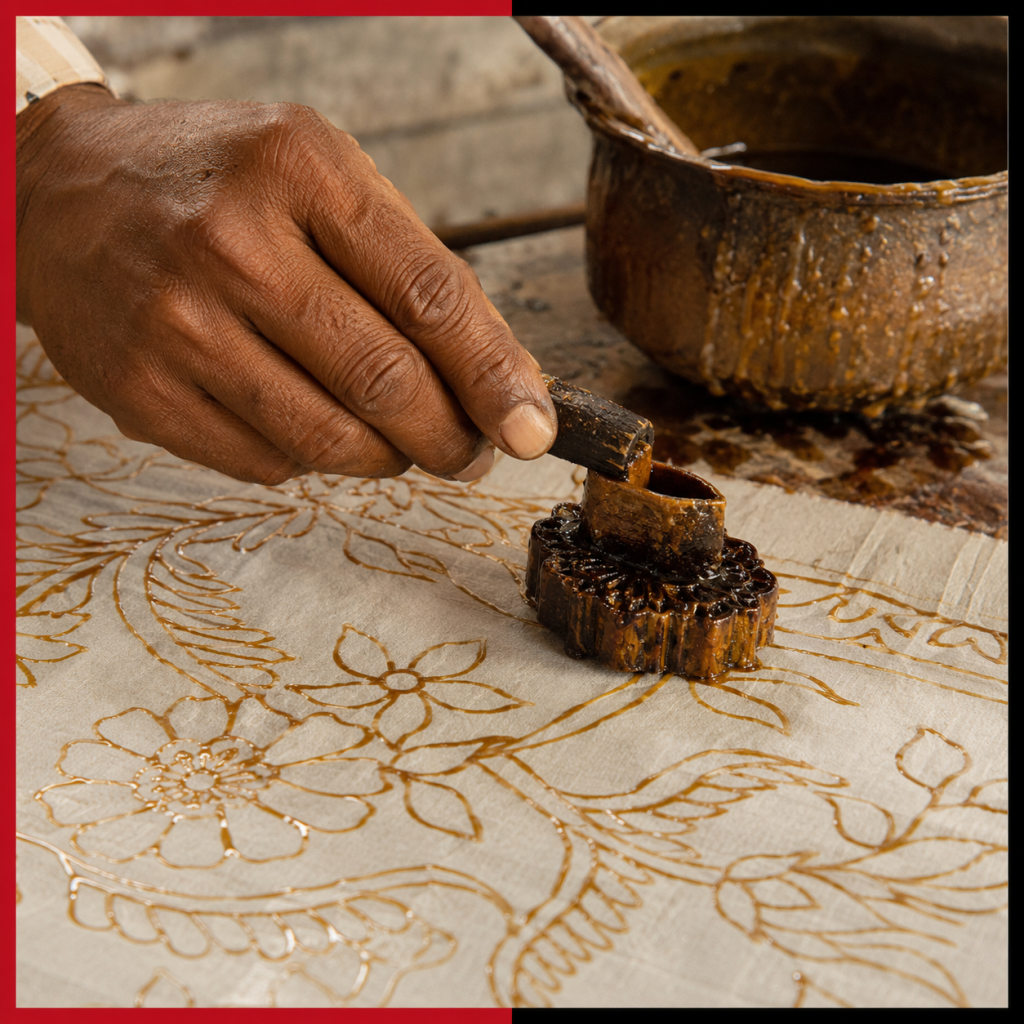
answer: Batik Print in Ujjain is a traditional textile-decoration technique in which artisans apply melted wax to selected areas of fabric before dyeing it. The wax blocks the dye, creating decorative patterns. After the wax is removed, contrasting motifs and characteristic crack-like lines appear on the cloth.
The technique is centred largely around Bhairavgarh near Ujjain. Artisans use wax, dyes, hand tools, blocks and carefully prepared fabric to produce intricate designs.
Ujjain Batik is used for making:
- Sarees
- Dupattas
- Dress materials
- Kurtis
- Stoles and scarves
- Bedsheets
- Cushion covers
- Wall hangings
- Contemporary fashion accessories
The Government of India’s handicrafts portal describes Ujjain Batik as a wax-resist textile tradition developed around Bhairavgarh.
History of Ujjain Batik Print
Direct answer: Wax-resist dyeing has existed in different parts of the world for centuries. The Ujjain tradition developed around Bhairavgarh, where artisan communities refined batik printing into a regional craft. The area became known for vividly coloured cloth decorated with floral, geometric and traditional motifs.
According to the Development Commissioner for Handicrafts, artisans from Gujarat and Rajasthan are believed to have arrived in Bhairavgarh around 400 years ago during the Mughal period. The area gradually became an important centre for batik printing in Madhya Pradesh.
Initially, batik cloth was widely used by communities living around the region. Over time, artisans expanded their designs and introduced the technique into sarees, garments and home-furnishing products.
The craft has continued by adapting traditional patterns to changing fashion preferences. Modern products may use contemporary layouts and colour combinations while retaining the core waxing and dyeing method.
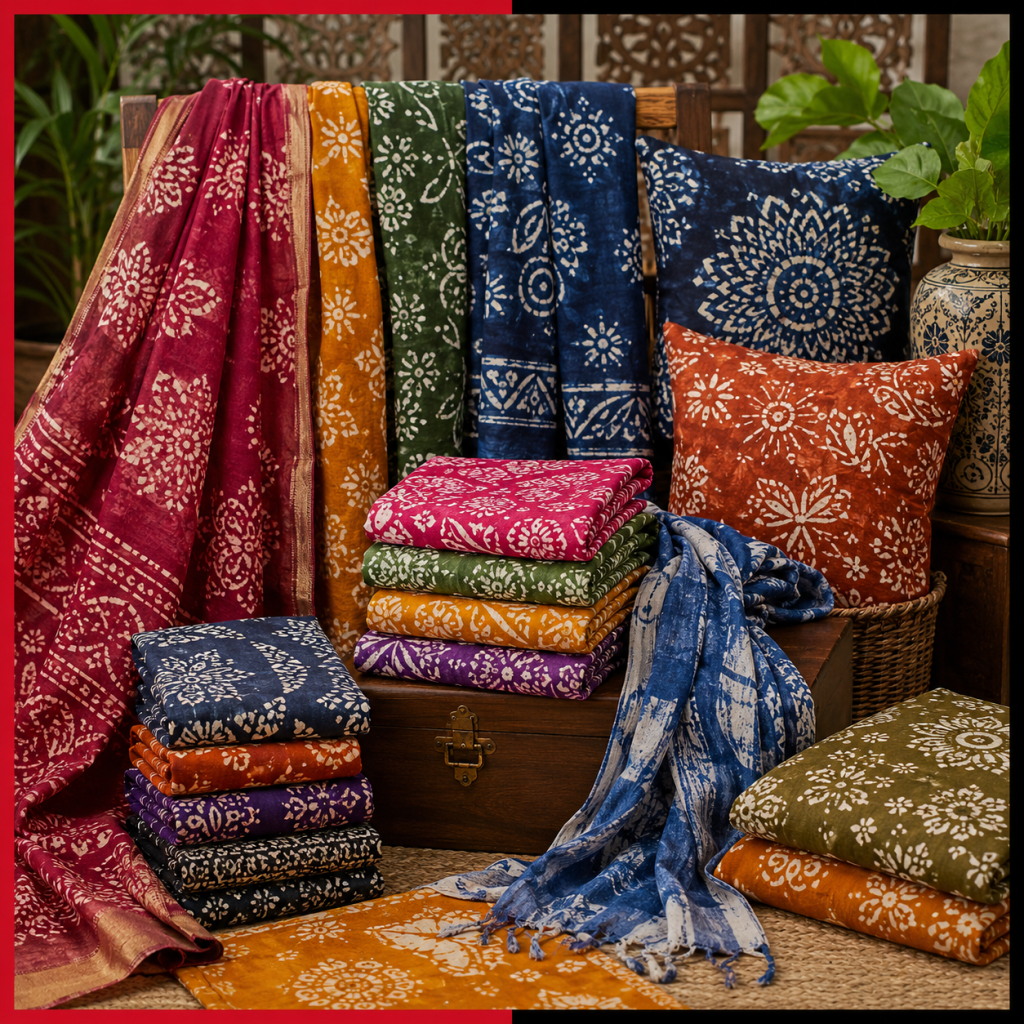
Why Is Ujjain Batik Print Important?
Direct answer: Ujjain Batik Print is important because it preserves a traditional handmade textile technique while creating livelihood opportunities for artisans. It also gives Ujjain a distinct product identity and contributes to the promotion of Madhya Pradesh’s handicrafts in domestic and international markets.
Ujjain Batik Print has cultural, artistic and economic value.
Cultural Importance
The craft reflects the textile knowledge passed through generations of artisan families. Each stage requires experience, from controlling the wax temperature to selecting colours and removing the resist without damaging the fabric.
Economic Importance
Batik production supports printers, dyers, block makers, finishers, tailors, packers and sellers. Demand for handmade sarees, fabrics and home décor can help sustain this local ecosystem.
Regional Identity
Ujjain Batik Print is recognised as Ujjain’s product under Madhya Pradesh’s One District One Product initiative.
Legal Recognition
“Ujjain Batik Print” is registered as a Geographical Indication for handicraft goods in Classes 24 and 25. The GI registration connects the product with Bhairavgarh and Ujjain in Madhya Pradesh.
How Is Batik Print in Ujjain Made?
Direct answer: Ujjain Batik Print is made by preparing the fabric, creating a design, applying hot wax to selected sections, dyeing the exposed areas and finally removing the wax. Multicoloured batik may require several rounds of waxing and dyeing before the fabric is washed, dried and finished.
The exact process can vary according to the design, fabric and workshop. However, the following stages are commonly used.
Step 1: Fabric Selection and Preparation
Cotton, silk or other suitable fabric is selected according to the final product. The cloth is washed or treated to remove starch, dirt and substances that could prevent even dye absorption.
It is then dried and stretched on a working surface.
Step 2: Design Planning
The artisan plans the pattern using drawings, perforated sheets, blocks or freehand guidance. Common layouts include repeating borders, central motifs, floral arrangements and geometric patterns.
Accurate spacing is important because a small mistake may affect the entire design.
Step 3: Wax Preparation
Wax is heated until it reaches a workable liquid consistency. The temperature must be controlled carefully.
Wax that is too cold may not enter the fabric properly. Excessively hot wax may spread beyond the intended pattern.
Step 4: Applying the Wax
The melted wax is applied with wooden or metal blocks, brushes or specialised hand tools.
Wax-covered sections resist the dye and retain their original colour. The artisan may also create fine cracks in the wax, allowing small amounts of dye to enter and produce batik’s signature crackled appearance.
Step 5: Dyeing the Fabric
The fabric is dipped into or treated with the chosen dye. Unwaxed sections absorb the colour, while waxed sections remain protected.
For multicoloured work, this stage may be repeated. Artisans protect selected sections with additional wax before applying the next colour.
Step 6: Removing the Wax
After dyeing is complete, the cloth is treated with hot water to remove the wax. The resisted areas and hidden design become clearly visible.
Step 7: Washing and Finishing
The fabric is washed, dried and checked for colour, pattern clarity and finishing. It may then be ironed, cut or stitched into the final product.
Detailed documentation of the Ujjain process also describes fabric preparation, design transfer, waxing, dyeing and final dewaxing as essential stages.
Key Features of Authentic Ujjain Batik Print
Authentic handmade batik usually carries visible signs of the resist-dyeing process.
Characteristic Crackled Lines
Thin, irregular lines may appear where dye enters small cracks in the wax. This is often considered part of batik’s visual character rather than a defect.
Slight Design Variations
Handmade products may have minor differences in motif positioning, colour distribution and wax application.
Strong Colour Contrast
The wax-resist method creates a visible difference between protected and dyed sections.
Traditional and Contemporary Motifs
Designs may feature:
- Flowers and leaves
- Geometric shapes
- Animals and birds
- Human figures
- Abstract patterns
- Traditional borders
- Tribal-inspired motifs
Handmade Appearance
Authentic batik often has more character and variation than mechanically printed imitations.
Benefits of Choosing Handmade Batik Fabric
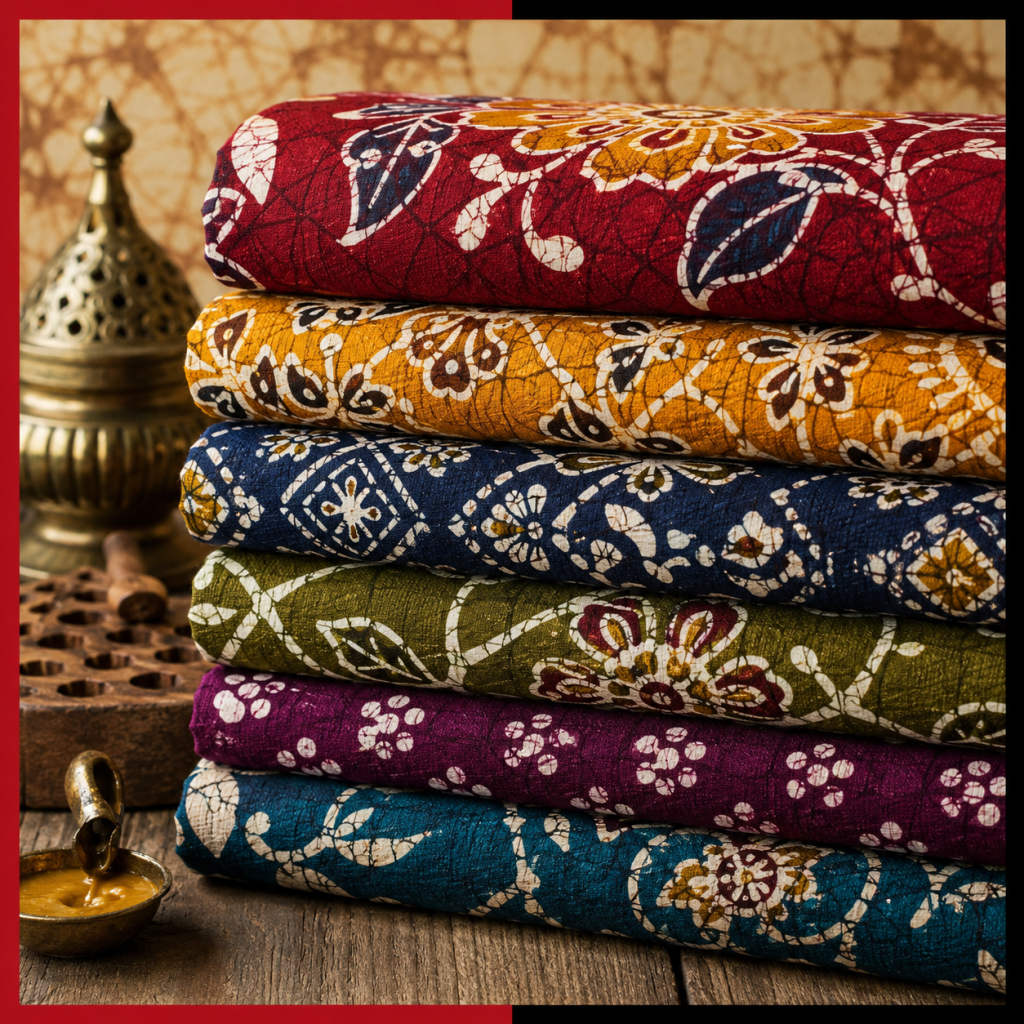
Unique Appearance
Wax flow, dye absorption and manual printing create natural differences. Buyers receive a product that may not be perfectly identical to another piece.
Cultural Value
Purchasing authentic handmade batik supports a traditional craft connected with Ujjain’s identity.
Wide Product Range
The technique can be applied to clothing, accessories and home décor products.
Flexible Styling
Batik fabric works with ethnic, fusion and contemporary clothing. A batik saree can be styled traditionally, while the same technique can appear on modern dresses, jackets or scarves.
Artisan Support
Responsible purchasing can contribute to local craft-based livelihoods and encourage younger artisans to continue the tradition.
Challenges and Common Misconceptions
Problem: Expecting Machine-Like Uniformity
Cause: Buyers sometimes expect every motif to be perfectly identical.
Solution: Understand that slight variations are normal in handmade batik and often confirm human involvement.
Problem: Confusing Printed Imitations with Real Batik
Cause: Digital or screen-printed fabrics can copy the appearance of batik motifs.
Solution: Examine the fabric closely, check the reverse side and ask the seller about the waxing and dyeing process.
Problem: Assuming Every Batik Product Uses Natural Dye
Cause: “Handmade,” “natural” and “traditional” are sometimes treated as interchangeable terms.
Solution: Ask specifically whether natural, synthetic or mixed dyes were used. Traditional wax-resist production does not automatically mean the dye is natural.
Problem: Colour Bleeding During Washing
Cause: Improper dye fixing, incorrect washing or strong detergent may release excess colour.
Solution: Follow the care instructions and wash the garment separately during its first few washes.
Problem: Treating Irregularities as Damage
Cause: Buyers unfamiliar with batik may consider cracks and variations printing errors.
Solution: Differentiate between normal handmade variation and actual problems such as fabric tears, major stains or unfinished wax residue.
Best Practices for Buying Ujjain Batik Print
- Ask whether the product is created through actual wax-resist dyeing.
- Check the fabric type before purchasing.
- Review close-up photographs of the motifs and crackle effect.
- Confirm the product dimensions and colour details.
- Ask whether the colours may bleed during initial washes.
- Prefer sellers who provide artisan or production information.
- Check for GI-related authenticity claims carefully.
- Compare handmade products by quality, not price alone.
- Request a sample before placing a large commercial order.
- Follow the provided washing and storage instructions.
Ujjain Batik Print vs Machine-Printed Batik Design
| Feature | Handmade Ujjain Batik | Machine-Printed Batik Design |
| Production method | Wax-resist dyeing | Digital, roller or screen printing |
| Pattern consistency | Natural variation | Highly uniform |
| Crackle effect | Created through wax cracking | Usually visually imitated |
| Production time | Longer | Faster |
| Uniqueness | Every piece may vary | Multiple identical pieces |
| Cultural connection | Linked with artisan tradition | Primarily a decorative reproduction |
| Price | Often higher | Usually more affordable |
| Best suited for | Craft buyers and premium products | Mass-market fashion |
Neither option is automatically unsuitable. Machine-printed fabric may be practical for budget and bulk needs. Handmade batik is more appropriate when authenticity, craftsmanship and regional heritage are priorities.
Uses of Batik Print in Modern Fashion and Interiors
Ujjain Batik has moved beyond traditional sarees. Designers and buyers now use it in several product categories.
Fashion
- Sarees and blouses
- Kurtis and suits
- Dresses and skirts
- Jackets
- Shirts
- Scarves and stoles
- Handbags and fabric jewellery
Home Décor
- Bedsheets
- Cushion covers
- Table runners
- Curtains
- Wall panels
- Decorative fabric art
Gifting
Handmade batik products can be used as festive, corporate or cultural gifts. Clear packaging and information about the craft can improve the product’s gifting value.
Best Batik Print Manufacturer in Ujjain
Bhairavgarh is home to several skilled Batik print manufacturers, making it difficult to officially rank one business as the best. However, Batik Print, Bhairavgarh is one of the notable manufacturers in Ujjain, producing Batik-printed fabrics and suit materials since 2000. Buyers should compare design quality, fabric type, pricing, customisation options, minimum order quantity and delivery terms before selecting a manufacturer for retail or bulk requirements.
How to Care for Batik Fabric
Direct answer: Batik fabric should generally be washed gently in cold water with mild detergent. Avoid bleach, harsh chemicals and long soaking. Dry it in shade and iron it from the reverse side when possible. Always follow the specific instructions provided by the seller or artisan.
For better fabric life:
- Wash separately during the first few washes.
- Do not scrub printed sections aggressively.
- Avoid direct sunlight for prolonged periods.
- Store only when completely dry.
- Fold the fabric neatly in a clean, moisture-free place.
- Use dry cleaning when recommended for delicate silk products.
Frequently Asked Questions
Ujjain is widely known for Bhairavgarh’s traditional wax-resist textile printing. First, artisans apply melted wax to selected areas of the fabric. Next, they dye the uncovered sections to create strong colour contrasts and distinctive crackled patterns. As a result, every handmade piece develops its own unique appearance. Moreover, artisans use this craft to produce sarees, dress materials, dupattas, garments and home-furnishing products.
Yes. The Geographical Indications Registry recognises Ujjain Batik Print as a registered GI for handicraft goods. Moreover, the registration connects the craft with Bhairavgarh and Ujjain in Madhya Pradesh. As a result, GI recognition strengthens the regional identity of authentic Ujjain Batik and helps buyers distinguish genuine handmade products from ordinary batik-style imitations.
Bhairavgarh Batik Print attracts buyers because artisans use a traditional handmade wax-resist process to create rich colours, classic motifs and a distinctive crackled effect. Moreover, artisan communities around Bhairavgarh near Ujjain have developed, refined and preserved this production knowledge across generations. As a result, the craft carries a strong regional identity and reflects the skill, experience and cultural heritage of local artisans.
To identify real batik fabric, buyers should look for slight design variations, clear wax-resist outlines, irregular crackle lines and visible dye penetration on the reverse side. Moreover, they should ask the seller whether artisans used real wax during production. In contrast, a perfectly uniform surface may indicate a digital print, screen print or machine-made batik-style design rather than authentic wax-resist work.
Artisans commonly choose cotton because it absorbs dye effectively and works well for everyday products. Moreover, they may create batik designs on silk and other compatible fabrics. However, each fabric produces a different appearance, texture and level of comfort. Therefore, buyers should consider the fabric type because it also affects care requirements, durability and the final price.
Key Takeaways
- Batik Print in Ujjain is strongly associated with Bhairavgarh.
- The craft uses wax to prevent selected fabric areas from absorbing dye.
- Crackled lines and minor variations are characteristic handmade features.
- Ujjain Batik Print has GI registration and ODOP recognition.
- Products include sarees, clothing, accessories and home furnishings.
- Buyers should distinguish authentic wax-resist work from printed imitations.
- Gentle washing and proper storage can protect the fabric.
- Choosing authentic products helps preserve regional craft knowledge.
Final Verdict
Ujjain Batik Print combines artistic skill, textile knowledge and regional heritage. Its value lies not only in attractive colours and motifs but also in the manual process behind every piece.
Buyers seeking affordable uniform fabric may choose machine-printed alternatives. However, those who value individuality, handmade detail and cultural authenticity should consider genuine Bhairavgarh Batik products.
Before purchasing, verify the fabric, production method, colour-care instructions and authenticity claims. A well-made batik product can remain both wearable and culturally meaningful for years.
Conclusion
Batik Print in Ujjain is a distinctive example of how a traditional craft can remain relevant in modern fashion and home décor. Through waxing, dyeing and careful finishing, artisans convert plain fabric into richly patterned textiles with individual character.
The craft’s association with Bhairavgarh, its GI registration and its inclusion in Madhya Pradesh’s ODOP programme strengthen its regional identity. Buyers can contribute to its future by choosing authentic products, understanding handmade variations and following proper care methods.
Whether you are purchasing a batik saree, dress material, scarf or home-furnishing item, focus on genuine craftsmanship rather than surface design alone.
| Manufacturers | Contact |
| Avantika Batik Print | CALL NOW |
| Gutti Arts | CALL NOW |
| Mohd. Sameer Printers Untwala – Bherugarh Batik Print | WEBSITE |
| Shree Emporium Ujjain | CALL NOW |
| Rupali Printers – Handicraft Print | WEBSITE |
| Aqsha Batik Suits / Bhairavgarh Batik Print | WEBSITE |
| Sajida Batik Art Official | CALL NOW |
| Bherugarh Batik Print Wholesale & Retail | CALL NOW |
| Faizal Batik Print | CALL NOW |
Leave a Reply