There is something unique about a great chilli. It is not only a source of heat in food. It offers aroma, color, texture and that unique taste which can totally transform any dish.
Chilli in Dhubri, Assam, has now been developed to not only be an agricultural product but also an officially recognised ODOP (One District One Product). According to government sources, chilli in Dhubri is known to be a good quality crop with pungency, while chilli powder and pickles can be used as value-added products of Dhubri chilli. But have you ever thought about how the chilli turns out to be that chilli-based product?
It is a lot more complex than you may think. It starts as a crop in the field but goes through many steps until it reaches our kitchens in form of the final product. Whether dried or grounded, depending on the final product, the crop undergoes sorting, cleaning, drying, processing, mixing, packing and conversion into usable product much longer than its fresh life cycle. So, let us find out how the process goes – from Dhubri’s fields to a chilli-based
Why is Chillies Significant in Dhubri, Assam?
The significance of Dhubri Chillies lies in its inclusion as an ODOP product because of the importance of this product in agriculture in the region. According to the government of Assam’s profile on ODOP products, Dhubri is well-known for the high quality of chillies and states that farmers cultivate varieties of chillies with varying degrees of pungency. In addition, chilli powder and pickles can be considered as value-added products having potential in the region.
The importance of chillies does not lie in the amount of spice it provides to food alone. Freshly harvested chillies have a comparatively short shelf life. Processing gives a means to turn this seasonally harvested agricultural product into something that is more easily stored, transported, and sold. This is where the true importance of chilli processing in Dhubri lies.

1. It all begins with the chilli harvest.
The quality of the ultimate chilli product starts right at the farm. Chilli pods are harvested when they attain the necessary maturity for their respective products. Red chilli pods are especially vital in the case of dried chillies and chilli powder because colour, smell and hotness will affect the eventual outcome. Harvesting does not only entail the picking up of lots of chillies. Harvesting entails picking up the right quality chillies. The Spices Board advises harvesting chillies at the proper stage of maturity because properly matured chillies can provide pungency and better colour retention. After harvesting, the chillies are collected properly to prevent bruising and contamination. This is the first significant check point in the whole processing process.

3. Cleaning of the Chilli
Having identified the right chillies, the next step will involve cleaning. Cleaning should be carried out to ensure that dirt, dust, stones, leaves and any other foreign substance is removed from the chillies. This is especially so in commercial chilli processing because the chillies may at some point be consumed as powder. Cleaning can be achieved using different methods depending on the level of the activity being carried out. Small scale processors may carry out manual cleaning while large processing systems may engage mechanical cleaning.
Typical commercial chilli processing systems include pre-cleaning, grinding, sieving and packaging.
The aim is always the same; clean chilli in, quality product out.
4. Drying – One of the Most Critical Stages
In case the chilli is to be processed into dried chilli or chilli powder, then this stage becomes one of the most critical stages of processing. Fresh chilli has quite a bit of moisture in it. If the moisture is not removed properly, it makes the storage of the product difficult.
Traditionally, sun drying was used for processing the chilli. The cleaned pods were laid out thinly on drying surfaces and were turned over and over again for even drying. According to the Spices Board, proper drying is very important for ensuring good colour, gloss and pungency and suggests better drying processes when necessary. Modern drying process provides better control over the drying process.
For instance, according to ICAR, solar drying process is such that green chilli can be dried much more quickly than through open sun drying and with better control over the process as well. As far as the chilli processor is concerned, the difference is really important.

5. Removing the Stem and Other Preparation Steps for the Dried Chilli
After drying, there can be more steps for preparing the chilli based on the intended product. If chilli powder is being made, the stem and any other undesirable materials must be removed before grinding. This drying step may be followed by another inspection. Another inspection step at this time is useful since processing is a chain. A problem that is missed during the initial sorting step can be removed before grinding.Here, the dried chilli will have changed a lot from its original state. It goes from a fresh green or red pod to a dried spice ingredient.
6. Grinding: Conversion of Whole Chilli into Powder
Here comes the step which is one of the most identifiable steps in processing of chillies – grinding. Chilli pods are sent into a grinder or a mill where they are converted into smaller pieces. Depending upon the machine and requirement, the chillies can be converted either into larger flakes or small powders. Commercial processing units for chillies may include hammer mills, cooling units, dust collecting units, and powder sifting units. The process of grinding requires proper regulation. Excessive heating of the chillies in the process may change the nature of the spices. This is why professional chilli processing units use cooling and milling processes. After grinding, the chilli powder is sifted to achieve uniformity in terms of particle sizes. All of a sudden, we have the recognizable red chilli powder in our kitchens!
7. Sifting and Grading of the Powder
Even grinding will not ensure a uniform chilli powder. The ground product is usually sieved into different sizes of particles. It results in a more uniform powder. It also ensures that the processor maintains the consistency of batches. From the consumer’s perspective, consistency may be difficult to appreciate. However, in case the same chilli powder is bought repeatedly, consumers would expect some consistency in terms of texture, colour, and performance in the food. Consistency starts from the processing unit.
8. Quality Control: Ensuring the Character of the Chilli
While processing entails only the grinding of a product, there is a need for quality control.There should be testing for cleanliness, moisture content and other characteristics of the chilli product. FSSAI standard for whole dried chillies
and chilli powder requires certain characteristics, including moisture content, foreign materials, ash and others. In the case of chilli powder, it should also contain dryness, lack of dirt, mould and other colouring matter. Chilli powder is especially susceptible to adulteration. Thus, FSSAI has created a testing guide to rapid tests of adulteration of chilli powder by artificial colouring agents or by brick powder, salt, talcum powder. Quality must be assured for the Dhubri chilli value chain. The aim should not just be to manufacture red powder. It should be to manufacture a clean, wholesome and authentic chilli product.
9. Packaging: The Protection of the Product after Processing
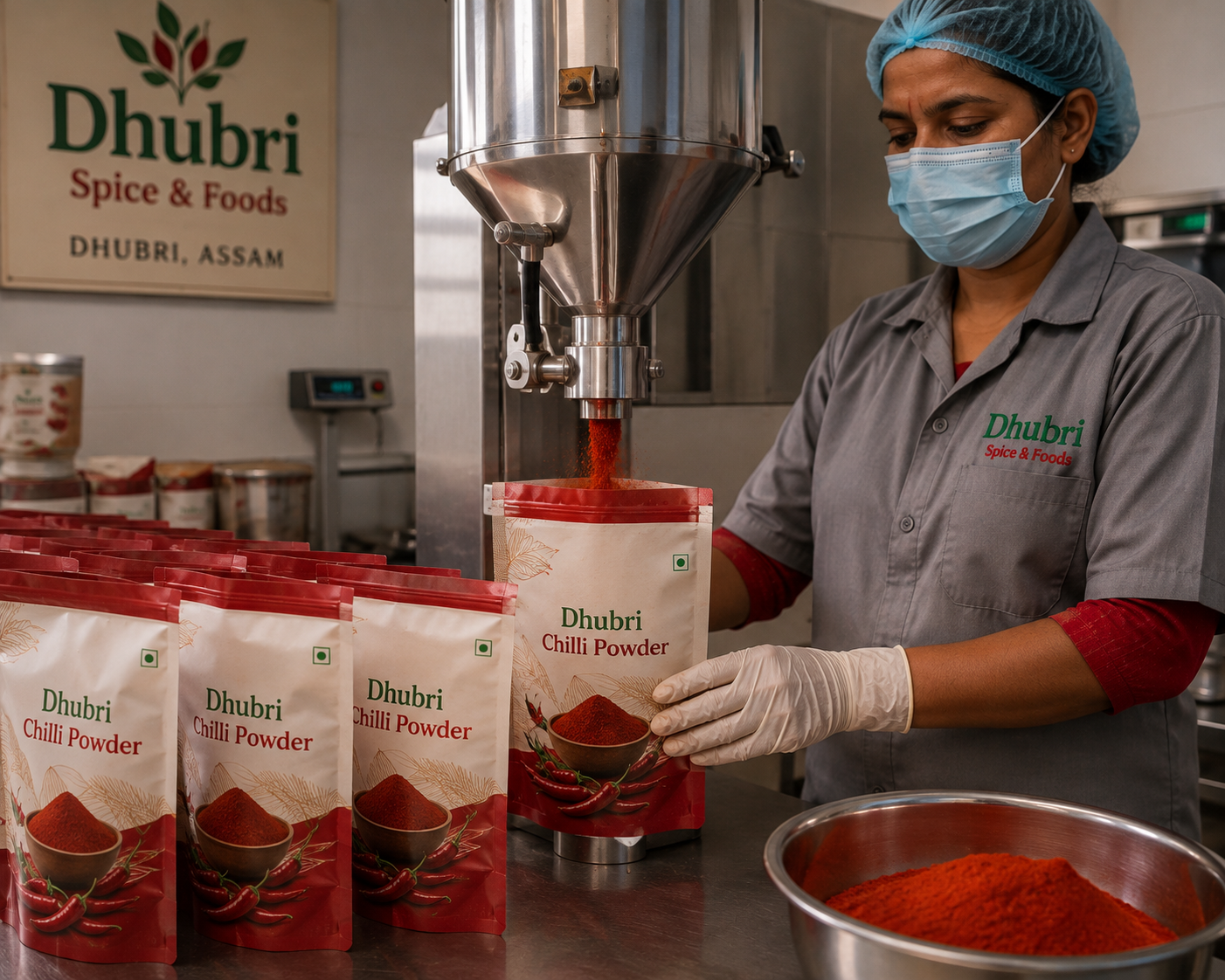
After the product has been tested for quality, packaging comes next. There are several purposes that packaging serves. These include protection from moisture and contamination as well as from environmental exposure that might be unnecessary. The process of packaging also helps in transportation and storage. In commercial chilli-processing units, there may be an automatic packing process employed for bulk and retail quantities.
For small-scale producers, packaging has another important purpose:
Identity.
While the farmer cultivates the chilli, the packaging of the product gives the chilli an identity. In other words, the sale will no longer be of the agricultural product. The sale will now be of Dhubri chilli powder.
10. From One Chilli Crop to Many Products
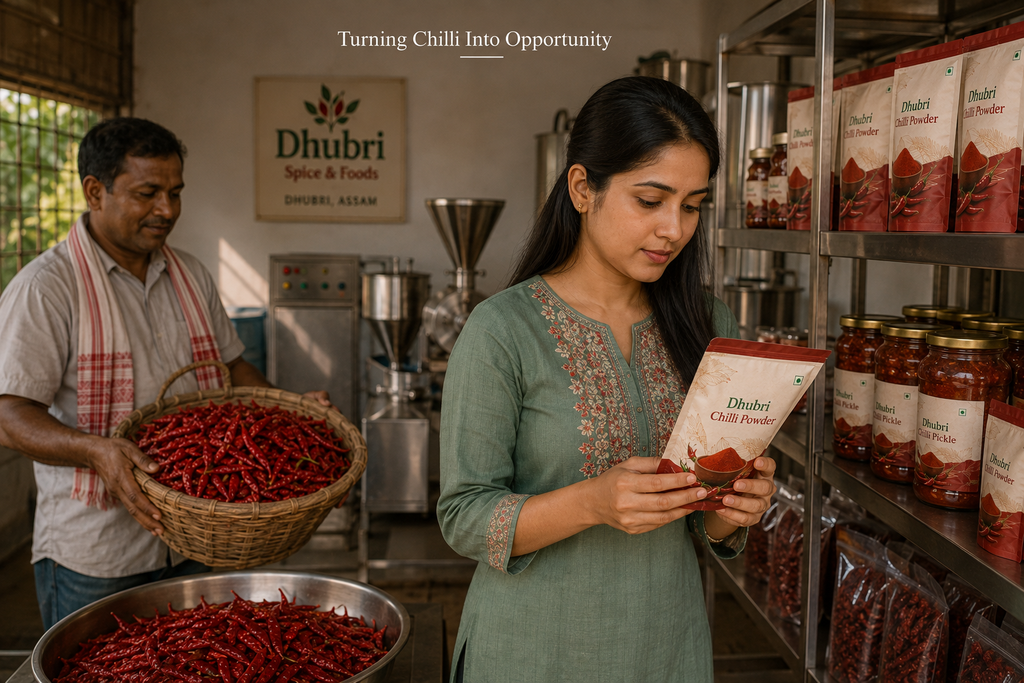
This story is not yet over with chilli powder. And here comes the interesting part of value addition using chilli as base material. Depending on the quality of raw materials, capabilities of processing and market needs, chilli can be turned into various products.
Chilli Powder
This is perhaps one of the most popular products.
It is made by cleaning, preparing, grinding and packing dried chilli into easily consumable spice.
Whole Dried Chilli
Instead of grinding, properly dried chilli pods can be cleaned, graded and packed.
They can then be used in their original form in cooking process.
Chilli Flakes
Another way to use dried chilli is by making chilli flakes.
These are chillies in coarser form compared to powdered chilli.
Chilli Pickle
Fresh or processed chilli can also be used as main ingredient in pickles.
The process of making the product consists of cleaning and preparing the chillies followed by mixing with ingredients like oil, salt and other spices.
As a result, there is formed a product which has completely different taste experience.
Chilli Sauce and Other Products
Chilli can be processed into sauces, pastes and other forms of products.
ICAR researches

11. Traditional Knowledge with Modern Processing Technology
Perhaps one of the most interesting things about the value chain in Dhubri for chilli is where traditional agricultural knowledge intersects with modern processing technologies. Farmers know their product. Processors know the processing, drying and transformation part. Modern technology can help improve consistency, hygiene, the drying process, grinding and packaging. The intersection can result in a more powerful value chain. It does not imply the necessity to give up on traditional ways.
It simply implies that better technology can help farmers sell their agricultural produce to new consumers without changing its essence. This is relevant for Dhubri since the product has already been recognized as an ODOP product. The Ministry of Food Processing Industries lists Dhubri as chilli-based product, and the food-processing profile by the Assam state government names chilli as ODOP product for Dhubri.
Perhaps one of the most interesting things about the value chain in Dhubri for chilli is where traditional agricultural knowledge intersects with modern processing technologies. Farmers know their product. Processors know the processing, drying and transformation part. Modern technology can help improve consistency, hygiene, the drying process, grinding and packaging. The intersection can result in a more powerful value chain. It does not imply the necessity to give up on traditional ways. It simply implies that better technology can help farmers sell their agricultural produce to new consumers without changing its essence. This is relevant for Dhubri since the product has already been recognised as an ODOP product. The Ministry of Food Processing Industries lists Dhubri as a chilli-based product, and the food-processing profile by the Assam state government names chilli as an ODOP product for Dhubri.
12. Why Value Addition is Important for the Farmers of Dhubri
Selling the crop immediately upon harvesting is just one of the ways to generate profit from agriculture. There is an alternative through value addition. Rather than selling fresh chilli alone, the possible value chain can be:
Farmer → Collector → Processor → Product → Brand → Consumer
And value can be added at each step. A kilogram of chilli in its raw form and a properly processed chilli product will not be the same in terms of business. Moreover, value addition may result in making the final product easier for consumption. That is the true benefit of value addition. It means that while the product maintains its agricultural origin, it becomes more useful and marketable.
13. The Future of Dhubri Chilli
The story of Dhubri Chilli is far from over. According to the official profile of Assam ODOP, there is great future potential of Dhubri chilli both domestically and internationally and especially in terms of value addition in the form of chilli powder and pickles. What comes next is not merely increased production of chilli.What comes next is better quality, consistent, and properly presented chilli products.
This means:
- Good drying.
- Proper processing.
- Effective grading.
- Safe packaging.
- Good branding.
But most importantly, a direct link with the provenance of the product. This is how an agricultural product becomes a food product.
From the Fields of Dhubri to the Kitchen
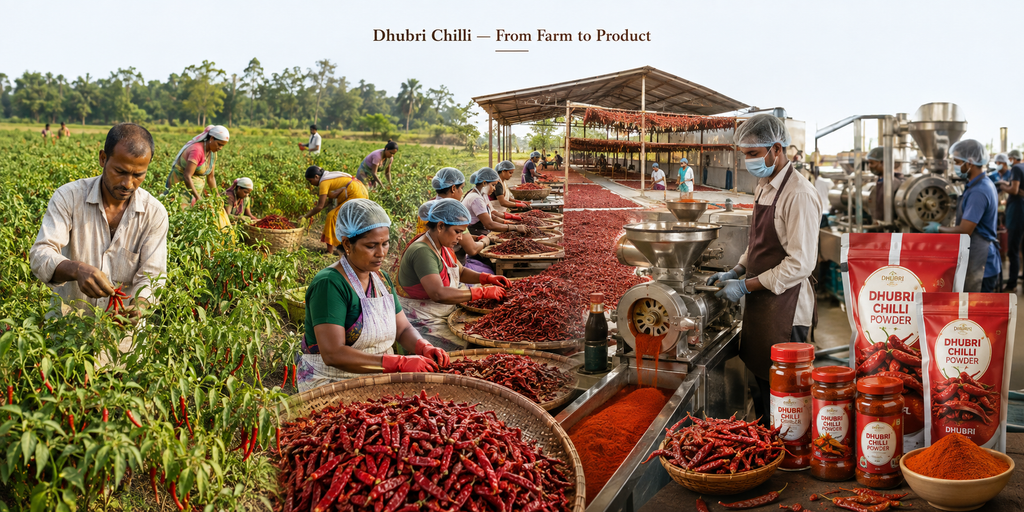
The odyssey of Dhubri chilli has a lot longer route than what seems to be on the surface. It all starts off with a farmer tending to chilli plants.
This is followed by harvesting.
- Sorting.
- Cleaning.
- Drying.
- Removal of stems.
- Grinding.
- Sifting.
- Testing for quality.
- Packing.
And finally, the produce finds its way to the kitchen.
Some chillies may retain their whole form.
Some may turn into powder form.
Some may turn into flakes.
While others may take the shape of pickles, pastes or sauces. The most significant aspect here is that the value of the chilli need not come to an end when it leaves the farm. With proper processing and value addition, Dhubri’s chilli can go from an agricultural produce to a recognised food poduce from Assam. This is the real story behind the ODOP chilli of Dhubri. It is not just about making your food spicy.
Conclusion
The chilli of Dhubri is much more than a simple spice. It is an agricultural produce that has gone through a full cycle of value addition. Through the process of harvest, dehydration, and making chilli powder, flakes, pickles, and other processed products, quality can be preserved and added. As an officially certified ODOP product from Dhubri, Assam, the chilli has potential for linking the agricultural produce with food processing, packaging, and branding. The future of Dhubri chilli is not just about cultivating it but also how well the region processes, packages, and sells it. And maybe that is why this small red chilli is so fascinating. It grows in the soil of Dhubri, but that need not be where its story ends.
FAQs about Dhubri Chilli
1. What is the ODOP product of Dhubri?
The ODOP product of Dhubri is Chilli/Chilli-based products under the ODOP initiative of Assam.
2. Why is Dhubri chilli important?
Dhubri chilli is well-known for its quality and pungency, and is one of the significant agricultural produce of the region.
3. What can you produce from Dhubri chilli?
Depending on the processing methods, some of the products could include dried whole chilli, chilli powder, chilli flakes, pickles, pastes, and sauces, etc.
4. How do you make chilli powder?
After drying, cleaning, preparation, grinding, and sieving, dried chillies are packed as chilli powder.
5. Why is drying necessary?
It lowers the moisture content and makes chilli better for storage and further processing. Drying also preserves colour and pungency.
6. Can you process green chilli?
Yes. Green chilli can also be processed into products like powder and puree through suitable processing.
7. Why is sorting necessary?
It will remove any damaged, immature, mouldy and unsuitable pods prior to processing.
8. Is chilli powder tested for quality?
Yes. As per food safety standards, there are requirements for quality of chilli powder regarding parameters like moisture, ash, foreign matter and others.
Leave a Reply