Lemons can be extremely ordinary fruits.They hang quietly from trees, amidst green leaves, waiting to be plucked. But not in Chirang district, Assam. There, the humble lemon has assumed far greater significance, taking the form of an agricultural product, a means of livelihood, a food processing raw material, and increasingly, a marketable product out of Assam. The district administration identifies Chirang as a lemon production and food-processing cluster while the district’s ODOP profile identifies lemon as the district’s agricultural product. Food processing projects in lemon juice and pickles have been registered by the district administration too, giving us an idea about how this fruit makes the leap from being a fruit to becoming a value-added product. That process only becomes more fascinating when you consider Assam’s celebrated Kaji Nemu, a GI-registered variety of Assam lemon which is now the fruit of Assam. According to government data, Kaji Nemu is unique for its aromatic properties and its relatively large size. The production of Assam lemon is now a commercial enterprise in districts including Chirang.
But how does the process happen?
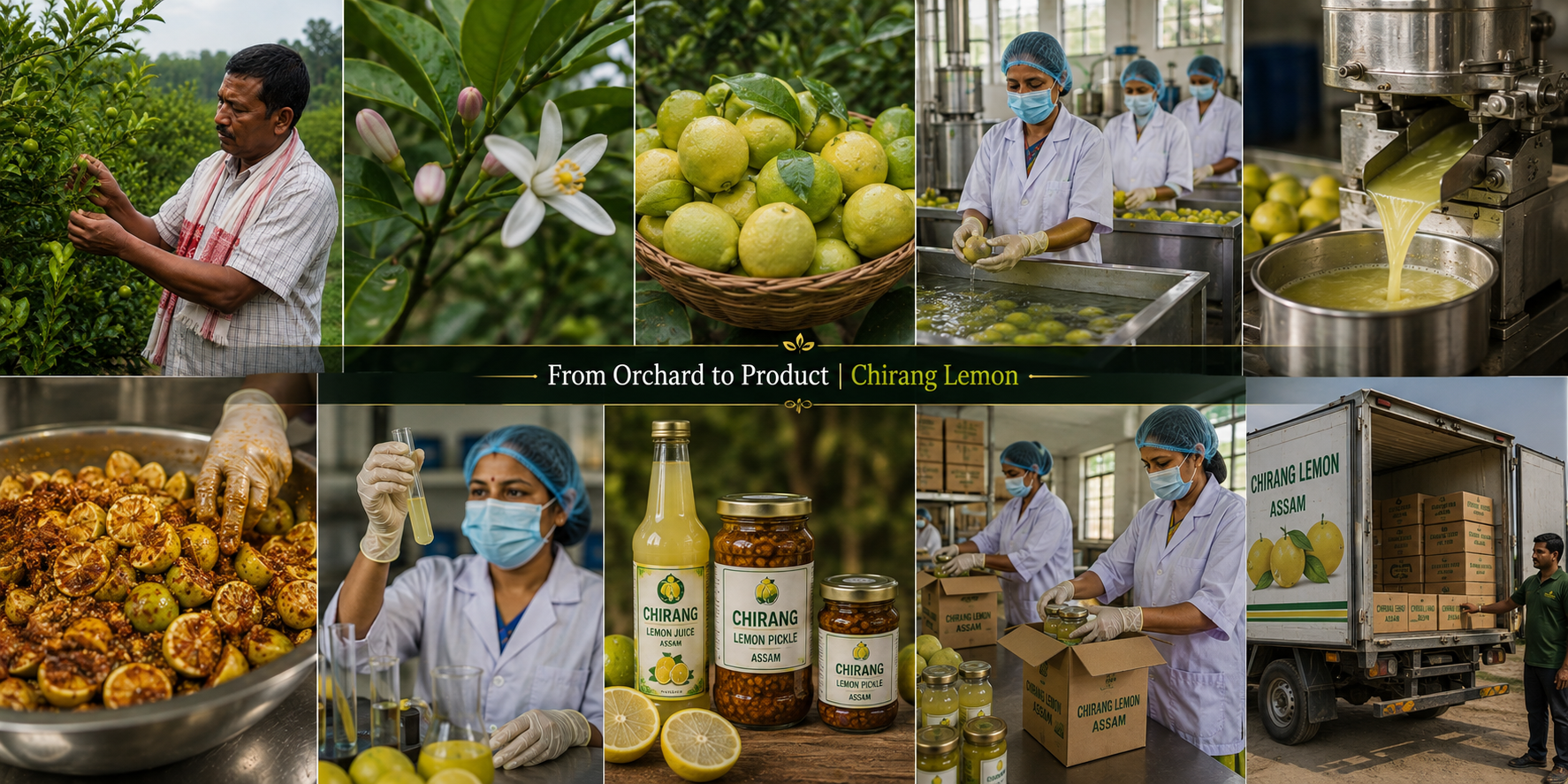
What is the journey of a lemon that grows in a Chirang orchard to becoming a fresh market product, lemon juice, a pickle or some other value-added food item?
Let us chart out that journey from farm to market.
Why Is Lemon Significant for Chirang, Assam?
The significance of lemon for Chirang is more than just a marketing story.
As per the Government of Assam food processing/ODOP framework, Chirang – Lemon district is one known for producing quality lemons. At the same time, the government data points to the suitability of the climate and the soil of the region for lemon cultivation and points to opportunities in storage, processing, and branding of this produce. This is also linked to livelihoods. As mentioned in the newsletter of Assam Panchayat & Rural Development 2025, for example, a lemon grower was identified in Belguri village, Chirang district who grew lemons along with arecanuts and used a lemon–arecanut intercropping model under the Swa Nirbhar Naari–Atmo Nirbhar Axom scheme. In this case too, then, the story of the lemon begins with the farmer and the orchards. Not the factories. And this distinction makes all the difference. Before lemon juice or pickles come to exist, it must first be ensured that lemons are produced in good health.
Step 1: Growing the Lemon Trees
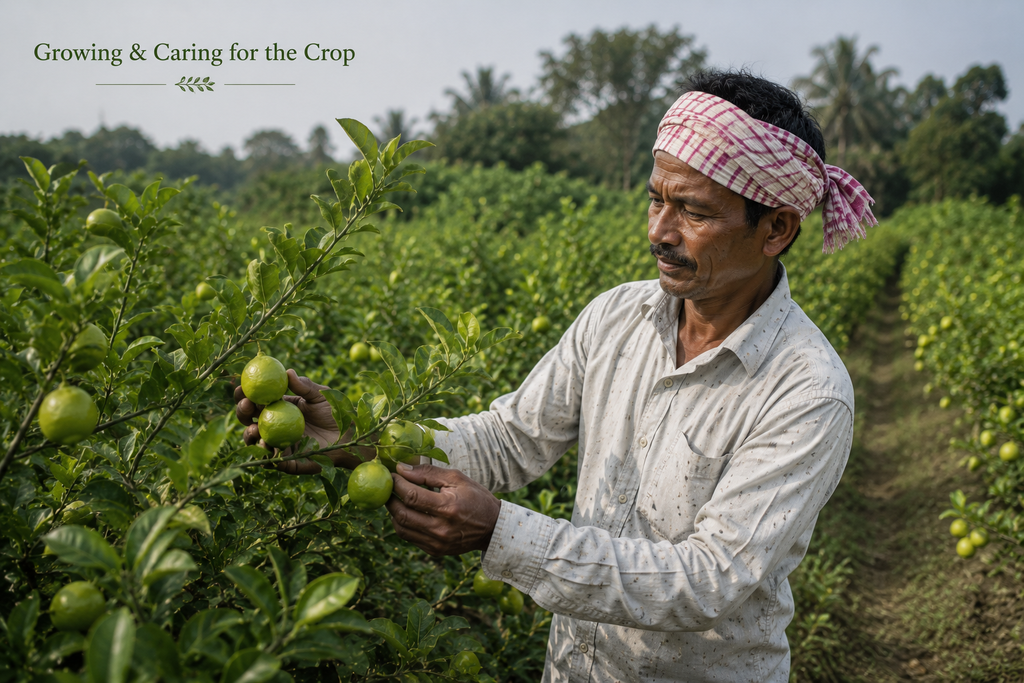
As simple as it sounds, the first step in any lemon production is the following: Growing a healthy lemon tree. Assam lemons thrive in the humid subtropical environment of the region. The agricultural practice guide on the Assam lemon suggests the use of loamy soil with good drainage properties.
The crop can be propagated using techniques such as stem cuttings and leaf-bud cuttings. Orchard management is a continuous process for a farmer.
Unlike growing wheat or rice, a lemon tree cannot be planted and harvested in a day. The tree needs proper spacing, soil, water, nutrient management, and protection from pests and diseases.
The quality of the product starts from here. If the tree is healthy, then the farmer will have a greater likelihood of getting the lemons of the required size, juice content and aroma for different markets.
Step 2: Selecting the Suitable Planting Material
Suitable planting material can start the lemon production. The Assam agricultural guide mentions the use of stem cuttings and leaf-bud cuttings as among the different propagation techniques for Assam lemon plantations.
This technique is used to grow healthy plants that will produce good quality fruit. It is especially crucial when farmers are growing a recognised variety like Kaji Nemu.
There are several qualities that set the Kaji Nemu apart from common lemons. The Government of Assam mentions its special qualities, such as the unique smell and relatively large size, and also considers it the state fruit of Assam. This becomes valuable information later. The farmer doesn’t just have to sell “the lemon”. This product can now be known as Assam lemon.
Step 3: Maintaining the Orchard
After the trees are grown, the process becomes a daily routine for the farmer – but it is never insignificant.
Farmers take care of:
- soil moisture
- weeds
- growth of the tree
- pests and diseases
- flowering
- fruit development
- nutrient requirements
In Chirang, the farmers can utilise intercropping practices. The Assam Rural Development newsletter reported that lemon and arecanut were being grown together in a Chirang farmer’s orchard. It shows how much more can be done in an orchard space.
These types of farming practices make the orchard productive and provide additional sources of agricultural income to the farmers. And the green fruits start coming out one by one.
Step 4: Flowering and Fruit Development
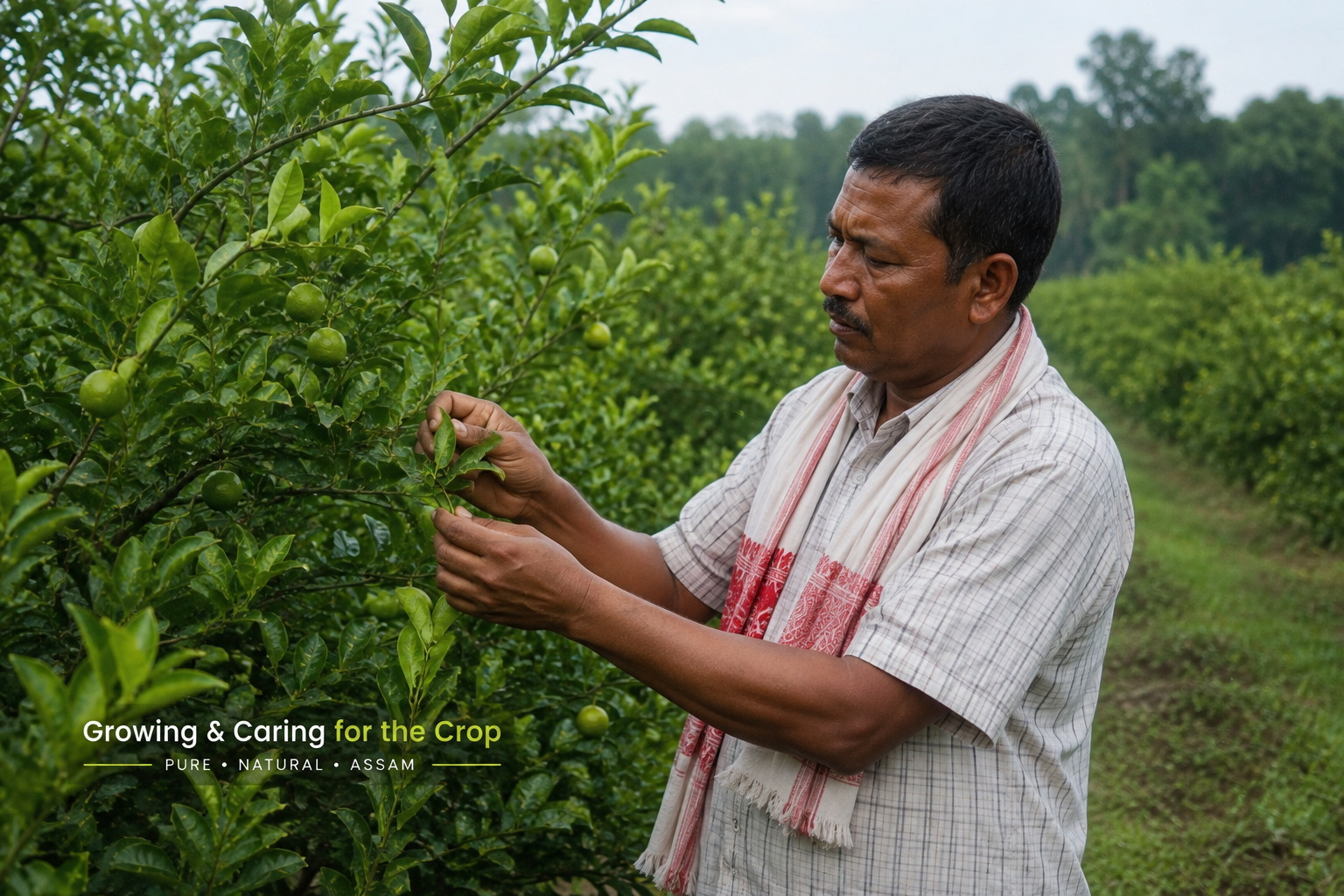
With each change in season, the orchard changes too. Flowers start blooming; small fruits develop. And then grow in size gradually. It is worth mentioning that the one of the special qualities characteristic for the variety of Kaji Nemu is that it bears fruit all through the year. Seasonal differences do exist. This registered variety is also famous with its unique aroma and fruit-bearing qualities. Fruit development is the phase at which patience is very crucial for the farmers. When it is intended to use the lemon in the fresh form, the fruit must look attractive. If the lemon is supposed to be used in juice or pickle, it must contain enough meat and juice. The use of the fruit can determine the selection process itself.
Step 5: Harvesting the Lemons
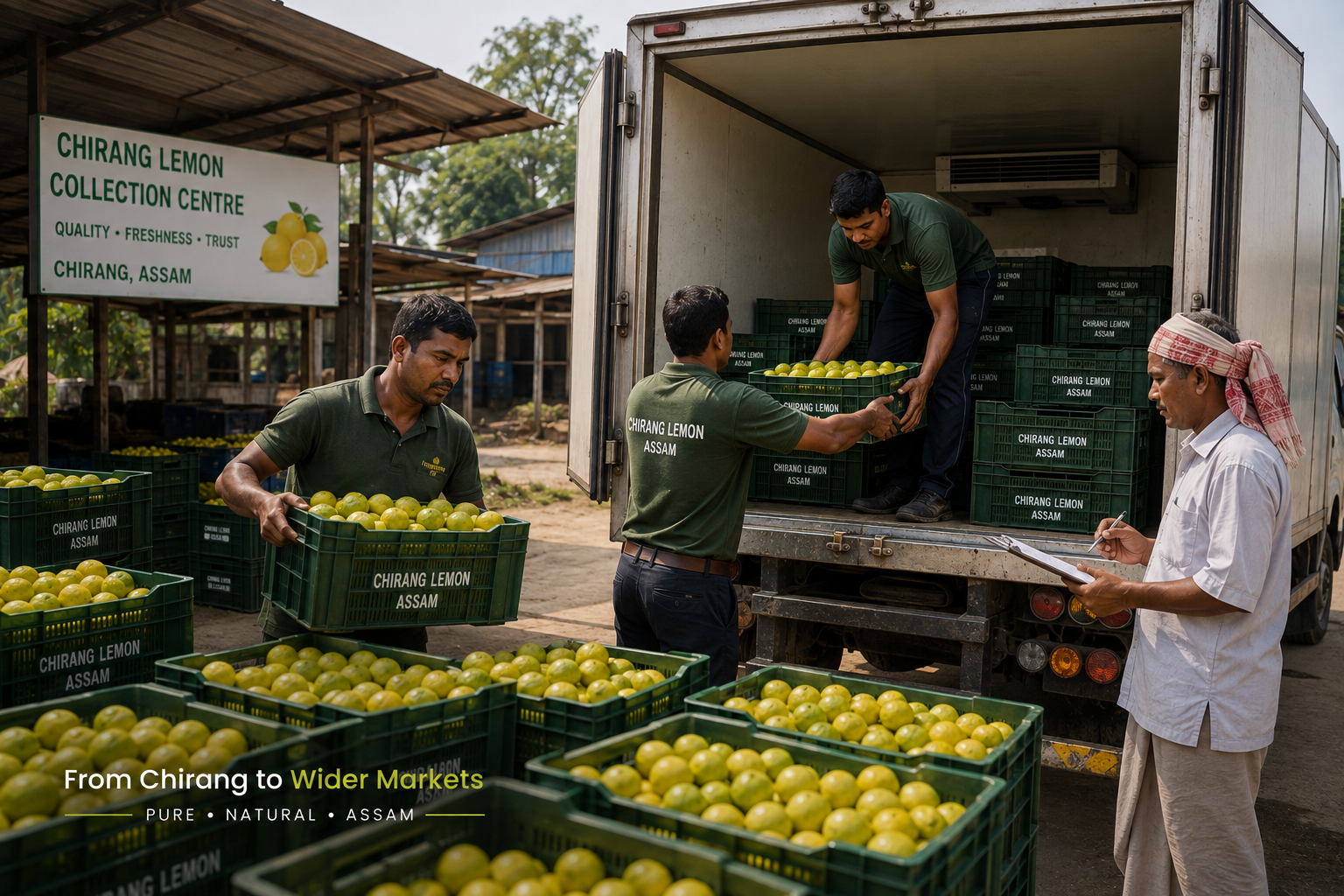
Finally comes the time that the farmers are eager for. It is harvest. Lemons are picked and gathered to be sold or processed. The quality criteria for fresh-market lemons depend on appearance. When talking about processing of the fruit, attention will be paid to fruit quality. Sometimes lemons are packed in baskets or crates and delivered to the place of collection or processing. This stage marks the time of changing the possession.
Product goes from farmer → processor or trader.
And from now on the path of the product can diverge greatly.
Step 6: Sorting and Grading
Not all harvested lemons are intended for processing immediately.The sorting process starts.
The workers examine the fruit and sort lemons taking into consideration such qualities of the fruit as:
- Size
- Maturity
- Appearance
- Damage
- Cleanliness
- Processing suitability
This stage seems to be simple but it plays its own role. It prevents damaged fruits from appearing in wrong section of the production line. It is also an element of creating the consistency. The product will be easier to process when its raw material is reasonably uniform. This stage is especially important when creating packaged products.
Fresh Lemon: The Simplest Product
It should be reminded that the fresh lemon itself is the finished agricultural product.Chirang lemons can be transported from orchards to the markets without processing in the form of juice or pickle. Actually, Chirang lemons have already entered international markets. Farmers from Chirang, along with Panbari Bodofa Agro Organic Producer Company, shipped approximately 1,200 kg of Assam lemon to the Wholesale International Market at New Spitalfields, London in July 2021.This is a crucial point. Processing doesn’t entail the replacement of fresh lemons. It is about coming up with more uses for the fruit.
Step 7: Processing Preparation of Lemons
The process of selecting lemons for processing means that cleanliness is crucial at this step. The fruit is taken to the food processing facility and gets ready for further steps. For example, a small-scale processing sequence may include the following steps:
Receiving → Sorting → Washing → Preparation → Processing → Filling → Packaging
However, it depends on the end product. If the lemon becomes a juice, its processing procedure is quite different from the case when it becomes a pickle. But the initial step of both procedures is the following:
fresh Chirang lemons. As stated above, PMFME applications for Lemon Juice & Pickles and Lemon Juice, Pickles & Mushroom Processing are recorded on the Government of Assam, Chirang, industry webpage.
How Is Chirang Lemon Juice Produced?
Perhaps the most straightforward example of value-added production is lemon juice. It involves the following steps using specially chosen lemons.
1. Washing
The fruits undergo washing to remove any dirt or impurities.
2. Sorting
Damaged fruit items are sorted out.
3. Cutting
The lemons are prepared by cutting them.
4. Juice extraction
Juice is extracted from the fruit items using various methods depending on the size of the batch.
5. Filtration
The juice may be passed through filters depending on what the final product should be like.
6. Processing
If the juice will become a product of packaging, processing according to the type of the product is needed.
7. Filling
The juice is put into containers.
8. Packaging
Packaging into food-grade containers is done.
This process transforms the fruit almost entirely.
While the whole agricultural product was a lemon, after the processing, it becomes a ready-to-consume beverage or ingredient.
How Lemon Pickle Is Produced
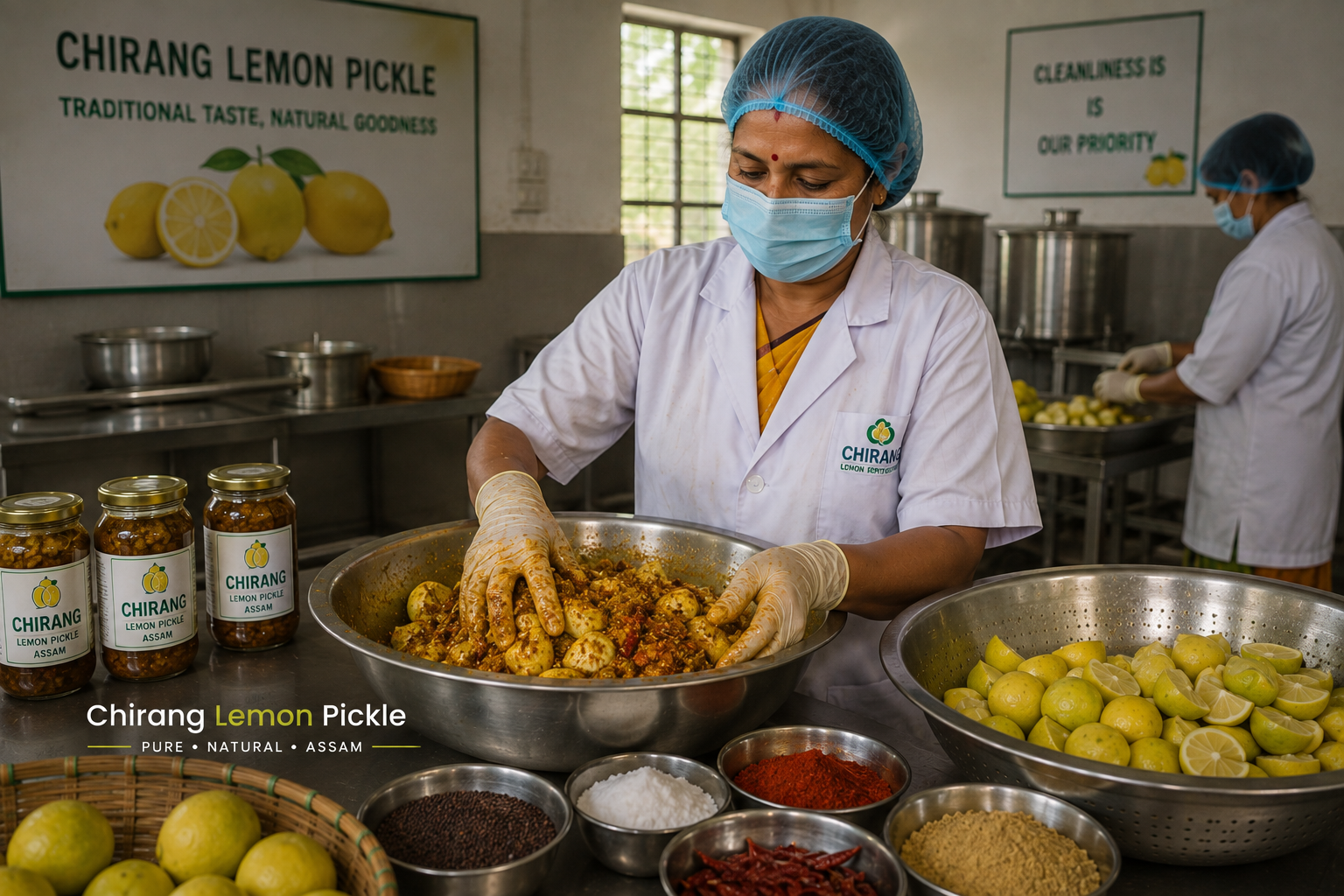
The process of pickle production takes a totally different route. While in juice production, it is only the juice that goes to the process; in the pickle production, the fruit is part of the product. The production process of pickle consists of the following stages.
1. Selection
Selection of quality lemons is made.
2. Cleaning
Cleaning and preparing of the fruit items.
3. Cutting
Cutting of the fruit to suitable sizes.
4. Salt treatment
Traditional pickle preparation includes adding salt.
5. Spice preparation
Preparation of spices like mustard, chillies, etc.
6. Mixing
Mixing of prepared lemon pieces with seasonings.
7. Maturation
Maturation through a proper preservation procedure gives the pickle its specific flavour and texture.
8. Packaging
Putting of the finished product into clean food-grade containers. Now comes something interesting. The same lemon which was used to give freshness to meals becomes an absolutely different product: sharp, salty, spicy and preserved.
Lemon Products Aren’t Just Juice and Pickle
Juice and pickle have been the most directly documented products of lemon processing by the district food processing program in Chirang. However, lemon processing has a lot more value-addition potential. Based on the available processing infrastructure and market demands, lemon from Assam can also serve as a raw material in the production of products such as:
- lemon drinks
- concentrates
- sauces
- preserved lemon
- dried lemon products
- food ingredients
- flavoured products
It does not mean that all these are established commercial products of the Chirang district. Rather, these are some examples of possible value addition in the lemon-processing industry of Chirang. And this difference is crucial. The objective is not to inflate the scope of operations. The objective is to point out how many different things can be done with the crop that is already growing in the area.
Step 8: Quality Control
Fancy packaging doesn’t necessarily mean that the product will be good. Quality control is important at all stages of processing. Processors have to pay attention to:
- quality of the raw materials
- cleanliness
- food-contact surfaces
- processes
- packaging
- storage
- labelling
- shelf life requirements
The Chirang district food-processing program explicitly talks about the support for common facilities such as sorting, grading, storage, common processing, packaging and laboratory testing.This demonstrates how the value chain goes far beyond the actual product.
What makes the story unique because of the Kaji Nemu variety?
Kaji Nemu is not any ordinary lemon. According to the Government of Assam, it is a unique variety that has an aroma characteristic of itself and is bigger in size and officially designated as the state fruit of Assam.
Furthermore, this variety has GI registration too. It gives a value proposition to the processors and marketers: the story of origin. Consumers are getting more and more interested in where their food products come from.
Instead of seeing just a bottle of “lemon juice”, one can see the label: Made of Assam lemon. This would create the connection between consumers and agricultural regions. For Chirang, that connection would be a way of creating commercial benefits.
People Who Are Involved in Producing These Products
Every bottle of lemon juice or every jar of pickle has a chain of people involved in producing it.
- The farmer who planted a lemon tree.\
- The worker who harvested fruits.
- The one who sorted the lemons.
- The processor who got the juice out of them.
- The food worker who created a pickle.
- The person in charge of quality assurance.
- The packager.
- The transportation person.
- The seller.
That is why agricultural processing goes far beyond machinery. It connects agriculture with local employment and entrepreneurship. The Government of Assam’s industrial program for Chirang is a mechanism that helps FPOs, SHGs and cooperatives in processing, packaging and marketing.
Completing the Chirang Lemon Pathway
It is all explained in one single pathway:
Lemon orchard
↓
Growth of plant
↓
Flowering
↓
Development of fruit
↓
Harvesting
↓
Sorting & grading
↓
Cleaning/Washing
↓
Fresh sales or processing
↓
Extraction of juice/Pickling
↓
Quality testing
↓
Bottling/jarring
↓
Storage
↓
Distribution
↓
Consumer
The fruit starts its journey from a tree. However, the economic journey may go beyond harvesting.
Where Does the Future Lie?
There are already some important foundations for the future of the lemon industry in Chirang. There are lemon farmers. There is recognition of a recognised lemon product cluster. There is documentation of food processing related to lemon juice and pickles. There is evidence that fresh Assam lemons have reached international markets. What is needed now is the improvement of the value chain.
- Better collection centres.
- Better sorting and grading.
- Better processing equipment.
- Better packaging.
- Better food processing testing.
- Better branding.
- Better connections with the markets.
The goal should not be simply selling more lemons. The goal should be to extract more value from the lemons already being produced in Chirang. A fresh lemon has only one market. A properly processed, packed and branded lemon product can reach many markets.
Conclusion: Much More than a Lemon
The story of Chirang’s lemon starts with an ordinary thing: a farmer planting and growing citrus trees.
However, from that point on the journey becomes much bigger. The fruit can be picked and sold fresh. It can be squeezed into juice. It can be turned into pickle. It can become part of many other food products of higher value. With proper processing, packaging, quality assurance and marketing, an agricultural produce from a district can reach places far away from the fields where it was grown. As was already mentioned, the connection of Chirang with lemon is recognized within the food processing ecosystem in Assam and Chirang’s Assam lemons have already reached international buyers. What is interesting about this story is not just the lemon itself. What is interesting is the journey of value addition. ,From the tree to the fruit.
From the fruit to juice or pickles. From the processing plant to the package. From Chirang to the market.
FAQ Section
What is Chirang known for?
Chirang is characterised by the Government of Assam’s food-processing framework and ODOP by Lemon as its agriculture product.
What is Kaji Nemu?
Kaji Nemu is an Assamese lemon which is known for its unique aroma and size. It has been recognised as the state fruit of Assam by the Government of Assam.
What lemon products are found in Chirang?
The PMFME of the Chirang district government administration mentions projects on lemon juice and pickles. While the Ministry of Food Processing Industries has recognised Chirang as a lemon-based products production cluster.
Are the lemons from Chirang exported?
Yes. In 2021, about 1,200 kgs of Assam lemons from Chirang have been exported to the New Spitalfields wholesale market in London.
How is lemon juice produced?
Fresh lemons are usually sorted, washed, processed and extracted. Lemon juice can further be filtered and suitably processed for safety purposes before filling and packaging.
How is lemon pickle produced?
Lemons are sorted, washed, sliced and mixed with salt and spices. This product is further subjected to suitable processes of preservation or maturation before packaging in food-grade containers.
Leave a Reply