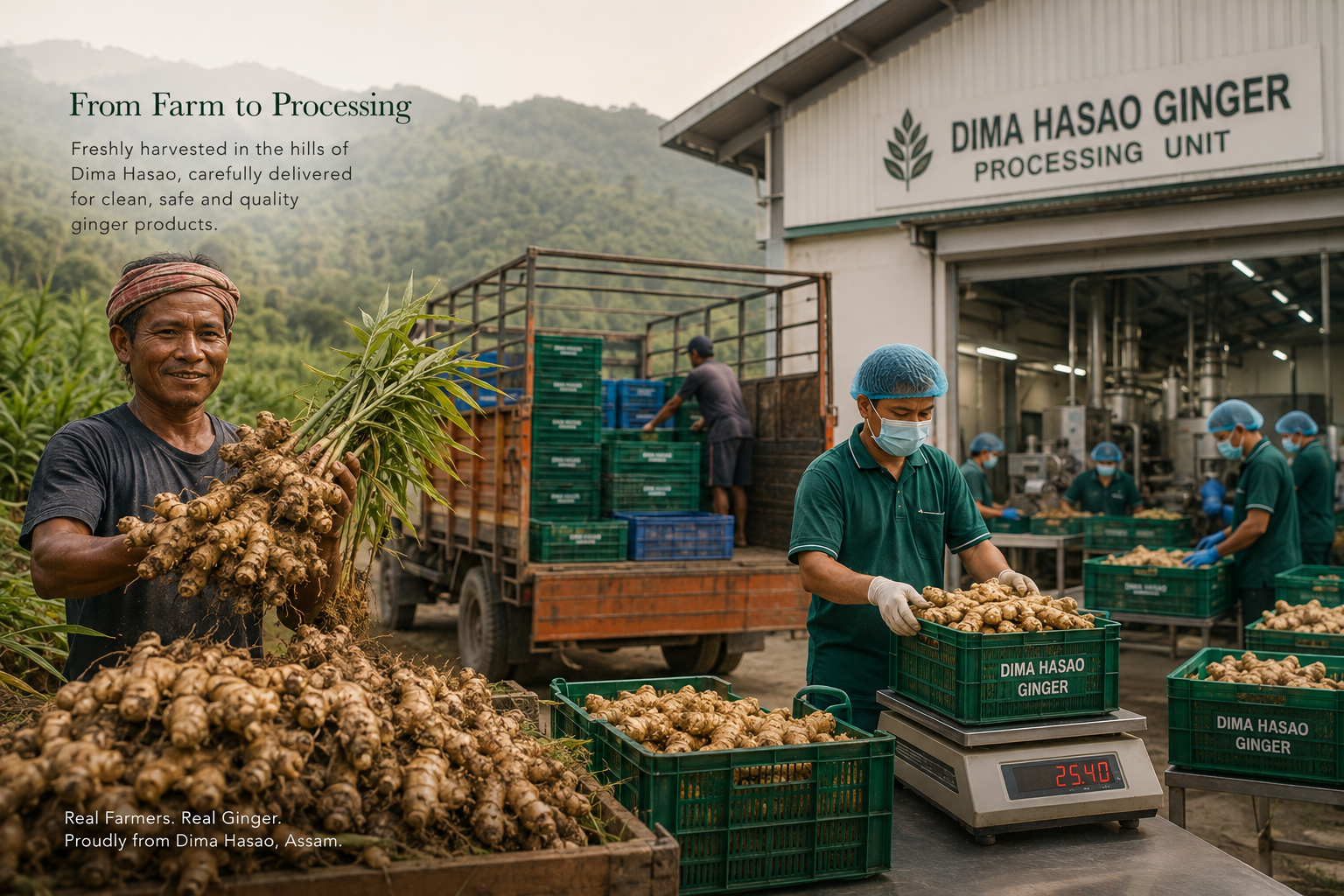
The first stages of ginger processing happen in a shape most consumers never even think about, deep in the hills of Dima Hasao, Assam. It is not yet the packaged spice powder you would buy from the store. It is not a bottle of ginger paste. It is not an ingredient waiting to go on display at the supermarket. Instead, it starts as a fresh harvest of a ginger rhizome covered in soil from the hill it grew in.
Dima Hasao has gained popularity as an association with ginger in the context of the agricultural and food-processing ecosystem of Assam. According to the Government of Assam, Dima Hasao – Ginger is an agricultural produce according to the district product profile with a description of the high-quality organic ginger of the hilly district.
Also, the Ministry of Food Processing Industries mentions the district of Dima Hasao among other clusters that are responsible for producing ginger-based products in the framework of PMFME. However, the fascinating part is the process that follows. What is the path from the hills of Dima Hasao to a dried, stored, transported and processed ginger in a form suitable for use in food processing?
The answer is a series of connected stages of harvesting, cleaning, grading, drying, processing, grinding, quality control and packaging of the crop. And here is a thing worth mentioning at the very beginning: official sources identify strong potential and processing possibilities for Dima Hasao ginger but do not prove that every stage of processing listed below happens at Dima Hasao itself right now.
So some of the processing stages can only be explained as the typical way of ginger processing which Dima Hasao production can be directed into.
Why is Dima Hasao Ginger Important?
Dima Hasao is a hill district in Assam. The administrative authorities there define the place as “a hilly area formed by the Borail Range with altitude and climate distinct from the plains of Assam.”
This geography is important for the story of agriculture.
The Government of Assam has defined the Dima Hasao ginger as being produced “organically in the hilly terrain” of the district “with distinct aroma and characteristic.”
So is the scale of production.
According to the Directorate of Economics and Statistics in Assam, Dima Hasao ginger production had increased over the years in the data set of this government body to reach 39,533 tonnes in the latest year recorded in the table and cultivated area of 4,393 hectares.
This volume of production gives rise to a natural question:
Where does all that ginger go?
And here comes processing into the picture.

Step 1: Cultivation of Ginger in the Hills
Before any processing can take place, there must first be good farming. The part known as ginger is a rhizome that grows underground. During the farming process, the plant will grow above ground with narrow green leaves and rhizomes will develop below ground level.
For the farmer, the quality of the end product starts way before harvesting time. Quality planting material, proper soil conditions, moisture control, and cultivation practices will determine the quality and size of the harvested rhizomes. Dima Hasao District is known for growing ginger in the hills. This is explicitly stated by the Government of Assam in linking the ginger cultivation to the hills and agroclimatic conditions of the area. This makes the ginger product either fresh produce or a product which is ready for processing.
Step 2: Recognizing the Harvesting Time of Ginger
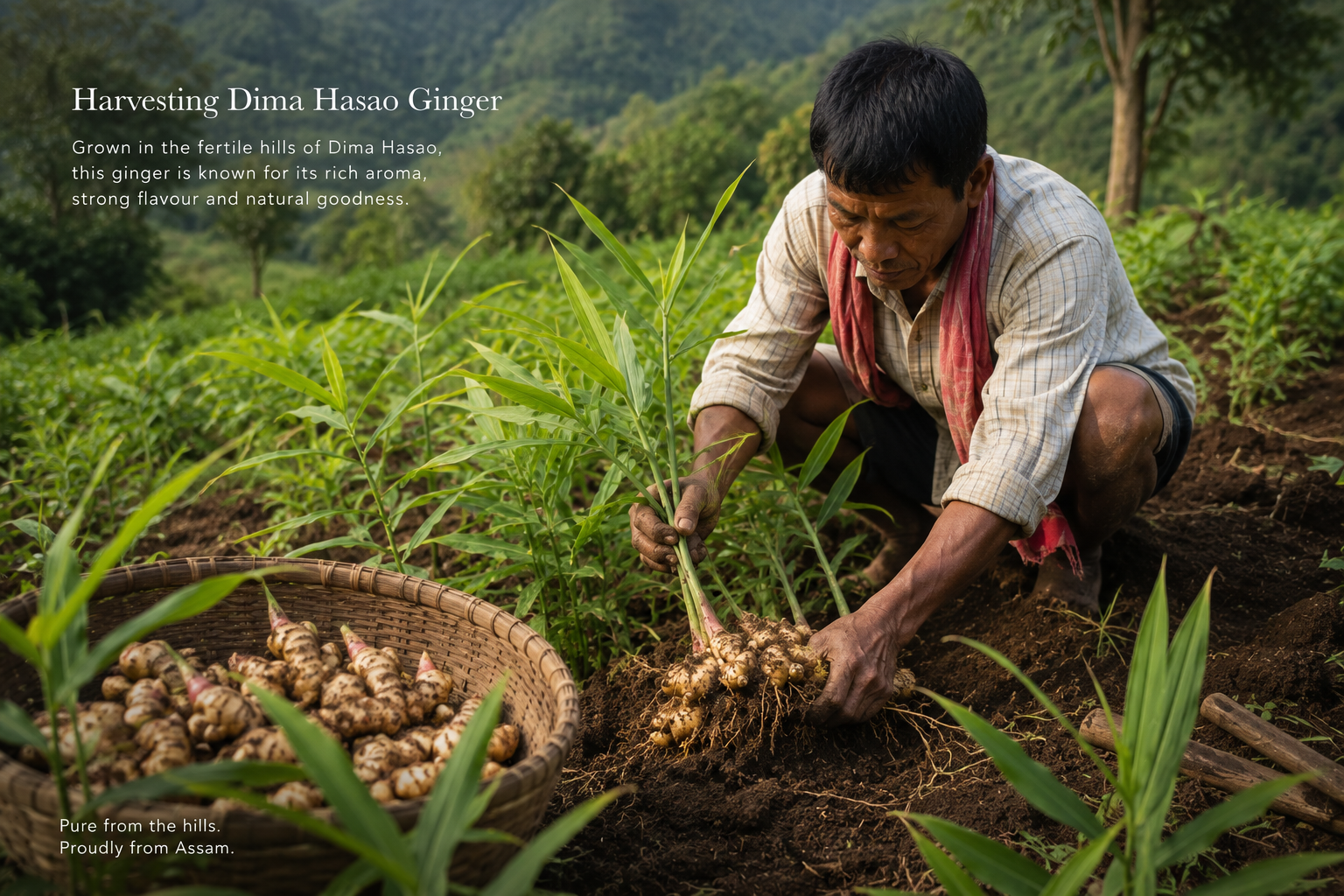
Unlike other fruits such as pineapples and lemons, the aboveground appearance of ginger does not give any clues on when to harvest. The important produce lies underground. There is a need, therefore, for the farmer to be aware of the crop development cycle and inspect the plants and soils before harvesting. Once the rhizomes have matured enough, harvesting can start. The idea here is to get the ginger without causing damage. This is because bruised rhizomes will affect storage and processing of the ginger.
Step 3: Soil Removal and Cleaning of Rhizomes
Ginger as freshly harvested is rarely seen in its cleaned-up form in shops. It always emerges from the earth soil-covered. The first step in the post-harvesting process will, therefore, involve cleaning. In this regard, the processing guidelines issued by the Indian Spices Board recommend washing of rhizomes to clean off soil and dirt before other processes. It seems easy but here lies a catch. Cleaning ginger should not damage it physically. The outer layer is designed to protect the inner parts of the rhizome. Scraping and harsh treatment can damage the rhizomes internally. For that reason, the cleaning process needs to be effective in two ways. Cleanliness and carefulness. Mechanical cleaning system can be used in large-scale plants to speed up this process. For instance, Assam already possesses ginger-related post-harvest facilities in other areas, as is seen by the AEZ Ginger facility at Amingaon, which has a mechanical system of washing, sorting, and packaging.
Step 4: Sorting and Grading
Once cleaned, ginger needs to be sorted into the appropriate lots.This is sorting and grading.The process can be done by workers or by processing machines based on different parameters like:
- Size
- Maturity
- Physical state
- Cleanliness
- Condition
- Intended purpose
Why is this step important? Because not all pieces of ginger have the same destiny.High-quality fresh ginger can be sold directly. Some may be selected for drying. Others may be chosen for powder, paste, or other processes. The more homogeneous the raw material, the easier it is to produce homogenous final products.

Step 5: Peeling or Scraping the Ginger
Peeling or scraping comes after, depending on which product you are trying to make. For example, if you are producing dried ginger, peeling or scraping will aid in making drying faster. According to the Indian Spices Board, ginger is traditionally scraped to peel off the skin, and excessive peeling needs to be avoided, as the oil-bearing cells are closer to the skin. It is one of those little processing decisions that make a huge difference. In case too much skin is removed, it will affect the flavour and aroma compounds. If the peeling is done inadequately, drying will take more time. Therefore, the goal should not be “Remove the skin” But: “Prepare the ginger for the next step while keeping the quality intact.” Modern processors may prefer mechanical means whereas the traditional processors may use manual scraping.
Step 6: Drying the Ginger
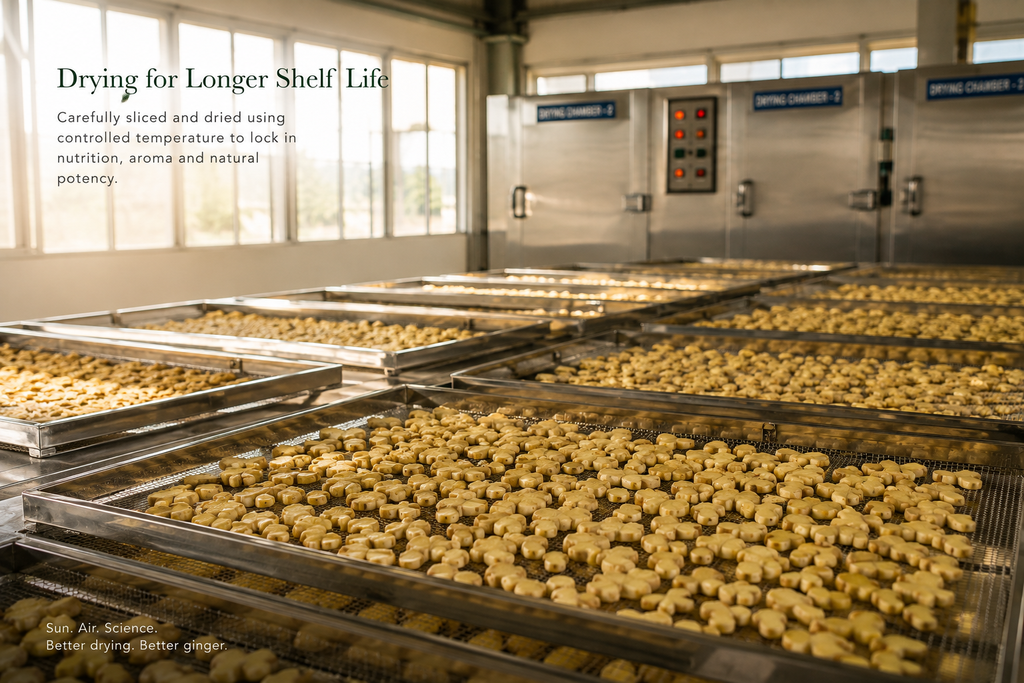
It is one of the crucial steps of ginger processing. Fresh ginger has a lot of moisture in it. Due to moisture, it is hard to preserve for longer times. But drying changes all that, As per the guidance of Spices Board, dried ginger should reach 8-10% safe moisture content with clean drying surfaces along with proper protection from contamination and mould.
Traditional sun drying is one such technique that is extensively employed. But there are drying techniques that offer a higher degree of consistency. As stated by Indian Spices Board, improved solar or artificial drying methods can be employed whereas research organizations have come up with temperature-controlled ginger drying equipment.
Dry ginger produces a totally different product from fresh ginger. For instance, fresh ginger turns into:
Dry ginger
Which in turn serves as raw material for:
- Ginger flakes
- Ginger powder
- Ginger oil
- Ginger oleoresin
- and other value-added products
Step 7: Processing of Dried Ginger into Flakes
If ginger is dried successfully, it may not necessarily be needed to grind it straight away. It could be left as large pieces or even processed as ginger flakes. In the strategy document on Northeast India by APEDA, dried ginger is described as being made through the cleaning, peeling and slicing of ginger, followed by controlled drying. Dried flakes can be used for oil extraction among other processing purposes.
Advantage of flakes:
Storage and transportation is easier as compared to fresh ginger. Moisture is reduced thereby improving storage time. This means ginger from a harvesting season can be commercially useful for a longer time.
Step 8: Grinding of Ginger to Powder
At this stage, the process produces what many consumers know.
Ginger powder. Dried ginger pieces are put through the grinding machine and turned to ginger powder. With modern technology for processing ginger, it is possible to achieve the following in one production line.
washing→slicing→drying→grinding
CSIR-CMERI talks about a ginger processing technology with dedicated equipment for washing, slicing, drying and grinding ginger, where there is specific equipment to grind ginger chips into ginger powder.
Advantages of this technology include the fact that:
Unlike crushing dried ginger manually, the processor is able to have some control on particle size.
The ginger powder can be used in:
- spice mixtures
- beverages
- food preparations
- bakery products
- seasoning
- and other food processing.
And suddenly, the ginger harvested in the hills of Dima Hasao has become an ingredient that can travel much farther.
Step 9: Ginger Paste
All ginger does not need to be dehydrated. Ginger paste is another method for adding value to ginger.
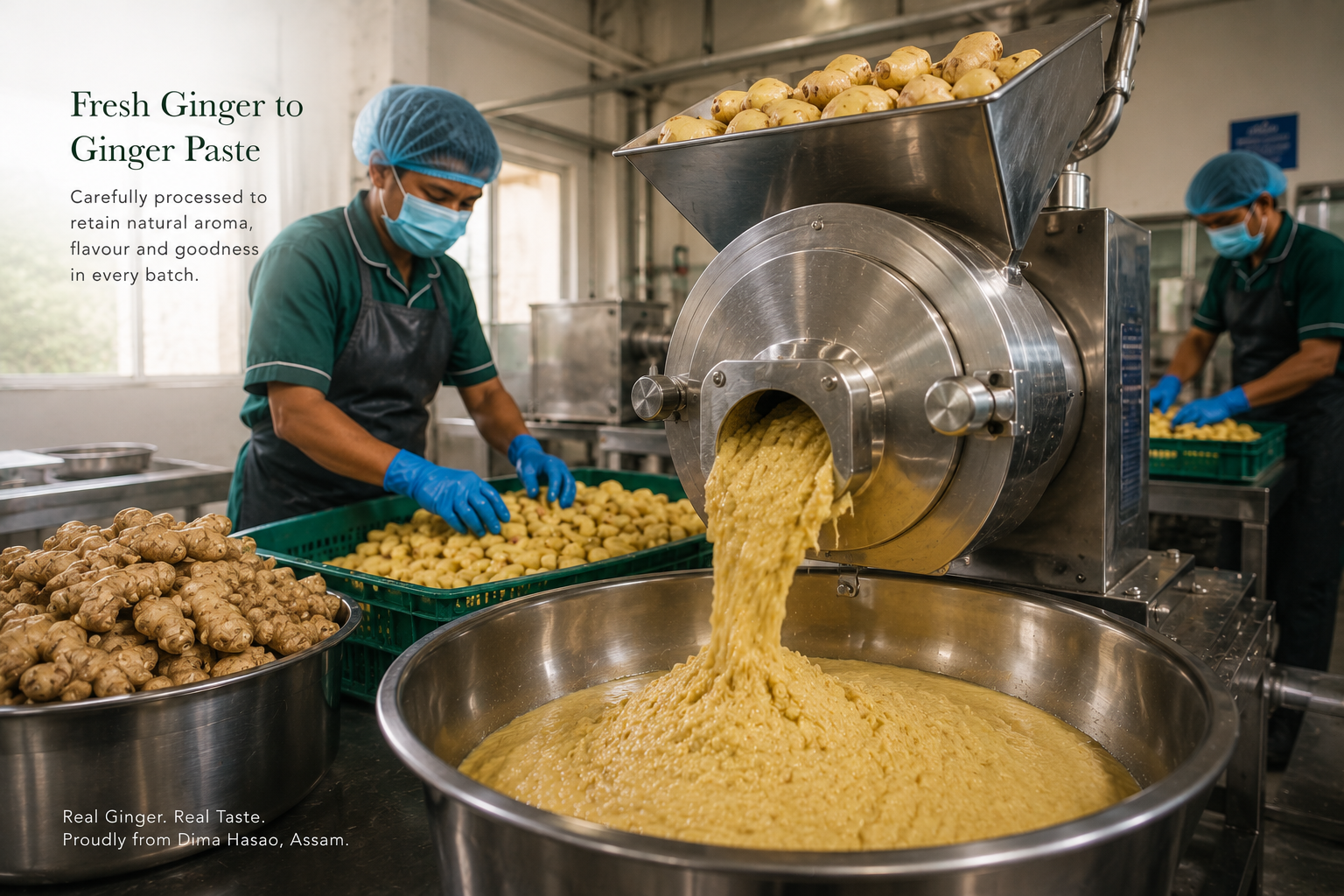
According to the Northeast India strategy by APEDA, ginger paste is a value-added product for ginger. It is described as a process of grinding ginger which has been cleaned and peeled with the addition of ingredients like acidulants and preservatives, when required.
It is quite different from the process of creating powder.
In this case, moisture retention takes place.
The basic steps are:
Cleaning → Peeling → Grinding → Formulating → Processing → Packing
The resulting paste could be used in culinary purposes. This forms another market for ginger.
Step 10: Ginger Oil and Oleoresin
Here ginger processing gets industrialised. There are aromatic as well as pungent compounds in ginger which can be extracted and concentrated into ginger oil and ginger oleoresin.
According to the concept of the government of Assam ginger processing project, ginger powder, ginger oleoresin, and ginger paste are some of the end products that can be achieved from local ginger.
The Indian Spices Board too recognises dried ginger as a raw material from which products like ginger oil and ginger oleoresin can be made.
These products differ from the normal ginger powder.
They are concentrate products which can be used by various industries.
This is one of the reasons why processing can bring much higher value addition than simply selling ginger.

Step 11: Quality Control
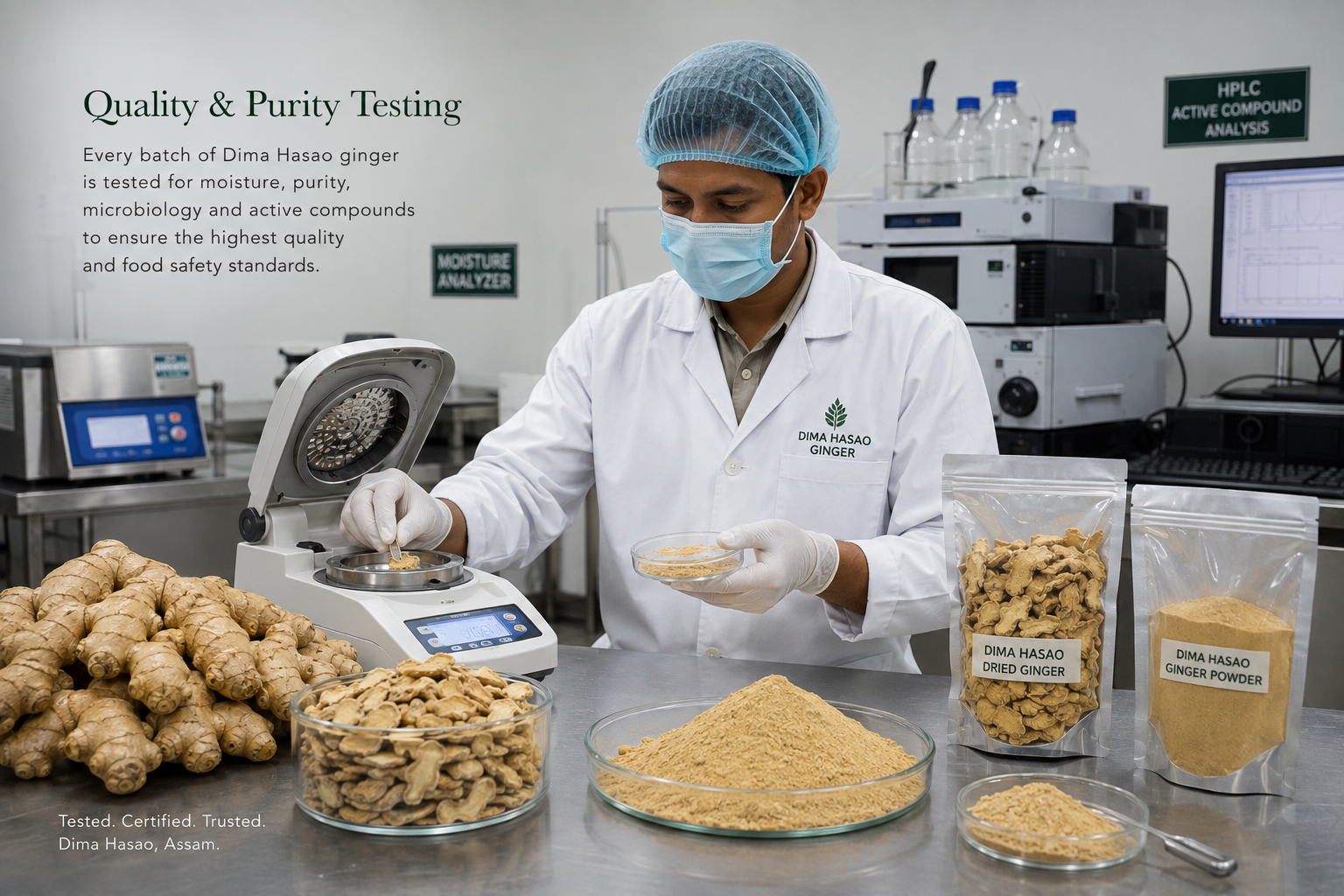
Processing does not stop once the ginger is powdered or pasted. Quality control is essential. The resulting product must be clean, uniform and appropriate for its intended purpose. With dried ginger, quality control in terms of moisture content is especially important. As Spices Board guidelines state, poor drying procedures may make ginger susceptible to mould growth.
At proper processing centres, quality control measures can comprise testing for:
- raw materials
- cleanliness
- moisture
- appearance
- particle size
- packaging
- storage
For instance, the processing plant for Assam’s AEZ Ginger at Amingaon has a quality control laboratory in addition to washing, sorting, packaging and cold storage facilities. Here we have another important rule: Processing is as much about controlling the product as producing it.
Step 12: Packaging of Finished Ginger
Protection is now required for the end product. Raw ginger can be packed for transportation. Dried ginger can be packed in suitable moisture-proof packaging. Powdered form requires moisture-proof packaging. Paste requires suitable packing.
Here is where the agricultural product becomes the consumer product. A mere rhizome can be converted into:
Dima Hasao Ginger Powder
Or
Ginger Paste
Or perhaps some other processed ginger product. Packing provides producers a chance to identify their product’s origin. This is particularly useful for Dima Hasao. Geographic identity is already associated with the product from Dima Hasao.
Dima Hasao Ginger and the Processing Opportunity
There is one thing which must not be forgotten behind all this. While Dima Hasao does have ginger production, lack of processing facilities has posed a problem. According to a NABARD district plan for Dima Hasao, the district lacked any infrastructure for fruit processing and cold storage. And establishment of small ginger processing units and ginger dehydration units was among the interventions identified.
This says something to us. The opportunity is not “Dima Hasao grows ginger.” But: “Dima Hasao grows sufficient ginger that justifies added value.” This makes all the difference in the world. When the farmers sell fresh ginger, they merely sell an agricultural commodity. But when the same crop is cleaned, dried, processed, powdered, formulated and packed, more stages of value addition take place.
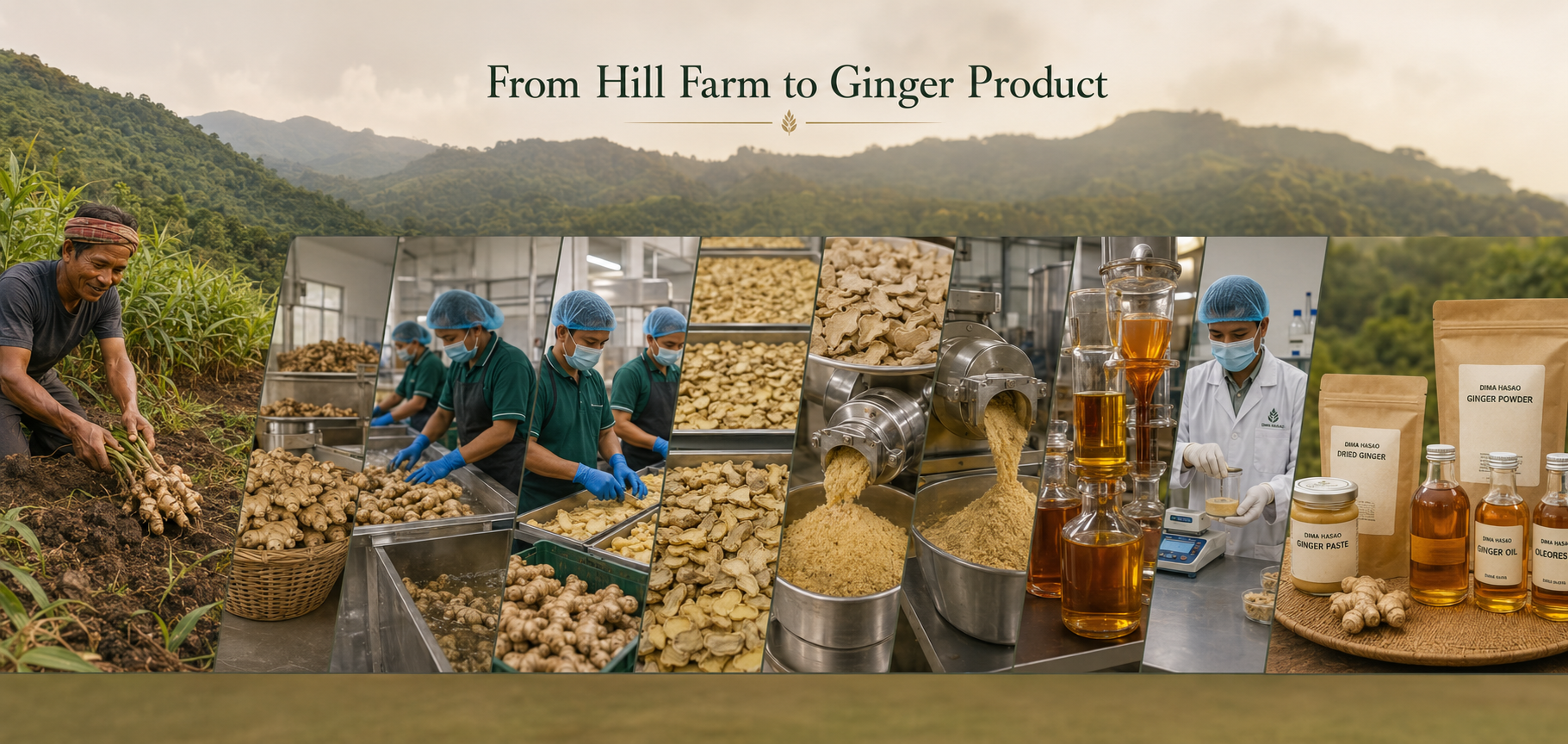
From Fresh Ginger to a Finished Product. The process can be explained in terms of a straightforward chain.
Fresh Ginger
↓
Harvesting
↓
Cleaning
↓
Sorting & Grading
↓
Peeling/Scraping
↓
Drying
↓
Dried Ginger / Flakes
↓
Grinding
↓
Ginger Powder
Or the process can follow this path:
Fresh Ginger
↓
Cleaning
↓
Peeling
↓
Grinding
↓
Ginger Paste
For commercial processing, it follows yet another path:
Ginger
↓
Cleaning & Preparation
↓
Extraction
↓
Ginger Oil / Oleoresin
Exactly this flexibility makes ginger such an intriguing agricultural commodity. A single crop leads to many different products.
Why Processing Is Important for Dima Hasao Farmers
Processing might be able to help solve one of the most critical problems of agriculture. Fresh ginger cannot just wait indefinitely until the right purchaser comes around.
Drying makes all the difference. As the Indian Spices Board points out, dry ginger has fundamentally different storage properties compared to fresh ginger, which can be used as a basis for even more value-added products.
Processing also opens up possibilities for:
- farmers’ associations
- SHGs
- cooperatives
- local entrepreneurs
- food processors
- packagers
- logistics companies
NABARD’s Dima Hasao program specifically mentioned opportunities for financing and development of ginger-processing activities and dehydration units. Therefore, this is not just a question of spices. This is an agricultural value chain.
Where Dima Hasao Ginger Can Go
Processed ginger no longer needs to be marketed exclusively as a fresh rhizome.
It can be marketed in various forms as:
- Fresh ginger
- Dry ginger
- Ginger flakes
- Ginger powder
- Ginger paste
- Ginger oil
- Ginger oleoresin
According to the investment information published by the Government of Assam, Dima Hasao is a major ginger producer in India, and there are plans to process the locally produced ginger for export, including production of powder, oleoresin and paste. This makes Dima Hasao a much more commercially viable area.The hills provide the raw materials. Processing creates the value. Packaging creates the product. And markets create the final link with consumers.
The Story Behind Dima Hasao Ginger
It is not difficult to look at a packet of ginger powder in a store and forget what its origin is. However, there could be much more work behind it. A farmer cultivates the field.
Ginger grows throughout the growing period.
- Rhizomes grow underground.
- Harvesting starts.
- Soil is cleared off.
- The harvest is sorted.
- Some ginger is sold fresh.
- Some ginger is dried.
Some ginger can be turned into flakes or powder.mOther parts can become paste or industrial raw materials.
Then the process of packaging and distribution starts Each stage involves more labor. And that is why Dima Hasao ginger is not only an agricultural product. It can become a value-added regional product.
The Future of Ginger Processing in Dima Hasao
The possibilities are evident but also the obstacles are numerous.
Better processing would require:
- better systems of harvesting
- washing and grading centers
- dehydration facilities
- food laboratories
- packing plants
- storage
- transportation
- market access
- technical education
The Government of Assam itself recognizes food processing as an opportunity for growth, since the state has plenty of ginger and good agroclimatic conditions, while also stressing the prospects in processing, sourcing, logistics and cold chains. In case of Dima Hasao, it could mean gradual shifting from the model that relies mostly on fresh ginger to a more diversified model relying mostly on processed ginger products.
Conclusion: Dima Hasao’s Ginger Hills to a Bigger Market
The journey of Dima Hasao ginger starts underground. A tiny rhizome sprouts under the soil of the hills of Assam. Then comes the harvesting stage. The soil is stripped off. The ginger is then cleaned and sorted. After which there are a number of different directions in which it can go. It can stay fresh. It can be dried. It can be made into flakes. It can be powdered. It can be processed into a paste form.
Also, on an industrial level, it can be used in the manufacture of ginger oil and oleoresin.
As it stands, documents from the government and the industries already recognise Dima Hasao as a cluster for the production of ginger products, and the investment document from Assam has noted the potential to use locally grown ginger for the manufacturing of products like powders, pastes and oleoresins.
In other words, the story of Dima Hasao ginger is not just one about ginger cultivation.Rather, Dima Hasao has all it takes to develop a big ginger value chain.
From hillside cultivation to harvesting.
From harvesting to processing.
From processing to products like powder, pastes etc.
And from a local Assam crop to wider markets.
That is the journey of Dima Hasao ginger.
FAQ Section
What is Dima Hasao famous for?
Dima Hasao is known for some agricultural products like ginger. According to the Government of Assam, Dima Hasao – Ginger is an agricultural district product, and its ginger is high quality and organically cultivated in the hilly areas of the district.
Why is Dima Hasao an important place for ginger production?
There is considerable production of ginger in Dima Hasao district. The official statistics of the Government of Assam report production of up to 39,533 tonnes in the latest year reported in the state’s ginger dataset.
What value-added products can be made from Dima Hasao ginger?
Value-added products could include dried ginger, ginger flakes, ginger powder, ginger paste, ginger oil and ginger oleoresin. The material on Assam’s ginger-processing project explicitly mentions powder, oleoresin and paste among the possible products from locally produced ginger.
How is ginger powder produced?
Ginger is usually cleaned, prepared, dried, and then turned into powder using modern processing facilities, which have washing, slicing, drying and grinding machines.
Why should ginger be dried?
Drying decreases moisture content and extends the shelf-life of the product. According to the Spices Board, ginger should be dried down to 8-10% moisture content.
Is Dima Hasao ginger processed locally?
The Government of Assam officially names Dima Hasao a ginger-based production cluster, and its planning documents indicate the need and possibility for the construction of additional ginger-processing and dehydration facilities. Thus, Dima Hasao is better described as a major ginger producer and processor rather than as a district where all ginger is processed.
Leave a Reply