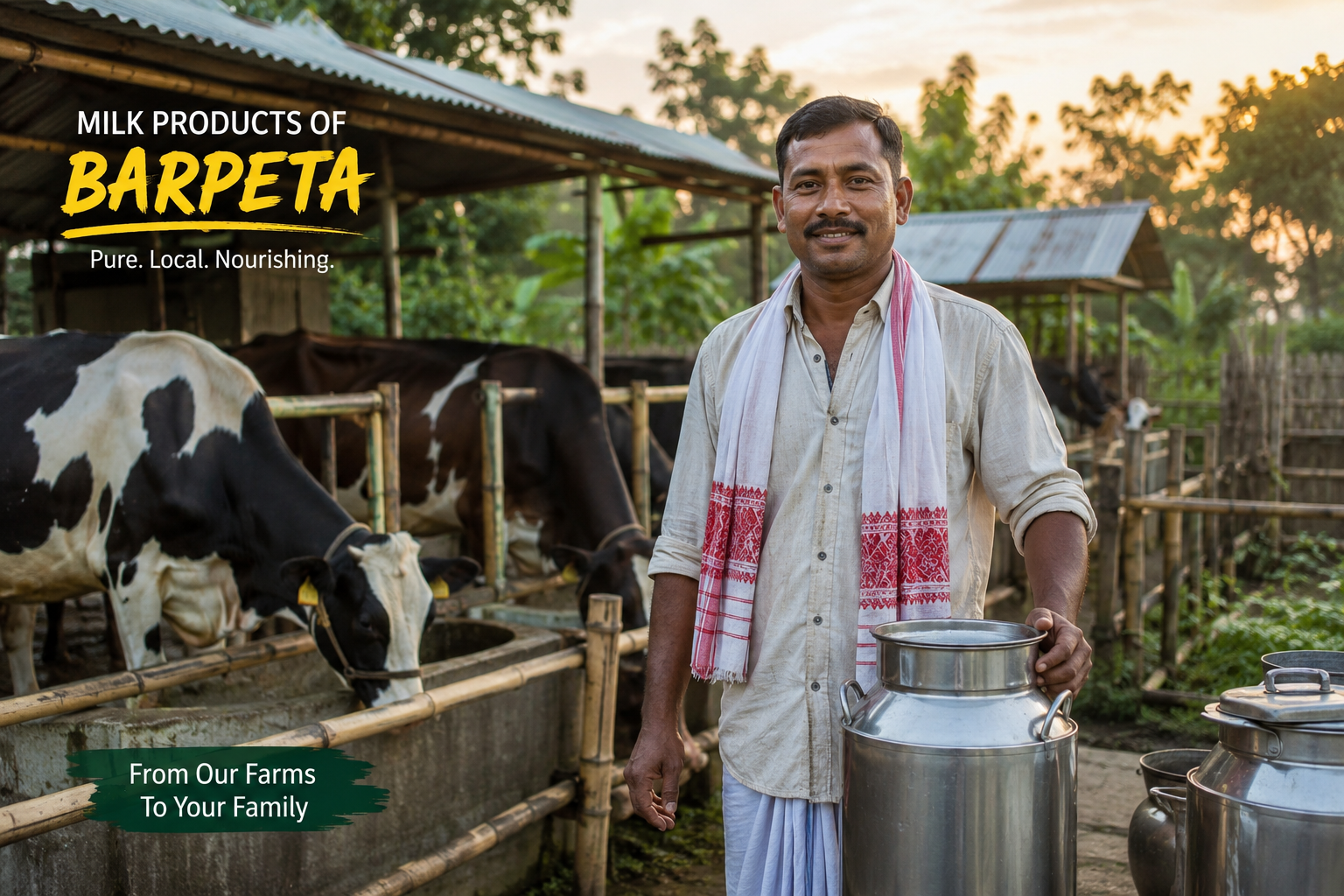
Rice, tea, spices, fruits and many other food products constitute one of the major food economies of the Indian state of Assam. However, there exists another food product of the state that does not seem unusual at all – milk products. In the list prepared under the One District One Product (ODOP) scheme of the state, it can be found out that Barpeta is associated with milk-based products in Assam. However, the question is how the process starts from the milk produced on a dairy farm until the final product of curd or paneer. Why has dairy farming become a dominant industry for income earning and food production in Barpeta, Assam? And how are milk, fresh milk, cream and paneer processed and packed after they have left the dairy farm?
The answer to all of the questions can be found by analysing the whole chain of processes that includes dairy farming, milk collection, quality testing, chilling and other processes.
Importance of Milk Products in Barpeta Region of Assam?
Barpeta has created some areas for milk production along with milk cooperatives. According to the Assam Livestock Development Agency, some regions like Pathsala, Nityananda, Howly and Barpeta Road have achieved success in milk production and sales. According to the Assam government, the practice of clustering by the farmers led to the creation of milk pockets and dairy cooperative societies in the area. Pathsala and Nityananda have emerged as important milk collection regions for the WAMUL cooperatives for Purabi milk. Hence, besides milk production and marketing by farmers in their region, Barpeta also comprises other processes and institutions like milk collection centres, dairy cooperatives, chilling of milk and added-value dairy products in addition to this. According to the Assam government’s present database on dairy infrastructures, Nityananda, Howly and Kolgachia in the Barpeta region are bulk milk chilling centres. These infrastructures have been created owing to the fact that milk is extremely perishable. The faster it is moved from the farm to collection and chilling centres, the easier it becomes to maintain quality prior to processing.

The journey of milk begins from the dairy farm. All dairy products originate from the same source, i.e., fresh milk. On the farm level, the dairy farmers take care of their cows, feed them and give them water. Moreover, there is a well-established government livestock and cattle development network in
Barpeta. A government livestock farm in Barapetta, which was built many years ago, was linked with milk farming and demonstration. According to government, the purposes of the livestock farm were
training farmers and unemployed youth, demonstrating scientific dairy-farming techniques and also making quality milk. High-quality milk production thus begins way before the milk is processed in the plant.
This includes:
- Healthy dairy animals
- Quality feeding
- Quality drinking water
- Veterinary care
- Milking hygiene
- Milk storage hygiene
- Collection in time
The quality of the final dairy product thus greatly depends on the quality of the milk produced.
Step 1: Milk Extraction & Handling
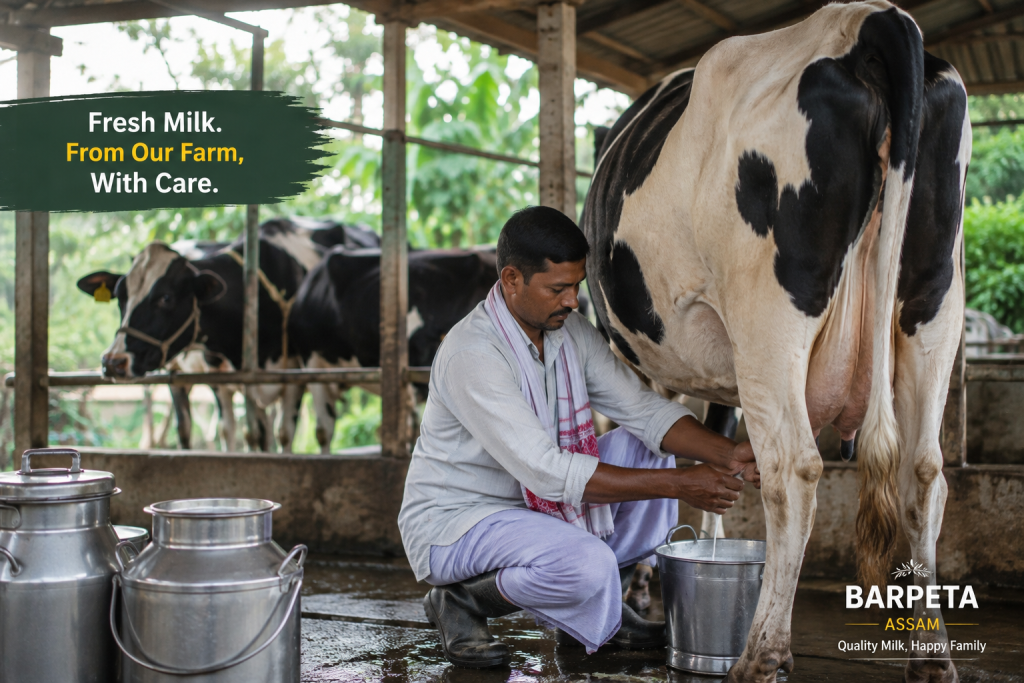
There is usually the process of collecting milk from dairy animals on a scheduled basis. First and foremost, hygiene plays a crucial role in the handling of dairy products. It is vital to ensure that there is cleanliness of an animal, of the milking place, of people’s hands and of equipment which is used. Moreover, containers for milking should be appropriate in terms of handling foodstuffs. In any case, once the process of milking has been accomplished, it is wrong just to leave it standing at room temperature for a considerable period of time. It is in this respect that the role of dairy product supply chains takes place. Thus, as the Assam Directorate of Dairy Development puts it: “Regular collection is normally done in the morning and evening, and the milk is collected from rural collecting centres and moved up to chilling centres/dairy plants.”
Step 2: Collection of Milk from Farmers
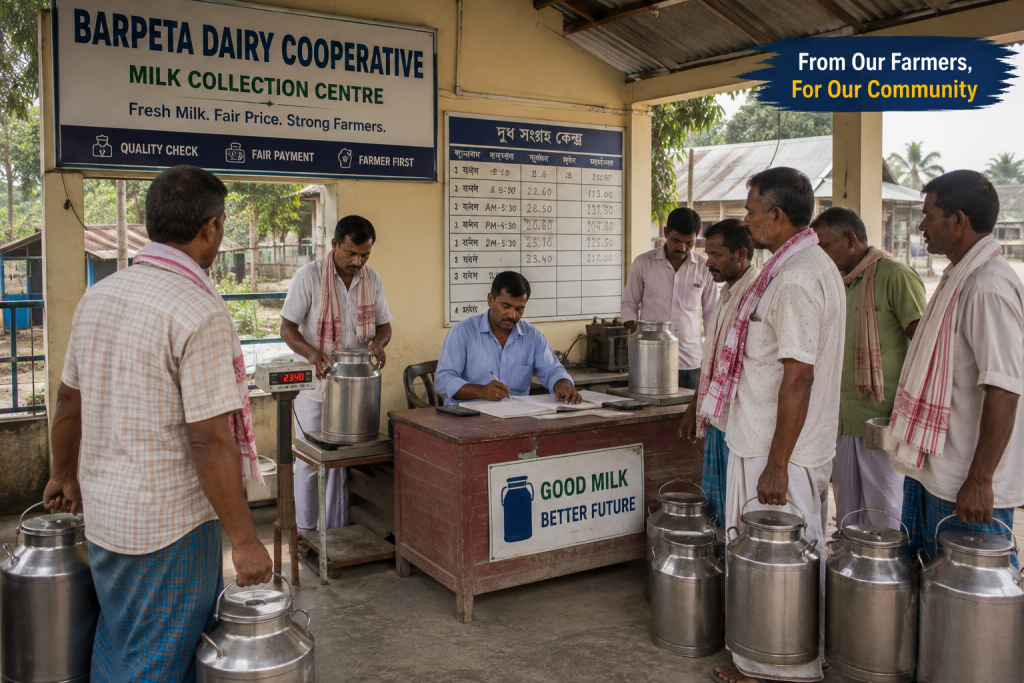
Once the milk is produced, the process of its collecting starts. Instead of each producer independently delivering their product to the dairy plant, an organised supply chain allows for gathering all milk at local collecting points. As the Assam government says, “Procurement is normally direct from individual farms, as well as through cooperative organisations. Milk is received at milk collection and chilling centres and transported to the dairy plant.” There are several milk collecting centres in Barpeta such as Bamakhata, Nityananda, Dumuria, Howly, Beikuchi, Kalbari, Banbahar, Banglipara and Saderi. These collecting points make it possible for numerous farmers to be involved in an organised milk supply chain.
Step 3: Milk Testing
Before milk progresses in the processing chain, it should be inspected first. According to the Assam Directorate of Dairy Development, there are such collection systems, where milk is not only weighed but also tested for fat content. This stage is necessary due to the nature of milk, as it is biological food and its characteristics differ. Testing is useful when it comes to collecting milk in order to understand its characteristics and provide adequate processing. Therefore, the basic order of the process can be described as follows:
Farmer → Collection Centre → Testing → Chilling → Processing → Product.
Step 4: Chilling of Fresh Milk
This step is very important in the milk processing chain. As mentioned above, fresh milk is perishable, and hence temperature control after collection is important. The city of Barpeta is provided with the infrastructure for cooling fresh milk. At least two Assam government dairy infrastructure sites have been registered. They are situated in Nityananda, Howly and Kolgachia. The basic goal of this process is quite obvious: fresh milk must go quickly from the moment of collection to the cooling process.
After that, the process will help transport the milk safely for future processing. One should remember the importance of dairy infrastructure in Barpeta District precisely because of this step.
Step 5: Milk Enters the Processing Stage
Once the process of collection and cooling is done, milk enters the stage of processing. The Assam Dairy Development Directorate says that dairy processing is basically done in two categories, which are primary milk production on the farms and milk processing intended to increase the shelf life of milk.
The process for milk can consist of heating it for safe drinking and processing milk to create semi-dehydrated or dehydrated dairy products. According to the type of product, there could be various types of processing of milk, including:
- Milk in packaging form
- Curd
- Paneer
- Cream
- Ghee
- Butter
And so on.

Curd – From Fresh Milk to Another Dairy Product.
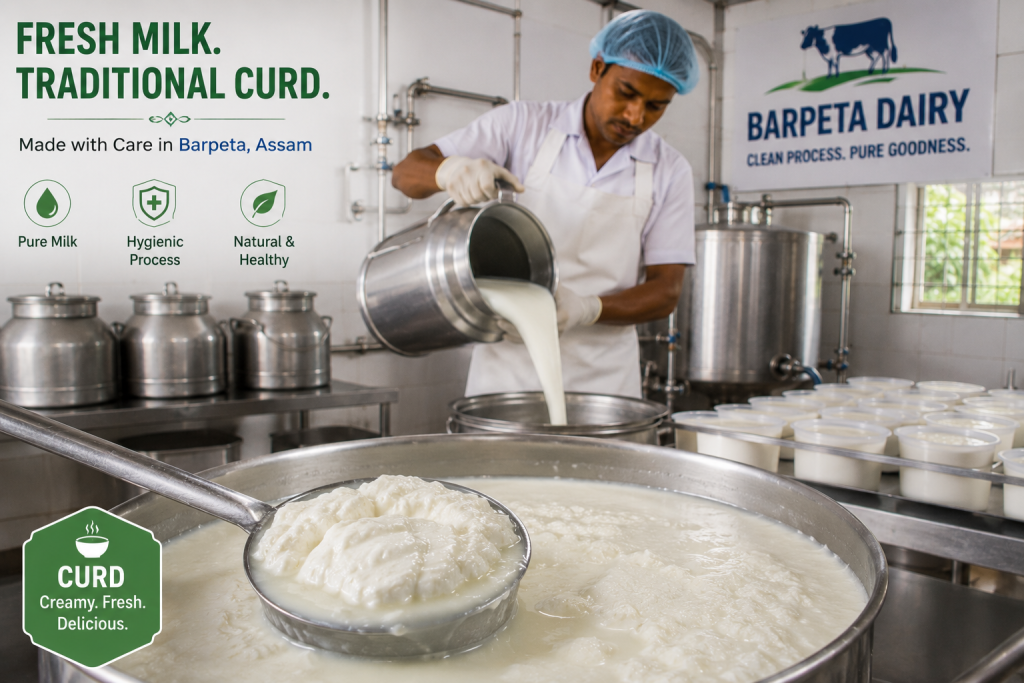
One of the most obvious cases of value addition for milk is curd. In this case, the principle of the process involves the preparation of the fresh milk in clean conditions and the introduction of the appropriate bacteria culture which makes fermentation turn the liquid milk into something else. As a result of fermentation, there occurs some thickening and changing the consistency of the milk to make it more solid and sourer.
Such transformation gives the curd. Thus, this case of making a new food product shows the basic principle of milk processing in general: From the same basic product, a different kind of food product may be produced through some technological processing.
Paneer – The Separation of the Solid from the Liquid Part
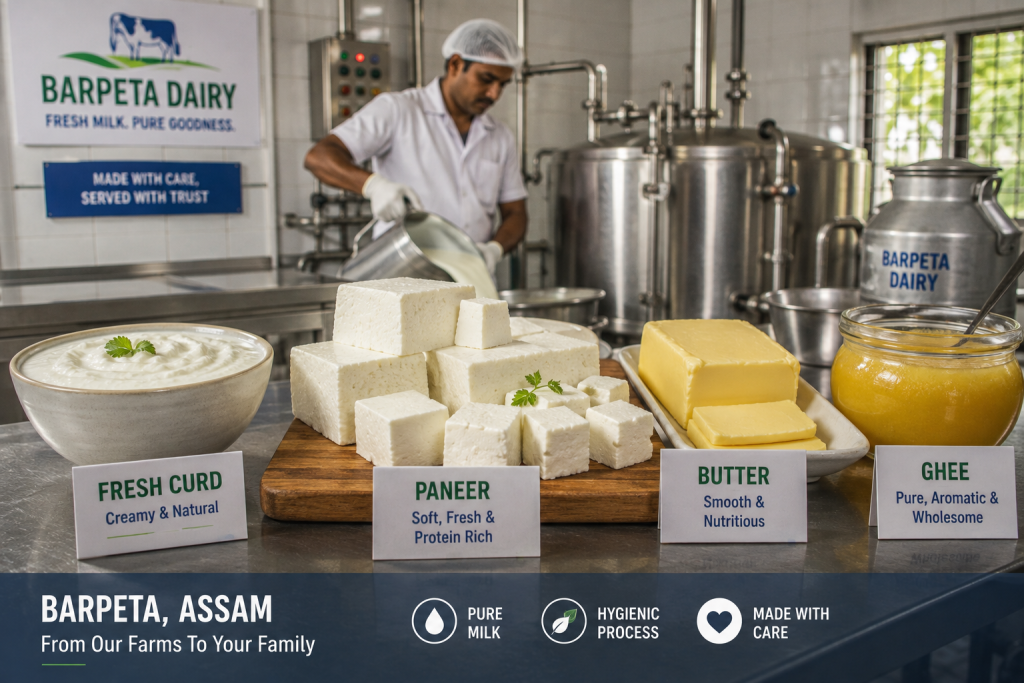
Paneer is one of the dairy products made by the value addition methods. In such processing, the key point is to separate some solid part of the milk from its liquid one. This process includes the heating of milk and introduction of some acid which is appropriate to coagulate milk. There occur some coagulates which should be separated from milk. They should be processed into blocks of curds which are pressed into the form. Thus, paneer is produced.
From the viewpoint of a dairy producer, this method is very useful as it transforms a very delicate product – the liquid milk – into another one which can be sold separately from milk.
How Cream and Butter Are Made
Milk includes fat which can be separated and concentrated in different dairy products. For example, cream is obtained during the separation of the fat part from the liquid milk. Further separation of fat will make butter.
Producing Ghee Using Fresh Milk As Another Dairy Product
A simple way to produce ghee can follow the following pathway:
Milk → Curd/Cream → Butter → Heating → Ghee
In the heating phase, moisture is evaporated to give the ghee milk fat product an aromatic, distinctive flavour and colour. Ghee is one of the dairy products that has a higher shelf life compared to fresh milk. Thus, the production of ghee serves as an illustration of the importance of dairy processing of milk in increasing the usability of milk. Importance of Value Addition to Dairy Farmers in Barpeta: Imagine yourself as a dairy farm producer of fresh milk. Fresh milk should be sold relatively fast. However, when you process fresh milk into products like paneer, curd, cream, butter and ghee, then you end up creating a different commodity. This activity of making a product out of fresh milk is called value addition. Value addition helps in providing an opportunity for:
- Shelf life extension
- Product diversification
- Market positioning
- Food entrepreneurship
- Job creation
- Women entrepreneurs
- Dairy entrepreneurships
According to the Assam government, in the Bajali sub-division in Barpeta, value addition through products like curd, paneer, cream and ghee contributes to the economics of the dairy farms there. Further, it notes that women’s self-help groups have also opened milk by-products shops in some villages such as Nityananda and Baghmara. This is because value addition in dairy product processing is not just about the product. Value addition creates an environment for the dairy farm itself. The importance of dairy cooperatives in Barpeta. Creating a good dairy farm environment requires more than farms do. It needs a connection from:
Farmers → Milk Collection Centres → Cooperatives → Chilling → Processing → Retail → Consumers
Barpeta has built an organised chain like this within several milk-producing regions in it. According to the Assam government, the dairy farmers in the villages of Pathsala, Nityananda and Howly adopted a cluster-based approach which resulted in the formation of dairy cooperative societies.
Value Addition as Vital for Barpeta Dairy Farms
Picture a farmer that produces milk every single day. The farmer has to sell his/her milk quite soon.
However, after transforming milk into paneer, curd, cream, butter or ghee, the farmer will have totally new commercial goods. This process is called value addition.Through value addition, new possibilities may emerge:
- Product shelf-life extension
- New kinds of products
- Market positioning improvements
- Local food industries development
- Employment generation
- Female-run businesses
- Small dairies creation
In particular, according to the Assam government, value-added products including curd, paneer, cream and ghee in the Bajali region of Barpeta help generate revenue for dairy farms. Also, self-help groups formed by women created milk product shops in areas like Nityananda and Baghmara.That matters since the processing of dairy is not the end but just one step. It is possible to form an ecosystem of services that is connected with farmers. Barpeta Dairy Cooperatives A good dairy farm ecosystem requires more than just farmland. It requires interaction of the following:
Farms → Collection Centres → Cooperatives → Chilling → Processing → Distributors/Retailers → Customers
Several regions of Barpeta established precisely this kind of organised network. According to an Assam government report, farmers in Pathsala, Nityananda and Howly followed a clustered strategy that helped them form dairy cooperatives. Also, through cooperatives, it would become easier to aggregate milk from several sources and sell it on an organised market. Besides, it provides a basis for creating local dairy products.
Dairy Cooperatives’ Role in Barpeta
Development of the milk ecosystem requires more than the farm.There must be linkages between:
Farmers -> Collection Centres -> Cooperatives -> Chilling -> Processing -> Retailers -> Consumers
The Assam state has created this system in many milk-producing regions within the state. According to the Assam government report, people in places like Pathsala, Nityananda and Howly have employed a clustered approach which facilitated the creation of dairy cooperative societies in the region. Cooperatives enable easy aggregation of milk from producers for supply to organised markets. Cooperatives also set a framework in place through which local dairy products could be produced.
Why Milk Products Appeal to Assamese Population
Milk products have special significance for Indian food culture. Fresh milk is consumed directly or added to tea or used for the production of sweets or for cooking. Curd is added as an accompaniment to the meal. Paneer is used in dishes. Butter and cream are used in the process of cooking or preparing food items. Ghee is known for its flavour as well as its uses. So versatile uses are an asset of milk over many other agricultural products. From a single agricultural product many edible foods are made. Versatility makes milk-based products an ideal choice for being selected as ODOP.
Milk’s Journey in the Context of Barpeta
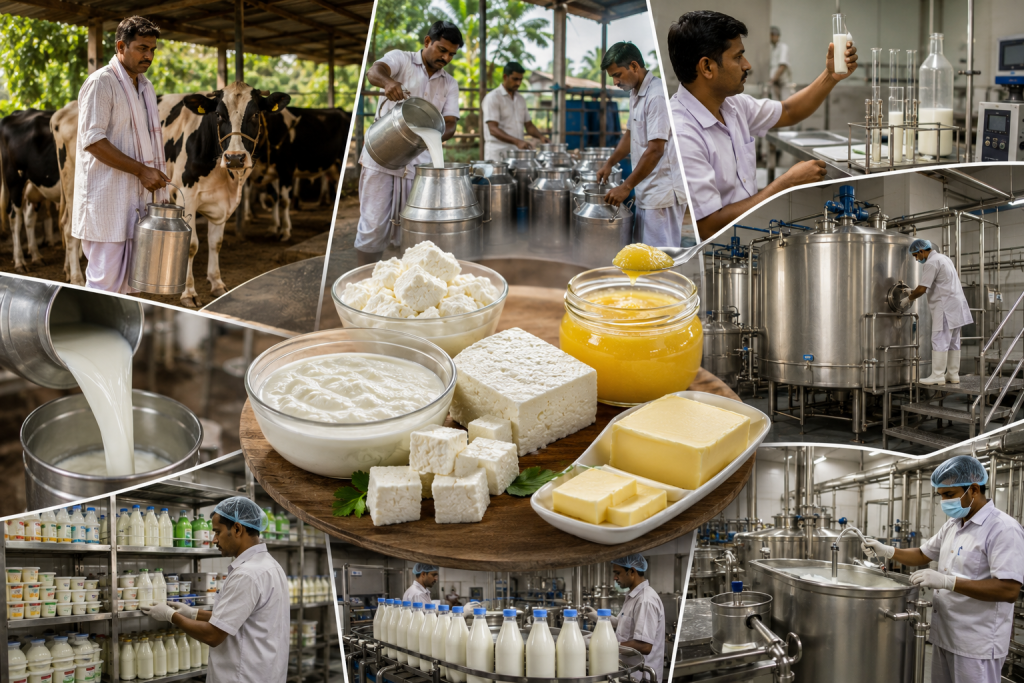
Now, milk’s journey from Barpeta’s farm till reaching the consumer could be described using the following chain.
1. Dairy Farming
The production of milk occurs by rearing dairy cattle at the farm.
↓
2. Milk Collection
Milk is collected through hygienic methods.
↓
3. Transportation to Collecting Centers
Farmers transport milk to collecting centres.
↓
4. Testing
In collection points, milk is weighed, and tests of some quality parameters, like fat, could be conducted.
↓
5. Chilling
Rapid transportation of milk to chilling infrastructure happens.
↓
6. Processing
Appropriate processing takes place depending on what is needed to be produced from milk.
↓
7. Value Addition
Milk becomes curd, paneer, cream, butter, ghee or any other form of dairy products.
↓
8. Packaging
Products are packaged through appropriate hygienic methods.
↓
9. Transportation of Products
Product moves toward local markets and to consumers.
And here comes the complete story of milk products of Barpeta, Assam.
Why Is the Story behind Barpeta’s Dairy Unique?
The uniqueness of Barpeta’s milk story lies in the fact that it isn’t limited only to a single milk-based product. It lies in the entire dairy value chain. Farmers are responsible for producing the raw material. Collection centers help gather the milk. Tests ensure quality management. Chilling facilities provide the protection needed for the product in the initial stage. Processors convert milk to various products.
Market and network systems help link producers to consumers. And value addition provides opportunities for dairy enterprises to go beyond just the fresh milk. Through the milk infrastructure in
Assam and the special programmes for Barpeta, the Assam government shows that dairy is now becoming an economically significant sector in the district.
Milk-Based Products – The Future of Barpeta’s Dairy Industry
There exists an opportunity for Barpeta’s dairy industry to go further ahead with the focus on processing, good branding and hygienic packaging of milk products and their added value.
Instead of treating milk as something which is collected from cows and sold as a fluid, it can be considered the base of the entire ecosystem of the food-processing business.
- Fresh milk becomes paneer.
- Milk can get converted into curd.
- Cream becomes butter.
- Butter gets turned into ghee.
Each transformation brings a new product, a new market and even new possibilities for local entrepreneurs. That is the very reason why food processing is essential for agricultural areas such as Barpeta.
Conclusion: The Barpeta’s Milk Story
When you come across the packets of milk, the blocks of paneer, the bowls of curds and the jars of ghee in the future, think that the finished product has much more meaning beyond that of the milk. In Barpeta of Assam, the story of milk starts with farmers of the district and proceeds further with collection centres, quality testings, chilling facilities, processing, value addition and marketing. Barpeta’s well-established milk pockets, milk cooperatives and cooling facilities are playing a huge role in creating the platform of an organised dairy value chain. Therefore, milk-based products play an integral part in ODOP of Barpeta. Every step from the milk farms to processors and finally to consumers tells a story itself. Barpeta’s milk is not just any kind of product; it is a whole local food-processing journey.

Questions And Answers On ODOP Of Barpeta
What is the ODOP of Barpeta, Assam?
According to the ODOP list in the source document, the ODOP product of Barpeta is milk-based products.
In which regions does milk collection take place in Barpeta?
The government of Assam has listed areas such as Pathsala, Nityananda, Howly and Barpeta Road as milk collecting or producing regions in Barpeta.
Where does milk get chilled in Barpeta?
The source document provides information that there are bulk milk cooling centres located at Nityananda, Howly and Kolgachia.
What products can be made from fresh milk?
Depending on the methods involved in manufacturing, a variety of milk-based products can be produced using fresh milk: curd, paneer, cream, butter and ghee, along with packaged milk, among other dairy products. The Assam government identifies products such as curd, paneer, cream and ghee as value-added milk products in the case of Barpeta/Bajali dairy.
Why is it necessary to chill milk?
It is necessary to chill milk due to its perishable nature. Chilling helps preserve the quality of milk until it is transported from collection points to further processing points.
Why are dairy co-operative farms necessary?
These farms enable the aggregating of milk from a number of farmers for creating an organised route through producers and collection facilities to the processing point and market.
Why are the milk-based products important for Barpeta?
Milk-based products provide opportunities not only for fresh-milk sales but also for value addition through products such as paneer, curd, cream and ghee. This can support dairy farmers, cooperatives, processors and local entrepreneurs.
Leave a Reply