There is almost magic in the process of honey production. A bee goes out of the hive, flies from one flower to another, collects the nectar, comes back home and, through a simple-looking process, produces a product that can be stored, transported and consumed even many months after the moment of production. Behind every gram of honey there is a much more complicated story. This story of Assam and its unique flora and traditional honey production techniques. Honey is the official One District One Product (ODOP) of the Baksa region in Assam, according to the source document for this project. However, this is not only a local story anymore.
In May 2026, the first-ever consignment of 20 metric tonnes of ODOP honey from Baksa, Assam, was exported to the USA with the help of the APEDA organisation. According to the Government of India report, there were approximately 1,650 metric tonnes of honey produced in Assam during FY 2023-2024, and Baksa is mentioned as one of the key producers in this region. But what is the real process of producing honey, and what is unique about the Baksa honey in Assam? Let us follow the way step-by-step.
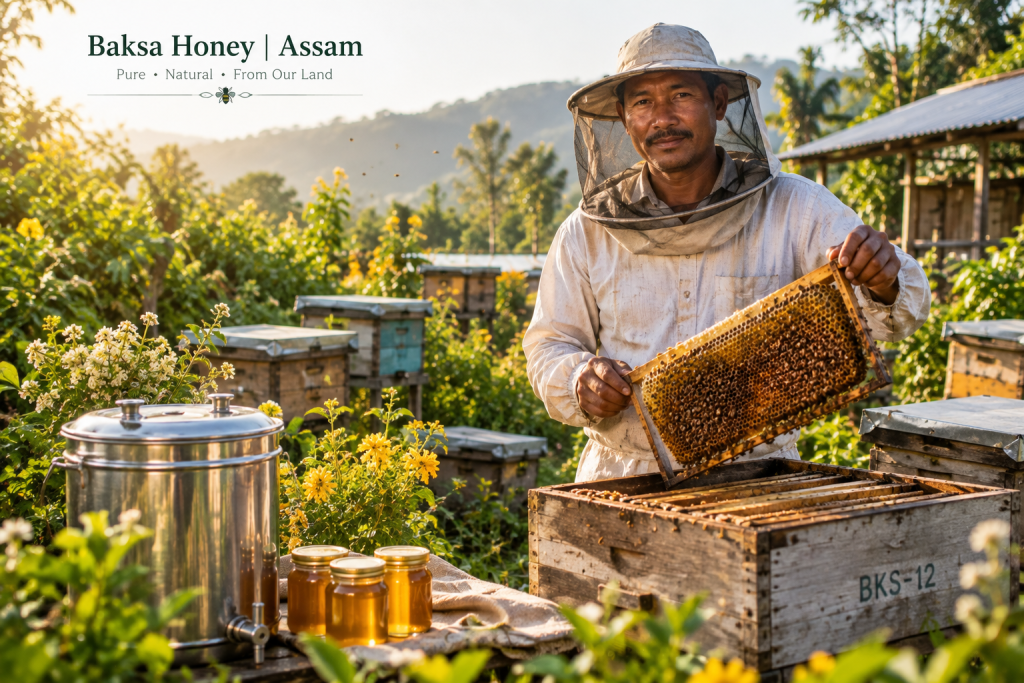
What Is So Special About Honey Production in Baksa Honey, Assam?
Assam is famous for producing honey in an unusual close connection with nature. Thus, the Government of India emphasises rich biological variety, the presence of forest resources and a long history of beekeeping in Assam, which determines its great potential for honey production. Also, according to the government report, honey collection has been performed by the communities of Karbi, Mishing and Bodo since ancient times, and honey served for consumption and also for medicinal and religious purposes. Baksa belongs to this unique honey-producing region of Assam. According to the documents of TRIFED, there is wild honey collection practised by Van Dhan Vikas Kendra in Barimakha, Baksa. Also, there is documented information about the horticulture of Baksa, which provides pollens and nectars to wild and domesticated honeybees. In addition to this, there is evidence on the traditions of
wild honey and beekeeping in communities of Baksa. All this makes Baksa honey really interesting. It is not about bees kept in wooden cases.
The Process of Obtaining Honey Begins at the Level of Flowers, Not the Hive
Before we move to the topic of honey extraction, it is crucial to note one thing, which, surprisingly, is often omitted in descriptions: flowers. The bees require pollen and nectar for the existence of the hive. Pollen is important nutrition for the hive, whereas nectar will later be used in creating honey. The agricultural and natural diversity of Baksa allows developing an abundance of floral sources. It is specifically indicated by TRIFED that in Baksa there are horticulture crops that give pollen and nectar to both wild and domesticated bees. All that is significant since, unlike people believe, honey does not simply appear out of nothing in a honey jar through the efforts of beekeepers.
A beekeeper only cares about protecting and managing the colony. As for the bees, they gather nectar and transform it into a sweet treat that appears at home or at a restaurant table. And, of course, the reason for such diversity of honey colouring, aroma, and even flavour lies exactly in the difference in flower sources. To put it simply:
Flowers give nectar → bees gather nectar → hive works with it → honey is formed inside combs.
Thus, this is how honey production begins.
Step 1: Gathering Nectar from Flowers by Bees
The bee that has found its way to flowers will gather nectar there. The amount of visits depends largely on the number of flowers that the bee will have visited. The nectar is gathered and brought back to the hive. Nectar is not that sticky, dense liquid, which people usually know. It is quite liquid at that moment. At the level of the hive, the nectar is processed and transformed under the influence of biological processes.
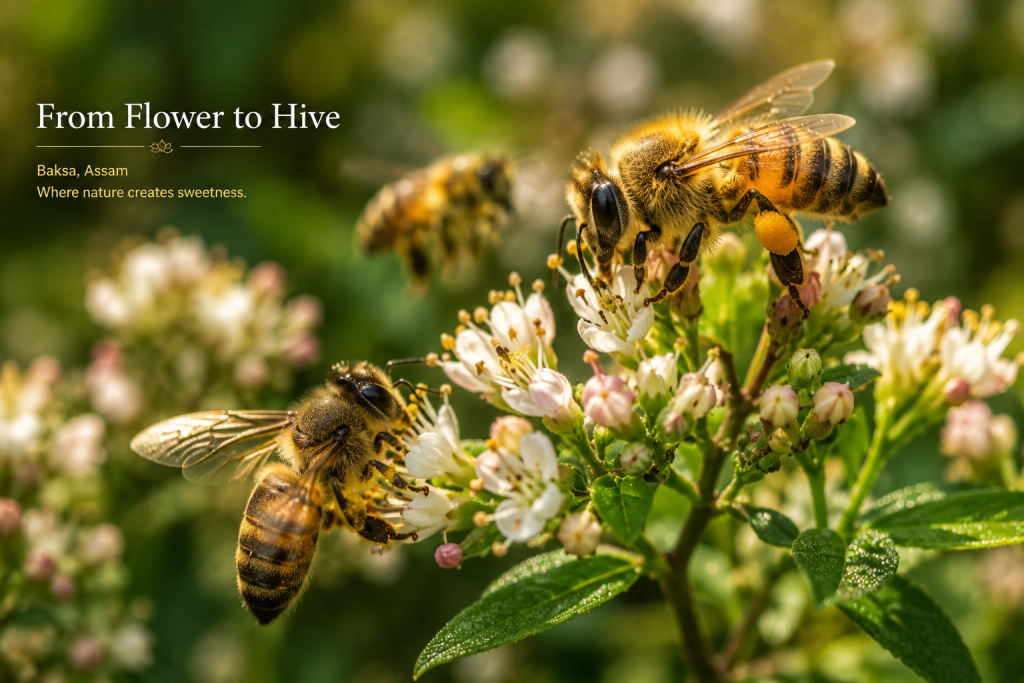
Step 2: The Return of the Collected Nectar to the Hive
Having returned from collection, the nectar reaches the hive. Further transformation of it begins here. Nectar is handled by bees within the colony; water content decreases while the enzymatic process of transformation goes on. It is nature’s own manufacturing plant. It is not about huge factories at this point. It is not about any stainless steel apparatus. It is about a living colony. It is the colony which converts nectar into a concentrated product which can be stored inside the comb.
Step 3: The Honey Stored in the Honeycomb
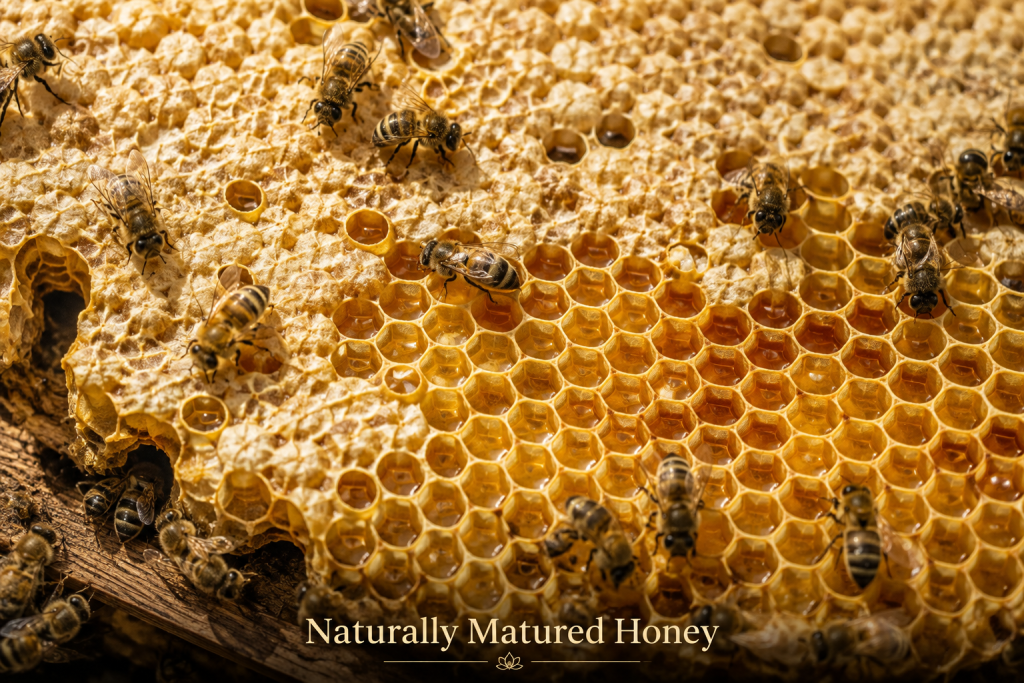
Once the honey is ready, bees store it in the hexagonal cells of the honeycomb. A honeycomb is not just a vessel.
It is the storage space of the food supply of the colony. When the honey is mature enough, bees cap it with a layer of wax. These cells are called capped cells. Such information is very relevant to harvesting. According to the TRIFED instructions on wild-honey value addition, wild honey should be harvested from capped cells, as honey from open (uncapped) cells might have higher moisture content. Also, the instructions emphasise the conservation of brood cells during harvesting so that the developing bees and queens would be safe.
Step 4: Harvesting the Honey in Baksa
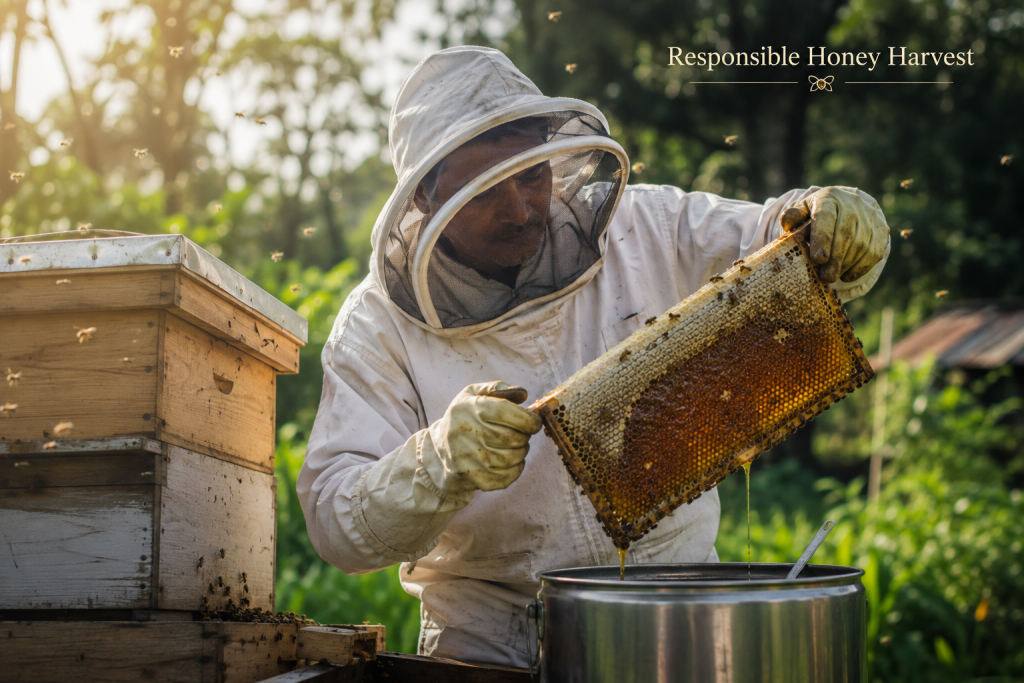
This is the point where a beekeeper or a honey collector intervenes in the process. But this intervention is not a matter of just opening the hive and taking everything from inside. Responsible honey harvesting does matter.
According to TRIFED, the harvesting guide for wild honey includes such topics as protective equipment such as bee suits and veils and harvesting methods that protect brood combs and colonies. As for the traditional wild-honey harvesting, it differs greatly from beekeeping practices. TRIFED records the collection of wild honey in Baksa from
December to May at the facilities of its Barimakha Van Dhan Vikas Kendra. It should be noted: Managed beekeeping is keeping bee colonies and harvesting from managed hives. Wild honey collection is the collection of honey from naturally created colonies. Both can be used in the honey story of Baksa, but they are different practices. The honeycomb is more than just a storage container. It is the place where the colony stores its food. Having become ripe enough, bees close each of the cells with a thin layer of wax; these cells are called capped. This is very important information when it comes to harvesting. The TRIFED guide on wild honey value addition recommends harvesting honey from the honeycombs with sealed or capped cells because the open ones may have higher moisture content.
Step 5: Separation of Honey from Wax
Once the honeycomb is ready for harvest, the next task will be separating honey from the wax comb. There are different approaches that depend on methods of collecting honey. TRIFED’s guidance to value-added processing mentions cutting the comb and letting the honey flow or being squeezed as one of the methods used for traditional fixed-comb hive harvests.
Uncapping the cells and draining honey through a fine-strained mesh is another approach TRIFED mentions. Modern commercial beekeeping operations usually use special mechanical equipment to extract honey while preserving the comb. Regardless, the principle is always the same: to separate honey from the comb while maintaining its cleanliness.
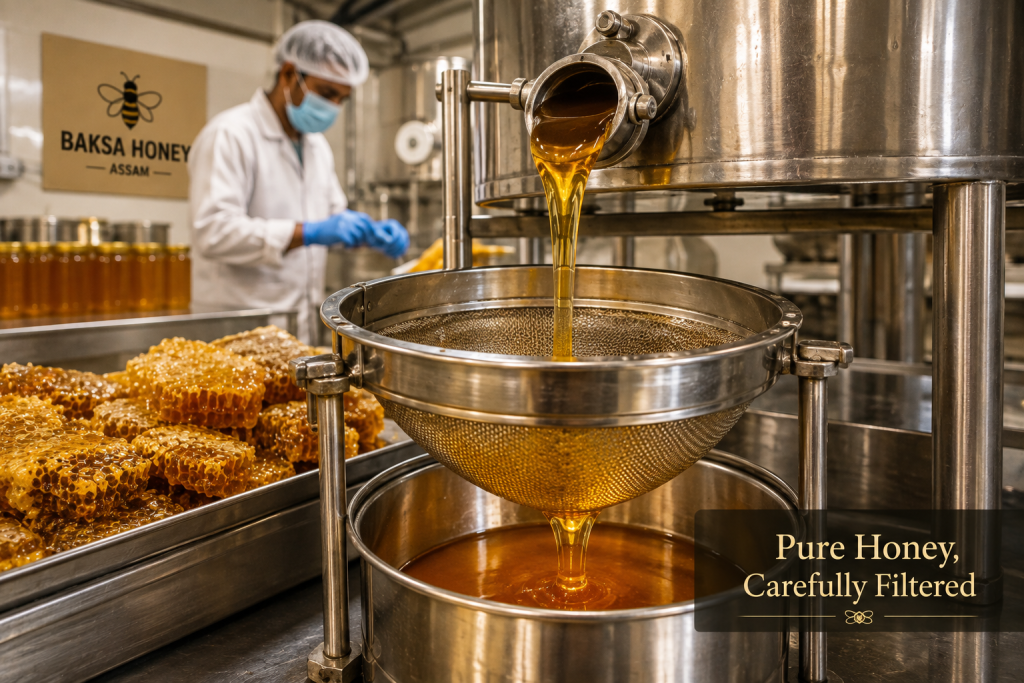
Step 6: Filtering Honey
Freshly squeezed honey often contains small bits of comb and other natural elements. Filtering is needed to remove any physical impurities before going to the bottling process. This process requires special care. The goal of filtering
The process isn’t altering the natural product but removing any unwanted physical elements from honey without affecting its natural characteristics. As for the food products aimed at the wide distribution, the issues of cleanliness and controlled handling increase their importance. The FSSAI honey standard requires honey to be clean and not contain visible foreign matter such as mould, dirt, scum, beeswax, and insect fragments.
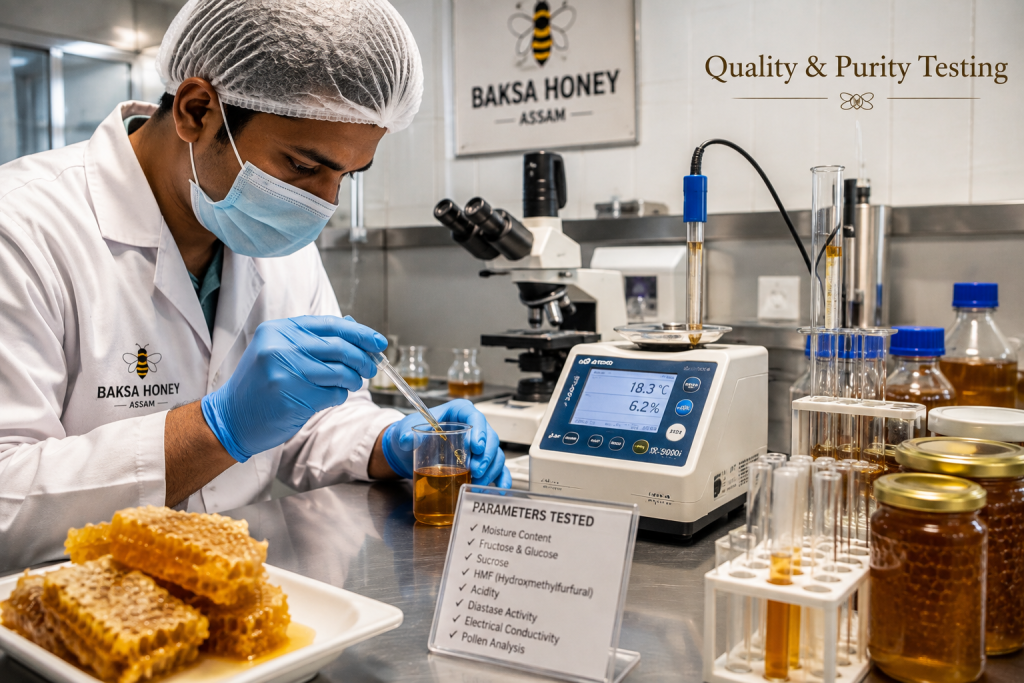
Step 7: Testing — The Most Invisible, but Extremely Important Stage
Probably, this is one of the least visible stages of the honey journey. But this stage is extremely important. The bottle of honey on the shop shelf looks quite unassuming. The preparation of honey for the modern market is not. During testing, it can be examined on characteristics such as moisture, sugars, acidity, specific gravity and many other factors. Currently, FSSAI’s analytical manual for honey and other beehive products includes methods to determine moisture, sugars, ratio of fructose-glucose, acidity, HMF, diastase activity, pollen and plant components, electrical conductivity and test markers for honey authenticity. The current FSSAI honey standard also determines parameters such as maximum moisture content and many more compositional characteristics.
Why Does Baksa Honey Taste Different?
The specialness of honey lies in its uniqueness, as the taste of the product differs in itself. Its taste, colour, texture and aroma differ depending upon the source and surrounding environment. Baksa district’s rich floral varieties are also one of the reasons why the Government of India points out its honey in terms of its natural purity and diversity of floral varieties. This makes Baksa honey special, as it carries the identity related to its geographical environment.
It has something about the local land contained inside. Obviously, not the actual landscape, but it has floral variety which was sourced by bees for its production. This is what makes honey such a unique agricultural product.
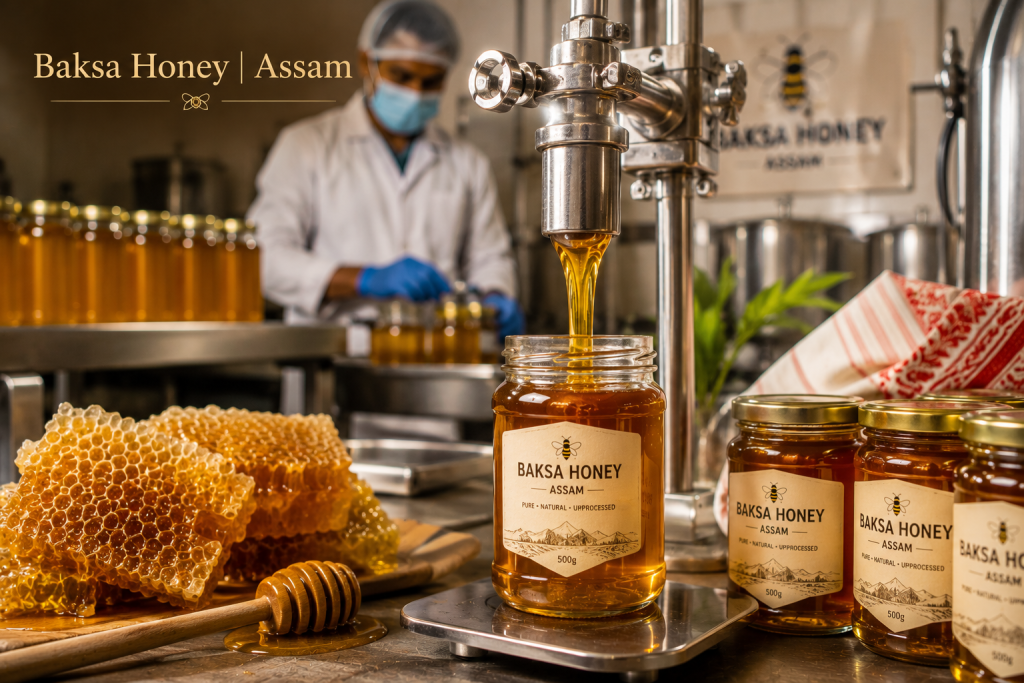
Step 8: Bottling and Packaging
After the honey is ready through proper processing and has undergone quality checks, it can now be bottled and packaged. Packaging may seem like the last small step. However, the way the product will be packaged forms a part of its identity. Clean and good packaging tells the consumer:
• Where does this honey originate from?
• What sets it apart from others?
• How has it been manufactured?
In the case of Baksa honey, geographical identity is significant. It is important to note that this product is not honey alone but Baksa honey of Assam. The importance of the association with the district rises in terms of the ODOP approach, where district-specific goods will be promoted for increased value addition and marketing.
Why is honey special in Assam?
Honey has a special place in Assam. It is used in the region as an agricultural ingredient, sweetener and household product. Honey has also been used historically in various traditional and cultural practices of Assam by different communities. There is something else why honey is valued by people:
its versatility.
• Honey can be used for preparing food or drinks.
• It is used as a food ingredient.
• It can be consumed directly.
Due to its nature, honey can travel great distances, unlike the flower where it was first made.
But there is also something else to say on Baksa honey.
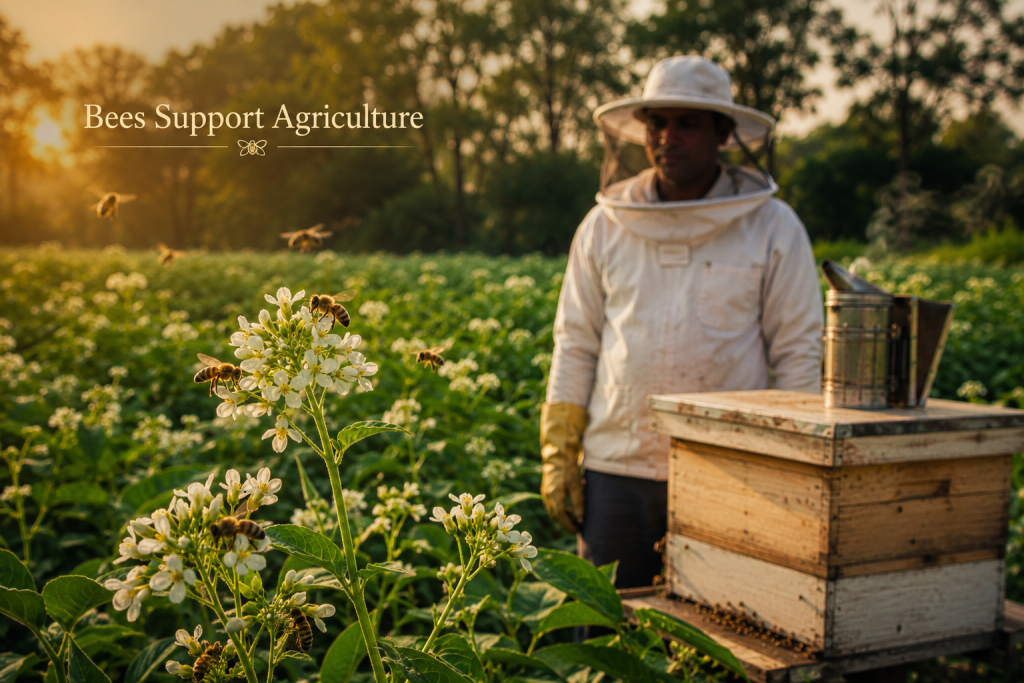
While bees manufacture honey, bees pollinate crops too. As TRIFED states, bees’ pollination will help improve the yield levels of the horticulture crops of Baksa, which in turn supply the pollen and nectar needed for wild and domestic bees. This opens up the possibility that beekeeping has a greater role in agriculture than mere honey production. The beekeeper earns from honey. Farmers gain from crop pollination. Flowers feed the bees. And communities earn an additional livelihood opportunity. The cycle becomes bigger than the product alone.
From Local Collecting to International Export
Up till now, honey collection and its value addition stories in places like Baksa were known within the local context. That scenario is changing fast.
On 9 May 2026, APEDA helped initiate the first export ever of ODOP honey from Baksa to the US market. The batch consisted of 20 metric tonnes of honey. According to the Government of India, the initiative would help local beekeepers and farmers receive nearly 43% higher price realisation than current farm gate prices prevalent in the local markets. The figures are important in redefining value addition. Value addition does not simply mean packaging honey in fancy jars. Instead, it can mean all of these:
good collection → good processing → quality testing → quality compliance → branding → market entry → better returns.
The export initiative also underlines the importance of quality infrastructure. APEDA helped with testing and laboratory facilities at the processing plant.
Why Baksa Honey is Unique
There is not a single reason behind its uniqueness.
The reasons include:
1. Assam Biodiversity
The Government of India associates Assam’s honey potential with its biodiversity and forest resources.
2. Floral Diversity
The Baksa horticulture environment gives pollen and nectar to bees.
3. Traditional Knowledge
Collection and beekeeping practices have been practised by the communities of Assam for many years.
4. Local Livelihoods
Honey gives the opportunity to the beekeepers and producers to earn money due to collection, processing and value addition.
5. ODOP Identification
Baksa honey is officially identified as an ODOP product in the source document for this project.
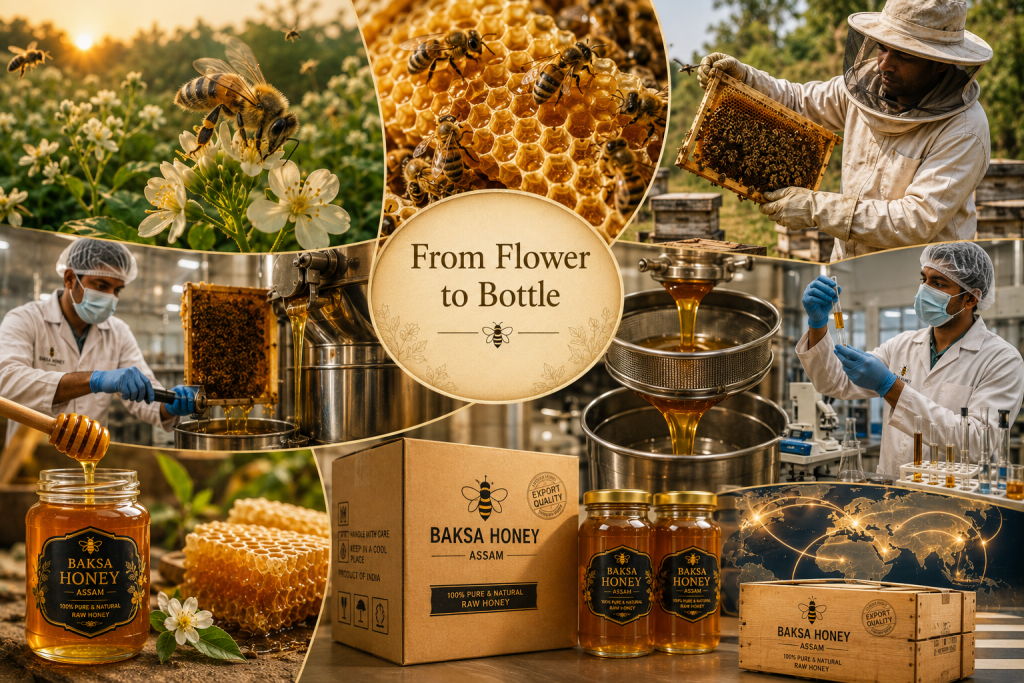
Flower to Bottle: Baksa Honey Process
The whole process can now be seen as a straightforward sequence:
Flowers and plants
↓
Collect nectar with bees
↓
Return nectar to the hive
↓
Transform and concentrate nectar with bees
↓
Honey matures within capped comb cells
↓
Honey collection by beekeeper or honey collector
↓
Separation of honey from comb
↓
Filter out unwanted matter
↓
Quality testing of vital parameters
↓
Packaging and labeling
↓
Future of Baksa Honey
The most interesting aspect about Baksa’s honey may be its future. The very first export has proved that a product made in a district of Assam can become part of a global value chain. However, the sustainable development of the value chain will require the maintenance of quality along with improving all the parts of the chain, including beekeepers or collectors, processors, laboratories, packaging and market links. The challenge is not simply selling more honey. It is to add more value to honey that is being produced. It can be better processing facilities, improved
packaging, better traceability, quality testing and recognition of geographical identity of Baksa. For producers, it means more opportunities on the market. For customers, it will help to have a greater understanding of the origin of their food. And for Assam, it will give one more example of successful promotion of locally grown agricultural products.
Conclusion: Not Just a Spoonful of Honey
The tale of Baksa honey is one that is essentially about a partnership.
- Flowers produce nectar.
- Bees process it.
- Beekeepers safeguard and extract it.
- Communities keep generations of knowledge alive.
- Processors add hygiene, testing, and packaging into the mix.
And finally, the markets of today give the end product a chance to get transported out of Baksa and beyond. Baksa honey is not only an ODOP product of Assam today but has also made its way to international markets, with the first 20 metric tonne shipment to the US taking place in May 2026.
But there may be something more beautiful about how it all starts. In a factory? In a supermarket? Even in a honey jar? Nope, it all starts with a bee visiting flowers in Assam. And somewhere within that very small journey from flower to hive is produced a product that contains the essence of Baksa. Not just any sweet food product is Baksa honey, but a story of bees, biodiversity, tradition, livelihood, processing, and growth in Assam as part of the global food markets.
Questions that may Be Frequently Raised
What is the ODOP product of Baksa, Assam?
Based on the ODOP document that was provided for this project, honey is the ODOP product of Baksa, Assam.
Why is Baksa famous for honey?
Baksa has the benefit of Assam’s biodiversity, floral wealth, and the long-established practice of honey collection and beekeeping. According to the government sources, Baksa ranks among the major producers of honey in the Bodoland Territorial Region.
When is wild honey collected in Baksa?
Documentation available in TRIFED on Barimakha Van Dhan Vikas Kendra notes the period between December and May for collecting wild honey.
How is honey removed from honeycomb?
The method of removal will depend on the production system, where it could either be draining of honey, pressing or mechanical extraction. TRIFED’s notes on traditional fixed-comb systems involve cutting the comb and squeezing and draining honey using a fine strainer.
Why should honey be filtered?
Filleting assists in getting rid of unwanted physical components of honey, like wax particles and others, while ensuring the food item.
Is there any export of Baksa honey?
Yes. In May 2026, there was an export of 20 metric tonnes of ODOP honey of Baksa, Assam, to the US. It was assisted by APEDA.
Why is testing of honey quality required?
Testing of honey quality will assist in evaluation of factors like moisture content, sugar composition, acidity and other factors. There have been several methods listed in FSSAI’s manual for honey analysis at present.
How can honey production benefit Assam?
Honey production will provide opportunity for employment and value addition for producers. Also from the agriculture standpoint, honey production has the advantage, as bees are pollinators.
Leave a Reply